<학술논문> DOI http://dx.doi.org/10.3795/KSME-A.2013.37.3.333
ISSN 1226-4873
쇼트피닝 가공된 Alloy 600 재료의 고온환경하에서의 잔류응력 및 피로특성
김종천* · 조홍석**· 정성균***†
* 서울과학기술대학교 NID 대학원, ** 한전 KPS 주식회사, ***† 서울과학기술대학교 기계공학과
Fatigue Characteristics and Compressive Residual Stress of Shot Peened Alloy 600 Under High Temperature
Jong Cheon Kim*, Hong Seok Cho** and Seong Kyun Cheong***†
* Graduate School of NID Fusion Technology, Seoul Nat’l Univ. of Science & Technology,
** KEPCO Plant Service & Engineering co., LTD,
***† Dept. of Mechanical Engineering, Seoul Nat’l Univ. of Science & Technology.
(Received July 16, 2012 ; Revised September 4, 2012 ; Accepted September 10, 2012)
1. 서 론
원자력 발전은 현재 세계에너지 생산량의 약 14% 이상을 차지하고 있으며, 국내의 원자력발전 이 차지하는 에너지가 전체 발전량의 약 31.1%를
차지하고 있다.
(1)이 같은 상황은 국내의 원자력 발전에 대한 높은 에너지 의존도를 나타내며, 앞 으로도 그 사용량이 증가될 것으로 판단된다.
Fig. 1 은 국내에서 운전 중이거나 건설 중인 원 자력발전소를 나타낸 것으로 총 28 기를 보유하고 있다. 원자력 발전의 기본 원리는 원료인 우라늄 (uranium)의 연쇄적인 핵분열에 의한 열에너지로 증기를 생산하고, 증기를 사용해서 전기를 생산하 는 방식이다. 또한, 전체 에너지 생산비용에서 우 Key Words: Alloy 600(니켈 합금), Shot Peening(쇼트피닝), Residual Stress(잔류응력), Fatigue Behavior(피로거
동), High-Temperature(고온환경)
초록: 본 논문에서는 쇼트피닝 가공된 Alloy 600 재료의 고온환경하에서의 압축잔류응력 및 피로거동에 대해 연구하였다. 연구에 사용된 Alloy 600 재료는 원자력발전소에서 사용되는 주요부품 소재이며, 피닝 가공으로 형성된 압축잔류응력은 응력부식균열(SCC; Stress Corrosion Cracking)의 발생을 크게 억제하는 것으로 알려져 있다. 현실성 있는 실험결과를 획득하기 위하여 실제 국내 원자력 발전소 주요부품의 사 용온도를 포함한 고온 환경에서 피로특성 및 압축잔류응력을 평가하였다. 연구결과 약 538℃이하에서는 피닝가공 효과가 존재하는 것으로 파악되었다. 피로수명은 538˚C 까지 유지되는 것으로 분석되었으며, 538˚C 에서의 압축잔류응력은 상온에서의 값에 비하여 68.2%를 유지하였다. 본 연구결과는 원자력발전 소의 안전 및 신뢰성 확보에 기초자료로 활용될 것으로 기대된다.
Abstract: The compressive residual stress and fatigue behavior of shot peened alloy 600 under a high-temperature environment is investigated in this study. Alloy 600 is used in the main parts of nuclear power plants, and the compressive residual stress induced by the shot peening process is considered to prevent SCC (stress corrosion cracking). To obtain practical results, the fatigue characteristics and compressive residual stress are evaluated under the actual operating temperature of a domestic nuclear power plant, as well as a high-temperature environment. The experimental results show that the peening effects are valid at a high temperature lower than approximately 538°C, which is the threshold temperature. The fatigue life was maintained at temperatures lower than 538°C, and the compressive residual stress at 538°C was 68.2% of that at room temperature. The present results are expected to be used to obtain basic safety and reliability data.
† Corresponding Author, [email protected]
Ⓒ 2013 The Korean Society of Mechanical Engineers
라늄이 차지하는 비율이 10% 정도로 낮아 시장 변동에 큰 영향을 받지 않는 장점이 있으며, 상대 적으로 석탄연료를 사용하는 화석 발전에 비해 이 산화탄소를 거의 발생하지 않아, 신재생에너지와 더불어 그 사용량과 범위가 확대되고 있는 상황이 다. 하지만, 원자력 발전의 특성상 안전성 확보가 매우 중요하며 사고에 대한 대비가 요구된다. 특 히, 원전을 구성하고 있는 금속재료에 고온/고압의 운전환경 및 기계적/화학적 응력 변수가 복합적으 로 작용하면 Fig. 2 와 같이 예기치 못한 응력부식 균열(SCC; Stress Corrosion Cracking) 현상이 야기되 어 원전 구조물의 내구성(durability) 확보에 문제 점으로 대두되고 있다.
(2,3)본 연구에서는 응력부식균열 억제, 피로수명 향 상 등에 효과가 있는 것으로 널리 알려진 피닝가 공의 유효성을 평가하기 위하여 원자력발전소에서 문제가 되고 있는 부품 중의 하나인 원자로 헤드 부 (reactor vessel head)
(4)의 실제 사용온도 및 고온 환경에서 잔류응력 분포 및 피로거동 특성을 평가 하고자 한다.
Fig. 1 Nuclear power plants in Korea
Tensile Stress
Susceptible
material Environment SCC
Environment SCC
(a) Three factors causing Stress Corrosion Cracking
Tensile Stress Surface Stress Improvement(SSI)
(b) SCC mitigation method; SSI and replacement Susceptible
material Material Replacement
Fig. 2 Schematic illustration of the SCC and mitigation methods
2. 실 험
2.1 시험편 준비
본 연구에 사용된 시험편의 재료는 원자력 발전소 주요 부품(BMI Nozzles)의 소재로 사용되고 있는 니 켈합금의 Alloy 600 재료를 사용하였다. 본 재료는 고온 및 부식환경에서 내식성(corrosion resistance)이 강한 재료로 알려졌으며, 이 같은 특성으로 고온환 경의 많은 구조물에 적용되어 사용되고 있다.
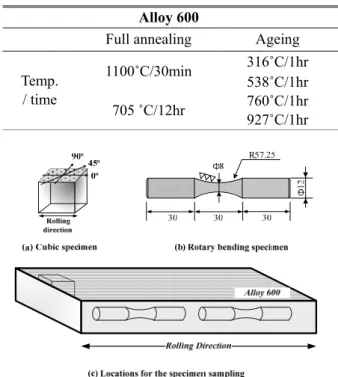
(5,6)Table 1, Table 2 는 Alloy 600 재료의 화학적 성분 및 열처리 조건을 나타낸 것이다. 경도분포 측정 및 잔 류응력 분석을 위해 Fig. 3(a) 형태로 시험편을 제작 하였으며, 피로수명 평가를 위해 Fig. 3(b)의 시험편 형상으로 ASTM E466 규격에 의거하여 피로 시험편 중앙부의 최소 직경이 8mm 가 되도록 가공하였다.
Fig. 4(a)는 열처리 전의 Alloy 600 재료의 조직형상이 며, Fig . 4(b)는 열 처리 후의 조직형상이다.
(Mechanical polished and chemical etching; HCl and HNO
3of ration 4:1, distilled water)
Table 1 Chemical composition of Alloy 600 (wt%)
C Mn P S Si Ni Cr
0.044 0.23 0.01 0.0002 0.2 74.34 16.09 Co Cu Fe Cb Ta Al Ti 0.03 0.02 8.59 0.02 0.003 0.18 0.18
Table 2 Heat treatment condition Alloy 600
Full annealing Ageing Temp.
/ time
1100˚C/30min 316˚C/1hr 538˚C/1hr 705 ˚C/12hr 760˚C/1hr 927˚C/1hr
Fig. 3 Description for shape of test specimens and
locations for specimens sampling
2.2 쇼트피닝가공
쇼트피닝 가공은 반복하중을 받는 금속재료의 피 로수명 향상 및 내식성 향상을 위한 냉간가공(cold working) 법으로 재료 표면에 쇼트볼(shot ball 을 투 사하여 표면 직하에 소성변형(plastic deformation)을 야기시키고 늘어나려고 하는 피닝 영향부(affected zone)와 그렇지 않은 내부의 경계층에서 압축잔류응 력층(CRSL; compressive residual stress layer)이 재료표 면으로부터 약 0.15~0.25mm 깊이까지 분포하게 된 다. 일반적으로 재료의 파괴는 인장응력이 형성된 환경에서 발생한다. 피닝 가공에 의하여 시험편 표 면에 발생한 압축잔류응력의 영향으로 반복 하중이 재료에 작용할 때 크랙(crack)형성이 지연되므로 피 로수명이 크게 향상 된다.
(7,8)피닝 가공은 0.45mmA 피닝강도(peening intensity) 조건으로 실시하였으며 피 닝 조건은 Table 3 과 같다.
(6,9)2.3 잔류응력평가
잔류응력 평가를 위해 X-선 회절법(XRD; X-ray diffraction)
(10)을 이용하여 잔류응력을 평가하였으 며, 고온환경이 피닝 가공으로 인가된 표면 잔류 응력에 미치는 영향을 평가하기 위해 0˚, 45˚, 90˚
방향으로 Fig. 3(a)의 시험편을 이용하여 측정하였 다. 잔류응력 측정 조건은 Table 4 와 같다.
(a) As-received Alloy 600
(b) After full annealed Alloy 600
Fig. 4 The microstructure of the specimen; as- received(top) and after annealed(bottom)
2.4 고온환경 피로거동평가
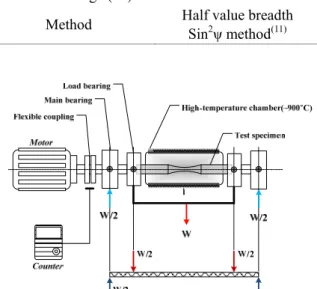
쇼트피닝 가공 처리된 Alloy 600 재료의 고온환경 피로거동 특성 평가를 위하여 고온피로실험 및 경도 분포 측정을 실시하였다. 고온피로실험은 Fig. 5 의 4 절점 회전 굽힘 시험기(SHIMADZU, H7)를 사용하였 으며, 시험기에 설치된 온도범위가 900˚C 까지 가능 한 고온 챔버를 이용하여 대기 환경에서 고온피로실 험을 진행하였다. 피로시험기의 회전수를 2,000±10 rpm 으로 일정하게 설정하였고, 사용한 피로시험기 는 반복 굽힘 응력으로 응력비(stress ratio, R)가 -1 인 순수굽힘응력(pure bending stress) 상태에서 피로시험 을 진행하였다. 고온 환경에 노출되었던 시험편 단 면을 채취하여 경도측정을 위한 연마를 하였으며, 마이크로 비커스 경도계(Micro Vickers Hardness tester, JP/FM-7)를 사용하여 가공면으로부터 시험편의 중심 부 방향으로 20µm 간격으로 경도를 측정하였다.
Table 3 Shot peening process conditions
(6)Content Shot peening Shot ball diameter 0.8 mm
Shot velocity 70 m/s Exposure time 8 min
Coverage above 100 % Intensity 0.45 mmA
Table 4 Measuring conditions of residual stress
X-ray Cr-Kα
Diffraction plane (220) Tube voltage 30 kV Tube current 6.7 mA Diffraction angle(Ni) 133.5°
Method Half value breadth Sin
2ψ method
(11)Fig. 5 Schematic illuminations of fatigue testing machine
with high-temperature chamber
3. 결과 및 고찰
원전 주요 부품소재인 Alloy 600 재료의 쇼트피 닝가공으로 인가된 표면 압축잔류응력이 고온환경 에서 재료의 피로거동에 어떻게 영향을 미치는지 연구하였다. 이를 위해 현재 국내 고 민감도 원자 력발전소의 헤드 온도(고리 1,2 호기; 315.4~311.1˚C, 영광 3,4 호기; 318.8˚C, 울진 3,4 호기; 322.7˚C)를 바탕으로 약 318˚C 를 사용온도로 정의하였으며, 피닝 가공의 유효성 범위를 평가하기 위해 온도범 위 316˚C, 538˚C, 760˚C, 927˚C 에서 실험을 진행하 였다.
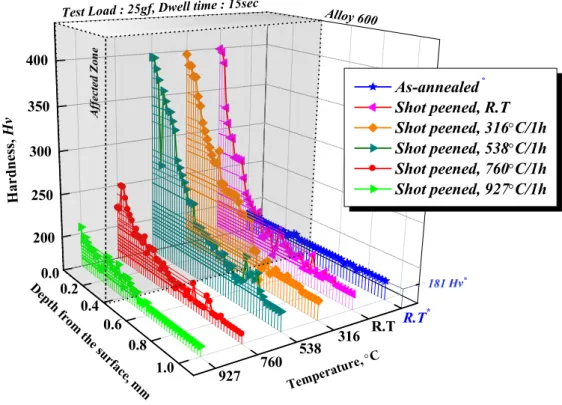
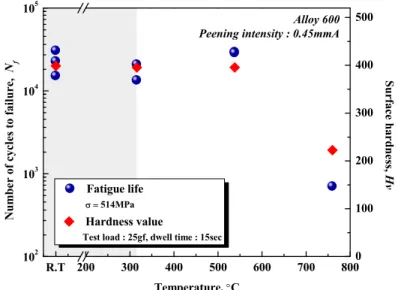
Fig. 6 은 피닝 가공면으로부터 깊이별 경도값을 측정한 결과로 피닝 가공전 181Hv 에서 피닝 가공 후 약 400Hv 으로 220% 경도값이 증가하였으며, 약 0.4mm 깊이 까지 피닝 영향부(affected zone)가 발생하였음을 확이 하였다. 또한 고온의 온도 환 경에 노출되었던 시험편의 경도측정 결과 목표 온 도인 538˚C 까지는 경도분포 변화가 발생하지 않 았지만, 목표온도 760˚C 및 927˚C 에서 경도분포가 감소하는 결과를 얻었다. Fig. 7 은 고온 환경에서 실시한 피로수명 평가와 표면경도측정 결과로 사
용된 피로시험기의 고온챔버의 온도 범위(~900 ˚C) 에 따라 760˚C 목표 온도까지 고온 피로실험을 진 행하였다. 평가결과 538˚C 까지 피로수명의 감소가 발생하지 않았지만, 목표 온도 760˚C 에서 급격한 수명 감소 현상이 발생하였으며, 표면 경도 분포 는 222.6 Hv 로 약 44%의 경도 감소 현상이 발생 하였다. 이 같은 결과는 본 연구에 사용된 Alloy 600 재료의 피닝 가공에 따른 냉간 가공률(cold working rate) 10~20%를 기준으로 재결정온도 (774~843˚C) 상응하는 결과로 고온의 환경에서 피 닝 영향부의 재결정화(refinement) 및 응력풀림 (stress relaxation) 현상이 발생하였기 때문으로 판
단된다.
(12,13)Fig. 8 은 사용된 Fig. 3(a) 형태의 시
험편을 각각의 온도 조건에 따라서 XRD 분석을 통해 재료표면의 잔류응력(residual stress)을 측정한 결과로 재료의 압연방향(rolling direction)을 기준으 로 0˚, 45˚, 90˚ 방향으로 잔류응력분포를 측정하였 다. 측정결과 모든 목표온도 조건에서 응력감소 현상을 나타내었다. 목표온도 538˚C 에서 초기 피 닝 가공으로 인가된 압축잔류응력의 68.2% 수준 의 잔류응력을 유지하였지만, 목표온도 760˚C 에서 는 약 34.5% 수준의 잔류응력 분포를 유지하였다.
Fig. 6 3D data plotting of hardness distributions in depth with various temperature conditions
0.00.2 0.4
0.6 0.8
1.0 200
250 300 350 400
Alloy 600
R.T* As-annealed Shot peened, R.T Shot peened, 316°C/1h Shot peened, 538°C/1h Shot peened, 760°C/1h Shot peened, 927°C/1h
316 R.T 538 760 927
Hardness, Hv
Temperature, °C Depth
from the surfa
ce, m m
Test Load : 25gf, Dwell time : 15sec
Fig. 7
Effect of temperature on the fatigue life and hardness distribution
Fig. 8
Effect of temperature on the residual stress distribution
Fig. 9
Comparison of total result values for peening effective validations by using the degradation rate
200 300 400 500 600 700 800
0.1 1
Degradation rate
Temperature, °C Hardness value
Fatigue life Residual stress
316ºC 538ºC
Zone A.
Zone B.
Alloy 600
R.T
Alloy 600 Peening intensity : 0.45mmA
0 200 300 400 500 600 700 800
102 103 104 105
Surface hardness, Hv
R.T Number of cycles to failure, Nf
Temperature, °C Fatigue life
σ = 514MPa
0 100 200 300 400 500
Hardness value
Test load : 25gf, dwell time : 15sec
0 200 300 400 500 600 700 800
-250 -200 -150 -100 -50
0 σ
0°
σ
45°
σ
90°
Stress, MPa
Temperature, °C R.T
Zone A.( ~ 318ºC) < Zone B.( ~ 538ºC)
Where, Zone A. is the nuclear power plants operating temperature( in domestic) Zone B. is the peening effective validation temperature
4. 결 론
본 연구에서는 원전 주요 부품소재인 Alloy 600 재료에 쇼트피닝 가공을 실시하여 인가된 표면 압축잔류응력이 고온환경에서 재료의 피로거동에 어떻게 영향을 미치는지 연구하였다. 특히, 재료의 응력부식균열 방지를 위해 Fig. 2 의 인장응력 인자를 제거하기 위한 방법으로 쇼트피닝 가공의 가능성을 제시하고자 하였다(Fig. 9). 이를 위해 고온환경에서의 잔류응력분포 및 피로거동 특성을 평가하였으며, 본 연구에서 얻은 결과를 요약하면 다음과 같다.
(1) 피닝 가공후 가공면으로부터 약 0.4mm 깊이 까지 피닝 영향부가 형성되었다. 피닝 가공후 181Hv에서 400Hv으로 220% 이상 경도분포가 상 승하였으며 목표온도 538˚C까지 경도분포를 유지 하였다. 하지만, 목표온도 760˚C, 927˚C에서 급격한 경도감소 현상이 발생하였다.
(2) 피로수명 평가결과에서도 목표온도 538˚C까 지 피로수명 분포를 유지하였지만, 760˚C에서 수명 감소가 발생하였으며, 표면 경도분포도 222.6Hv로 약 44%의 경도분포 감소가 발생하였다.
(3) 표면잔류응력 평가결과 모든 온도범위에서 잔류응력 감소현상이 발생하였다. 목표온도 538˚C 에서 68.2%의 표면 압축잔류응력 분포를 유지하 였으며, 760˚C에서는 약 34.5% 수준의 잔류응력분 포를 유지하였다.
(4) 이 같은 결과는 고온 환경에서 사용된 Alloy 600 재료의 피닝 영향부에 재결정화, 응력풀림 현 상이 발생하여 경도분포 및 잔류응력을 감소시키 는 역할로 작용했기 때문으로 판단된다.
(5) 본 연구를 통해 다양한 온도범위에서 피닝 가공의 유효성을 평가하였으며, 특히, Fig. 9 의 국 내 원자력발전소 헤드의 평균 온도범위에서 경도 분포 약 99%, 압축잔류응력 약 76%를 유지하였으 며, 수명평가 결과 에서는 상온조건의 약 75% 상 태를 유지하였다. 응력부식균열 발생 인자인 표면 인장응력 제거를 위한 방법으로 쇼트피닝 가공의 가능성을 확인하였지만, 본 연구에 사용된 Alloy 600 재료의 응력풀림 현상 및 금속의 재결정화 현 상에 대한 추가적인 연구와 연구결과를 바탕으로 실제 응력부식균열 환경에서의 쇼트피닝의 효과성 검증 연구가 요구된다.
참고문헌