• 검색 결과가 없습니다.

A Study on the Improvement of Safety Management System for ATO - Base on the Aviation Safety Voluntary Reporting System -

N/A
N/A
Protected

Academic year: 2021

Share "A Study on the Improvement of Safety Management System for ATO - Base on the Aviation Safety Voluntary Reporting System -"

Copied!
5
0
0

로드 중.... (전체 텍스트 보기)

전체 글

(1)

I. INTRODUCTION

To identify unanticipated risk factors, aviation safety voluntary report is essential to the effec- tive operation of aviation Safety Management System (SMS). Through the aviation safety voluntary report “Entering Downwind into the Visual Flight Rules (VFR) Route from the Opposite Direction” submitted to the flight training institute at Uljin Airport, the control center revised the standard operational pro- cedure to use, if possible, a straight-in approach

when entering the VFR route instead of making a steep turn for entrance in order to prevent reverse entry into Uljin Airport’s VFR route by training aircrafts.

The above demonstrates that aviation safety voluntary report system is a vital factor for preventing accidents. However, evident from the reception status of aviation safety voluntary reports (Table 2), the settlement of the system trails behind compared to those of developed countries. In particular, track records of App- roved Training Organizations (ATO) are signi- ficantly lower than those of others in the aviation industry. Accordingly, this study inter- viewed safety officers with at least five years at ATO work experience, flight instructors, main- tenance engineers and students to verify the system and aims to provide a realistic plan of improvement.

Technical Review https://doi.org/10.12985/ksaa.2020.28.4.182 ISSN 1225-9705(print) ISSN 2466-1791(online)

A Study on the Improvement of Safety Management System for ATO

- Base on the Aviation Safety Voluntary Reporting System -

Jin-Tae Kim

*

, Gun Young Lee

**

, Jin-Kook Choi

***

ABSTRACT

As all flight training institutions in Korea were approved by the Ministry of Land, Infrastructure and Transport (MOLIT) as aviation training organizations (ATO), safety management based on the Aviation Safety Management System (SMS) became mandatory.

However, even though safety management using SMS has become mandatory, the performance of aviation safety voluntary report, which is the core of the system, remains low compared to other countries. The current address of SMS, a ATO, is like a watermill without water. The present study is to find out why voluntary aviation safety reports, which is equivalent to water from waterwheel, is underperforming and to suggest ways to revitalize it.

Key Words : Approved Training Organization(ATO, 전문교육기관), SMS(항공안전관리시스템), Aviation Safety Voluntary Report(항공안전자율보고), Aviation Safety(항공안전), Safety Management (안전관리)

Received: 04. Dec. 2020, Revised: 09. Dec. 2020, Accepted: 14. Dec. 2020

* Korea National University of Transportation

** Professor, Korea National University of Transportation

*** Professor, Korea National University of Transportation

Corresponding Author E-mail : [email protected]

Corresponding Author address : 50 Daehak-ro, Chungju-

si, Chungbuk

(2)

Ⅱ. RESEARCH

2.1 Approved training organization

Following the revised Aviation Act of Decem- ber 14, 1991, the revised enforcement ordi- nances of Aviation Act of August, 17, 1992, and the revised enforcement regulations of Aviation Act of February 13, 1993, the system of Ap- proved Training Organizations was established in Korea. In order to elevate the general compe- titiveness of the aviation industry and intensively cultivate aviation workers, who are expected to be in great shortage, the system was established to fit domestic circumstances while observing the criteria as stipulated in Annex 1 of International Civil Aviation Organization (ICAO).

To be designated as an ATO, application and on-site reviews are conducted for an orga- nization to examine whether its aviation per- sonnel educational courses and methods, status of instructors, and facilities and equipment comply with the standards stipulated in the above bulletin.

2.1.1 Status of ATOs in Korea (pilot)

As shown in Table 1, there are a total of 23 ATOs for pilot training in Korea; twelve are universities, such as Korea Aerospace University and Korea National University of Transportation, one manufacturer, Korea Aerospace Industries, Ltd, seven airplane using businesses, like Sunny Air(Hong, 2020) and three military organizations.

2.2 Aviation safety management system The Aviation Safety Management System aims

to limit risks of damage or loss to an app- ropriate level. Since human and organizational factors have controls over risks, clear, systematic and preemptive safety management activities are possible through regular communication between the organization and the safety committee, and safety awareness of all members, based on the selection of suitable managers and safety policies and goals set by the head of organization (Yun, 2013).

2.2.1 Collection of safety data and information All organizations must decide upon the safety data and information to collect in order to support safety performance management process and to make safety decisions. Verifying and collecting safety data must meet the demands of the organization that should effec- tively manage safety. In some cases, it empha- sizes on additional safety data so as to better evaluate the effects of safety risk management process (levels of risk and severity) and identify relevant risks. Likewise, safety performance management process may stress on the need for additional information for a more compre- hensive understanding of a particular safety issue and/or the establishment or improvement of safety performance indicators (Lee, 2019).

2.2.2 Methods for collecting safety data Depending on the size of an organization, the 23 ATOs (pilot) in Korea are run by 10 to 30 employees, who are flight instructors, aircraft maintenance instructors and opera- tional management instructors, while also taking on various administrative tasks that sustain the organization. Unlike large airlines, these ATOs are not equipped with professional manpower that specializes in safety tasks, and thus, experience much difficulty in collecting safety data, which is critical to preventing accidents.

Methods of data collection used at ATOs are investigations for accidents and serious acci- Table 1. Approved training organization status

(Hong, 2020)

Universit- ies

Manufact- urer

Airplane using business

Military Organiz- ations

Total

12 1 7 3 23

(3)

dents, aviation safety voluntary report, line operations safety audit (LOSA), flight data log (FDL), voluntary and mandatory safety report system, and safety patrol.

2.3 Aviation safety voluntary report system It is possible to prevent flight accidents and secure safety by discovering potential hazards, identifying problems and establishing solutions.

The aviation safety voluntary report system is one that guarantees pardon for mistakes that do cause grave problems, while protecting the reporter’s identity so that matters of safety issues can be disclosed without hesitation. In Annex 19 of ICAO, the implementation of aviation safety voluntary report system was amended from “recommended” to “mandatory enforcement” for all members of ICAO.

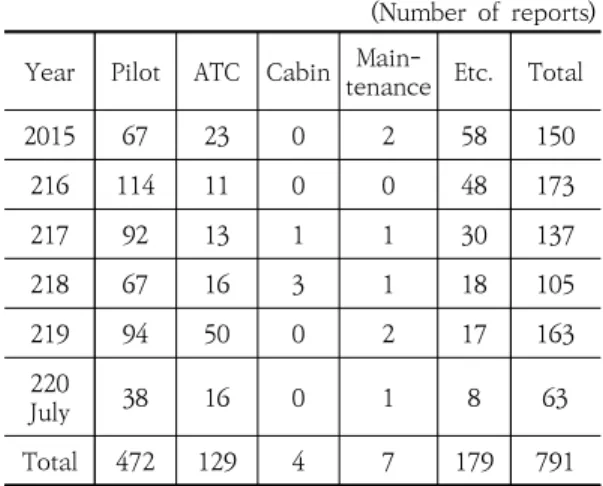
Table 2 summarizes the number of aviation safety voluntary reports submitted to Korea Transportation Safety Authority between 2015 and July, 2020. A total of 791 reports from pilots, air traffic controls, cabin crews, main- tenance engineers and others were submitted during this period.

Table 3 shows the number of reports received by NASA in 2019 alone, where a total of 5,997 reports were made from Part 91 (civil aircrafts), Part 121 (air carriers), and Part 135 (commercial, non-scheduled aircraft operations).

Compared to the figures of the US, Korea’s number of aviation safety voluntary reports is low in relation to the size of its aviation industry. This is attributable to the culture of Korean pilots unwilling to disclose their mis- takes, lack of publicity, and absence of trust related to punishment.

2.4. ATO interviews on aviation safety voluntary report

A total of 20 personnel at Muan International Airport’s ATO were interviewed on aviation

safety voluntary report, five from each division of safety officers, flight instructors, mainte- nance engineers and students. There are three categories of questions, and a total of 10 questions on aviation safety voluntary report, SMS, and punishment and responsibility related to accident reports. Interviewees were asked to rate the questions on a five-point scale (1: do not know; 3: somewhat know; 5: clearly know).

According to survey results, as shown in Table 4, responses of 1 (do not know) and 3 (somewhat know) accounted for 155 choices out of the total 200, composing 77% of all choices.

Analysis of survey results demonstrated that while safety officers were aware of aviation safety voluntary report and SMS, other personnel either lacked interest or knowledge of it. The fact that there are numerous aviation personnel who do not know aviation safety voluntary report and its submission method has been identified as the problem that needs to be

Table 2. Aviation safety voluntary reports reception status (Kim, 2020)

(Number of reports) Year Pilot ATC Cabin Main-

tenance Etc. Total

2015 67 23 0 2 58 150

216 114 11 0 0 48 173

217 92 13 1 1 30 137

218 67 16 3 1 18 105

219 94 50 0 2 17 163

220

July 38 16 0 1 8 63

Total 472 129 4 7 179 791

Table 3. US aviation database online (NASA, 2020)

(Number of reports) Year Part 91 Part 121 Part 135 Total

2019 1,456 4,251 290 5,997

(4)

addressed. It has also been made aware that there was confusion on the extent of application of non-punitive principle, and that there were limited methods of verifying safety-related infor- mation. There is a lack of awareness for sharing safety information, and the reality is that pu- nishment is generally carried out as a method of recurrence prevention.

On the other hand, it was found that the performance of aviation safety voluntary report is closely related to a reward system. The consensus was that it is difficult to improve the performance of aviation safety voluntary report through the existing reward system. It was concluded that the implementation of a reward system relevant to one’s personal identity, such as granting extra points when hired at an air

transport company, could actively encourage participation in aviation safety voluntary report system.

Ⅲ. CONCLUSION

The Ministry of Land, Infrastructure, and Transport of Korea is managing safety through the implementation of SMS, which appointed all aviation institutes in the country as ATOs, as a measure to ensure a systematic aviation education and aviation safety. Despite such efforts, there are constraints to effectively utilizing SMS at ATOs that have a limited number of officers.

The purpose of this study is to manage risk, the essence of SMS, by collecting data related to aviation safety through aviation safety volun- tary report. It verified the state of aviation safety voluntary report at ATOs and reached the below conclusion.

First, there is a lack of information on avi- ation safety voluntary report, and airline per- sonnel only report an issue when related to punishment.

Second, they do not recognize the necessity of aviation safety voluntary report.

Third, there are limited methods to share information related to aviation safety.

The limitation of this study is that consi- dering the uniqueness of the sample, the ATO at Muan International Airport, the number is quite small. It is possible to obtain a more accurate data by continuously accumulating it to increase the number of samples in the future. Furthermore, efforts should be made by aviation industry employees to contribute to aviation safety by entering and sharing data themselves. Aviation safety is not the respon- sibility of only chief management or safety officers. As the first step to preventing accidents, aviation safety will be realized when all aviation personnel recognize and promote safety aware- Table 4. The number of people studied

(Number of persons)

Category Questions Scale

1 2 3 4 5

Aviation safety voluntary

reports

Cognitive

status 10 5 3 2

Reporting

system 10 5 4 1

Rewards 12 1 1 6

SMS (Safety manage-

ment system)

Cognitive

status 13 2 5

Components 3 10 2 5

Relationship with aviation

safety voluntary

report

15 4 1

Operation-

related 13 2 5

Accident reports

Accident / incident information

sharing

15 1 1 3

Education

status 13 3 4

Punishment

Related 18 2

(5)

ness, upon which voluntary safety reports will take place.

Acknowledgments

This paper is a modified version of a published manuscript submitted to the 2020 Fall Conference of the Korean Society for Aviation and Aeronautics.

References

1. Hong, B. P., “The Status of ATO”, 2020, URL:

http://www.molit.go.kr/USR/policyData/m_34 681/dtl.jsp?id=4473

2. Yun Y. J., “Air safety management system research and development”, Korea Civil Aviation Association, Aviation Promotion 60, 2013, pp. 75.

3. Lee G. Y., “Safety Management System,”

Booknet Publishing Company, Seoul, 2019, pp. 94.

4. Kim K. J., “Aviation safety voluntary re- porting system”, 2020 SMS Theory and Practical Course, Korea Transportation Safety Authority, 2020, p. 217.

5. NASA, “ASRS Data Base”, https://akama.arc.

nasa.gov/ASRSDBOnline/QueryWizard_Filter.

aspx

수치

Table  2  summarizes  the  number  of  aviation  safety  voluntary  reports  submitted  to  Korea  Transportation  Safety  Authority  between  2015  and  July,  2020

참조

관련 문서

A study on the safety analysis of steam generator tube plugging level upward in Hanbit Unit #5,6..

Incheon’s Disaster Safety Policy.. 05 Disaster Management System Introduction of Incheon.. General Status

RWC (Restricted Work Case): Injuries by which workers are reassigned to other duties or cannot perform the full range of normal duties MTC (Medical Treatment Case):

Objective: The purpose of this study is to investigate the relationship between employee satisfaction and patient safety and quality improvement after compulsory certification

RWC (Restricted Work Case): Injuries by which workers are reassigned to other duties or cannot perform the full range of normal duties MTC (Medical Treatment Case):

– Organizational support for safety education (e.g. orientation, training, workshops, etc.) for all level of project members – Regular safety meetings and daily toolbox

And the objective of radiation safety control is to ensure radiation safety by limiting the probability of stochastic effects below the acceptable ALARA

In conclusion, the result that the walk-using safety educational activities designed for young children had effects on their safety problem solving ability