http://www.medicinalcrop.org
http://dx.doi.org/10.7783/KJMCS.2015.23.5.363
도라지 절단 길이에 따른 사포닌 함량 및 항산화 활성
이병진**·전승호**·노일래***·김영국****·조영손*†
*경남과학기술대학교 농학•한약자원학부, **경남과학기술대학교 종자실용화연구소,
***경상대학교 농업식물과학과, ****농촌진흥청 국립원예특작과학원 인삼특작부
Effect of Saponin Content and Antioxidant Activities of Platycodon grandiflorum Radix by Cutting Length
Byung Jin Lee**, Seung Ho Jeon**, Il Rae No***, Young Guk Kim****and Young Son Cho*†
*Department of Agronomy and Medicinal Plant Resourses, Gyeongnam National University of Science and Technology, Jinju 52725, Korea.
**Research Center for Seed Utilization of Gyeongnam National University of Science and Technology, Jinju 52725, Korea.
***Department of Agronomy Gyeongsang National University, Jinju 52828, Korea.
****Department of Herbal Crop Research, NIHHS, RDA, Eumsueng 27709, Korea.
ABSTRACT
Background : Platycodon grandiflorum radix used as a therapeutic agent for lung and respiratory diseases in traditional Korean medicine. The saponin and sugar content in P. grandiflorum root is dependent on the drying temperature and method. In this study, we investigated saponins and antioxidant contents in dried P. grandiflorum roots either not cut or cut to different lengths.
Methods and Results : P. grandiflorum roots were either cut to 0.5, 1.0 or 2.0 ㎝ in length or left uncut. They were dried at 45℃
and the effect of antioxidant substances, antioxidant ability, and saponin content were investigated. P. grandiflorum roots rapidly dried out when cut to short lengths. The saponin contents (platycodin D, polygalacin D, and deapioplatycodin D) was highest in the uncut P. grandiflorum roots. When the cut lengths were long, the levels of polyphenolic compound increased. However, 2,2'-azino- bis-3-ethylbenzo-thiazoline-6-sulfonic acid (ABTS) and 1,1-diphenyl-2-picrylhydrazyl (DPPH) radical scavenging activities were higher in the samples cut to shorter lengths.
Conclusions : These results suggested that the saponin and antioxidant content of P. grandiflorum roots could be maximized by controlling the drying rate of the roots via adjustments to the root cutting length.
Key Words : Platycodon grandiflorum, Antioxidant, ABTS Radical, DPPH Radical, Saponin
서 언
도라지 (Platycodon grandiflorum A. DC)는 한국, 일본 및 중국의 산간지방에 널리 자생하는 초롱꽃과 식물로 뿌리를 약 용 및 나물용으로 많이 이용되고 있다. 도라지의 뿌리는 한약 재 명으로 길경 (Platycodi radix)이라 불리며 다량의 사포닌이 함유되어 있는데, 이러한 사포닌에는 platycodin A, C, D와 polygalacin D, spinasterol, spinasterol glucoside, inulin 등의
성분이 알려져 있다 (Konishi et al., 1978; Tada et al., 1975). 특히 platycodin D는 동물실험을 통해 진해 거담작용, 중추신경억제작용 (Sung and Seo, 1998), 혈당강화작용 및 콜 레스테롤 대사개선작용 (Zhao et al., 2006), 항암활성 효과 (Choi et al., 2001) 항염증 효과 (Ahn et al., 2005; Wang et al., 2004), 항비만 효과 (Lee et al., 2010) 등이 있는 것 으로 밝혀졌으며, 이러한 약리효과는 재배 지역과 재배방법에 따라 달라질 수 있다고 보고되고 있다 (Lee et al., 2014b).
†Corresponding author: (Phone) +82-55-751-3221 (E-mail) [email protected]
Received 2015 June 12 / 1st Revised 2015 July 24 / 2nd Revised 2015 August 5/ 3rd Revised 2015 August 13 / 4th Revised 2015 August 19 / 5th Revised 2015 August 25 / 6th Revised 2015 September 1 / Accepted 2015 September 3
This is an open access article distributed under the terms of the Creative Commons Attribution Non-Commercial License (http://creativecom- mons.org/licenses/by-nc/3.0/) which permits unrestricted non-commercial use, distribution, and reproduction in any medium, provided the original work is properly cited.
도라지를 약용으로 사용하기 위해서는 건조과정을 거치게 되는데 인공건조 방법으로는 일광건조 (Swami et al., 2007), 열풍건조, 냉풍건조 (Kwon et al., 2013), 감압건조 (Lee and Kim, 2009) 및 동결건조 (Mujumdar, 2000; Kwon et al., 2013) 등의 방법이 사용되고 있다. 건조공정 중 일광 건조를 하는 경우가 열풍건조나 동결건조를 하는 경우 보다 건조된 도라지에 포함된 사포닌 함량이 더 높다고 보고되었으나 (Lee and Cho, 2014) 일광건조를 하는 경우 건조시간이 많이 소요 되어 건조과정 중 부패가 일어날 수 있다고 하였고 기상조건 에 영향을 많이 받는다고 보고되고 있다 (Swami et al., 2007). 또한 도라지를 대상으로 열풍건조를 하는 경우 낮은 온 도에서 건조하는 것이 고온에서 건조하는 것보다 건조된 도라 지에 더 높은 사포닌 함량이 포함될 수 있다고 보고되기도 하 였다 (Lee and Cho, 2014; Lee et al., 2014a).
식물계에 널리 분포되어 있는 페놀성 화합물은 다양한 구조 와 분자량을 가지며 페놀성 화합물의 phenolic hydroxyl기가 단백질과 같은 거대분자와 결합을 통해 항산화, 항암 및 항균 등의 생리기능을 가지는 것으로 알려져 있다 (Rice-Evans et al., 1997). 곡류에 함유되어 있는 항산화 물질 중 polyphenolic 화합물들은 우수한 항산화력을 가지고 있는 것으로 알려져 있 으며, 이는 free radical을 안정화시킬 수 있는 phenolic ring 의 존재 때문인 것으로 보고되어져 있다 (Middleton and Kandaswami, 1994). 천연물의 항산화활성은 활성 radical에 전자를 공여하고 식품 중의 지방질 산화를 억제하는 특성을 가지고 있어 인체 내에서는 활성 radical에 의한 노화와 질병 을 억제시키는 역할을 하고 있다 (Kim et al., 2001, 2013).
현재 도라지 약리성에 관한 연구와 도라지를 약용으로 사용하 기 전 전처리 과정으로 건조 온도 (Lee and Cho, 2014)와 건조방법 (Lee et al., 2014a)에 관한 연구는 진행된 바 있으 나 건조속도에 관한 연구는 미흡한 실정이다.
따라서 본 연구에서는 절단 길이를 달리한 도라지를 대상으 로 서로 다른 건조방법을 적용함에 따른 도라지 뿌리의 약리적 성분과 항산화물질에 미치는 영향을 분석하여 도라지의 약리적 소재 활용에 필요한 실험적 기초자료를 제공하고자 하였다.
재료 및 방법
1. 실험재료
재배한 4년근 도라지 (Platycodon grandiflorum A. DC)를 2015년 2월에 수확하여 선별 분류하여 사용하였다. 절단하지 않은 도라지 뿌리를 대조구 (무절단)로 하고 도라지 뿌리를 0.5, 1.0, 2.0㎝ 길이로 절단한 후 건조온도 45℃로 건조하면 서 24시간 간격으로 무게를 측정하였고 무게의 변화가 없을 때 까지 건조하여 분쇄기 (Super grinder JL-1000, Hibell, Hwaseong, Korea)로 분쇄하고 0.5 ㎜ 체로 선별하여 냉동고에
보관하면서 시험에 사용하였다.
2. 무기물 함량
무기물 함량은 식품공전 미량성분시험법 (KFDA, 2011)을 토대로 한 습식분해법 (NIAST, 2000)으로 분석하였다. 시료 0.5 g에 65%의 HNO3 3㎖ 와 30% H2O2 1㎖ 를 teflon bottle에 담아 이를 전처리 시험용액으로 하였으며, microwave digestion system (Ethos-1600, Milestone, Sorisole, Italy)를 이용하여 최고 산분해를 실시하였다.
3. 사포닌함량
사포닌 추출방법은 Park 등 (2000)이 제안한 방법으로 도라 지 1 g을 70% 에탄올 50 ㎖에 혼합하여 45℃ 항온수조에서 2시간 진탕 후, 4,000 rpm에서 15분 원심분리하여 상등액 추 출을 2회 반복하고 이것을 감압 농축하여 HPLC-grade 증류수 10㎖에 녹였다.
사포닌 함량 분석에 사용된 HPLC는 Agilent 1260 Series HPLC system (Agilent techolgies, Wilmington, DE, USA) 를 이용하여 측정하였다. HPLC 분석은 C18 (4.6× 250 ㎜, 5㎛, Shiseido, Tokyo, Japan) column을 사용하였다. 이동상 은 water, acetonitrile를 사용하였으며, acetonitrile 비율을 0 min (18%) - 22 min (18%) - 32 min (30%) - 60 min (50%) 로 순차적으로 조절하였다. Column 온도는 35℃로 유지 하였 고, injection volume은 10 ㎕, 유속은 1 ㎖/min로 하였다. 검 출파장은 203 ㎚ 에서 측정하였다.
사포닌 표준시료는 한국한방진흥원 천연물 물질은행 (Natural Substance Bank, Korean Promotion Institute for Traditional Medicine Industry, Gyeongsan, Korea)으로부터 분양받은 platycodin D, platycodin D3, deapioplatycodin D, polygalacin D를 각각 1 ㎎ 씩 취하여 증류수 10 ㎖에 녹여 HPLC용 표준 사포닌 용액을 조제하여, 표준품을 각각 100, 50, 25 ㎛/㎖로 조절하여 표준액을 만들었다. 각 사포닌 표준액 10 ㎕를 취하 여 HPLC로 검량하고 작성한 검량선으로부터 환산하였다.
4. 항산화성분 함량
시료를 80% 메탄올로 2시간 동안 3회 진탕추출 (SK-71 Shaker, JEIO Tech, Kimpo, Korea)한 다음 여과하여 감압농 축 (Eyela N-1000, Tokyo, Japan) 하여 추출한 추출물에 대 한 총 polyphenol 함량은 Folin-Ciocalteu phenol reagent가 추출물의 폴리페놀성 화합물에 의해 환원된 결과 몰리브덴 청 색으로 발색하는 원리로 분석하였다 (Dewanto et al., 2002).
각 추출물 50 ㎕에 2% Na2CO3용액 1 ㎕를 가한 후 3분간 방치하여 50% Folin-Ciocalteu reagent (Sigma Aldrich, St.
Louis, MO, USA) 50㎕를 가하였다. 30분 후 반응액의 흡광 도 값을 750 ㎚ 에서 측정하였고 표준물질인 gallic acid
(Sigma Aldrich, St. Louis, MO, USA)를 사용하여 검량선을 작성하였고 회귀식은 y = 0.003x (R2= 0.989)로 나타났으며, g 중의 ㎎ gallic acid (dry basis)로 나타내었다. 총 flavonoid 함량은 Dewanto 등 (2002)의 방법에 따라 추출물 250 ㎕ 에 증류수 1 ㎖와 5% NaNO2 75㎕,를 가한 다음, 5분 후 10%
AlCl3 6H2O 150㎕, 가하여 6분 방치하고 1 N NaOH 500㎕를 가하였다. 11분 후, 반응액의 흡광도 값을 510 ㎚에 서 측정하였다. 표준물질인 (+)-catechin (Sigma Aldrich, St.
Louis, MO, USA)를 사용하여 검량선을 작성하였고 회귀식은 y = 0.005x (R2= 0.998)로 나타났으며 시료 g 중의 ㎎ catechin (dry basis)으로 나타내었다. 총 tannin 함량은 Duval 과 Shetty (2001)의 방법에 따라 측정하였다. 즉, 시료 용액 1㎖ 에 95% ethanol 1 ㎖와 증류수 1 ㎖를 가하여 잘 흔들 어 주고 5% Na2CO3 용액 1 ㎖ 와 1 N Folin-Ciocalteu reagent (Sigma Aldrich, St. Louis, MO, USA) 0.5㎖를 가 한 후 실온에서 60분간 발색시킨 다음 725 ㎚에서 흡광도를 측정하였으며 tannic acid (Sigma Aldrich, St. Louis, MO, USA)로 표준물질로 검량선 (y = 0.0097x, R2= 0.9769)을 작성 하여 시료 g 중의 ㎖ tannic acid (dry basis)로 나타내었다.
5. ABTS 및 DPPH 라디칼 소거활성 측정
추출물에 대한 항산화활성은 ABTS (2,2'-azino-bis-3- ethylbenzo-thiazoline-6-sulfonic acid, Sigma-Aldrich) 및 DPPH (1,1-diphenyl-2-picrylhydrazyl, Sigma-Aldrich) radical 의 소거활성을 측정하였다 (Lee and Lee, 2006). ABTS radical의 소거활성은 ABTS 7.4 mM과 potassium persulphate 2.6 mM을 하루 동안 암소에 방치하여 ABTS 양이온을 형성 시킨 후 이 용액을 735 ㎚에서 흡광도 값이 1.4 - 1.5가 되도 록 몰흡광계수 (ε = 3.6 × 10⁴•M−1•㎝−1)를 이용하여 메탄올로 희석하였다. 희석된 ABTS용액 1 ㎖에 추출액 50 ㎕를 가하 여 흡광도의 변화를 정확히 30분 후에 측정하였으며, 표준물 질로서 Trolox (Sigma-Aldrich, St. Louis, MO, USA)를 동량 첨가하였고 ㎎•TE (Trolox equivalent antioxidant capacity)/g 로 표현하였다. DPPH radical의 소거활성은 0.2 mM DPPH용 액 (99.9% methanol에 용해) 0.8 ㎖ 에 시료 0.2 ㎖를 첨가한 후 520 ㎚ 에서 정확히 30분 후에 흡광도 감소치를 측정하였 으며, 표준물질로서 Trolox (Sigma-Aldrich, St. Louis, MO, USA)를 동량 첨가하였고 ㎎•TE/g로 표현하였다.
6. 통계분석
모든 실험은 3회 반복으로 하여 실험결과는 평균으로 나타 내고 SAS Enterprise guide 4.0 (SAS Enterprise Institute, Cary, NC, USA)을 이용하여 계산하였고, One-way ANOVA (Analysis of variance) test를 실시한 후 최소 유의차 검정 (LSD)에 의해 평균간의 유의차를 p < 0.05 수준에서 유의적인
차이를 검증하였고, 절단 길이에 따른 사포닌 함량과 항산화 활성 성분량 및 활성과의 상관관계는 Pearson’s correlation으 로 5%와 1% 수준에서 처리하였다.
결과 및 고찰
1. 건조속도
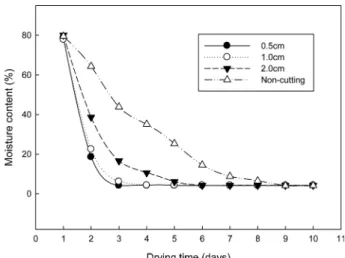
도라지 (Platycodon grandiflorum A. DC)의 절단 길이에 따른 수분 함량 변화는 Fig. 1에 나타내었다. 절단 길이가 짧 을수록 건조 속도는 빨랐다. 절단 길이 0.5 ㎝에서는 3일 만에 건조가 되었으며, 1.0 ㎝에서는 4일이, 2.0 ㎝에서는 5일이, 무 절단은 9일 만에 건조되었다.
2. 전질소와 무기성분 함량
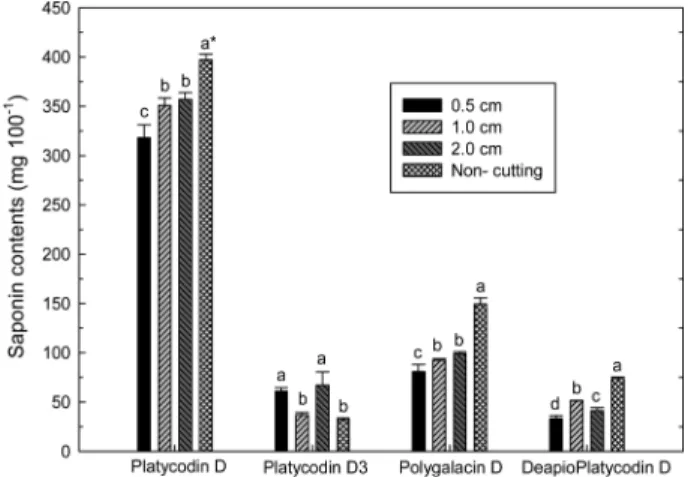
도라지를 절단 길이별로 건조하여 전질소와 무기성분을 분 석한 결과를 Table 1로 나타내었다. 도라지 절단 길이에 따른 전질소 함량 0.76 - 0.53%로 절단 길이 0.5 ㎝에서 가장 높게 나타났는데 이를 사포닌 함량과 비교하면 반대의 경향을 보였 으며, 특히 사포닌 중에서도 deapioplatycodin D (DPD)의 함 량과 반대의 경향을 보였다 (Fig. 2). 이러한 결과는 도라지 대상으로 한 건조공정이 도라지에 포함된 2차대사 산물인 사 포닌 함량에 영향을 주는 것으로 사료된다.
무기성분인 인산은 0.50 - 0.67%로 절단 길이에 따른 차이는 유의성이 인정되지 않았으며, 칼륨은 1.17 - 1.50%로 다른 무 기 성분에 비해 가장 많이 함유되어 있다. 칼륨은 세포내액의 주된 양이온으로 나트륨과 함께 체액의 삼투압과 수분 균형을 조절하며, 고혈압 예방과 치료에 효과적이다 (Lee et al., 2013). 칼슘은 0.5 ㎝ 는 0.31%로 가장 적었으며, 무절단은 0.36%로 절단 길이가 길어질수록 증가하는 경향을 보였다. 마 그네슘 함량은 0.5 ㎝에서 0.28%로 가장 많았으며 1 ㎝에서
Fig. 1. Changes in moisture of Platycodon grandiflorum radix by cutting size.
0.22% 가장 낮게 나타났지만 절단 길이에 따른 일정한 경향 은 나타나지 않았다. 나트륨 함량은 절단 길이에 따른 통계적 유의성이 인정되었지 않았다. 이러한 결과는 더덕 (Choi et al., 2006)과 허브식물 (Arslan and Ozcan, 2008), 도라지 (Lee et al., 2014a) 등에서 건조 방법과 건조시간의 차이가 무기성분에 영향을 미친다는 보고 같이 본 연구에서도 건조과 정에 수분손실이 무기성분 함량에 영향을 준 것으로 판단된다.
3. 사포닌 함량
도라지를 0.5, 1.0, 2.0 ㎝ 그리고 대조구로 무절단하여 45℃
에서 건조하여 사포닌함량을 분석한 결과를 Fig. 2로 나타내 었다. 전체 사포닌 함량은 절단 길이가 길수록 증가하는 경향 을 보였으며, 특히 4종류의 사포닌 중에 platycodin D의 함량은 무절단에서 397 ㎎%, 2 ㎝에서 356 ㎎%, 1 ㎝에서 350 ㎎%
0.5㎝에서 318 ㎎% 으로 절단 길이가 짧을수록 사포닌 함량 이 낮아지는 경향을 보였으며 (p < 0.05), polygalacin D와 deapioplatycodin D의 함량은 무절단에서 각각 149 ㎎%과 74㎎%로 가장 높았으며 (p < 0.05), platycodin D3와 함량은 2㎝에서 67 ㎎%로 가장 높게 나타났다 (p < 0.05). 도라지 건 조공정에서 도라지에 함유된 사포닌 함량은 건조 온도 (Lee and Cho, 2014)와 건조방법 (Lee et al., 2014a) 그리고 저장 기간과 방법 (Lee et al., 2014b)에 영향을 받으며 특히 건조 온도가 낮고 건조시간이 길수록 사포닌 함량은 증가한다 (Lee and Cho, 2014; Lee et al., 2014a)고 보고된 바 있다. 이상 의 결과를 통해 도라지 건조 공정에서 도라지를 무절단하여 건조하는 경우 비록 사포닌 함량이 증가하지만 건조시간과 비 용이 많이 소요되어 경제성과 약리활성에 대한 충분한 고려가 필요할 것으로 사료된다.
4. 항산화활성 성분 함량
Polyphenolic 화합물들은 우수한 항산화력을 가지고 있는 것 Table 1. Mineral contents of Platycodon grandiflorum radix by cutting size.
Cutting size (㎝)
Mineral Contents (%)
T-N P2O5 K Ca Mg Na
0.5 0.76± 0.03a 0.67± 0.08a 1.35± 0.04b 0.31± 0.01a 0.28± 0.01a 00.03± 0.00a*
1.0 0.58± 0.04c 0.47± 0.10b 1.18± 0.02c 0.36± 0.04a 0.22± 0.01c 0.04± 0.01a 2.0 0.65± 0.09b 0.63± 0.10a 1.50± 0.01a 0.35± 0.01a 0.25± 0.01b 0.04± 0.01a Non-
cutting 0.53± 0.07c 0.50± 0.06b 1.17± 0.11c 0.36± 0.02a 0.24± 0.03bc 0.03± 0.00a Data represent the means± SD of triplicate determinations from three separate experiments. *Values in a column with a different letters (a - c) are significantly different (p < 0.05) using DMRT.
Fig. 2. Saponin contents of Platycodon grandiflorum radix by cutting size. *Data represent the means±SD and different letters on the same kind of bars are significantly different (p < 0.05) using DMRT.
Fig. 3. Antioxidants for cutting size of Platycodon grandiflorum radix. A; polyphenol content, B;
flavonoid content, C; tannin content. *Data represent the means ± SD and different letters on the same kind of bars are significantly different (p < 0.05) using DMRT.
으로 알려져 있으며, 이는 free radical을 안정화시킬 수 있는 phenolic ring의 존재 때문인 것으로 보고되어져 있다 (Middleton and Kandaswami, 1994). 도라지 뿌리의 절단 길 이에 따른 총 polyphenol 함량을 측정한 결과 절단 길이가 짧을수록 증가하는 경향을 보였다 (Fig. 3A). 절단 길이가 0.5㎝ 에서 3.30 ㎎/g으로 가장 많았으며 무절단은 2.70 ㎎/g 으로 가장 적게 나타났다.
Flavonoid는 주로 anthocyanidins, falvonols, flavones, cathechins 및 flavanones 등으로 구성되어 있으며, 그 구조에 따라 특정 flavonoid는 항산화 및 항균성 등 다양한 생리활성을 갖고 있는 것으로 보고되고 있다 (Middleton and Kandaswami, 1994; Choi et al., 2013). 도라지의 flavonoid 함량은 극히 미 량이 들어있으며, 절단 길이에 따른 함량의 0.05 - 0.07 ㎎/g으 로 유의성이 인정되지 않았지만 (p < 0.05) 절단 길이가 길어질 수록 줄어드는 경향을 보였다 (Fig. 3B).
Tannin은 차의 맛, 향기 및 색에 깊이 관여하며, 미생물의 생육 억제, 각종 효소활성의 저해작용으로 보고되고 있다 (Nakagawa and Amano, 1974; Martin and Martin, 1983).
tannin 함량 또한, 절단 길이가 짧을수록 함량이 높게 나타났 으며 0.5 ㎝ 길이로 절단 했을 때 2.21 ㎎/g, 무절단 했을 때 1.66㎎/g으로 0.5 ㎝ 절단이 무절단에 비해 33%가 증가하는 것으로 나타났다 (Fig. 3C).
건조도라지의 항산화 성분은 건조가 빠를수록 증가하는 경 향을 보였는데, 이러한 결과는 Ha 등 (2004)이 보고한 바와 같이 도라지 건조속도가 빨라지면 건조도라지의 색이 황갈색 으로 변하는 과정에서 polyphenol과 tannin함량이 증가된 것으 로 사료된다. 자연계에 존재하는 polyphenolic 화합물의 종류 에 따라 항산화 능의 차이가 있으며 (Hwang et al., 2013) 건조도라지 총 페놀계 화합물에 관한 선행연구에서 암세포 증 식 억제효과가 있는 것으로 보고되고 있어 (Hwang et al., 2013) 도라지의 약리활성을 나타내는 성분 중 사포닌 뿐 만아 니라 페놀성 화합물도 심도 있는 연구가 필요할 것으로 사료 된다.
5. 항산화 활성변화
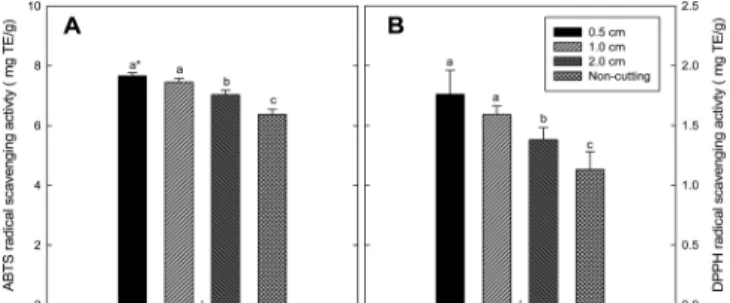
도라지의 절단 길이에 따른 ABTS radical 소거활성은 절단
길이 0.5 ㎝ 에서 7.7 ㎎•TE/g으로 가장 높게 나타났으며, 1.0㎝에서 7.45, 2.0 ㎝에서 7.03, 무절단에서 6.37 ㎎•TE/
g 으로 절단 길이가 길어질수록 뚜렷하게 감소하였다 (Fig.
4A). DPPH radical 소거활성에서도 절단 길이 0.5 ㎝ 에서 1.76㎎•TE/g가장 높게 나타났으며, 1.0 ㎝에서 1.59, 2.0 ㎝ 에서 1.38, 무절단에서 1.38 ㎎•TE/g 으로 절단 길이가 길어 질수록 뚜렷하게 감소하였다 (Fig. 4B). 도라지는 건조 속도가 빠르면 색차계 색도에서 적색도와 황색도가 많이 나타나는데 (Lee and Cho, 2014) 이런 결과는 도라지 건조과정에 황갈색 변화가 항산화성분 함량에 영향을 주어 페놀화합물과 ABTS, DPPH radical 소거활성이 증가한 것으로 사료된다.
6. 도라지 절단 길이에 따른 사포닌함량, 항산화 성분들이 함량과 항산화 활성과의 상관관계
도라지의 절단 길이에 따른 사포닌함량과 항산화성분 및 활 성과의 상관관계를 SAS program으로 분석한 결과는 Table 2 에서와 같이 유의성이 인정되는 것으로 나타났다. 절단 길이 에 따른 사포닌 함량과 항산화성분 polyphenol과 flavonoid와의 상관관계에서 PCD3를 제외한 나머지 성분과는 각각 −0.823*
에서 −0.967**,−0.830*에서 −0.973**으로 고도 부의 상관관 계를 보였고 tannin과의 상관관계에서는 상관관계가 없는 것 으로 나타났다. 사포닌 함량과 DPPH radical 소거활성과의 상 관관계에서는 −0.837*에서 −0.977**로 ABTS radical 소거활 성과의 상관관계에서는 PCD3를 제외한 나머지는 −0.857*에서 Fig. 4. Antioxidants for cutting size of Platycodon grandiflorum radix. A; ABTS radical scavenging activity and B; DPPH radical scavenging activity. *Data represent the means ± SD and different letters on the same kind of bars are significantly different (p < 0.05) using DMRT.
Table 2. Correlation coefficient between antioxidant content and saponin content Platycodon grandiflorum radix by cutting size.
Polyphenol Flavonoid Tannin ABTS DPPH
PCD1) −0.967** −0.973** −0.534ns −0.960** −0.971**
PCD3 00.412ns 00.434ns −0.191ns 00.454ns −0.971**
PGD −0.920** −0.910** −0.640ns −0.969** −0.933**
DPCD −0.823* −0.830* −0.333ns −0.857* −0.837*
1)PCD; Platycodin D, PCD3; Platycodin D3, PGD; Polygalacin D and DPCD; Deapioplatycodin D.
ns, *, **; No significance or significance at 0.05 and 0.01 probabilities, respectively.
−0.967**으로부의 상관성이 있는 것으로 나타났다.
도라지 건조속도가 빠르면 사포닌 함량이 감소하고 항산화 물질이 증가하여 도라지의 다른 약리적 성분 (Hwang et al., 2013)이 증가한다. 이상의 연구결과로 도라지 사용목적에 따라 도라지의 건조 속도를 달리 할 필요가 있을 것으로 사료된다.
감사의 글
본 연구는 농촌진흥청지원 연구비지원(과제번호: PJ010930) 의해 수행된 결과로 이에 감사를 드립니다.
REFERENCES
Ahn KS, Noh EJ, Zhao HL, Jung SH, Kang SS and Kim YS.
(2005). Inhibition of inducible nitric oxide synthase and cyclooxygenase II by Platycodon grandiflorum saponins via suppression of nuclear factor-kB activation in RAW 264.7 cells.
Life Science. 76:2315-2328.
Arslan D and Ozcan MM. (2008). Evaluation of drying methods with respect to drying kinetics, mineral content and colour characteristics of rosemary leaves. Energy Conversion and Management. 49:1258-1264.
Choi CY, Kim JY, Kim YS, Chung YC, Seo JK and Jeong HG.
(2001). Aqueous extract isolated from Platycodon grandiflorum elicits the release of nitric oxide and tumor necrosis factor alpha from murine macrophages. International Immunopharmacology.
1:1141-1151.
Choi KH, Nam HH and Choo BK. (2013). Effect of five Korean native Taraxacum on antioxidant activity and nitric oxide production inhibitory activity. Korean Journal of Medicinal Crop Science. 21:191-196.
Choi MY, Oh HS and Kim JH. (2006) Changes of physicochemical properties of cultivated Codonopsis lanceolata stored at various storage conditions. Korean Journal of Plant Research. 19:59-67.
Dewanto V, Wu X and Liu RH. (2002). Processed sweet corn has higher antioxidant activity. Journal of Agricultural and Food Chemistry. 50:4959-4964.
Duval B and Shetty K. (2001). The stimulation of phenolics and antioxidant activity in pea(Pisum sativam) elicited by genetically transformed anise root extract. Journal of Food Biochemistry. 25:361-377.
Ha DC, Lee JW, Do JH, Park CK and Ryu GH. (2004). Drying rate and physicochemical characteristics of dried ginseng root at different temperature. Journal of Food Science and Nutrition.
33:741-746.
Hwang SY, Choi HM and Lim SY. (2013). Total phenolics of dried Platycodon grandiflorum and its effect on growth of human cancer cell lines. Korean Journal of Food Science and Technology. 45:84-89.
Kim HS, Kim TW, Kim DJ, Lee JS, Kim KK and Choe M.
(2013). Antioxidant activities and α-glucosidase inhibitory effect of water extracts from medicinal plants. Korean Journal of Medicinal Crop Science. 21:197-203.
Kim SM, Cho YS and Sung SK. (2001). The antioxidant ability and nitrite scavenging ability of plant extracts. Korean Journal of Food Science and Technology. 33:626-632.
Konishi T, Tada A, Shoji J, Kasai R and Tanaka O. (1978).
The structures of platycodin A and C, monoacetylated saponins of the roots of Platycodon grandiflorum A. DC. Chemical and Pharmaceutical Bulletin. 26:668-670.
Korean Food and Drug Administration(KFDA). (2011). Food standards codex. Korean Food and Drug Administration. Seoul, Korea. p.330-374.
Kwon GM, Kim JW and Youn KS. (2013). Effect of different pre-treatments on the physicochemical and antioxidant activities of cold-vacuum dried peaches. Korean Journal of Food Science and Technology. 45:466-472.
Lee BJ and Cho YS. (2014). Effects of drying temperature on the saponin and free sugar contents of Platycodon grandiflorum radix.
Korean Journal of Food Science and Technology. 46:769-772.
Lee BJ, Jeon SH, Lee SW, Chun HS and Cho YS. (2014a).
Effects of drying methods on the saponin and mineral contents of Platycodon grandiflorum radix. Korean Journal of Food Science and Technology. 46:636-640.
Lee BJ, Jeon SH, Lee SW, Chun HS and Cho YS. (2014b). Soil physicochemistry and saponins content of Platycodon grandiflorum radix cultured from different sites in Gyeongnam province. Korean Journal of Medicinal Crop Science. 22:463-468.
Lee HY, Kang RH, Kim YS, Chung SI and Yoon YS. (2010).
Platycodin D inhibits adipogenesis of 3T3-L1 cells by modulating kruppel-like factor 2 and peroxisome proliferator-activated receptor gamma. Phytotherapy Research. 24(Supplement 2):161-167.
Lee JH and Kim HJ. (2009). Vacuum drying kinetics of Asian white radish(Raphanus sativus L.) slices. LWT-Food Science Technology. 42:180-186.
Lee SM and Lee JS. (2006). Tocopherol and tocotrienol contents of vegetable oils, margarines, butters, and peanut butters consumed in Korean diet. Food Science and Biotechnology.
15:183-188.
Lee SJ, Shin SR and Yoon KY. (2013). Physicochemical properties of black doraji(Platycodon grandiflorum). Korean Journal of Food Science and Technology. 45:422-427.
Martin JS and Martin MM. (1983). Tannin assays in ecological studies: Precipitation of ribulose-1,5-bisphosphate carboxylase/
oxygenase by tannic acid, quebracho, and oak foliage extracts.
Journal of Chemical Ecology. 9:285-294.
Middleton E and Kandaswami C. (1994). Potential health promoting properties of citrus flavonoids. Food Technology.
48:115-119.
Mujumdar AS. (2000). Drying Technology in Agriculture and Food Sciences. In Krokida M and Maroulis Z.(ed.). Quality changes druing drying of food materials. Science Publishers Inc. Enfield. NH, USA. p.61-106.
Nakagawa M and Amano I. (1974). Evaluation method of green tea grade by nitrogen analysis. Journal of Japanese Society of Food Science and Technology. 21:57-63.
National Institute of Agricultural Science and Technology (NIAST). (2000). Methods of soil and plant analysis. Rural Development Administration. Suwon, Korea. p.103-146.
Park IS, Kang EM and Kim NS. (2000). High-performance
liquid chromatographic analysis of saponin compounds in Bupleurum falcatum. Journal of Chromatographic Science.
38:229-233.
Rice-Evans CA, Miller NJ and Paganga G. (1997). Antioxidant properties of phenolic compounds. Trends in Plant Science.
2:152-159.
Sung NJ and Seo JK. (1998). Medical action of perennial Platycodon radix. In proceeding Institute of Agricultural Resource Utilization Symposium for 50th anniversary GSNU.
Institute of Agricultural Resource Utilization. Gyeongsang National University. Korea. p.35-47.
Swami SB, Das SK and Maiti B. (2007). Convective hot air drying and quality characteristics of bori: A traditional Indian nugget prepared black gran pulse batter. Journal of Food
Engineering. 79:225-233.
Tada T, Kaneiwa Y, Shoji J and Shibat S. (1975). Saponins of the root of Platycodon grandiflorum: Isolation and the structure of platycodin D. Chemical and Pharmaceutical Bulletin.
23:2965-2972.
Wang C, Schuller-Levis GB, Lee EB, Levis WR, Lee DW, Kim BS, Park SY and Park E. (2004). Platycodin D and D3 isolated from the root of Platycodon grandiflorum modulate the production of nitric oxide and secretion of TNF-α in activated RAW 264.7 cells. International Immunopharmacology. 4:1039-1049.
Zhao HL, Cho KH, Ha YW, Jeong TS, Lee WS and Kim YS.
(2006). Cholesterol-lowering effect of platycodin D in hypercholesterolemic ICR mice. European Journal of Pharmacology.
537:166-173.