JDCS Vol. 18, No. 7, pp. 1443-1450, Nov. 2017
LoRa 망 기반의 주차 지명 시스템 : 큐잉 이론과 큐러닝 접근
조 영 호1 · 서 영 건2 · 정 대 율3*
1
경상대학교 대학원 문화융복합학과
2
경상대학교 컴퓨터과학과
3*
경상대학교 경영정보학과
LoRa Network based Parking Dispatching System : Queuing Theory and Q-learning Approach
Youngho Cho
1· Yeong Geon Seo
2· Dae-Yul Jeong
3*1
Department of Cultural Convergence, Graduate School, Gyeongsang National University, Gyeongnam 52828, Korea
2
Department of Computer Science, Gyeongsang National University, Gyeongnam 52828, Korea
3
*Department of Management Information, Gyeongsang National University, Gyeongnam 52828, Korea
[요 약]
본 연구는 지역축제 시 갑자기 증가하는 주차병목문제를 해결하기 위해 IoT(Internet of Things)의 센서네트워크 중 저전력,장거 리 무선망인 LoRa 네트워크 기반으로 한 인공지능 주차시스템을 개발하는데 주 목적이 있다. 지리적 범위와 시간의 제한을 특징 으로 하는 지역 축제에서는 관광객들이 짧은 시간에 최대한 많은 것들을 누리려 하는 욕구를 가지는데, 이때 발생하는 교통체증에 대한 효과적인 주차 공간 분배 문제가 필수적이다. 축제전용 주차장의 용량이 각기 제한적이므로 각 주차장의 수용가능규모의 임 계값을 넘기 전에 다른 축제장으로 유도하는 것이 필요하다. 이를 위해 주차 대기시간 및 주차서비스에 성공하기까지의 확률분포 는 큐잉이론의 쁘아송 분포를 따르며, 가장 빠른 길을 찾기 위해 Q-learning 알고리즘을 적용한다. 본 연구는 이 두 가지의 알고리즘 을 융합하여 축제 장소에서 적용 가능한 지능형 주차시스템을 제안하고 실험한다.
[Abstract]
The purpose of this study is to develop an intelligent parking dispatching system based on LoRa network technology. During the local festival, many tourists come into the festival site simultaneously after sunset. To handle the traffic jam and parking dispatching, many traffic management staffs are engaged in the main road to guide the cars to available parking lots. Nevertheless, the traffic problems are more serious at the peak time of festival. Such parking dispatching problems are complex and real-time traffic information dependent. We used Queuing theory to predict inbound traffics and to measure parking service performance.
Q-learning algorithm is used to find fastest routes and dispatch the vehicles efficiently to the available parking lots.
색인어 :
주차, LoRa, 사물통신, 큐잉 이론, 큐러닝 시스템
Key word : Parking, LoRa, IoT, Queuing Theory, Q-learning system
http://dx.doi.org/10.9728/dcs.2017.18.7.1443
This is an Open Access article distributed under the terms of the Creative Commons Attribution Non-CommercialLicense(http://creativecommons .org/licenses/by-nc/3.0/) which permits unrestricted non-commercial use, distribution, and reproduction in any medium, provided the original work is properly cited.
Received 19 September 2017; Revised 16 October 2017 Accepted 25 November 2017
*Corresponding Author; Dae-Yul Jeong Tel: +82-055-772-1533
E-mail: [email protected]
Ⅰ. Introduction
Local festivals contribute to the activation of the local economy by inducing residents' motivation for continuous and voluntary participation and also encouraging participation of outside tourists [1]. Cultural events such as local festivals have limited parking space due to their regional capacity restriction.
Also, tourists try to experience more contents in a short time as possible. For this reason, a lot of vehicles rush in the same place at the same time that cause traffic congestion as well as social, environmental and economic problems[2]. Recently, some methods of using the IoT (Internet of Things) platform have been proposed to solve this traffic congestion[3-6][20,21]. Car parking lot detection method based on automatic threshold algorithm[3], using sensors for intelligent autonomous parking[4] and a method of using a laser scanner to search for car-parking lot position[5]
have been proposed. However, there is a disadvantage that expensive H/W such as a sensor or a laser scanner for an image process is required. In addition, the ITS method using cloud computing[6][13-14] is lacking in end-to-end solution because its performance is determined by various wireless technologies in the sensor layer[14].
In this paper, we use IoT platform-based LoRa (Long Range) network technologies and intelligent search method to handle the suddenly increasing traffic efficiently. First, LoRa networks are used as sensor networks, which have advantages of low-cost, low-power, long-distance wireless networks. This provides a platform for all drivers looking for a parking lot to provide information such as real-time parking situation. Second, we use both Q-learning algorithm and Queuing theory to find the shortest distance to find shortest available parking space. We propose an intelligent traffic dispatching and parking allocation system that enable end-to-end solution in the case of suddenly increasing traffic during the local festival.
Ⅱ. Related Studies
2-1 Intelligent Parking System
Faheem el al.[7] proposed many different technologies for the intelligent parking systems. Although all the proposed intelligent parking systems have the common use of the Internet, they can be divided into 6 categories according to the subjects of the adopted technologies. However, they have limitations such as indoor or limited outdoor parking situation, time delays due to complicated operations, and parking space limitation mainly due to the spatial
information transmission constraints[18][21]. In this study, we have reviewed many available technologies that appropriate to the locally distributed multiple outdoor parking lots in a specific area.
LoRa network with IoT sensors is most prospect technology[8].
2-2 LoRa Network
As the LoRa network uses the license-exempt band, it can be developed by anyone and is a most prospective platform capable of various services. The maximum reaching distance is 20Km and the module price is so low. Meanwhile, there is a disadvantage that frequency interference may be caused by using the license-exempt band frequency 921MHz[15]. There is an advantage of low maintenance cost due to the feature of ultra low power with extremely small battery. The architecture uses Star-of-the-Star topology and connects low power devices for long distance wireless transmissions[8][16].
2-3 Queueing Theory and Q-learning Algorithm
Considering the actual situation of widely distributed parking lots in a specific area and extremely traffic congestion by the rushing travelers, the problems are very difficult to solve compared with single parking lot allocation problem because of effective dispatching waiting cars within short time as well as efficient communications between sensors and server. LoRa network with IoT sensor chips can be a promising alternative to solve the widely distributed network problem as minimum operation cost. Dispatching pouring cars to the available parking lots subject to minimum time constraint is still difficult problem[19][20]. We have applied Queuing theory and Q-learning algorithm to predict the inbound traffics and to find shortest route to the available destination.
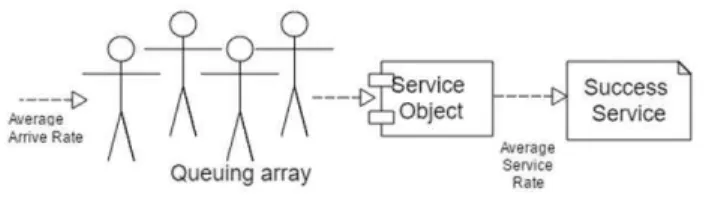
Queuing model in fig. 1 is appropriate to measure the performance of service system with waiting conditions and time to be serviced. The model describes the arrival characteristics, service characteristics, and service location[22]. The main assumptions underlying the theory are that the arrival distribution follows Poisson distribution and service time distribution of the system follows the exponential distribution. The queuing model is appropriate enough for describing events that occur randomly within a given time. It is easily applied to simulate traffic handling with random vehicle arrivals. The Poisson distribution value is applied to the Q-learning algorithm as a threshold value.
Queuing theory enables discrete event simulation because it can
process sequence by time. Therefore, the queue of the queuing
theory should be well synchronized with the waiting time and idle
time of the server. This methods is suitable for LoRa network
because of LoRa provide real time communication based on IoT[12][23].
To find shortest route from the tollgate to a target destination with the traffic information and available parking lot capacity, intelligent algorithm with learning mechanism should be developed. Many algorithms are suggested for finding the shortest distance traffic route such Dijkstra algorithm, A* algorithm, Bellman-Ford algorithm, Floyd algorithm (Floyd), and so on [9][10][11]. Recently, Q-;earning algorithm with reinforcement learning has emerged as an alternative method to overcome the shortcomings of previous algorithms. It was developed on the basic concept of artificial intelligence and learning strategy. The principle of the Q-learning algorithm is that an agent’s future action is defined on the base of the action in the current state plus the sum of the rewards for future actions. It is an algorithm that performs reinforcement learning on the assumption that a single agent does not change a given finite condition.[12] To solve the actual parking situation problem with the dynamic environment due to the change of the incoming and leaving vehicles continuously, we propose a new queuing model with Q-learning algorithm based on a single agent.
그림 1. 큐잉모델 Fig. 1. Queuing model
Ⅲ. LoRa Network based Parking Dispatching System
3-1 System Architecture
To develop a prototype for the efficient traffic dispatching system with the distributed parking lot environment in a local city festival period, we need to minimize the actual situation. This study has the following assumptions. It assumes that the LoRa network module is installed and all the parking status information of each lot is gathered instantly. To simply the problem, all inbound traffic are from two highway tollgates and dispatched three nearest parking lots. The travelers use smart phone to get parking information of their destination. The system agent (inbound traveler) must be a member of the system with his own ID. We assume legal constraints such as fine does not exist and
traffic signals function well which will not cause traffic jam. The inbound traffic rate of each tollgate and parking lot follows Poisson distribution. The single agent behavior is predicted with proposed Q-learning algorithm rather than multiple agents.
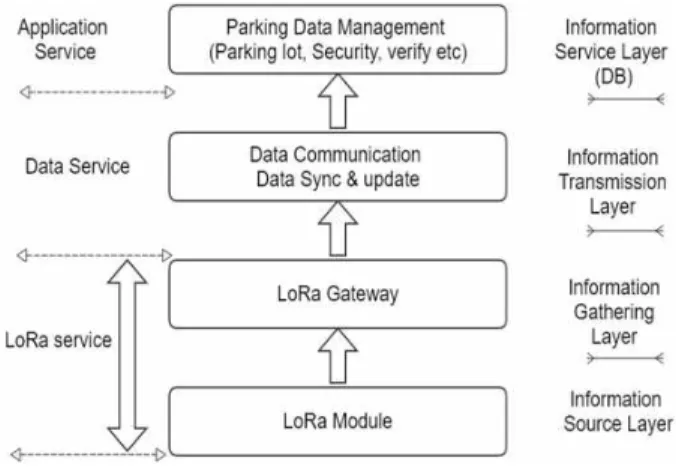
We propose a system architecture which is divided into two main areas (fig. 2). Travelers can get information from LoRa network server after passing tollgates, but he/she can get information just only through internet with TCP/IP protocol before getting to highway tollgate entry. LoRa network is composed of star-of-star topology that is connected to end device via single-hop LoRa link connected to one or several gateways.
Therefore, the next step is gateway to the net server with standard IP protocol.
Each LoRa module is installed in a parking lot and consists of minimum size and lowest price with light sensor function. In the LoRa service section, the data are obtained from the IoT sensor that is simply stored and updated simultaneously. Data communication layer which is connected with LoRa Gateway serves as the interface with the parking management system which is the main server(fig. 3). This access mode simplifies the management of all complex networks for accessing end nodes and moving to the net server[11].
그림 2. 제안 시스템의 구조
Fig. 2. System architecture
그림 3. 시스템 구조의 계층 Fig. 3. System architecture layers
3-2 Proposed QueQ-learning
To develop a prototype for the proposed system, we developed an efficient algorithm with the following variables and processing routines on the basis of queuing theory and Q-learning algorithm.
C : Capacity of a car parking block ʟ : Number of levels in car parking block Ut : Current utilization of car parking block Pil : Probability of the ith car parking block tv : arrived time of vehicle v at parking block Learning Rate(LR) : The learning rate controls how fast we modify our estimates.
gamma : Discount factor
(discounted value of future rewards)
# Q-learning algorithm pseudo code :
# Q(state, action) = R(state, action) + gamma *
# Max[Q(next state, all actions)]
# Queuing theory :
# Compute Pil with tv, Ut, ʟ, C * if Pil > 75% then
# threshold=0,
# else threshold = 1 ( Pil = <75% ) 1. Set parameter and environment rewards in matrix R.
2. Initialize matrix Q to zero.
3. For each episode:
Select a random initial state.
Do while the goal state hasn't been reached.
Select one of all possible actions for the current state.
Using this possible action, consider going to the next state.
Change state if threshold was changed.
#Queuing theory adjusted
Get maximum Q value for this next state based on all possible actions.
Compute: Q(state, action) = R(state, action) + gamma * Max[Q(next state, all actions)]
#learning step
Set the next state as the current state.
End Do End For
Ⅳ. Experimentation and Evaluation
4-1 Experimental environment
The Q-learning environment consists of a matrix of 10 × 10 discrete states. It starts in the bottom left column and goes to the top right column to become the absorption state where Q (s, a) value is 100(fig. 4). Therefore, the path for the maximum Q value is diagonal(fig. 5).
그림 4. 모의실험 행렬 Fig. 4. Simulation matrix
4-2 Experimental results
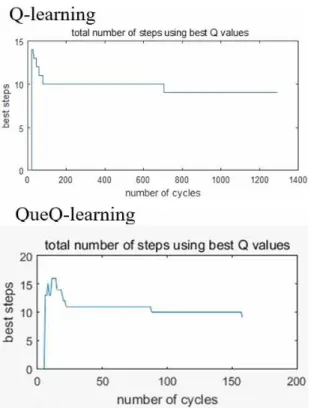
In QueQ-learning algorithm, it is shown in fig. 6, the number of cycles for total number of steps using best Q value is faster 그림 5. 최적의 Q(s, a) 라우팅
Fig. 5. Best Q(s, a) routing
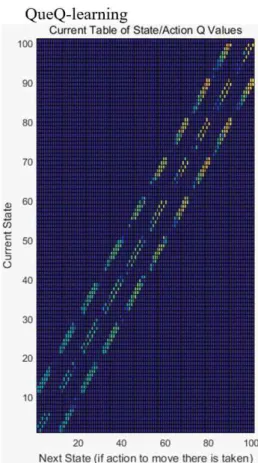
than about 8 times Q-learning algorithm. In addition, the number of moves shown in fig. 7 was 15,000 in Q-learning algorithm, while QueQ-learning algorithm found the best step in about 6,500 times. One way of examining the current Q values would be to look at the sum of the entire Q matrix as the number of move increase(fig. 8 and fig. 9). As convergence gets closer, the gradient gets closer and closer to zero. Finally, in fig. 10, it shows the state of the Q-values stored for each state action. The y-axis represents the current state, and the x-axis shows the possible actions to move to the next state. The diagonal lines represent the current Q (s, a) value from 0 to 100. Therefore, Q-learning algorithm and the proposed QueQ-learning algorithm converged with the same Q value.
그림 6. QueQ-러닝과 Q-러닝의 최적 단계에서 반복 회수 비교
Fig. 6. Comparison of number of cycles with best steps for QueQ-learning and Q-learning
그림 7. QueQ-러닝과 Q-러닝의 최적 단계에서 이동 회수 비교
Fig. 7. Comparison of number of moves with best steps for QueQ-learning and Q-learning
그림 8. QueQ-러닝과 Q-러닝의 Q 행렬합과 반복 회수 비교
Fig. 8. Comparison of number of cycles with sum of Q
matrix for QueQ-learning and Q-learning
그림 9. QueQ-러닝과 Q-러닝의 Q 행렬합과 이동 회수 비교
Fig. 9. Comparison of number of moves with sum of Q matrix for QueQ-learning and Q-learning
그림 10. Action과 state의 Q-값 Fig. 10. State/action Q-values
Ⅴ. Conclusion
This study proposes an intelligent parking allocation system
that combines Queuing theory and Q-learning algorithm based on
LoRa network, a low-power, low-cost, long-range wireless sensor
network. Using the structure of LoRa network with the existing
sensor network technologies, it was possible to construct a system
that is fast, simple and low cost. The important idea of this paper
is to calculate parking rates every time which will be important
information to the actor’s decision. To give the critical threshold
of parking rate which inform the possible failure rate when a
vehicle try to get parking, the travelers will have chance of
parking success with minimal travel time. To guide the shortest
route for the traveler, the Q-Learning algorithm will minimize
trial and error to get the target destination. The Q-learning
algorithm using Queuing theory, which is a queuing theory that
can obtain the shortest distance in a short time, has resulted in
faster calculation time. However, there are many variables and
constraints that can’t be predicted when two or more agents are
involved. It is also difficult to calculate the exact performance of
queuing model when traffic signals are not efficient and jam
situation occur by the overflow of traffic. More research is needed about Q-Learning algorithms for the multiple agent situations and traffic overflow.
References
[1] Giuseppe Attanasia, Fortuna Casoriab, Samuele Centorrinoc and Giulia UrsodaUniversity, “Cultural investment, local development and instantaneous social capital”, The Journal of Socio-Economics, Vol. 47, pp.228– 247, 2013.
[2] Zhao and Hua Xiao, “Research on Intelligent Optimization and Control Method for Urban Traffic Signal“, Beijing University of Technology, ProQuest Dissertations Publishing, 2007.
[3] Choeychuen, K., “Automatic parking lot mapping for available parking space detection”, In Proceedings of the 5thInternational Conference on Knowledge and Smart Technology, Chonburi, Thailand, pp.117-121, 2013.
[4] Li, T. S., Ying-Chieh Y., JyunDa, W., Ming-Ying H., and Chih-Yang C., “Multifuntional intelligent autonomous parking controllers for carlike mobile robots“, IEEE Trans, Ind, Electron, pp.1687-1700, 2010.
[5] Keat, C.T.M., Pradalier, C., Laugier, C., “ Vehicle detection and car park mapping using laser scanner“, In Proceedings of the IEEE/RSJ International Conference on Intelligent Robots and Systems, Canada, pp.2054–2060, 2005.
[6] Ganchev I., O’Droma M. and Meere D., “Intelligent car parking locator service”, Int. J. ITK, Vol. 2, pp.166–173, 2008.
[7] Faheem S. A., Mahmud G. M., Khan, M. Rahman and H. Zafar, “A survey of Intelligent Car Parking System“, Journal of Applied Research and Technology, Vol. 11, 2013.
[8] Benson J. P. and etc, “Car-park management using wireless sensor networks”, “In Proceedings of 31st IEEE Conference on the Local Computer Networks, USA, pp.588–595, 2006.
[9] Di Lecce V. and Amato A., “Route planning and user interface for an advanced intelligent transport system. IET Intell. Transp. Syst. 5, pp.149–158, 2011.
[10] Caicedo F. and Vargas J., “Access control systems and reductions of driver’s wait time at the entrance of a car park”, ICIEA, Singapore, pp.1639–1644, 2012.
[11] Boussier J. M. and etc, “Using agent-based of driver behavior in the context of car park optimization”, “In Proceedings of the 3rd International IEEE Conference on
Intelligent Systems, London, UK, pp.395–400, 2006.
[12] Macro Centenaro and etc, “Long-Range Communications in Unlicensed Bands: the Rising Stars in the IoT and Smart City Scenarios“, IEEE Wireless comm., 2016.
[13] Bitam S. and Mellouk A., “Its-cloud: Cloud computing for intelligent transportation system“, “In Proceedings of the IEEE Global Communications Conference“, Anaheim, CA, USA, pp.2054–2059, 2012.
[14] ITU-T Study Group 13 on Future Networks including Cloud Computing, Mobile and Next-Generation Networks.
Available online:
http://www.itu.int/en/ITU-T/about/groups/Pages/sg13.aspx .
[15] Ji Z., Ganchev I. and O’Droma M., “An iWBC consumer application for always best connected and best served”, IEEE Trans. Consum. Electron. Vol. 57, pp.462–470, 2011.
[16] Domingo A. and etc, “Almirall, E. Public open sensor data:
Revolutionizing smart cities”, IEEE Technol. Soc. pp.50–
56, 2013.
[17] Armbrust M. and etc, “A view of cloud computing”, Commun ACM, Vol. 53, pp.50–58, 2010.
[18] Wantanee V. and etc, “Mobile Crowdsourcing Platform for Intelligent Car Park Systems“, 978-1-4673-7825-3/15/2015 IEEE.
[19] Yong Joo ji, Hak-Hui Choi, and Dong-sung kim,
“Design and Implementation of Parking Guidance System Based on Internet of Things (IoT) using Q-learning model“, IEMEK, J. Embed. Sys. Appl., Vol. 11, No. 3, pp.153-162, 2016.
[20] Xu Zhiqing, He Jialianga and Li Haidong, “On Research IoT based Intelligent Parking Management System and Its Design“, International Journal of Smart Home, Vol. 10, No. 5, pp.217-230, 2016.
[21] Leon Stenneth and etc, “Street parking using mobile phones“, Department of Computer Science, University of Illinois, Chicago, USA.
[22] Robert Marsanic and etc, “Application of the Queuing theory in the planning of optimal number of servers (Ramps) in closed parking system“, UDK 625.712.63.
[23] Junhee Go and etc, “Implementation of GPS-based
Wireless Loss Prevention System using the LoRa Module”,
Journal of DCS, Vol. 18. No. 4, pp. 761-768, July. 2017.
조영호(Youngho Cho)
1993년 : 명지대학교 전자공학과 학사 2002년 : 연세대학교 전자전파공학과 석사 2012년 : 경상대학교 경영학과 석사
2017년~현재 : 경상대학교 대학원 문화융복합학과 박사 과정 관심분야 : LoRa망, IT융복합, 지능형 주차 시스템
서영건(Yeong Geon Seo)
1987년 : 경상대학교 전산과 학사 1997년 : 숭실대학교 전산과 박사 1989년~1992년 : 삼보컴퓨터 1997년~현재 : 경상대학교
컴퓨터과학과 교수 2014년~현재 : 경상대학교 대학원 문화융복합학과 교수 관심분야:Med. Image, IT융복합, Computer Network
정대율(Dae-Yul Jeong)