영아기 부모 양육스트레스 관련 연구 동향 분석
이진희1, 임진형2*
1제주국제대학교 유아교육과, 2제주한라대학교 유아교육과
Analysis of Research Trends Related to Parenting Stresses in Infancy
Jin-Hee Lee1, Jin-Hyung Lim2*
1Department of Early Childhood Education, Jeju International University
2Department of Early Childhood Education, Cheju Halla University
요 약 본 연구의 목적은 영아기 자녀를 둔 부모 양육스트레스 관련 연구 동향을 분석하는 것이다. 이를 위해 부모 양육
스트레스 관련 논문 최초 발행 시점인 1998년부터 2019년까지 한국연구재단(KCI)에 등재된 국내 학술지 논문 82편을 분석하였다. 연구문제에 따라 연구시기, 연구주제, 연구유형, 연구대상별로 빈도와 백분율을 산출하여 분석하였다. 연구 결과는 다음과 같다. 첫째, 연구시기별 분석결과, 1998년부터 2019년까지 시기별로 지속적인 증가세를 보였다. 둘째, 연구주제별 분석결과, 부모 관련 주제가 가장 많았으며, 자녀 관련, 양육환경 관련, 부모-자녀 관련 순으로 나타났다.
부모 관련 주제 중 양육신념과 행동 관련 변인연구가 가장 많이 이루어졌다. 셋째, 연구유형별 분석결과, 양적연구가 주를 이루었고 질적연구와 문헌연구는 이루어지지 않았다. 양적연구에서는 질문지를 활용한 검사방법이 가장 많았다.
넷째, 연구대상별 분석결과, 어머니를 대상으로 한 연구가 우세하였으며 모-영아, 부모, 부모-영아-교사 등의 순으로 나 타났다. 본 연구는 영아기 부모 양육스트레스에 대한 관심과 학문적 연구의 범위를 넓히는 계기를 제공했다는 점에서 의의가 있다.
Abstract This study analyzed the research trends related to parenting stress of parents with infancy. To
this end, 82 papers in journals registered in the KCI from 1998 to 2019 were reviewed. The frequency and percentage were calculated and analyzed for each research period, research topic, research type, and research subject. The research results were as follows. First, from 1998 to 2019, there was a continuous increase in each period. Second, regarding the research subject, the themes related to parents were the most researched, followed by the child, parenting environment, and parent-child.
Among the topics related to parents, research on the variables related to parenting beliefs and behaviors was the highest. Third, quantitative research was absolute, and no qualitative research was conducted.
Among the quantitative studies, the most common test method was through a questionnaire. Fourth, regarding each research subject, the research of mothers was dominant, followed by mother-infant, parent, and parent-infant-teacher. This study is significant because it provides an opportunity to broaden the scope of research and academic interest in the parenting stress of infancy parents.
Keywords : Infancy, Parent, Parenting Stress, Research Trend, Journal Article in Korea
*Corresponding Author : Jin-Hyung Lim(Cheju Halla Univ.) email: [email protected]
Received December 28, 2020 Revised February 2, 2021 Accepted February 5, 2021 Published February 28, 2021
1. 서론
영아기는 인간의 생애에서 차지하는 기간은 짧으나 발 달이 급속도로 이루어지며 다른 시기에 비해 이후의 발 달에 미치는 영향력이 상대적으로 크다는 점에서 중요하 다[1]. 특히 이 시기의 주 양육자와의 안정적인 애착 형성 은 이후의 대인 관계의 기초가 될 뿐만 아니라 사회•정 서, 인지발달의 기반이 되므로[2][3], 1차 양육자라 할 수 있는 부모의 역할은 매우 중요하다. 어린이집을 이용하는 연령이 하향화되면서 영아가 교사와 함께 지내는 시간이 늘었으나 여전히 영아와 1:1로 가장 밀착되어 지내는 사 람은 부모이다[4].
한편, 현대사회의 핵가족화 현상에 따라 자녀양육을 위한 조부모, 친족 등의 가족지원체계가 무너지면서 자녀 양육에 대한 부모의 책임과 역할이 늘어나 양육스트레스 가 증가하였다[5]. 최근 코로나19 상황으로 인한 어린이 집 및 교육기관 폐쇄 등의 이유로 취업 여성은 물론 전업 주부들이 자녀양육에 대한 스트레스를 호소하고 있다[6].
자녀양육에 대한 스트레스는 저출산의 문제와도 관련이 있어[7][8] 부모 양육스트레스에 대한 관심을 둘 필요가 있다.
스트레스란 적응하기 어려운 환경에 처할 때 느끼는 심리적, 신체적 긴장 상태이며[9], 양육스트레스는 자녀 양육에서 파생되는 부모역할 수행과정의 일상적 스트레 스와 부모역할 부담, 타인 양육에 대한 죄책감 등을 포함 한다[7]. 양육스트레스에 영향을 주는 요인은 다양하나 일반적으로 부모요인, 자녀요인, 양육환경 요인[10][11]
으로 구분된다. 부모요인은 부모의 교육수준, 취업여부 [12], 사회경제적 지위[13], 결혼만족도와 부부갈등 [14][15], 양육신념 및 양육효능감, 양육지식[16][17][18]
등이 양육 스트레스에 영향을 미치는 요인들이다. 자녀요 인은 영아의 기질[19][20]과 발달수준[21], 자녀의 수 [13], 성[22], 연령[23] 등이 양육스트레스에 영향을 미치 는 요인들이다. 양육환경 요인으로는 가정 및 사회적 지 원[24][25], 유아교육기관 만족도[26], 가족친화제도[27]
등의 유무가 양육스트레스에 영향을 미치는 것으로 보고 되고 있다.
양육스트레스는 부모 자신의 심리적 안녕 뿐만 아니라 자녀에게도 부정적 영향을 미친다. 실제로 양육스트레스 는 어머니의 정서적 우울, 자아존중감 저하, 부부관계의 악화 등에 영향을 주었다[10][28][29]. 양육스트레스는 어머니의 자녀 양육행동에도 영향을 미치는 것으로 나타 났다. 양육스트레스가 높은 경우, 자녀를 방임하고 신체
적, 정서적으로도 부적절한 양육태도를 보이고[30] 일치 하지 않는 훈육방법을 사용하는 것으로 나타났다[31]. 부 적절한 양육행동은 자녀의 전반적인 발달에도 영향을 미 친다. 관련 연구에 의하면, 양육스트레스가 영아의 사회 정서 행동[32][33] 및 애착행동[34], 어린이집 초기적응 [35], 영아의 기본생활습관 및 놀이[36]에 부정적인 영향 을 미치는 것으로 나타났다. 결국 양육스트레스는 직접적 으로는 부모 자신, 자녀와 가족의 안녕에까지 영향을 미 치는 요인이라 할 수 있다.
영아기는 심리적으로 양육자에게 크게 의존하는 시기 이며, 신체적인 요구에 따른 민감한 돌봄이 중요한 시기 이다[37]. 발달특성상 12개월 미만 영아의 경우, 신체적, 심리적 욕구충족을 위하여 절대적으로 성인에게 의존할 수 밖에 없다[1]. 18개월 전후로는 걸음마가 시작되면서 영아는 주변 환경을 적극적으로 탐색하면서 활동성이 강 해지는 한편 심리적 독립이 시작되면서 자기주장이 강해 진다[38][39]. 이러한 발달 특성으로 인하여 어머니는 부 모역할에서 오는 심리적인 부담과 신체적인 피로가 증가 하는 등 스트레스를 받게 된다[40][41]. 자녀 양육에 대 한 부모의 스트레스는 출산 기피현상과도 연계되므로 [37] 이에 대한 관심이 필요하다. 심각해진 저출산 문제 를 해결하기 위한 다양한 방안과 정책이 수립되는[42] 상 황임을 고려할 때도 부모 양육스트레스 관련 연구를 집 중적으로 분석하는 것은 의미있는 일이다.
부모 양육스트레스 관련 연구동향을 분석한 연구로는 영아와 유아, 초등학생 자녀를 둔 부모 양육스트레스 연 구동향 분석[7], 영유아기 자녀 부모 양육스트레스 관련 학위논문 동향 분석 연구[8]가 있다. 이러한 선행연구 [7][8]는 영아기부터 초등학생 부모를 포함한 논문의 동 향을 분석하였다. 영아기는 일생의 어느 시기보다 성인의 적극적이고 민감한 돌봄이 필요하고 부모 양육스트레스 가 가중될 수 있으므로[43] 그동안 축적된 양육스트레스 관련 연구동향을 살펴볼 필요가 있다. 이는 어린 자녀를 양육하는 데서 오는 스트레스 경감 또는 완화를 위한 방 안을 찾는 데도 기초 정보를 제공하게 될 것이다.
따라서 본 연구에서는 자녀의 연령을 36개월 미만으 로 제한하여 한국연구재단 등재 학술지에 게재된 영아기 부모 양육스트레스 관련 연구동향을 분석하였다. 이러한 작업은 기존 연구에 대한 비판적 고찰과 함께 영아 관련 연구의 범위를 넓히는 데 기여하게 될 것이다. 본 연구의 목적을 달성하기 위해 설정한 연구문제는 다음과 같다.
첫째, 영아기 부모 양육스트레스 관련 연구의 시기별 동향은 어떠한가?
Categories Journal title
Early Childhood Education
·Edu-care
Korean Journal of Early Childhood Education, The Journal of Korea Open Association for Early Childhood Education, Journal of Korean Child Care and Education, Journal of Future Early Childhood Education, Journal of Early Childhood Education & Educare Welfare, Journal of Children’s Media & Education, Early Childhood Education Research & Review, The Korea Association of Child Care and Education, The Journal of Eco Early Childhood Education &
Care, Korean Journal of Child Care and Education Policy, Journal of Parent Education Child
Studies·
Human Develop -ment
Korean Journal of Child Studies, The Korean Journal Child Education, Journal of the Korean society of child welfare, The Korean Journal of Human Development, Korean Journal of Psychology, The Journal of Special Children Education, Korean Journal of Play Therapy Table 1. Analysis subject
-ologyHome
·Family studies
Journal of the Korean Home Economics Association, Korean Journal of Human Ecology, The Korean Society of Community Living Science, Journal of Family Relations, Korean Journal of Family Therapy
Medical·
Health Science
Journal of the Korean Neuropsychiatric Association, Child Health Nursing Research, Korean J Women Health Nurs, Journal of The Korean Society of Maternal Child Health
Etc
Journal of Korea Academia-Industrial cooperation Society, Korean Journal Stress Research, Soonchunhyang Journal of Humanities,The Journal of Learner-Centered Curriculum and Instruction, Journal of Integrated Design Research
division category Contents
Study period Analyzed in 5-year increments from 1998 to 2019
Research Topic
Parent-related
Self-understanding emotion Parenting beliefs and
behavior Couple relationship personal background
program Child related Development area
personal background Parent and child
related Parent-child interaction and behavior Parenting
environment related
Family friendliness, use of childcare facilities, etc.
Research
type Quantitative
research Observation method, Test method, Questionnaire Table 2. Analysis criteria
둘째, 영아기 부모 양육스트레스 관련 연구의 주제별 동향은 어떠한가?
셋째, 영아기 부모 양육스트레스 관련 연구의 유형별 동향은 어떠한가?
넷째, 영아기 부모 양육스트레스 관련 연구의 대상별 동향은 어떠한가?
2. 연구방법
2.1 분석대상본 연구의 분석대상은 영아기 부모 양육스트레스 관련 논문의 최초 논문 발행시점인 1998년부터 2019년까지 의 논문 82편이다. 논문 선정을 위한 학술지 검색은 한국 교육학술정보원(KERIS) 검색엔진을 활용하였고, 2020 년 8월 13일부터 2020년 8월 21일까지 이루어졌다. 논 문 선정과정은 다음과 같다. 먼저, 한국교육학술정보원 (KERIS)의 학술 DB를 이용하여 ‘영아 부모 양육스트레 스’, ‘걸음마기 부모 양육스트레스’를 검색어로 하여 논문 을 수집하였다. 다음으로, 논문의 객관적인 질적 수준을 확보하기 위하여 한국연구재단의 등재 및 등재후보지에 게재된 논문으로 제한하여 재선정하였다. 마지막으로, 선 정한 논문의 제목과 초록, 본문 내용을 검토하여 학술대 회 포스터 발표 논문은 제외하였고, 포스터 발표논문을 학술지에 게재한 경우에는 적합한 논문으로 선정하였다.
이러한 과정을 통해 최종 선정한 분석대상 논문은 총 82 편이었고, 학술지별로 권미경(2009)의 연구를 참고하여 5개 분야로 나누었다. 분류된 학술지는 Table 1과 같다.
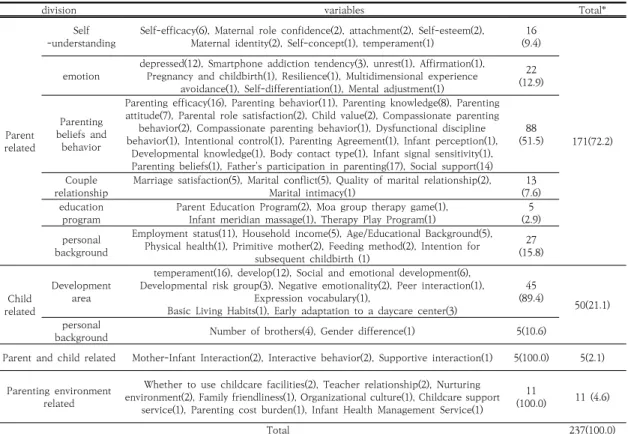
둘째, 연구주제별 분석기준은 관련 문헌 및 선행연구 [7][44]를 기초로 하여 부모 관련, 자녀 관련, 부모-자녀 관련, 환경 관련으로 구분하였고, 연구주제별로 구체적인 세부변인을 재분석하였다.
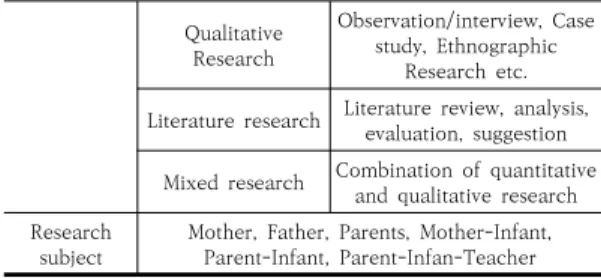
셋째, 연구유형별 분석기준은 선행연구[45][46] 에 기 초하여 양적연구, 질적연구, 문헌연구, 혼합연구로 분류 하였다. 양적연구는 관찰법, 검사법, 질문지법으로 분류 하였고, 질적연구는 심층면담, 사례연구, 실행연구로 분 류하였다. 문헌고찰, 분석, 평가, 제안 등의 연구는 문헌 연구로 분류하였고, 양적연구와 질적연구를 병행한 경우 는 혼합연구로 분류하였다.
넷째, 연구대상별 분석기준은 선행연구[7][8]에 기초 하여 어머니, 아버지, 부모, 어머니-영아, 부모-영아, 어 머니-영아-교사의 6개 범주로 분류하였다. 구체적인 분 석기준은 Table 2와 같다.
Qualitative Research
Observation/interview, Case study, Ethnographic
Research etc.
Literature research Literature review, analysis, evaluation, suggestion Mixed research Combination of quantitative
and qualitative research Research
subject Mother, Father, Parents, Mother-Infant, Parent-Infant, Parent-Infan-Teacher
division 1998 -2004 2005
-2009 2010 -2014 2015
-2019 Total Early
Childhood Education·Edu
care
- 3
(3.7) 19
(23.2) 20
(24.4) 42
(51.2) Child Studies
·Human Development
(1.2)1 4
(4.9) 4
(4.9) 6
(7.3) 15
(18.3) Homeology·
Family studies - 1
(1.4) 5
(5.7) 5
(7.1) 11
(13.4) Medical·
Health Science
(1.2) 1 6
(7.3) 1
(1.2) 1
(1.2) 9
(11.0)
Etc - - 3
(3.7) 2
(2.4) 5
(6.1)
Total 2
(2.4) 14
(17.1) 32
(39.0) 34
(41.5) 82
(100.0) Table 3. Analysis of research trends by research period
n(%)
2.2 분석절차 및 분석방법
자료분석은 유아교육 전문가인 연구자 2인이 수립한 분석기준을 충분히 숙지한 후 실시하였다. 연구자 2인이 각자 분석대상 논문을 읽고, 연구시기, 연구주제, 연구유 형, 연구대상별 분석기준에 따라 1차 분류하였다. 1차 분 류 결과, 판단 보류한 논문의 내용을 재확인 하였으며, 연 구자 간 의견 차이가 있는 경우 협의를 통해 재검토 및 재분류의 과정을 거쳤다. 최종 분류한 자료는 EXCEL 2019 프로그램을 사용하여 연구문제별로 빈도와 백분율 을 산출하였다.
3. 연구결과 및 해석
3.1 영아기 부모 양육스트레스 관련 연구의 시기별 동향 분석
영아기 부모 양육스트레스 관련 연구의 시기별 동향을 살펴본 결과는 Table 3과 같다. 이를 구체적으로 살펴보 면, 1998-2004년 2편(2.4%), 2005-2009년 14편 (17.1%), 2010-2014년 32편(39.0%), 2015-2019년 34
편(41.5%)으로 시기별로 지속적인 증가세를 보이고 있음 을 알 수 있다. 학술지 분야별로 살펴보면 유아교육·보육 학 42편(51.2%)으로 가장 많았고, 아동학·발달심리학 15 편(18.3%), 가정학·가족학 11편(13.4%), 의료·보건학 9 편(11.0%), 기타 5편(6.1%)의 순으로 게재되어, 유아교 육·보육학 분야를 중심으로 연구가 이루어졌음을 알 수 있다.
3.2 영아기 부모 양육스트레스 관련 연구의 주제별 동향 분석
영아기 부모 양육스트레스 관련 연구의 주제별 동향 을 분석한 결과는 Table 4와 같다. 이를 구체적으로 살 펴보면, 부모 관련 주제가 81편(61.4%)으로 가장 많았 고, 자녀 관련 36편(27.3%), 양육환경 관련 10편(7.6%), 부모-자녀 관련 5편(3.8%)의 순으로 나타났다.
division 1998
-2004 2005
-2009 2010
-2014 2015
-2019 Total*
Parent
related 2
(2.5) 14
(17.3) 31
(38.3) 34
(42.0) 81
(61.4) Child related 1
(2.8) 6
(16.7) 17
(47.2) 12
(33.3) 36
(27.3) Parent and
child related - 2
(40.0) 1
(20.0) 2
(40.0) 5
(3.8) Parenting
environment
related - 2
(20.0) 6
(60.0) 2
(20.0) 10
(7.6)
Total* 3
(1.0) 24
(8.9) 55
(47.5) 50
(42.6) 132 (100)
*Calculation of overlapping research topics
Table 4. Analysis of research trends by research topics n(%)
영아기 부모 양육스트레스 관련 연구의 주제별 세부 변인을 분석한 결과는 Table 5와 같다. 이를 구체적으로 살펴보면, 부모 관련 변인 171개(72.2%), 자녀 관련 변 인 50개(21.1%), 양육환경 관련 변인 11개(4.6%), 부모- 자녀 관련 변인 5개(2.1%)의 순으로 나타났다. 부모의 양 육신념 및 행동 변인에 대한 연구가 가장 많이 이루어졌 음을 알 수 있다. 자녀 관련 변인으로는 영아의 발달 45 개(89.4%), 개인배경 5개(10.6%)로 영아의 발달 변인에 대한 연구가 주로 이루어졌음을 알 수 있다. 그 외 양육 환경 관련 변인 11개(4.6%)와 부모-자녀 관련 변인 5개 (2.1%)로 상대적으로 연구가 덜 이루어졌음을 알 수 있 다.
division variables Total*
Parent related
-understandingSelf Self-efficacy(6), Maternal role confidence(2), attachment(2), Self-esteem(2),
Maternal identity(2), Self-concept(1), temperament(1) 16 (9.4)
171(72.2) emotion depressed(12), Smartphone addiction tendency(3), unrest(1), Affirmation(1),
Pregnancy and childbirth(1), Resilience(1), Multidimensional experience avoidance(1), Self-differentiation(1), Mental adjustment(1)
(12.9)22
Parenting beliefs and
behavior
Parenting efficacy(16), Parenting behavior(11), Parenting knowledge(8), Parenting attitude(7), Parental role satisfaction(2), Child value(2), Compassionate parenting
behavior(2), Compassionate parenting behavior(1), Dysfunctional discipline behavior(1), Intentional control(1), Parenting Agreement(1), Infant perception(1),
Developmental knowledge(1), Body contact type(1), Infant signal sensitivity(1), Parenting beliefs(1), Father's participation in parenting(17), Social support(14)
(51.5)88
Couple
relationship Marriage satisfaction(5), Marital conflict(5), Quality of marital relationship(2),
Marital intimacy(1) 13
(7.6) education
program Parent Education Program(2), Moa group therapy game(1),
Infant meridian massage(1), Therapy Play Program(1) 5 (2.9) personal
background
Employment status(11), Household income(5), Age/Educational Background(5), Physical health(1), Primitive mother(2), Feeding method(2), Intention for
subsequent childbirth (1)
(15.8)27
Child related
Development area
temperament(16), develop(12), Social and emotional development(6), Developmental risk group(3), Negative emotionality(2), Peer interaction(1),
Expression vocabulary(1),
Basic Living Habits(1), Early adaptation to a daycare center(3)
(89.4)45 50(21.1)
personal
background Number of brothers(4), Gender difference(1) 5(10.6)
Parent and child related Mother-Infant Interaction(2), Interactive behavior(2), Supportive interaction(1) 5(100.0) 5(2.1) Parenting environment
related
Whether to use childcare facilities(2), Teacher relationship(2), Nurturing environment(2), Family friendliness(1), Organizational culture(1), Childcare support
service(1), Parenting cost burden(1), Infant Health Management Service(1)
(100.0)11 11 (4.6)
Total 237(100.0)
*Overlap calculation of detailed variables of research
Table 5. Analysis of detailed variables by research topics n(%)
3.3 영아기 부모 양육스트레스 관련 연구의 유형별 동향 분석
division 1998 -2004 2005-
2009 2010
-2014 2015 -2019 Total Quan
tati ve ti rese char
Obser -vation
method - 1
(1.2) - - 1
(1.2) (98.8)81 Test
method - 1
(1.2) - 1
(1.2) 2
(2.4) Questi
-onn-aire
(2.4)2 12
(14.6) 31
(37.8) 33 (40.2) 78
(95.1) Qualitative
Research - - - - 0
(0.0) Literature
research - - - - 0
(0.0) Mixed
research - - 1
(1.2) - 1
(1.2)
Total 2
(2.4) 14
(17.1) 32
(39.0) 34
(41.5) 82
(100.0) Table 6. Research trend analysis by research type
n(%)
영아기 부모 양육스트레스 관련 연구의 유형별 동향을 분석한 결과는 Table 6과 같다. 이를 구체적으로 살펴보 면, 양적연구 81편(98.8%), 혼합연구 1편(1.2%), 질적연 구와 문헌연구 각각 0편(0.0%)으로 나타나, 주로 양적연 구가 이루어졌음을 알 수 있다. 양적연구의 세부동향에서 는 질문지법 78편(95.1%), 검사법 2편(2.4%), 관찰법 1 편(1.2%)의 순으로 나타났다.
3.4 영아기 부모 양육스트레스 관련 연구의 대상별 동향 분석
영아기 부모 양육스트레스 관련 연구의 대상별 동향을 분석한 결과는 Table 7과 같다. 이를 구체적으로 살펴보 면, 어머니 44편(53.7%), 어머니-영아 27편(32.9%), 부 모 7편(8.5%), 부모-영아-교사 2편(2.4%), 아버지, 부모- 영아는 각 1편(1.2%)의 순으로 나타나, 어머니를 대상으 로 한 연구가 가장 많이 이루어졌음을 알 수 있다.
division 1998
-2004 2005
-2009 2010
-2014 2015
-2019 Total
Mother 2
(2.4) 8
(9.8) 14
(17.1) 20
(24.4) 44
(53.7) Mother
-Infant - 6
(7.3) 12
(14.6) 9
(11.0) 27
(32.9)
Parents - - 4
(4.9) 3
(3.7) 7
(8.5)
Father - - - 1
(1.2) 1
(1.2) Parent
-Infant - - - 1
(1.2) 1
(1.2) Parent
-Infant
-Teacher - - 2
(2.4) - 2
(2.4)
Total 2
(2.4) 14
(17.1) 32
(39.0) 34
(41.5) 82
(100.0) Table 7. Research trend analysis by research subject
n(%)
4. 논의 및 결론
본 연구의 목적은 영아기 부모 양육스트레스 관련 연 구동향을 분석하는 것이다. 연구결과를 기반으로 하여 논 의해 보면 다음과 같다.
첫째, 영아기 부모 양육스트레스 관련 연구의 시기별 동향을 분석한 결과, 1998년부터 2019년까지 시기별로 지속적인 증가세를 보였다. 이는 부모 양육스트레스에 대 한 연구가 지속적으로 증가하고 있다는 선행연구[7][8]의 내용을 지지하는 결과이다. 1999년 영유아보육법의 제 정으로 어린 자녀 양육에 대한 사회적 관심이 모아지면 서, 점차적으로 부모 양육스트레스를 이해하기 위한 노력 이 학문 분야에도 반영된 결과로 해석할 수 있다. 최근 일부 지자체에서는 저출산 대응 우수사례로 ‘육아 스트레 스 해소 프로젝트’가 선정된 바 있다[42]. 저출산 문제를 해결하기 위한 측면에서도 영아기 부모 양육스트레스 경 감 또는 완화에 대한 연구가 지속적으로 필요하다. 학술 지 분야별로 게재된 연구논문의 편수를 분석한 결과, 유 아교육·보육학, 아동학·발달심리학, 가정학·가족학, 의료·
보건학 분야 순으로 게재되어 유아교육·보육학 관련 분 야 중심으로 연구가 이루어지고 있음을 알 수 있다.
둘째, 영아기 부모 양육스트레스 관련 연구의 주제별 동향을 분석한 결과, 부모 관련, 자녀 관련, 양육환경 관 련, 부모-자녀 관련 순으로 나타나 부모 관련 주제가 가 장 많이 이루어졌음을 알 수 있다. 부모 양육스트레스가 독립 또는 종속변인으로 선정되어 부모 관련 주제 연구
가 더 많이 이루어진 것은 영유아기 자녀를 둔 부모의 양 육스트레스의 학위논문 연구동향을 분석한 연구결과[8]
와 유사하다. 유아 또는 초등학생에 비해 성인의 절대적 인 보호가 필요하여 부모의 신체적, 정신적 에너지를 집 중적으로 쏟게 되는 영아기 부모의 양육스트레스에 대한 관심은 지속되어야 한다.
주제에 따른 세부 변인별 연구동향을 분석한 결과에 대해 논의하면 다음과 같다. 먼저, 부모 관련 변인은 부모 의 양육신념 및 행동 변인, 개인배경, 정서, 자기이해, 부 부관계, 프로그램의 순서로 나타났으며, 부모의 양육신념 및 행동 변인 연구가 가장 많이 이루어졌다. 부모의 신념 은 다른 어떤 요소들보다 영아에게 지속적인 영향을 미 치며[47], 부모가 지닌 가치나 신념 같은 인지적 특성은 외형적 행동보다 자녀의 발달에 더 중요한 변인이다 [48][49]. 이러한 측면에서 양육에 대한 부모의 신념은 양육스트레스를 설명하는 중요한 변인이 될 수 있으며 양육신념 및 양육행동 관련 연구는 지속될 필요가 있다.
부모의 개인 배경 관련 변인 연구는 취업 여부, 가구소 득, 연령, 학력 등에 따른 양육스트레스의 정도를 밝히는 것이었다. 개인 배경 중 취업여부와 관련된 연구가 가장 많이 이루어졌으나 연구결과에 있어서 미 취업모에 비해 취업모의 양육스트레스가 일관되게 높게 나타나지는 않 았다. 이는 부모의 취업 여부와 무관하게 영아기의 독특 한 발달 특성으로 인한, 영아기 자녀를 둔 부모의 양육스 트레스에 대한 관심이 집중되어야 함을 보여주고 있다.
부모의 정서 및 자기 이해 관련 변인은 우울, 불안, 스 마트폰 중독 경향 등의 부모의 정서 상태와 부모의 자아 존중감, 자아개념, 자기 효능감 등이었다. 부모의 정서와 관련해서 산전, 산후 우울에 대한 연구, 6개월 자녀를 양 육하는 부모 스트레스 연구 등 12개월 미만 영아를 둔 부모 양육스트레스 연구가 여러 편이다. 임신과 출산을 포함하여 영아의 월령에 따른 양육스트레스의 정도 차이 가 발생할 수 있다. 특히 12개월 미만, 즉 0세 영아의 자 녀를 둔 부모의 양육스트레스에 대한 질적인 탐색연구도 이루어질 필요가 있다. 부모의 자기 이해와 관련하여, 자 녀를 둔 부모이기 이전에 한 인간으로서의 자신에 대한 이해와 자아존중감, 자아효능감을 지원·강화하기 위한 프 로그램 개발 연구도 필요하다.
부부관계 관련 변인 연구는 결혼만족도, 부부갈등 등 의 연구였다. 자녀양육에 대한 스트레스는 부부관계, 부 부갈등과도 무관하지 않으므로 부부지원 프로그램 개발 등 이에 대한 연구가 확대되어야 한다. 프로그램 개발연 구는 부모관련 변인 연구에서 상대적으로 가장 빈도가
낮게 나타났다. 양육신념 및 행동과 관련된 특정 변인에 초점을 둔 체계적인 자녀양육 프로그램 개발 및 적용연 구도 활발히 이루어질 필요가 있다.
다음으로, 자녀 관련 변인 연구는 영아의 발달, 영아의 개인배경 관련이 주를 이루었다. 부모의 양육스트레스가 영아의 발달에 미치는 영향이 크므로[32][33][34][35] 두 요인 간의 관계를 완충할 수 있는 조절 또는 매개할 수 있는 변인 탐색연구가 활발히 이루어져야 할 것이다. 한 편, 양육스트레스에 영향을 주는 자녀 변인으로는 형제 수, 자녀의 성과 관련된 연구가 이루어졌다. 자녀의 기질 유형에 따라서도 양육 스트레스의 정도가 다를 수 있다.
생의 초기 기질에 대한 이해가 선행되어야 영아의 성장 과 발달을 지원할 수 있다[1]는 점에서 영아 기질 유형에 적합한 양육태도(fitness of good)와 관련된 부모교육 및 프로그램을 계획하고 효과를 검증하는 연구도 가능하 리라 본다.
양육환경 관련 변인 연구는 사회적 환경 및 가족친화 제도 등이 이루어졌다. 육아정책 및 제도와 관련하여 영 아를 둔 맞벌이 부모의 경우 육아휴직제를 권장이 아닌 의무사항으로 전환하는 등의 정책개선 제안 연구도 필요 하다. 현재, 남성 근로자가 육아휴직을 실제 사용하는 비 율은 낮은 편이며[50], 아직도 육아는 여성이 전담해야 한다는 인식이 만연하다. 정책 및 제도개선 연구는 특히 12개월 미만 영아의 경우, 기관이 아닌 가정 내 양육을 필수로 하는 사회적 분위기를 조성하는 데 기여할 것이 며, 아버지의 육아참여를 유도하여 어머니의 양육스트레 스를 경감하기 위한 효율적인 방안이 될 것이다.
마지막으로, 부모-자녀 관련 변인 연구는 집단 치료놀 이와 모-아 상호작용, 양육 스트레스에 따른 상호작용 연 구 등이었다. 세상과 관계 맺기가 시작되는 영아기 상호 작용의 가치 및 중요성에도 불구하고 관련 연구가 부족 하다. 영아기 상호작용은 부모 양육스트레스를 넘어서 영 아에게 중요한 발달적 의미를 갖는다는 점[51]을 고려하 여, 양육스트레스 정도와 부모-영아 상호작용 간의 관련 성 연구도 활발히 진행될 필요가 있다.
셋째, 영아기 부모 양육스트레스 관련 연구의 유형별 동향을 분석한 결과, 양적연구가 주를 이루었고, 질적연 구와 문헌연구는 이루어지지 않았다. 영아기 부모 양육스 트레스를 심도 있고 다양한 관점에서 탐색하기 위해서는 자연적인 맥락과 과정을 중요시하는 특성을 지닌 질적연 구[45]도 필요하다. 특히 어린 영아를 양육하는 취업모 또는 맞벌이 부부의 양육의 어려움 및 개별적인 요구를 분석해 보는 심층면담 연구를 시행해 볼 필요가 있다. 양
적연구의 세부 동향에서는 질문지법을 활용한 연구가 가 장 많았다. 이는 선행연구[7][8]와 유사한 결과로, 향후 양육스트레스 관련 환경 및 부모 양육태도 관찰연구, 부 모 스트레스 심리검사 등의 연구도 가능할 것이다.
넷째, 영아기 부모 양육스트레스 관련 연구의 대상별 동향을 분석한 결과, 어머니를 대상으로 한 연구가 가장 많았고, 어머니-영아, 부모, 부모-영아-교사의 순으로 나 타났다. 양육스트레스와 관련하여 어머니를 대상으로 한 연구가 주를 이루고 있었다. 이러한 결과는 연구 분야에 서도 아직까지 자녀 양육에 대한 주 역할이 어머니라는 인식을 반영한 것으로 보인다. 아버지를 대상으로 한 연 구도 보다 적극적으로 이루어져야 하며, 아버지 양육참여 및 지원을 위한 연구들도 필요하다.
이상의 연구결과와 논의를 기초로 하여 연구의 의의 및 후속 연구를 위한 제언을 하면 다음과 같다. 첫째, 인 생의 시작점인 영아기에 질 높은 돌봄을 제공받는 것은 이후의 삶에 절대적인 영향력을 발휘한다. 본 연구는 신 체적, 육체적 부담이 가중되는 3세 미만의 영아기 자녀를 둔 부모 양육 스트레스에 보다 집중할 수 있는 계기를 제 공하였다는 점에서도 의의가 있다. 둘째, 본 연구의 결과 에서 나타난 바와 같이, 영아기 자녀를 둔 부모 양육스트 레스와 관련하여 양적연구의 방법을 활용한 연구가 주를 이루었다. 사례연구 및 심층면담 등의 질적연구의 방법을 활용하여 자녀양육과 관련된 생생한 부모의 소리를 듣는 노력이 필요하다. 이는 심각한 사회현상으로 대두된 저출 산 문제와 관련하여 한 가닥 문제해결의 실마리를 찾을 수 있는 여지를 보여줄 것이다.
References
[1] M. H. Lee, S. J. Kwak, Y. H. Jeon, Infant development.
Seoul, Korea: Jungminsa, 2014.
[2] P. Fonagy, G. Gergely, E. L. Jurist & M. Target, Affect regulation, mentalization, and the development of the self. New York: Other Press, 2002.
[3] K. E. Grossmann, K. Grossmann, E. Waters, (Eds.) Attachment from infancy to adulthood: The major longitudinal studies. New York: Guilford Press. 2005.
[4] K. J. Ryu, Y. J. Kim, Y. S. Song. “Parenting Stress with her Infant and Social Support and Parenting Efficacy of Mother who commit their infants to child-care facilities”, Journal of Korean Child Care and Education, Vol.5, No.1, pp.1-23, 2009.
[5] E. S. Pyun, The Mother's Role of Recognition and the Parenting Stress of Working Mothers Having Children
from Infants to Preschoolers. Master’s thesis, The Graduate School of Ewha Womans University, Seoul, Korea, 2004.
[6] https://www.yna.co.kr/view/AKR20200827167000004?
input=1195m
[7] M. K. Kwon, “Analysis of Trends in Research on Parenting Stresses”, Journal of Korean Home Management Association, Vol.29, No.2, pp.39-50, 2011.
[8] H. W. Choi, “A Research Trend in Parenting Stress of Mothers with Young Children- Centering Around Thesis, Master’s thesis”, The Graduate School of Changwon National University, Changwon, Korea, 2019.
[9] https://ko.dict.naver.com/#/entry/koko/4e31e6449242 4f0db27dfecf983052c8
[10] H. K. Kang, B. H. Cho, “Dual-Career Parenting Stress:
Effects of Mother's Values and Support systems”, Korean Journal of Child Studies, Vol.20, NO.2, pp.41-55, 1999.
[11] R. R. Abidin. “The determinants of parenting behavior”, The Journal of Clinical Child Psychology, Vol.21, No.4, pp.401-412. 1992.
[12] S. M. Sohn, “Parenting Stress and Related Factors of Employed and Non-employed Mothers with Infants”, Journal of Future Early Childhood Education, Vol.19, No.1, pp.331-357, 2012.
[13] S. H. Lim, S. H. Park, “The Relation of Mothers`
Socioeconomic Status and a Number of Children to Parenting Stress and Toddler`s Expressive Vocabulary”, Journal of Future Early Childhood Education, Vol.17, No.1, pp.251-278, 2010.
[14] S. W. Seo, D. K. Lee, “The effects of mother’s marital satisfaction, couple conflict and infants’ emotional temperament on mother’s parenting stress”, Korean Journal of Early Childhood Education, Vol.33, No.5, pp.279-298, 2013.
DOI: https://doi.org/10.18023/kjece.2013.33.5.012 [15] S. J, Yoon, “The Mediating and Moderating Effects of
Marital Satisfaction and Marital Conflict between Infant Temperament and Parenting Stress”, Korea Journal of Child Care and Education, Vol.95, pp.173-193, 2015.
[16] K. H. Ok, M. H. Kim, “The Effects of Parenting Beliefs and Supportive Interaction on Mothers' Parenting Stress of Young Children: Variations by Income Level and Employment Status”, Korean Journal of Childcare and Education, Vol.11, No.1. pp.461-480, 2015.
[17] J. H. Lee, H. S. Han, Ran. Choi, “Mediated effect of positive emotion between parenting self-efficacy and parenting stress of mothers”, Korean Journal of Children's Media, Vol.11, No.2, pp.89-109, 2012.
[18] J. S. Lee, Y. S. Bang, J. O. Bae, “Longitudinal Relationship between the Child-rearing Knowledge, and Self-esteem and Parenting Stress of Mothers with
a Child in Infancy”, Journal of Parent Education, Vol.8, No.3, pp.27-41, 2016.
[19] S. J. Eom, “The Effect of Infant Temperament and Social Support on Maternal Parenting Stress : The Mediating Effects of Paternal Parenting Involvement”, Korea Journal of Child Care and Education, Vol.87, pp.29-49, 2014.
[20] S. R. Kim, H. J. Choi, K. H. Jeong, Y. L. Lee, “The Effect of Mothers` Parenting Stress on Children`s Social and Emotional Behaviors according to Fathers`
Participation in Child Care: a Structural Equation Modeling Analysis”, Early Childhood Education Research & Review, Vol.16, No.1, pp.551-575, 2012.
[21] Y. K. Moon, H. S. Min, “The Effects of Infant's Temperament, Development, Mother's Parenting Stress and Social Support on Infant Mother's Self-efficacy”, Korean journal of human ecology, Vol.21, No.1, pp.59-70, 2012.
[22] S. Y. Park, K. H. Rubin. “Toddler's Gender and Temperament by Maternal Stress as Predictors of Mothers' Parenting Behavior”, Korean journal of child studies,Vol.29 No.2, pp.109-124, 2008.
[23] Y. G. Kim, Y. S. Song. “The Relation Between a Mother's Parenting Knowledge about Infants and Parental Stress”, The Journal of Korea Open Association for Early Childhood Education, Vol.12, No.4, pp.475-493, 2007.
[24] S. M. Sohn, “The Effect of Parenting Efficacy and Family and Social Support on Parenting Stress of Mothers with Infants”, Journal of Early Childhood Education & Educare Welfare, Vol.14, No.4, pp.267-288, 2010.
[25] S. L. Kim, C. H. Park. “Effects of Fathers' Parental Involvement and Social Support on Parenting Stress of Mothers with Infants: Mothers' Psychological Characteristics as a Mediator”, The Korean Society of Community Living Science, Vol.27, No.3, pp.451-464, 2016.
[26] M. J. Lee, “Teacher-Mother Communication and Early Childhood Educational Institution Satisfaction Rate and Parenting Stress”, Master’s thesis, The Graduate School of Catholic University, Seoul, Korea, 2006.
[27] Y. J. Jeong, G. Y. Jeon, “Effects of Family-friendly Policies and Work-family Culture on Parenting Stress and Parenting Efficacy of Working Parents with Infants”, Journal of family relations, Vol.19, No.1, pp.3-28, 2014.
[28] S. J. Sin, M. J. Joung. “Effects of Stress, Social Support and Efficacy on Mothers' Parenting Behaviors”, Korean journal of child studies, Vol.19, No.1, pp.27-42, 1998.
[29] A. S. Weitlauf, A. C. Vehorn, J. L. Taylor, Z. E. Warren.
“Relationship satisfaction, parenting stress, and depression in mothers of children with autism”, Autism: The International Journal of Research and
Practice, Vol.18, pp.194-198, 2012.
DOI: https://doi.org/10.1177/1362361312458039 [30] H. J. Kim, A comparative study on the stress of child
rearing between a working mother in a dual-income family and a full-time housekeeper. Master’s thesis, The Graduate School of Social Development Chung-Ang University, Seoul, Korea, 2005.
[31] S. H. Kim, J. Y. Park, “The relationship between personality and child rearing stress of employed mothers”, Journal of the Korean Home Economics Association, Vol.50, No.8, pp.41-52, 2012.
DOI: http://dx.doi.org/10.6115/khea.2012.50.8.041 [32] S. R. Kim, H. J. Cho, K. H. Jung, Y. L. Lee, “The Effect
of Mothers` Parenting Stress on Children`s Social and Emotional Behaviors according to Fathers`
Participation in Child Care : a Structural Equation Modeling Analysis”, Early Childhood Education Research & Review, Vol.16, No.1, pp.551-575, 2012.
[33] H. O. Kim, “The comparison of effects of mother`s depression and parenting stress on the emotional development of infants between poor families and non-poor families”, The Journal of Child Education, Vol.4, No.1, pp.119-139, 2015.
[34] J. Y. Chae, Y. J. Park, “Parenting Stress and Maternal Attachment to Infants: Examining the Moderating Effect of Social Support”, The Korean Journal of Human Development, Vol.23, No.4, pp.101-120, 2016.
DOI: http://dx.doi.org/10.15284/kjhd.2016.23.4.101 [35] K. N. Lee, H. S. Yoo, “The effect of temperament,
parenting stress, and teacher-infant relationship on infants’ early adjustment to child care centers”, The Journal of Eco Early Childhood Education, Vol.13, No.3, pp.165-190, 2014.
[36] H. J. Choi, S. L. Kim, “The Effects of Mother’s Parenting Style and Parenting Stress on Their Children’s Basic Living Habits and Play-social Development”, Korean Journal of Human Ecology, Vol.27, No.2, pp.79-90, 2018.
DOI : http://dx.doi.org/10.5934/kjhe.2018.27.2.79 [37] J. Y. Kwon, M. R. Chung, S. K. Park, “Variables
Related to the Parenting Stress of Mothers with Toddlers”, Early Childhood Education Research &
Review, Vol.16, No.3, pp.143-160, 2012.
[38] S. R. Park, B. R. No, H. J. Park, S. H. Yi, “The Structural Relationship among Trajectories of Mothers’
Parenting Stress, Children’s Temperament and Internalizing Problems: Multiple Group Analysis according to Employment Status of Mothers”, Korean Journal of Child Care and Education Policy, Vol.9, No.1, pp.119-148, 2015.
[39] K. Renee, A. M. Barbara, “Parenting infants: Relative importance of parenting characteristics and related behaviors”, Journal of Early Childhood and Infant Psychology, Vol 8, pp.21-34, 2012.
[40] H. J. Park, H. J. Kim, S. H. Ahn, “The Relationship
between Toddlers’ Negative Emotionality and Mothers’
Parenting Stress: The Moderating Roles of Husbands’
Cooperation, Mother-Teacher Partnership, and Other Social Support”, Journal of Korean Home Management Association, Vol.34, No.6, pp.55-67, 2016.
DOI : http://dx.doi.org/10.7466/JKHMA.2016.34.6.55 [41] G. A. Lee, H. J. Jeon, E. K. Goh, “Influencing Factors
on Parenting Stress of Mothers with Infant Children”, Journal of Learner-Centered Curriculum and Instruction, Vol.19, No.17, pp.1211-1227, 2019.
[42] http://news.kmib.co.kr/article/view.asp?arcid=001479 4955 (accessed Dec. 23, 2020)
[43] I. H. Lee, J. E. Park, S. Y. Choi, “The Structural Relationship of Parenting Stress, Parenting Efficacy, and Parenting Behavior of Mothers with Infants”, The Journal of Child Education, Vol.19, No.4, pp.81-91, 2010.
[44] H. S. Cho, W. Y. Jeong, M. Y. Gil, “An Analysis of Domestic Research Trends in Kindergarten Teacher’s Job Stress”, Early Childhood Education Research &
Review, Vol.22, No.6, pp.121-146, 2018.
DOI : http://dx.doi.org/10.32349/ECERR.2018.12.22.6.121 [45] J. H. S, H. S. Choi, “An analysis of trends in studies
relating to early childhood happiness”, Korean Journal of Early Childhood Education, Vol.34, No.1, pp.5-28, 2014.
DOI: http://dx.doi.org/10.18023/kjece.2014.34.1.001 [46] Y. J. Park, Analytic Review of Research Trends of
dual-earner families who have young children - Using graduate theses, Master’s thesis, The Graduate School of Education Chung-Ang University, Seoul, Korea, 2017.
[47] I. E. Sigel, A conceptul analysis of beliefs. In I. E.
Sigel(Ed), Parental Beliefs Systems: The Psychological consequences for children, pp.345-371, Hillsdale, NJ:
Erlbaum. 1985.
[48] J. J. Goodnow, “Parent’s idea, actions and feelings”, Child Development, Vol.59, No.2, pp.286-320, 1988.
DOI: https://doi.org/10.2307/1130312
[49] S. A. Miller, “Parent’s beliefs about Children’s cognitive Development”, Child Development, Vol.59, No.2 pp.259-285, 1988.
DOI: https://doi.org/10.2307/1130311
[50] https://www.hankookilbo.com/News/Read/A20201222 14130003744 (accessed Dec. 23, 2020)
[51] C. O. Park, S. Y. Gu, O. I. Lee, Theory and Practice of Infant-Teacher Interaction. Seoul, Korea: Jungminsa, 2010.
이 진 희(Jin-Hee Lee) [종신회원]
• 1999년 2월 : 이화여자대학교 교 육대학원 (교육학 석사)
• 2011년 2월 : 전남대학교 대학원 (교육학박사)
• 2005년 3월 ∼ 2014년 2월 : 제 주국제대학교 보육교사교육원 교
• 2014년 3월 ∼ 현재 : 제주국제대학교 유아교육과 조교수수
<관심분야>
영아발달과 교육, 유아사회교육, 교사 재교육
임 진 형(Jin-Hyung Lim) [종신회원]
• 2000년 2월 : 이화여자대학교 대 학원 (문학석사)
• 2011년 2월 : 이화여자대학교 대 학원 (문학박사)
• 2000년 3월 ~ 2004년 2월 : 우송 정보대학교 유아교육과 겸임교수
• 2004년 3월 ~ 현재 : 제주한라대 학교 유아교육과 부교수
<관심분야>
영유아발달, 유아교사교육, 유아교육 교수법