KAUTPT Vol. 10 No. 4 2003.
Effects of Graded Exercise-Induced Fatigue Joint Position Perception
Choi Jong-duk, M.Sc., P.T.
on the Knee
Dept. of Rehabilitation Therapy, The Graduate School, Yonsei University Yi Chung-hwi, Ph.D., P.T.
Dept. of Physical Therapy, College of Health Science, Yonsei University Institute of Health Science, Y onsei University
국문요약
운동강도에 따라 유발된 근피로가 슬관절 위치감각 인지에 마치는 영향
최종덕
연세대학교 대학원 재활학과
이충휘
연세대학교 보건과학대학 물리치료학과 및 보건과학연구소
본 연구의 목적은 운동강도(최대근수축의 10, 30, 50, 70%) 에 따라 유발되는 국소적인 근피로가 슬관절의 위치감각 인지에 미치는 영향을 연구함으로써 근력강화의 운동치료 적 효과와 운동학습과 관련된 효과를 동시에 만족시키는 최적의 운동강도를 제시하는 것이었다. 대상자는 건강한 성인여자 40명이었다. 청각을 통한 위치감각 정보를 제공하 는 장치와 원판 각도계가 부착된 등속성 Cybex를 사용하였다. 근피로의 상태를 확인하 기 위해서 근전도를 이용하여 주파수 스펙트럼 분석을 실시하였다. 청각되먹임이 주어진 각도와 대상자에 의해 재생되어진 각도의 오차값들과 큰피로의 변화를 비교하기 위해 일요인 분산분석을 이용하였다. 오차값들의 평균은 50% 의 군에서 가장 작았으며 근피로 또한 70% 의 군에서만 크게 생성되었다 따라서 최대 근 수축력의 50% 가 운동치료 시 가장 효과적인 운동강도임을 알 수 있었다.
핵심단어: 근전도; 근피로; 운동강도; 운동학습; 주파수 분석.
Corresponding author: Choi Jong-duk fhoidew(àJ)zanmail. net
KAUTPT Vo1. 10 No. 4 2003.
Intrc>duction
Exercise-induced musc1e fatigue has been identified as an important factor in determining the exercise type, method, and intensity in a therapeutic exercise prescription. Musc1e fatigue has an espe- cially strong negative effect on position sense, as shown by numerous studies on the interaction between musc1e fatigue and position sense (Barrack, 1989; Barrett,
1991; Barrett et al, 1991; Gooch and Randle, 1993; Laabs, 1973; Marks, 1994;
Marks and Quinney, 1993; Skinner et al, 1984).
In frequency spectrum analysis, myo- electric signals in time domain are con- verted to frequency domain to confirm musc1e fatigue (Basmajian and De Luca,
1985). Electrophysiological fmdings for musc1e fatigue frequency shift toward lower frequency component (Broman et al, 1985). Therefore, the change of mean frequency was used to evaluate localized musc1e fatigue (Hary et al, 1982; Stulen and De Luca, 1982).
Skinner et al (1986) and Mark (1994) introduced a notion that continuous high-intensity exercise may decrease per- ceptual threshold sensitivity of la afferent fibers in the musc1e spindle. Consequently, this decreased perceptual sensitivity may impair one’s ability to accurately perceive and process the joint position and motion sense information that are the essential sensory feedback for the execution of co- ordinated movement. In contrast, Marks
and Quinney (Broman et al, 1985) showed no significant effect of ex- ercise-induced musc1e fatigue on the knee joint movement accuracy. The discrepancy in the previous studies may be due to the fact that exercise-induced fatigue level of the tested musc1e may have varied or not been controlled. Furthermore, previous
studies have failed to yield the optimal amount of exercise intensity to not com- promise joint perception sensitivity and yet to maximize motor performance and accuracy.
The purposes of this study were to in- vestigate the relationship between ex- ercise-induced muscle fatigue at the four different isokinetic exercise level (10%, 30%, 50% and 70% of maximal force) and position sense change and then to find the optimal exercise level for motor leaming and therapeutic strengthening ex- ercise effectiveness without impairment of poslhon sense.
Methods
Subjects
F아ty healthy women, aged from 19 to 27 (mean age 20.9 years), participated in this study voluntarily. The subjects were randomly assigned to four ex- perimental groups of 10 subjects each.
Subjects with neurological or muscu- loskeletal disease or cardiovascular disease were exc1uded. Al1 subjects signed in- formed consent forms approved by the University Institutional Review Board pri-
KAUTPT Vol. 10 No. 4 2003
or to their participation. by the pilot study. Auditory feedback was
Instruments
The Cybex 1) was used to induce mus- cle fatigue of the knee joint. To provide an auditory feedback for knee joint angle appreciation, a bell was attached to Cybex. To measure the knee joint range of motion, a disk goniometer was also attached. VCR recording devices (Camcorder) were installed at equal dis- tance and angle from the Cybex to meas- ure instantaneous knee joint angle. Muscle fatigue was measured by using the power spectrum method of the MPI00 System2).
For data acquisition and analysis, Acknowledge 3.7.1 software3) was used in this study.
Procedures
Mean 01 Absolute Errors Comparison in Relation 10 Exercise lntensity
A subject was randomly assigned to
fo따 experiment groups with different ex- ercise intensities. Maxirnal muscle strength was measured at 60 RPM to detennine individual exercise intensity. A subject was asked to perfonn isokinetic pedaling at 150 RPM with the number of pedaling repetitions (30 times) that was detennined
1) Lumex Inc. FITRON Cycle-Ergometer,
NY, U.S.A.
2) Biopack System Inc. Santa Barbara, CA,
U.S.A.
3) Biopack System Inc. Santa Barbara, CA,
U.S.A
provided by a bell sound when the left pedal passed 1350 so that the subject would be aware of the knee joint position. After a resting period of 5 sec- onds, subjects in four different groups were asked to perfonn isokinetic pedaling without auditory feedback at different ex- ercise intensities. Instructions to remember the specific angle (1350) while perfonning isokinetic pedaling were given to the subjects. After the resting period of 5 seconds, the pedal was located passively by the experimenter to another angle that was selected by a subject. There were three angle patterns that could be selected by the subjects. The subject were then asked to relocate the left pedal actively at 1350• This procedure was repeated 5 times, and this procedure was recorded by a camcorder to measure the mean of ab-
s이ute errors (between specific angle, 135。
and reproduced angle)
Mean Frequel1C)’ of Muscles in Relation
10 Exercise lntensity
Four surface EMG electrodes on the skin over the following muscles: medial rectus femoris, lateral rectus femoris, vastus lateralis, . and vastus medialis (Johnson et al, 1973; Zippo, 1982). The reference electrodes were attached to the sacrurn of the lowes back. Induced mus- cle fatigue was measured at the initial 10 seconds and at the final 10 seconds by the frequency spectrum while the subjects perfonned isokinetic pedaling for 50 sec-
KAUTPT Vol. 10 No. 4 2003.
onds at different exercÌse intensities. The adjusted gain was lk. The sampling rate for data collection was 1024. A band-pass filter with a low frequency cutoff of 20 Hz and a high frequency cutoff of 450 Hz, and 60 Hz notch filter were used.
Staûsûcal analysis
Statistical an때ses were performed us- ing SPSS 9.0 for Windows. A one-way ANOV A and a Least Significant Difference (LSD) post hoc test were used with significance level of .05.
Results
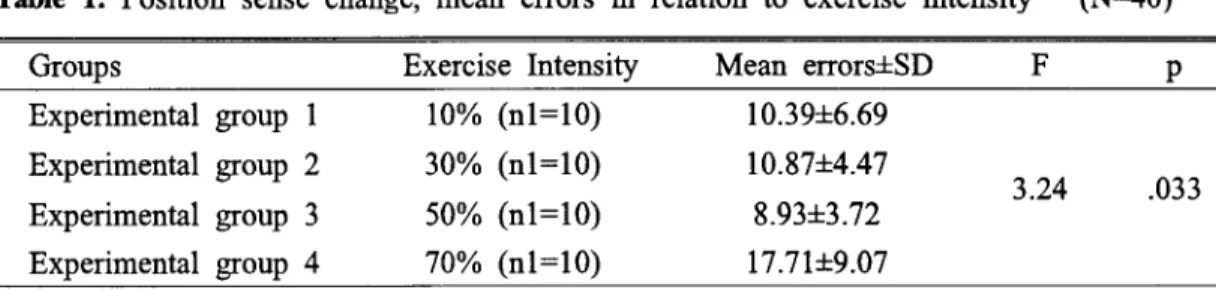
Table 1 shows the mean errors in four different exercise intensities. The highest mean error was obseπed at group 4.
There was a significant difference in the mean error in experiment groups (p=.033).
Significant differences were found be- tween group 4 and group 1, 2 and 3, but significant differences were not found be- tween groups 1, 2 and 3.
Table 2 shows the mean frequency change of different muscles in four differ- ent groups (Figure 1). Group 4 demon- strated the highest frequency change rate.
Table 1. Position sense change, mean errors in relation to exercise intensity (N=40)
Groups Exercise Intensity Mean errors土SD F
Experimental group 1 10% (nl=10) 10 .3 9土6.69
Experimental group 2 30% (nl=10) 10.87土4 .47
3.24 Experimental group 3 50% (nl=10) 8.93土3.72
Experimental group 4 70% (nl=10) 17.71 土9.07
Table 2. Mean frequency change of different muscles in four different groups
MRF LRF VM VL
FC (%) F FC (%) F FC (%) F FC (%)
Group 1 3.38 3.73 1.92 4.65
Group 2 .63* .99 2.33 4.99
11.05** 12.40** 6.11 **
Group 3 .83* .94* 2.97 2.38
Group 4 .39* -4.55* -4.15* -5.54*
MRF; Med. Rectus Femoris, LRF; Lat. Rectus Femoris, VM; Vastus Medialis VL; Vastus Lateralis, FC; Frequency change
**p<.05, *It shows the tendency of muscle fatigue.
p
.033
F
13.56**
These values were taken from during the initial 10 seconds and the final 10 seconds in four exercise groups of differing intensity.
KAUTPT Vol. 10 No. 4 2003
Significant differences were found be- tween group 4 and groups 1, 2 and 3, and significant differences were not found among groups 1, 2 and 3. The decreases of the four muscles mean frequency rep- resent the tendency of muscle fatigue.
This result can be explained by the fact that muscle fatigue in group 1, 2, and 3 was not prominent compared with that in group 4.
Discussion
Position sense is reduced because the sensitivity of Ia afferent fiber of muscle spindle is decreased and the ability to carry information to the central nervous
7.5
~
Q) 。。
g
.되
§ o 효 : -2
훌 -5
system is decreased (Marks, 1994). In ex- periment 1, we expected a progressively increasing mean of absolute errors with increasing exercise intensity based on findings of Marks (Marks, 1994).
However, muscle fatigue in groups 1, 2, and 3 was not prominent compared with that in group 4. Therefore, position sense errors in groups 1, 2, and 3 were not evident. Improved position sense in group 3 can be explained by two possible mechanism. First, w없m-up effect could have favorably influenced position sense.
Second, recognition and integration of po- sition sense by auditory feedback in an identical environment could surpass the localized muscle fatigue (Marks and
따 W
g m
口--觸
-7.
Figure 1. Mean frequency change in four different groups.
These values were taken from during the initial 10 seconds and the fmal 10 seconds in four exercise groups of differing intensity.
Decreases of group 4 show the tendency of muscle fatigue
si때ificantly.
KAUTPT Vol. 10 No. 4 2003.
Quinney, 1993). Clark et al (1979) sug- gested that the recognized level of joint position provided initially during the ex- periment improves as the subjects adapt to their environment during the experiment.
This supports the findings of Whitley and Elliott (1968) that improved learning was achieved by minimizing the effect of fa- tigue and maximizing the performance of repetitive muscle contraction for position sense recognition. In experiment 2, the prominent quadriceps muscle fatigue in group 4 is closely related to increased position sense error (Table 1, 2). The mean frequency was shifted toward low frequency domain as localized muscle fa- tigue occurred (Arendt-Nielsen et al, 1989; Basmajian, 1979; Basmajian and De Luca, 1985; Hary et al, 1982; Mills, 1982; Sadoyama et al, 1988). Muscle is composed of slow twitch fiber and fast twitch fiber. Slow twitch fiber in low fre- quency domain has characteristics such as resistance to fatigue. Therefore, with a sustained muscle contraction, fatigue re- sistant slow twitch muscle fiber continues to activate, and fatiguing fast twitch mus- cle fiber stops activating resulting in the mean frequency shifting to a lower fre- quency domain (Mills, 1982).
Conclusion
This study investigated the effect of muscle fatigue induced by different ex- erclse intensihes on posltlOn sense m healthy subjects. In experiment 1, position
sense error in group 4 increased remark- ably compared with groups 1, 2, and 3.
In experiment 2, prominent muscle fatigue was observed in group 4 compared with groups 1, 2, and 3.
We suggest that 50% of the maximal muscle contraction is the most effective exercise intensity without interfering ther- apeutic exercise eff농ctiveness based on strength or motor learning effect which is completed by perceiving joint position.
Further studies involving patients with im- paired knee position sense are needed to precisely investigate the relationship be- tween muscle fatigue and position sense and to apply this finding in clinical settmgs.
References
Arendt-Nielsen L, Mills KR, Forster A.
Changes in muscle fiber conduction velocity, mean power frequency, and mean EMG voltage during prolonged submaximal contractions. Muscle N하ve.
1989; 12:493-497.
Barrett DS. Proprioception and function after anterior cruciate reconstruction. J Bone Joint Surg Br. 1991;73(5):833- 837.
Barrett DS, Cobb AG, Bentley G. Joint proprioception in normal, osteo- arthritic and replaced knees. J Bone Joint Surg Br. 1991;73(1):53-56.
Barrack RL, Skinner HB, Buckley SL.
Proprioception in the anterior cruciate deficient knee. Am J Sports Med.
KAUTPT Vo1. 10 No. 4 2003
1989;17:1-6.
Basmajian N. Muscles Alive: Their Functions Revealed by Electro-
myo맑aphy. 4th ed. Williams &
Wilkins Co., 1979:79-113.
Basmajian N , De Luca CJ. Muscles Alive: Their Functions Revealed by Electro-myography. 5th ed. Wi11iams
& Wilkins Co., 1985;201-220.
Broman H, Bilotto G, De Luca CJ.
Myoelectric signal conduction velocity and spectral parameters: Influence of force and time. J Appl Physio1.
1985;58: 1428-1437.
Clark FJ, Horch KW, Bach SM, et a1.
Contribution of cutaneous and joint receptors to static knee position sense in man. J Neurophysio1. 1979;42:
877-888.
Eberstein A, Beattie B. Simultaneous measurement of muscle conduction velocity and EMG power spectrum changes during fatigue. MuscIe Nerve. 1985;8:768-773.
Gooch JL, Randle J. Force perception be- fore and after maximal voluntary contraction. Percept Mot Skills.
1993;76:399-402.
Hary D, Belman MJ, Propst J, et a1. A statistical analysis of the spectral mo- ments used in EMG tests of endurance. J Appl Physio1. 1982;53:
779-783.
Johnson MA, Polgar J, Weightman PD, et a1. Data on the distribution of fiber typers in thirty-six human muscles. J Neurol Sci. 1973;18:111-129.
Laabs GJ. Retention characteristics of dif- ferent reproduction cues in motor short
t많mshort-term memory. J Exp Psycho1.
1973; 1 00: 168-177.
Marks R. Effect of exercise-induced fatigue on position s하lSe of the knee. Australian
Physioth앙apy. 1994;40:175-181.
Marks R, Quinney HA. Effect of fatigu- ing maximal isolänetic quadriceps contractions on ability to estimate knee-position. Percept Mot Skills.
1993;77:1195-1152.
Mi11s KR. Power spectral analysis of electromyogram and compound mus- cle action potential during muscIe fa- tigue and recovery. J Physio1. 1982;
326:401-409.
Sadoyama T, Masuda T, Miyata H, et a1.
Fibre conduction velocity and fibre composition in human vastus lateralis.
Eur J Appl Physio1. 1988;57:767-771.
Skinner HB, Barrack RL, Cook SD, et a1.
Joint position sense in total knee arthroplasty. J Orthop Res. 1984; 1:
276-282.
Skinner HB, Wyatt MP, Hodgdon JA, et a1. Effect of fatigue on joint position sense of the knee. J Orthop Res.
1986;4: 112-118.
Stulen FB, De Luca CJ. Muscle fatigue monitor: A noninvasive device for observing localized muscular fatigue.
IEEE Trans Biomed Eng. 1982;29:
760-768.
Whitley JD, Elliott GM. Leaming compo- nent in repetitive maximal static contractions. Percep Mot Skills. 1968;
KAUTPT Vol. 10 No. 4 2003.
27:1195-1150.
Zippo P. Recommedations for the stand- ardization of lead positions in surface electromyography. Eur J Appl Physiol.
1982;50:40-54.