RESEARCH ARTICLE
Received: May 26, 2021, Revised: June 9, 2021, Accepted: June 15, 2021 eISSN 2233-7679
†Correspondence to: Min-Seock Seo, https://orcid.org/0000-0001-7203-7775
Department of Conservative Dentistry, Wonkang University Daejeon Dental Hospital, 77 Dunsan-ro, Seo-gu, Daejeon 35233, Korea Tel: +82-42-366-1143, Fax: +82-42-366-1115, E-mail: [email protected]
Copyright © The Korean Society of Dental Hygiene Science.
Relationship between Obesity and Dental Caries in Some University Students: A Pilot Study
Soo-Jeong Hwang
1, Hoon Kim
2, and Min-Seock Seo
3,†1Graduate School of Medical Science and Engineering, Korea Advanced Institute of Science and Technology (KAIST), Daejeon 34141, 2Department of Dentistry, Konyang University Hospital, Daejeon 35365, 3Department of Conservative Dentistry, Wonkang University Daejeon Dental Hospital, Daejeon 35233, Korea
Background: Obesity and dental caries have common risk factors such as food intake, eating habits, and lifestyle. Nevertheless, there has been no consensus on the significant association between obesity and dental caries, and additional studies are needed.
We investigated the relationship between obesity and dental caries in some college students in this pilot study.
Methods: Forty-two obese college students (body mass index [BMI]≥25) registered at a University Obesity Clinic and 19 normal students (18.5≤BMI<25) were recruited. Oral examinations were conducted, and anthropometric data and blood samples were collected. The blood concentrations of low-density lipoprotein (LDL), high-density lipoprotein, and triglyceride were also measured. After controlling for dental plaque index, a univariate analysis of dental caries indicators related to obesity was performed; partial correlation analysis was also conducted. A nonparametric test was used for the analysis of gender-related trends due to the limited number of participants.
Results: The obese group had significantly fewer missing teeth (p=0.014), missing surfaces (p=0.035), filled surfaces (p=0.038), and decayed-missing-filled surfaces (p=0.020) than the normal group. There was no difference between the males in the normal and obese groups. The females in the obese group had significantly fewer missing teeth (p=0.003), missing surfaces (p=0.003), and decayed-missing-filled surfaces (p=0.046). Partial correlation analysis showed a weak negative correlation (r=−0.256) between the blood LDL concentration and decayed-missing-filled teeth. The other obesity and dental caries indicators were not correlated.
Conclusion:The blood cholesterol concentration had a negative relationship with dental caries, and there were fewer cases of dental caries in the obese group in this study. However, it is important to clarify the relationship between obesity and dental caries through a dietary survey or additional investigations considering other confounding factors.
Key Words: Cholesterol, Dental caries, Obesity
Introduction
With a growing obese population, obesity has become problem worldwide, and Korea is no exception. Obesity refers to a state of excessive accumulation of fat tissues in the body, and it is accompanied by metabolic disorders and is known to be multifactorial, including genetic, social environmental, and economic factors1). Factors that cause obesity include diet, lack of exercise, genetic factors, and environmental factors. In particular, social and economic
growth led to changes in lifestyle and diet with increased intake of carbohydrates and high-calorie foods, which has become a major cause of obesity.
Among carbohydrates, sugars are associated with dental caries, a serious oral disease, and considering that there are various antecedents to dental caries in addition to cariogenic bacteria, such as food consumption, diet, and lifestyle factors, obesity and dental caries have a lot in common.
While the relationship between obesity and dental caries has been studied extensively, there is yet a consensus on
the significant association and correlation between obesity and dental caries. This is presumably due to the fact that obesity is also related to high-fat diet, and the relationship between fat and dental caries should also be investigated.
Many Korean studies have been conducted on the relationship between obesity and dental caries, but the results are inconsistent. Some studies reported that the two are not significantly associated2,3), and some studies reported that obese individuals have a higher dental caries rate4,5). There are also studies reporting that dental caries decreases with increasing obesity6,7). Therefore, more research data needs to be accumulated to address this inconsistency in study findings pertaining to obesity and dental caries. In this background, we planned a study to investigate the relationship between obesity and dental caries, and here, we report the results of a pilot study conducted on students of a single university to analyze obesity-related test and oral assessment results.
Materials and Methods
1. Subjects
Obese students who were registered at the Obesity Clinic at Konyang University and normal-weight students who served as exercise and lifestyle modification assistants at the same clinic who provided an informed consent were enrolled in this study. The sample consisted of 21 male and 40 female students. With reference to the Asia-Pacific obesity criteria using body mass index (BMI), there were 42 obese students (BMI≥25) and 19 normal-weight students (18.5≤BMI<25).
2. Oral examination
Oral examination and recording were performed by one dentist and one dental hygiene student as an assistant, and dental caries was determined based on the World Health Organizaiton criteria. Because dental caries is influenced by oral environment management, a stain was applied before examining the dental plaque, and the Sum of Turesky modification of the Quigley–Hein index was used as a plaque index. To assess the reliability of the dental caries examination, a second examination was performed four weeks later, and the equivalent form reliability was
0.889 for decayed teeth, 0.921 for missing teeth, 0.967 for filled teeth, 0.757 for decayed surfaces, 0.957 for missing surfaces, and 0.967 for filled surfaces.
3. Obesity data collection
Participants’ anthropometric data were analyzed using InBody (InBody Co., Seoul, Korea), a body composition analyzer with direct segmental multi-frequency-bioelectric impedance analysis. Blood samples were collected and sent to the Konyang University Hospital laboratory for low-density lipoprotein (LDL), high-density lipoprotein (HDL), and triglyceride measurements.
4. Statistical analysis
The p-value of the one-sample Kolmogorov–Smirnov test was 0.343 for decayed-missing-filled teeth (DMFT), 0.124 for decayed-missing-filled surfaces (DMFS), 0.433 for LDL, 0.189 for HDL, 0.703 for triglyceride, and 0.882 for BMI, based on which parametric testing was deemed appropriate. Thus, the differences between the normal-weight and obesity groups were analyzed using independent t-tests. As oral environmental management had to be controlled for in order to examine the relationship between obesity and dental caries, one-way ANOVA was performed to analyze dental caries according to obesity after controlling for the dental plaque index. The relationship between obesity and dental caries was analyzed using partial correlation analysis after controlling for the dental plaque index. For sex-specific analyses, the Mann–Whitney U-test, a non-parametric test, was used due to the smaller samples. Statistical analyses were performed using the IBM SPSS 20.0 (IBM Corp., Armonk, NY, USA) software.
Results
1. Difference of dental caries index according to obesity
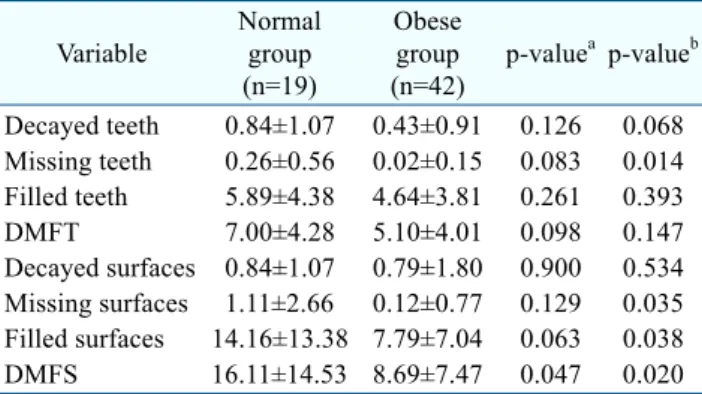
Regarding the differences in dental caries indices between the normal and obese groups, the obese group showed lower indices overall, but none of the differences were significant with the exception of DMFS (Table 1).
DMFS was 16.11±14.53 in the normal group and 8.69±
7.47 in the obese group, showing a significant difference
Table 1. Difference of Dental Caries Status according to Obesity Variable
Normal group (n=19)
Obese group (n=42)
p-valuea p-valueb
Decayed teeth 0.84±1.07 0.43±0.91 0.126 0.068 Missing teeth 0.26±0.56 0.02±0.15 0.083 0.014 Filled teeth 5.89±4.38 4.64±3.81 0.261 0.393
DMFT 7.00±4.28 5.10±4.01 0.098 0.147
Decayed surfaces 0.84±1.07 0.79±1.80 0.900 0.534 Missing surfaces 1.11±2.66 0.12±0.77 0.129 0.035 Filled surfaces 14.16±13.38 7.79±7.04 0.063 0.038
DMFS 16.11±14.53 8.69±7.47 0.047 0.020
Values are presented as mean±standard deviation.
DMFT: decayed-missing-filled teeth, DMFS: decayed-missing- filled surfaces.
aIndependent t-test.
bUnivariate analysis adjusting dental plaque index.
Table 3. Difference of Dental Caries Status according to Obesity in Female
Variable Normal group (n=13)
Obese group
(n=27) p-valuea Decayed teeth 0.0 (0.0∼2.0) 0.0 (0.0∼3.0) 0.167 Missing teeth 0.0 (0.0∼2.0) 0.0 (0.0∼0.0) 0.003 Filled teeth 7.0 (0.0∼11.0) 5.0 (0.0∼12.0) 0.113 DMFT 8.0 (0.0∼12.0) 6.0 (0.0∼12.0) 0.071 Decayed surfaces 0.0 (0.0∼2.0) 0.0 (0.0∼5.0) 0.167 Missing surfaces 0.0 (0.0∼10.0) 0.0 (0.0∼0.0) 0.003 Filled surfaces 14.0 (0.0∼47.0) 7.0 (0.0∼31.0) 0.072 DMFS 15.0 (0.0∼57.0) 7.0 (0.0∼32.0) 0.046 Values are presented as median (minimum∼maximum).
DMFT: decayed-missing-filled teeth, DMFS: decayed-missing- filled surfaces.
aMann–Whitney U-test.
Table 2. Difference of Dental Caries Status according to Obesity in Male
Variable Normal group (n=6)
Obese group
(n=15) p-valuea Decayed teeth 1.5 (0.0∼4.0) 0.0 (0.0∼4.0) 0.107 Missing teeth 0.0 (0.0∼0.0) 0.0 (0.0∼1.0) 0.527 Filled teeth 4.0 (0.0∼17.0) 5.0 (0.0∼14.0) 0.814 DMFT 6.0 (2.0∼17.0) 6.0 (0.0∼16.0) 0.784 Decayed surfaces 1.5 (0.0∼4.0) 0.0 (0.0∼9.0) 0.436 Missing surfaces 0.0 (0.0∼0.0) 0.0 (0.0∼5.0) 0.527 Filled surfaces 8.5 (0.0∼37.0) 8.0 (0.0∼19.0) 0.754 DMFS 10.5 (2.0∼37.0) 9.0 (0.0∼21.0) 0.755 Values are presented as median (minimum∼maximum).
DMFT: decayed-missing-filled teeth, DMFS: decayed-missing- filled surfaces.
aMann–Whitney U-test.
(p=0.047). The differences in the dental caries indices were analyzed after controlling for the dental plaque index, and the obese group showed significantly lower missing teeth, missing surface, filled surface, and DMFS compared to the normal group.
2. Difference of dental caries status according to obesity in male
In males, the differences in dental caries indices between the normal and obese groups were analyzed using a nonparametric test, and the results showed that there were no significant differences in any of the dental caries indices between the two groups (Table 2).
3. Difference of dental caries status according to obesity in female
In females, the differences in dental caries indices between the normal and obese groups were analyzed using a nonparametric test, and the results showed that there were significant differences in missing teeth, missing surface, and DMFS between the two groups, where the median DMFS was higher in the normal group (15.0) than in the obese group (7.0) (Table 3).
4. Partial correlation between obesity and dental caries
The relationship between obesity and dental caries was analyzed with partial correlation analysis after controlling for the dental plaque index (Table 4). There was no relationship between DMFT and DMFS with BMI, body fat mass, percentage body fat, waist hip ratio, amount of protein, mineral, body fat, and body water measured using a body composition analyzer. Regarding the blood samples, there was a weak negative correlation between LDL and DMFT (Table 5).
Discussion
In this study, some dental caries-related indices were significantly lower in the obese group than in the normal-weight group, with no significant differences in other indices, suggesting that obesity is either not related
Table 4. Partial Correlation between Obesity Related Index and Dental Caries Index Adjusting Dental Plaque Index
Variable DMFT BMI BFM PBF WHR Protein Mineral Body fat Body water
DMFT 1 0.016 0.019 0.060 0.094 −0.007 −0.005 0.022 0.026
DMFS 0.799* −0.023 0.124 0.157 0.033 −0.070 −0.067 0.061 −0.043
DMFT: decayed-missing-filled teeth, DMFS: decayed-missing-filled surfaces, BMI: body mass index, BFM: body fat mass, PBF:
percentage body fat, WHR: waist hip ratio.
*p<0.05.
Table 5. Partial Correlation between Cholesterol and Dental Caries Index Adjusting Dental Plaque Index
Variable DMFT LDL HDL Triglyceride
DMFT 1 −0.256* −0.080 −0.098
DMFS 0.820* −0.199 −0.006 −0.157
DMFT: decayed-missing-filled teeth, DMFS: decayed-missing-filled surfaces, LDL: low-density lipoprotein, HDL: high-density lipoprotein.
*p<0.05.
to dental caries or actually negatively correlated with dental caries. A review of 29 studies on obesity and dental caries in children and adolescents published between 1990 and 2020 found that the results on the relationship between obesity and dental caries are inconsistent. Thirteen out of these 29 studies (44.8%) reported an insignificant relationship between obesity and dental caries, while 16 (55.2%) reported a significant relationship between the two8). However, even among studies that reported significance, the prevalence of dental caries was higher in overweight and obese individuals in some studies5,9-13), lower in obese individuals in some studies14-16), and higher in the underweight group in some studies10,17).
To examine the relationship between obesity and dental caries, the inconsistent findings of epidemiological studies should be evaluated, and this requires a close examination of the diet that induces dental caries and that underlying obesity. In addition to excessive food intake, a high-fat diet can induce obesity18,19). While obese individuals show a higher total carbohydrate consumption than their normal- weight counterparts, their exposure to carbohydrates decreases if lifestyle factors are controlled for20). Lee et al.21) reported that total sugar consumption is not significantly correlated with body weight, BMI, and percent body fat.
Based on these results, we can speculate that obesity is more influenced by fat intake, as opposed to carbohydrate intake. Fats in diet are reported to help eliminate sugar,
and some fatty acids have antibacterial effects22). These results suggest that individuals with high fat-induced obesity would have a lower prevalence of dental caries.
In contrast, Kim et al.23) reported in their study on obese adults that the male obese group had a higher protein and carbohydrate consumption, while the female obese group had a higher intake of simple sugars compared to their normal-weight counterparts. Bang and Hyeon24) also reported that while there were no differences in men, obese women had a higher carbohydrate consumption than their normal-weight counterparts. Dental caries, which is closely related to carbohydrates, can be predicted by obesity induced by a high-carbohydrate diet. Although we did measure blood cholesterol concentrations in this study, we could not determine whether the diet pattern that induced obesity was a high-fat diet or high-carbohydrate diet. Hence, subsequent studies should specifically investigate the diets of the obese and normal-weight groups.
However, a review of studies that investigated the association between obesity and dental caries reported that the relationship cannot be described solely based on a single common risk factor or diet, and although all risk factors must be evaluated, it is not easy to evaluate them simultaneously, which results in contradictory and inconsistent results25). Modeer et al.26) included flow rate of whole saliva, chronic disease, drug therapy, and socioeconomic factors as confounders in identifying the relationship
between obesity and dental caries. Thus, various factors that can potentially influence the relationship must be reviewed for an accurate analysis of the association between obesity and dental caries.
Notes
Conflict of interest
No potential conflict of interest relevant to this article was reported.
Ethical approval
This study was approved by the Institutional Review Board of Konyang University Hospital (No. KYUH 13-89).
Author contributions
Conceptualization: Soo-Jeong Hwang and Min-Seock Seo. Data acquisition: Soo-Jeong Hwang. Statistical Analysis: Soo-Jeong Hwang, Hoon Kim, and Min-Seock Seo. Supervision: Soo-Jeong Hwang. Writing–original draft: Soo-Jeong Hwang, Hoon Kim, and Min-Seock Seo.
Writing–review & editing: Soo-Jeong Hwang, Hoon Kim, and Min-Seock Seo.
ORCID
Soo-Jeong Hwang, https://orcid.org/0000-0003-4725-1512 Hoon Kim, https://orcid.org/0000-0003-4952-1555 Min-Seock Seo, https://orcid.org/0000-0001-7203-7775
References
1. Han JH, Hwang JM: The relationship between BMI and health & oral health promotion behavior of high school. J Korean Soc Dent Hyg 10: 141-156, 2010.
2. Choi SS, Jung HS, Choi MS: Relationship between dental caries experience and obesity among elementary school of student`s in Gyeongsan. J Dent Hyg Sci 12: 429-436, 2012.
3. Lee JE, An SY, Song JH, Ra JY: Relationship between obesity and dental caries in primary teeth in Iksan city. J Korean Acad Pediatr Dent 43: 151-157, 2016.
https://doi.org/10.5933/JKAPD.2016.43.2.151
4. Lee SM, Kim SC: A study on the weight length index and dental caries of elementary school students. J Korean Soc
Dent Hyg 3: 25-43, 2003.
5. Jang JH: The relationship of diet habits, obesity and level of oral health among elementary school children. J Korean Soc Dent Hyg 8: 229-240, 2008.
6. Kim MJ, Shin DI, Yang HJ: The relationship between obesity and oral diseases of students at just an elementary school in Chungnam. Korean J Health Serv Manag 7: 95-105, 2013.
https://doi.org/10.12811/kshsm.2013.7.1.095
7. Lee SH: Relationship between obesity and dental caries. J Digit Converg 12: 633-641, 2014.
https://doi.org/10.14400/JDC.2014.12.12.633
8. Lee DI, Han JI, Seo SA, Lee MJ, Jeon DJ, Hwang SJ: Review about relationship between obesity and dental caries in children and adosescents. J Korean Dent Hyg Sci. [Preprint].
2021 [cited 2021 Jun 13]. Available from: https://jkdhs.
jams.or.kr/po/volisse/sjPubsArtiPopView.kci?soceId=INS0 00002383&artiId=SJ0000000851&sereId=SER000000002
&submCnt=3.
9. Park IS: A study on relationship between obesity and dental caries of young children in the province of Gangwon-do. J Dent Hyg Sci 12: 459-468, 2012.
10. Jang JH, Lee MS, Kim JG, Yang YM, Lee DW: Association between Body Mass Index and dental caries: based on the Korea National Health and Nutrition Examination Survey 2013-2015. J Korean Acad Pediatr Dent 46: 283-292, 2019.
https://doi.org/10.5933/JKAPD.2019.46.3.283
11. Bagherian A, Sadeghi M: Association between dental caries and age-specific body mass index in preschool children of an Iranian population. Indian J Dent Res 24: 66-70, 2013.
https://doi.org/10.4103/0970-9290.114956
12. Willershausen B, Haas G, Krummenauer F, Hohenfellner K:
Relationship between high weight and caries frequency in German elementary school children. Eur J Med Res 9:
400-404, 2004.
13. Sharma A, Hegde AM: Relationship between body mass index, caries experience and dietary preferences in children. J Clin Pediatr Dent 34: 49-52, 2009.
https://doi.org/10.17796/jcpd.34.1.17364206hqm0477h 14. Moon JS, Song BS: Dental caries according to obesity in the
elementary school students. J Korean Public Health Nurs 13:
59-69, 1999.
15. Lock NC, Susin C, Brusius CD, Maltz M, Alves LS: Obesity and dental caries among South Brazilian schoolchildren: a
2.5-year longitudinal study. Braz Oral Res 33: e056, 2019.
https://doi.org/10.1590/1807-3107bor-2019.vol33.0056 16. Kim JH, Lee KG: Correlation study of nutrient intake and
oral health status -based on the 5th primitive data of Korea National Health and Nutrition Examination Survey-. J Korea Acad-Ind Cooper Soc 15: 3051-3057, 2014.
https://doi.org/10.5762/KAIS.2014.15.5.3051
17. Kim SJ, Lim SH: The effect of weight length index and blood components on dental caries of preschool children. J Korean Soc Dent Hyg 4: 31-48, 2004.
18. Lee JS, Lee HO, Yim JE, Kim YS, Choue RW: Effects of medical nutrition therapy on changes of anthropometric measurements, dietary pattern and blood parameters in over weight or obese women. Korean J Nutr 38: 432-444, 2005.
19. Lee YN, Yim KS, Lee SK, Mo SM, Choi HM: Diet-ralated factors of overweight adolescent girls. Korean J Community Nutr 1: 354-365, 1996.
20. Han YR, Kwon SO, Lee SA: Distribution and exposure prevalence of carbohydrate-based food intake among obese Korean adults based on the Health Examinees (HEXA) study. Korean J Community Nutr 22: 159-170, 2017.
https://doi.org/10.5720/kjcn.2017.22.2.159
21. Lee YM, Bae YJ, Kim EY, et al.: Relationship between total sugar intake and obesity indices in female collegians. Korean
J Nutr 45: 57-63, 2012.
https://doi.org/10.4163/kjn.2012.45.1.57
22. Bowen WH: Food components and caries. Adv Dent Res 8:
215-220, 1994.
https://doi.org/10.1177/08959374940080021301
23. Kim MY, Lee SW, Shin ES, Park HS: Diet and eating behavior in obese patients. J Korean Acad Fam Med 15:
353-362, 1994.
24. Bang SY, Hyeon SS: Comparison of physical activity and dietary patterns according to the degree of obesity in Korean men and women Data from the Seventh Korea National Health and Nutrition Examination Survey VII-1(2016). J Digit Contents Soc 19: 1527-1534, 2018.
https://doi.org/10.9728/dcs.2018.19.8.1527
25. Alshihri AA, Rogers HJ, Alqahtani MA, Aldossary MS:
Association between dental caries and obesity in children and young people: a narrative review. Int J Dent 2019: 9105759, 2019.
https://doi.org/10.1155/2019/9105759
26. Modéer T, Blomberg CC, Wondimu B, Julihn A, Marcus C:
Association between obesity, flow rate of whole saliva, and dental caries in adolescents. Obesity (Silver Spring) 18:
2367-2373, 2010.
https://doi.org/10.1038/oby.2010.63