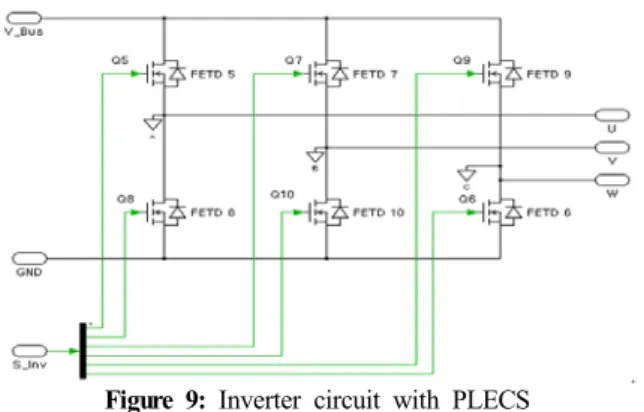
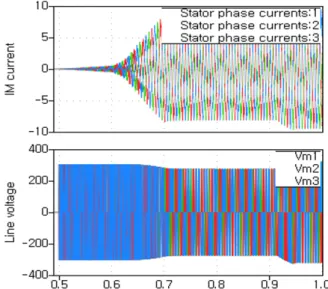
http://dx.doi.org/10.5916/jkosme.2016.40.5.429 Original Paper
This is an Open Access article distributed under the terms of the Creative Commons Attribution Non-Commercial License (http://creativecommons.org/licenses/by-nc/3.0), which permits
†Corresponding Author (ORCID: http://orcid.org/0000-0003-3627-476X): Division of Marine Engineering, Korea Maritime and Ocean University, 727, Taejong-ro, Yeongdo-gu, Busan 49112, Korea, E-mail: [email protected], Tel: 051-410-4283
1 Underwater Vehicle Research Center, Korea Maritime and Ocean University, E-mail: [email protected], Tel: 051-410-4866
Design of a hybrid power management system and cold start simulation in a fuel cell ship with PLECS
Jin-Seok Oh † ․ Young-Min Kang 1
(Received March 2, 2016; Revised April 25, 2016;Accepted May 18, 2016)
Abstract: Currently, many studies on green ships are under way. Fuel cell (FC) ships are of interest as future low-emission, fuel-efficient vessels. In this paper, a hybrid power management system for an FC ship was designed. The system consists of an FC, a battery, a unidirectional DC/DC converter, a bidirectional DC/DC converter, a filter, an inverter, and a propulsion component. To design the system, we analyze electric sources and converters, and create PLECS models of hybrid power man- agement system. Then, we check the cold start sequence and perform a simulation to understand the characteristics of the hy- brid power management system in an FC ship.
Keywords: Fuel cell ship, Hybrid power management system, Unidirectional DC/DC converter, Bidirectional DC/DC converter, PLECS
1. Introduction
Fuel cells (FCs) are emerging as an attractive power source because they are clean, highly efficient, and reliable [1]. However, the FC has several problems such as energy storage, response capability, cold starting, and voltage fluctu- ation at peak load. Therefore, hybrid power systems that have an auxiliary energy source, such as battery or an ul- tra-capacitor, for improving the dynamic response character- istics are used [2][3].
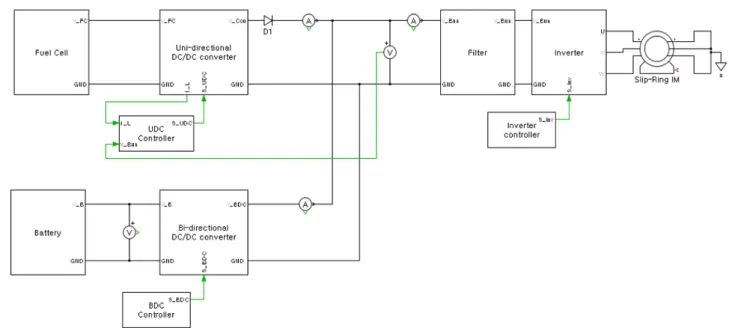
A hybrid power management system is composed of sev- eral parts: the generation, the auxiliary source, the con- verters, the filter, and the propulsion component. Figure 1 shows a diagram of the hybrid power management system for an FC ship.
Figure 1: Diagram of hybrid power management system for a fuel cell ship
The proposed hybrid power management system has two pow- er sources, namely, an FC as the generation source and a battery as the auxiliary source. The FC is connected to the unidirec- tional DC/DC converter (UDC) and the battery is connected to the bidirectional DC/DC converter (BDC). UDC and BDC are important for managing power in the system. By adjusting the duty ratio of the PWM signal, the UDC manages the FC power and the BDC manages the battery power in the system.
The ship load can change based on sea states. When the pulse load is generated, the FC supplies a much higher peak current than for a constant load. Once the peak load is generated, the FC is damaged by the sudden current fluctuation. This rapid change of the FC power can cause problems and reduce its lifetime. Therefore battery power is used to respond to sudden power surges.
If the system correctly changes the power output of the FC after using battery power, then the battery is charged using FC power.
Figure 2 shows the circuit of a hybrid power management
system for an FC ship. In peak power applications, the battery
is used in modules in which many components are connected in
series and parallel to obtain acceptable voltage and power
levels. The battery terminal voltage Vb determines the number
of battery modules, which must be connected in series to form
a module.
Figure 2: Circuit of hybrid power management system for a fuel cell ship
2. Modeling of electric sources 2.1 Fuel cell
A fuel cell is a power device that converts chemical energy into electrical energy. Therefore, the voltage and current values can be obtained using a thermodynamic equation. If the fuel cell is used for generating electrical energy, the actual voltage is lower than the theoretical voltage because of irreversible losses. The sources of voltage drop can be divided into three categories: active polar- ization, polarization resistance, and concentration polarization.
(1) where is the polarization voltage, is the ideal cell volt- age of the temperature and pressure function, is the active polarization, is the concentration polarization, is the polarization resistance, is the gas constant, is the chem- ical reaction temperature, is the Transfer coefficient, is the Faraday constant, is the output current in the FC, is the current loss, is the exchange current density, is the limit- ing current density, and is the internal resistance.
The expression shows that the actual cell voltage of the fuel cell is the value after subtraction of the total losses from elec- trical energy production. A fuel cell stack voltage can be ob- tained by multiplying the cell voltage by the number of cells.
Because the FC output is low-voltage and high-current, in most cases, a DC/DC converter is used in conjunction with it.
2.2 Battery
A battery is used to provide auxiliary power in the system. In the case of the initial start-up scenario or a rapid load increase,
the battery supplies power instead of the FC. Specifically, lead-acid batteries can be rapidly charged and discharged. The battery is connected in parallel with the high voltage DC bus via the BDC. The BDC operates in a suitable mode based on the condition of the battery and the FC.
The battery can be modeled using an internal resistance model.
(2)
where is the battery terminal voltage, is the open-circuit voltage, is the Polarization constant, is the battery SOC (state of charge), is the internal resistance, and is the out- put current.
Among the many available modeling methods, in this paper, the internal resistance model is used. The internal resistance model can estimate the SOC based on the power usage. A bat- tery pack voltage can be obtained by multiplying the number of battery cells connected in series.
3. Modeling of electric converters 3.1 Unidirectional DC/DC converter
The UDC is used to generate the constant DC grid voltage.
Because the fuel cell output voltage can be changed to the de-
sired output voltage, the fuel cell output voltage should be
made constant. The UDC is designed using phase-shift
full-bridge (PSFB) DC-DC converters, which are widely used in
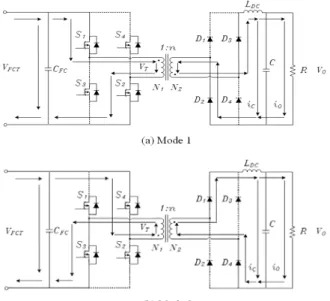
FC power systems. The UDC can operate in a constant voltage
condition or in a limited current condition. The operation of the
proposed UDC is simplified, i.e., all devices and component are
assumed to be ideal. Figure 3 shows the operation mode dia-
grams of the UDC.
Figure 3: Operation mode of full-bridge converter
Switches 1 and 2 turn on in mode 1. Switches 3 and 4 turns on in mode 2. The load current is the output in a specific direc- tion, regardless of the mode. The waveforms of each mode are shown in Figure 4.
Figure 4: Waveforms for each mode of full-bridge converter
Mode 1 is different from mode 2 in terms of its dynamic equations. The sign of the induced voltage in the transformerat primary side is different in mode 1 and mode 2. The fuel cell voltage input and UDC output voltage are repre- sented by a current applied to the converter internal coil, which is given by Equation (3) below [3].
(3)
where is the primary coil voltage and is the turn ratio.
The filter part in the converter consists of an inductor
and a capacitor . The inductor is used to filter the converter output current ripples. The output capacitor is used to filter the converter output voltage ripple; it can be obtained as follows:
≥
≥
(4)
where is the average inductor current at the boundary be- tween continuous and discontinuous condition, is the con- verter switching frequency in the UDC, is the duty cycle, and
is the voltage of the grid. To ensure that the converter is always working in continuous conduction mode, a minimum out- put current is required; it is equal to the average maximum boundary current, which occurs at D = 0.5. The voltage ripple should be less than 1% of the output voltage.
Figure 5: UDC circuit with PLECS
The UDC PLECS model is shown in Figure 5. The UDC controller receives feedback regarding the primary coil voltage
and the inductor current to maintain the output voltage at the target voltage. The UDC target voltage is 320 V DC; each element is designed to handle the voltage output well. The de- sign parameters of the UDC are given in Table 1.
Parameters Values Parameters Values
V out 320 [V] C 2 1 [uF]
V in 220 [V] C 4.7 [mF]
f UDC 50 [kHz] L M 80 [mH]
FET 0.01 [Ω] L DC 1 [mH]
D 0.01 [Ω] n 2
Table 1: Design parameters of UDC
3.2 Bidirectional DC/DC converter
The BDC allows power flows in both directions for energy
storage discharge and recharge. The BDC connects the DC bus
to the battery; it can transmit energy in both directions.
Additionally, the BDC boosts the battery voltage to the DC grid voltage. If the DC grid voltage is higher than the BDC output voltage, the BDC recharges the battery. The BDCha response must be fast enough to compensate for the slow dynamics of the FC during start-up or sudden load changes. Generally, a buck-boost converter is combined with the BDC, which can work in buck mode to charge the battery, and in boost mode to discharge the battery. Figure 6 shows the BDC circuit.
Figure 6: BDC circuit
To ensure that the inductor is designed for keeping the con- tinuous condition current mode, the inductor in the BDC is given in buck and boost converter mode, as shown below.
≥
≥
(5)
Additionally, the capacitor is chosen based on the delay time , the voltage drop ∆
, and the inverter maximum cur- rent as follows:
×