Introduction
Aging is a wide-spread trend in the world and South Korea is one of fastest aging countries in the world (OECD, 2008). Aging process is much faster in the rural areas in South Korea (SGIS, 2012) since younger people gathers in the urban area for better education and employment. The elderly in the rural area has somewhat different life style in South Korea: living in a private house without an elevator, doing manual labor in the field, staying in relatively
limited boundary with insufficient public trans- portation, and having difficulty in joining the leisure activities. The elderly in the urban areas are living more in apartment (condo or co-op style in a tall build- ing), more active in social activities with well-con- nected public transportation (subway is free for those who are older than 65), enjoying leisure activity more often, and usually not working.
Poor balance and falls in the elderly are common, incapacitating, and occasionally deadly event all over the world. About one third of those over 65 years of Corresponding author: Jang-whon Yoon [email protected]
Does the Wealthier Elderly Show Better Standing Balance?
Socioeconomical Factors and Standing Balance of the Elderly Living in Rural and Urban Areas in South Korea
Jang-whon Yoon, PhD, PT
Fundamental Science Laboratory, Dept. of Physical Therapy, College of Biohealth Sciences, Hoseo University
Abstract
1)Background: South Korea is one of fastest aging countries in the world. Poor balance and falls of the elderly are main health issues.
Objects: The goal of this study was to understand the association between the socioeconomical factors and the standing balance of elderly living in the rural and urban area.
Methods: One hundred sixty-six elderly participants who were older than 65 and were able to walk without an assistive device were recruited in the city of Gwangju and in the rural area of Jeonnam, South Korea. All participants performed the static and dynamic standing balance tests. Static standing balance was measured with chronometer in seconds while standing on one leg. Dynamic balance was tested with the timed up and go test (TUG), measured in seconds while getting up from a chair and walking 3 meters and back to sit. The static and dynamic standing balance was analyzed using analysis of variance and the Fisher’s Least Significant Difference post hoc test.
Results: Male participants from both areas had no difference in one leg standing and TUG. The female elderly living in rural area took shorter in TUG than females living in urban area. Age decreased the one leg standing time in both areas while did not affect the TUG significantly. As the monthly income increased, both of one leg standing and TUG increased in urban area, while the medium monthly income showed best performance (it was not statistically significant) in both of one leg standing and TUG in rural area.
Conclusion: Socioeconomical factors affects differently the standing balance of the elderly living in rural and urban South Korea. Female living alone in urban area with low monthly income demonstrated worst standing balance in this study.
Key Words: Elderly; Falls; One leg standing; Socioeconomical factors; Timed up and go test.
age fall at least once a year (Voermans et al, 2007).
Having more than two falls in a year was associated with all-cause mortality among people who are older than 65 (Bowling et al, 2013). The predisposing fac- tors for the falling included lower extremity impair- ment, decreased arm strength, decreased vision and hearing, and affective impairment (Tinetti et al, 1995).
These fall risk factors can be classified as either in- trinsic (e.g., lower extremity weakness, poor grip strength, balance disorders, functional and cognitive impairment, visual deficits) or extrinsic (e.g., four or more prescription medications, poor lighting, loose carpets, and lack of bathroom safety equipment) and probable synergism between factors needs to be con- sidered (AGS et al, 2001).
Poor balance and falls of the elderly is also the main health issues in South Korea. Injury-related deaths were the third most common cause of death followed by cancer and circulatory disease (Choi et al, 2014). Average number of falls in a year was 2.3 in 2014. 63.4% of fallen elderly sent to a hospital or clinic and 47.4% had residual complications (KOSIS, 2014). Females (30.5%) had far more falls experiences than male (17.5%) and the elderlies living in rural area (26.2%) experienced falls slightly more often than those in urban area (24.8%) of Korea (KOSIS, 2014). Since each fall has different characteristics (i.e., outdoor vs. indoor, type and severity of injury), more specific approach for each sub-group of elderly is important to prevent falls and reduce the fall re- lated injuries (Kim, 2016).
Assessing the static and dynamic standing balan- ces of the community-dwelling elderly is one of the fundamental data to screen the elderly at risk of falls and implementing a preventive intervention. A special panel on falls prevention (AGS et al, 2001) suggested a research agendum in their guideline, “Can fall-prone individuals be risk stratified in terms of whom will most benefit from assessment and interventions?”
Since the falling patterns and the influencing factors between the urban and rural areas can be different, it is worthy to compare the static and dynamic stand-
ing balance of the elderlies living in both areas. The goal of this study was to understand the association between the socioeconomical factors and the standing balance of elderly living in the Korean urban and rural areas. The hypothesis is that the elderly living in the rural area would show better standing balance than those living in the urban area in Korea because they have more physical work at the field.
Methods
Subjects
Inclusion criteria were to be older than 65 years, community-dwelling, and able to walk at home with- out an assistive device. Exclusion criteria were pres- ent of any activity-limiting pain, history of neuro- logical, cardiovascular, or vestibular disorders, recent (<3 months) surgery. The 221 elderly were contacted for this study and the 166 elderly participants living in the city of Gwangju (47 males and 42 females) or in the rural area of Jeonnam (31 males and 46 females), South Korea were participated in this study.
Procedures
Eleven physical therapy students were trained to assess the static and dynamic standing balances and visited all participants at their home. All participants completed a questionnaire asking their health, work, income, and residential status. Static and dynamic standing balances were measured in a randomized order after an instruction session with demonstration and a couple of familiarization trials. Static standing balance was measured with chronometer in seconds up to 30 seconds while standing on one leg (dominant side) as in the stork test (‘one leg standing’). Dynamic balance was tested using the timed up and go (TUG) test. The TUG test measures the time in sec- ond while a subject to stand up from an armchair, walk a distance of 3 m, turn around, walk back to the chair, and sit down on the chair.
In a study with community-living volunteers older
than age 60 (Vellas et al, 1997), less than 5 seconds of one-leg balance was the only significant independent predictor of injurious falls (relative risk: 2.13; 95%
confidence interval: 1.04, 4.34; p=.03). In addition, the one-leg stand was reliable (reliability coefficient=.69) and able to discriminate between functional levels (Curb et al, 2006). TUG test use as a short test of mobility skills for community-dwelling elderly was proposed (Podsiadlo and Richardson, 1991). A descrip- tive meta-analysis (Bohannon, 2006) reported the ref- erence TUG values of 8.1 (7.1∼9.0) seconds for 60 to 69 year olds, 9.2 (8.2∼10.2) seconds for 70 to 79 years, and 11.3 (10.0∼12.7) seconds for 80 to 99 years.
The TUG measurement showed high test-retest reli- ability [intra-correlation coefficient (2,1)=.97] in a pre- vious study (Steffen et al, 2002).
Statistical analysis
The characteristics of the urban and rural partic- ipants were compared using the chi-square test and Student’s t-test. The relationship between the living
area and gender, between the living area and age, and between the living area and income level on the one leg standing and TUG tests were analyzed with two-way analysis of variance. When interaction with the living area is significant, the effect of gender, age, and income level on the one leg standing and TUG tests was separately analyzed in the urban and rural areas. The level of significance was set at α=.05.
Results
All 166 participants were all older than 65 (mean:
72.1, standard deviation (SD): 6.1, range: 65∼88) and able to walk at home without an assistive device.
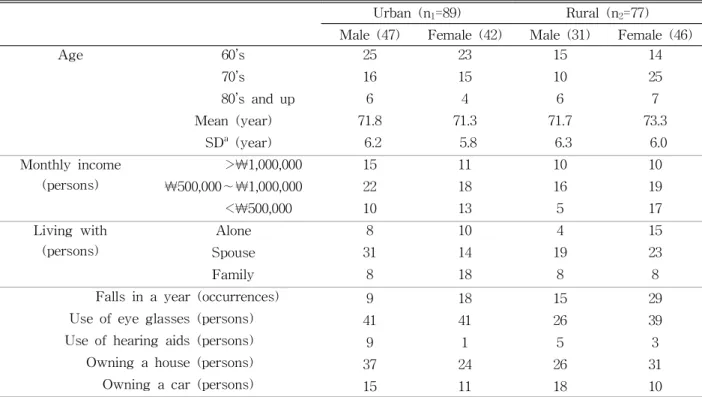
There was no significant difference (p=.135) in the age between the participants living in urban and ru- ral areas. The characteristics of participants are dis- played in Table 1. There was no significant differ- ence in ‘monthly income’, ‘living with’, ‘use of eye glasses’, ‘owing a house’, ‘owning a car’ and ‘use of
Urban (n1=89) Rural (n2=77) Male (47) Female (42) Male (31) Female (46)
Age 60’s 25 23 15 14
70’s 16 15 10 25
80’s and up 6 4 6 7
Mean (year) 71.8 71.3 71.7 73.3
SDa (year) 6.2 5.8 6.3 6.0
Monthly income (persons)
>₩1,000,000 15 11 10 10
₩500,000∼₩1,000,000 22 18 16 19
<₩500,000 10 13 5 17
Living with (persons)
Alone 8 10 4 15
Spouse 31 14 19 23
Family 8 18 8 8
Falls in a year (occurrences) 9 18 15 29
Use of eye glasses (persons) 41 41 26 39
Use of hearing aids (persons) 9 1 5 3
Owning a house (persons) 37 24 26 31
Owning a car (persons) 15 11 18 10
astandard deviation.
Table 1. Characteristics of participants (N=166)
hearing aids’ between urban and rural areas. Monthy income level was categorized based on the basic living expense per individual in the news (Jung, 2016). Falls in one year was greater in rural area (t=-2.279, p=.024).
Balance by gender
There was no significant difference (p=.503) in one leg standing between living areas (Figure 1). Male participants in both areas stand longer on one leg than the females but not statistically significantly (p=.057). The interaction between living area and gender on one leg standing was not significant (p=.981). There was a significant interaction in the TUG result between living area and gender (p=.040).
In males, there was no difference in TUG test be- tween urban and rural area (p=.412). However, the female elderly living in rural area took 3.9 second shorter for TUG test (p=.001).
Balance by age
Aging decreased the one leg (p<.001) standings in
both areas (Figure 2) while it did not significantly affect the TUG test (p=.071). There was no sig- nificant interaction between age and living area, which means that the effect of age was not different in both living areas.
Balance by income level
The one leg standing and the TUG test were im- proved as monthly income increased in urban area (Figure 3), but did not reach to statistical level of significance (p=.190 and p=.082). Highest monthly in- come group took second place in rural area, however, the effect of monthly income was not significant (for one leg standing p=.281 and for TUG p=.134).
Balance by other factors
Owning a house was related to greater one leg standing (p=.002) and shorter TUG (p=.002) in both areas. Owning a car did not affect either of one leg standing (p=.068) and TUG (p=.274) in both areas.
Living with somebody found to be better in both of Figure 1. The one leg standing and TUG tests by gender in urban and rural areas.
Figure 2. The one leg standing and TUG tests by age in 10 years in urban and rural areas.
the one leg standing (p=.001) and the TUG (p=.031) in both areas. Living alone showed worst result in both of the one leg standing and the TUG results in both areas. Elderly living with spouse and children had best static standing balance and the TUG score in both areas.
Elderly who are at danger
The elderly unable to perform the one-leg stand for at least 5 seconds is considered at increased risk for injurious fall (Steffen TM et al, 2002). In this study, participants whose one leg standing was less than 5 seconds were more frequent in female and in rural area (Table 2). Aging increased the frequency in rural area but not in urban area. Monthly income
did not affect the frequency in urban area while the participants in middle income (₩500,000∼₩1,000,000) did better in one leg standing in rural area. In both areas, more than half of participants who live alone could not able to sustain the one leg standing more than 5 seconds.
In this study, participants whose TUG test was more than 12 seconds (Bischoff et al, 2003) were more frequent in female and in urban area (Table 3).
Aging increased the frequency in rural area but not in urban area. Monthly income did not affect much the frequency in urban area while the participants in middle income (₩500,000∼₩1,000,000) had increased in TUG test longer than 12 seconds in rural area. In Figure 3. The one leg standing and TUG tests by monthly income in urban and rural areas.
Urban (n1=89)
Rural (n2=77)
Gender Male 26% 48%
Female 38% 50%
Age 60’s 29% 38%
70’s 35% 49%
80’s and up 30% 77%
Monthly income
>₩1,000,000 27% 60%
₩500,000∼₩1,000,000 33% 29%
<₩500,000 35% 73%
Living with (person)
Alone 51% 63%
Spouse 22% 43%
Family 35% 50%
Table 2. The percentage of participants whose one leg standing was less than 5 seconds (N=166)
Urban (n1=89)
Rural (n2=77)
Gender Male 62% 48%
Female 81% 54%
Age 60’s 69% 45%
70’s 74% 49%
80’s and up 70% 77%
Monthly income
<₩1,000,000 62% 40%
₩500,000∼₩1,000,000 75% 66%
>₩500,000 74% 41%
Living with (person)
Alone 78% 53%
Spouse 67% 55%
Family 73% 44%
Table 3. The percentage of participants whose timed up and go test was more than 12 seconds (N=166)
Korea, the basic pension for a single familied elderly is ₩600,000 per month (Jung, 2016). Participants who live alone did as well as other participants living with spouse or family in both areas but participants living in urban area showed higher frequency in TUG test took longer than those who lives in rural area.
Discussion
Falls in the elderly are the increasing but modifi- able problem when the mechanism and influencing factors are thoroughly investigated and a sound risk management program is set. In this study, there was no difference in one leg standing and TUG in male participants. Age decreased the one leg standing time in both areas while did not affect the TUG significantly. Relationship with the monthly income was not statistically significant in both of one leg standing and TUG in rural area. Living alone de- creased both of one leg standing and TUG in both areas. Elderly living with spouse and children per- formed best in both of one leg standing and TUG in both areas. Owning a house was related to greater one leg standing and shorter TUG in both areas.
Owning a car did not affect either of one leg stand- ing and TUG in both areas.
Most of falls are typically a multifactorial problem, where multiple risk factors jointly contribute to falls in each individual patient (Voermans et al, 2007).
Gait and balance tests are key elements of fall as- sessment of the elderly who is at high risk. Timed tests such as TUG and one leg standing test have the advantage of providing quantitative information, and scores beyond established cut-off values may help to predict the risk of falls (Berg et al, 1992;
Podsiadlo and Richardson, 1991; Sourdet et al, 2012).
In the age 65-and-over population as a whole, ap- proximately 35% to 40% of community-dwelling, gen- erally healthy older persons fall annually (Rubenstein and Josephson, 2002). Both of the incidence and the severity of fall related complications rise steadily af-
ter age of 60 (AGS et al, 2001). The velocity of center of pressure during one leg standing found to be affected with stimulating the visual and tactile systems (Kim et al, 2015).
In males, there was no difference in TUG test be- tween urban and rural area (14.02 seconds and 13.19 seconds, p=.412). However, the female elderly living in rural area took 3.9 second shorter for TUG test (14.13 seconds and 18.14 seconds, p=.001). In a pre- vious study with the elderlies who go to the welfare center (Jeon et al, 2014), the TUG score of the non-faller group was 10.00 seconds and the faller group was 8.59 seconds. This difference can be from the inclusion criteria of the study. Their participants were more active since they were recruited at the welfare center. The 10th-90th percentiles for TUG test performance were 6.0∼11.2 seconds for commun- ity-dwelling and 12.7∼50.1 seconds for institutionalized elderly women (Bischoff et al, 2003).
The TUG test was recommended as a screening tool to determine whether an in-depth mobility as- sessment and early intervention, such as prescription of a walking aid, home visit or physiotherapy, is necessary (Bischoff et al, 2003). Community-dwelling elderly women between 65 and 85 years of age should be able to perform TUG test in 12 seconds or less (Bischoff et al, 2003). In this study, participants whose TUG test was more than 12 seconds were more frequent in female and in urban area. Male and female had no significant difference in the TUG test as in a previous study (Steffen et al, 2002). Aging increased the frequency in rural area but not in ur- ban area. Monthly income did not affect much the frequency in urban area while the participants in middle income had the TUG test longer than 12 sec- onds in rural area. Participants who live alone did as well as other participants living with spouse or fam- ily in both areas but participants living in urban area showed higher frequency in TUG test took longer than those who lives in rural area. Further inves- tigation is needed to focus on the elderly at high risk of fall, such as a female living alone in urban
area with low monthly income.
Living with somebody found to be better in both of the one leg standing and the TUG in both areas.
Living alone showed worst result in both of the one leg standing and the TUG results in both areas.
These findings support the results of the survey on the actual conditions of older person by the Korean Ministry of Health, Welfare and Family Affairs (KOSIS, 2014). Elderly living with spouse or children had better performance in this study and reported less falls than one living alone (KOSIS, 2014). It seems be affected by the phenomenon of ‘healthy worker effect’, in this case a elderly with better health and function stays more with family. The fall experience increases with age (from 65 to 85 and more) and decreases with level of education and family income (KOSIS, 2014).
Even the static and dynamic standing balances are closely related to the prevalence of falls in elderly, insufficient balance is not the only cause of all falls.
Findings of this study provide cross-sectional in- formation of static and dynamic standing balance of elderly living in rural and urban areas. Participants were not randomly contacted. Power analysis was not performed prior to data collection. Further inves- tigation is needed to focus for the elderly at high risk of fall, such as a female living alone in rural area with low monthly income.
Conclusion
The goal of this study was to understand the as- sociation between the socioeconomical factors and the standing balance of elderly living in the rural and urban area. The hypothesis was that the elderlies living in the rural area would show better standing balance than those living in the urban area in Korea, however, socioeconomical factors affects differently the standing balance of the elderly living in rural and urban South Korea. Relationship with the monthly income was not statistically significant in
both of one leg standing and TUG in rural area.
Living alone decreased both of one leg standing and TUG in both areas. Elderly living with spouse and children performed best in both of one leg standing and TUG in both areas.
References
AGS, BGS, AAOS. Guideline for the prevention of falls in older persons. American geriatrics soci- ety, british geriatrics society, and american academy of orthopaedic surgeons panel on falls prevention. J Am Geriatr Soc. 2001;49(5):664-672.
Berg KO, Wood-Dauphinee SL, Williams JI, et al.
Measuring balance in the elderly: Validation of an instrument. Can J Pulbic Health. 1992;83 Suppl2:S7-S11.
Bischoff HA, Stahelin HB, Monsch AU, et al.
Identifying a cut?off point for normal mobility:
A comparison of the timed ‘up and go’ test in community dwelling and institutionalised elderly women. Age Ageing. 2003;32(3):315-320.
Bohannon RW. Reference values for the timed up and go test: A descriptive meta analysis. J Geriatr Phys Ther. 2006;29(2):64-68.
Bowling CB, Booth JN 3rd, Safford MM, et al.
Nondisease-specific problems and all-cause mor- tality in the reasons for geographic and racial differences in stroke study. J Am Geriatr Soc.
2013;61(5):739-746. https://doi.org/10.1111/jgs.12214 Choi JH, Kim SH, Kim SP, et al. Characteristics of intentional fall injuries in the ED. Am J Emerg Med. 2014;32(6):529-534. https://doi.org/
10.1016/j.ajem.2014.01.053
Curb JD, Ceria-Ulep CD, Rodriguez BL, et al.
Performance-based measures of physical func- tion for high-function populations. J Am Geriatr Soc. 2006;54(5):737-742. https://doi.org/10.1111/
j.1532-5415.2006.00700.x
Jeon MJ, Jeon HS, Yi CH, et al. Comparison of eld- erly fallers and elderly non-fallers: Balancing
ability, depression, and quality of life. Phys Ther Korea. 2014;21(3):45-53. https://doi.org/10.12674/
ptk.2013.20.3.045
Jung CW. Provide 600,000 won to every elderly no matter what! [Internet]. Seoul, 2016 March 24 [Cited 2016 March 24]. Available from: http://
www.pressian.com/news/article.html?no=134393 Kim GH, Tak JY, Lim HH, et al. Effects of various
sensory stimulation on surface area and velocity of center of pressure during one leg standing in healthy adults. Phys Ther Korea. 2015;22(3):
41-49. https://doi.org/10.12674/ptk.2015.22.3.041 Kim SH. Risk factors for severe injury following in-
door and outdoor falls in geriatric patients. Arch Gerontol Geriatr. 2016;62:75-82. https://doi.org/
10.1016/j.archger.2015.10.003
KOSIS. The survey on the actual conditions of older person in korea Korean Ministry of Health, Welfare and Family Affairs; [Internet]. Daejeon, [Cited 2016 March 24]. Available from: http://ko- sis.kr/statHtml/statHtml.do?orgId=117&tblId=DT_1 1771_2011N040&conn_path=I2
Organization for Economic Cooperation and Development, Ageing OECD societies. Trends Shaping Education 2008 [Internet]. Paris, 2008 April 8 [Cited 2016 March 24]. Trends Shaping Education. 2008 Available from: http://www.oecd.org/berlin/41250023.pdf Podsiadlo D, Richardson S. The timed “Up & Go”: A
test of basic functional mobility for frail elderly persons. J Am Geriatr Soc. 1991;39(2):142-148.
Rubenstein LZ, Josephson KR. The epidemiology of falls and syncope. Clin Geriatr Med. 2002:18(2):
141-158.
SGIS. Aging status report. [Internet]. Daejeon [Cited 2016 March 24]. Available from: http://sgis.kostat.
go.kr/contents/shortcut/shortcut_07.jsp
Sourdet S, van Kan GA, Soto ME, et al. Prognosis of an abnormal one-leg balance in ommunity-dwell- ing patients with Alzheimer's disease: A 2-year prospective study in 686 patients of the real. FR study. J Am Med Dir Assoc. 2012;13(4):407.e1-e6.
https://doi.org/10.1016/j.jamda.2011.11.003
Steffen TM, Hacker TA, Mollinger L. Age-and gen- der-related test performance in commun- ity-dwelling elderly people: Six-Minute Walk Ttest, Berg Balance Scale, Timed Up & Go Test, and gait speeds. Phys ther.
2002;82(2):128-137.
Tinetti ME, Inouye SK, Gill TM, et al. Shared risk factors for falls, incontinence, and functional dependence. Unifying the approach to geriatric syndromes. JAMA. 1995;273(17):1348-1353.
Vellas BJ, Wayne SJ, Romero L, et al. One-leg bal- ance is an important predictor of injurious falls in older persons. J Am Geriatr Soc. 1997;45(6):735-738.
Voermans NC, Snijders AH, Schoon Y, et al. Why old people fall (and how to stop them). Pract Neurol. 2007;7(3):158-171. https://doi.org/10.1136/
jnnp.2007.120980
This article was received September 12, 2016, was reviewed September 12, 2016, and was accepted December 2, 2016.