• 검색 결과가 없습니다.

Medical students’ perception and satisfaction with group discussion and presentation in medical philosophy course

N/A
N/A
Protected

Academic year: 2021

Share "Medical students’ perception and satisfaction with group discussion and presentation in medical philosophy course"

Copied!
15
0
0

로드 중.... (전체 텍스트 보기)

전체 글

(1)

Over the last 20 years, the importance of the humanities and sociological education in medi- cal education has been highlighted from different perspectives. Therefore, increasing the qual- itative and quantitative level of humanities, so- cial sciences and medical humanities based on an interdisciplinary or mutidisciplinary model between various studies in medical and human-

ities and social sciences sectors became an im- portant responsibility of medical colleges.

Humanities and social sciences education com- ponent areas at various medical colleges throughout the world have common areas and a variety of different areas coexist depending on the colleges.

1

As early as the 1970s, the hu- manities and social sciences started to establish

Original Article

Medical students’ perception and satisfaction with group discussion and presentation in medical philosophy course

Min-Jeong Kim

1

, Si-Sung Park

2,3

1

Department of Neurology, Kosin University Gospel Hospital, Busan, Korea

2

Department of Psychiatry, College of Medicine, Kosin University, Busan, Korea

3
Department of Medical Humanity, College of Medicine, Kosin University, Busan, Korea

Objectives : The purpose of this study was to evaluate the self-achievement, perception and satisfaction of group discussion and presentation in medical philosophy class.

Methods : A questionnaire was developed based on topical subject of main textbook of medical philosophy and course evaluation reported by students. The questionnaire composed of self-learning achievement for the seven subjects, perception of necessity and profitability of contents and education method of medical philosophy and satisfaction with components of education method and overall class.

Results : The data were collected from 250 medical students who complete the course of medical philosophy.

Regardless of grade and gender, students reported high self-achievement, perception and overall satisfaction of medical philosophy course, but there were difference in satisfaction of components of each education methods. Students recognized positively as discussion and presentation in philosophy class, but had low awareness of the benefits of private small-group activities. The more students regarded it is beneficial for the contents and methods of philosophy classes, the overall satisfaction with the medical philosophy course was high. And the more students regarded it is necessary to educate and beneficial for the contents and methods of philosophy classes, the satisfaction with the education methods of medical philosophy course was high.

Conclusion : To improve the achievement level and satisfaction with the philosophy course, it is necessary to induce active interest in small group activities, and provide detailed and various discussion materials in class.

Key Words: Group Discussion, Medical Education, Medical Philosophy

Corresponding Author: Si-Sung Park, Department of Psychiatry and Medical Humanity, Kosin University College of Medicine, 262, Gamcheon-ro, Seo-gu, Busan, 49267, Korea

Tel: +82-51-990-6638 Fax: +82-51-241-5832 E-mail: [email protected]

Received:

Revised:

Accepted:

Oct. 27, 2015

Dec. 18, 2015

Jan. 25, 2016

(2)

from the medical ethics which would be faced directly in the clinical medical field.

2

On the other hand, the inclusion of philosophy in medicine which is closely related to ethics seems to have been added only relatively recently, since the late 1990s.

3

When introducing philosophy into medical ed- ucation, which is focused on the biomedical model, the content and methods of a philosophy course should be carefully considered. Martens4 stated that the key features that should be consid- ered in a philosophy course are how the philoso- phy should be taught and how it could be taught.

According to Martens, in order to teach philoso- phy to medical students who are particularly fa- miliar with the natural sciences, appropriate ap- plicable learning contents and methods should be found. In this respect, the contents of philoso- phy appropriate for teaching medical students would be the philosophy of medicine, which is studied through an interdisciplinary model be- tween medicine and philosophy rather than as philosophy itself as a pure academic. Thus, uni- versal philosophy is applied to the specific field of medicine. Currently, Korean medical educa- tion schools are encouraged to organize the med- ical humanities curriculum into an integrated education. However, there are some things to consider for a successfully integrated curriculum configuration. Koo

1

pointed out that it is not

easy to specify the categories of essential knowl- edge in the integrated curriculum as a downside of integrated curriculum of humanities, social sciences and medicine, and because of that, the Harvard University defines a wide range of medi- cal sociology areas rather than an integrated cur- riculum and then lets students choose. In this respect, whether to determine the curriculum as a multidisciplinary model or an interdiscipli- nary model must also be sufficiently taken into account. When configuring the humanities, so- cial sciences and medicine into an integrated education, it tends to be an multidisciplinary model. However, when introducing the elements of humanities to the medical level by appropria- tion, the target tends to be limited to the acquis- ition of contents applied in the medical way in- stead of acquiring the unique knowledge of humanities. In contrast, when configuring the elements of medicine and humanities inter- disciplinary, it is difficult to appropriately organ- ize it for an integrated curriculum, whereas it is relatively easy to specify the knowledge catego- ries and this therefore has the advantage of utiliz- ing the unique learning method of humanities.

In this context, the philosophies of medicine classes are an appropriate area to configure in the curriculum of an interdisciplinary model be- tween medicine and philosophical study areas.

Philosophy must be self-learned and the cogni-

(3)

tive abilities and ethical abilities should be on this premise. Learning should go through the steps to recall the elements, classify data, follow the structure of flexible reasons and create stability.

4

In modern education, learning is the process of getting information and resources for learning elements, going through reasons for them and firming the knowledge and behavior.

Particularly, the important thing in a philosoph- ical education is to develop critical thinking through questions. Instead of acquiring in- formation and knowledge provided through the class, learning should be based on thinking and judgment followed by criticism and practice by themselves.

4

Group discussion is more suitable for this than a simple lecture. In Korean medical education, as the group discussion has been shown to be more effective for medical ethics education, it is also an appropriate teaching method in philosophy which is the basis of ethics.

5,6

Presentations and group discussions made on the basis of advanced learning would be appropriate learning methods for this course.

If such a philosophy course is targeted to medical students, the philosophy of medicine course may show a deviation in the level of academic ach- ievement depending on the individual capa- bilities of students participating. In addition, it can be expected that recognition of the philoso- phy of medicine course may vary depending on

personal interests for medical students who may consider philosophy a somewhat unfamiliar top- ic for study.

Based on this background, this paper was de- signed to investigate and analyze: the learning elements that comprise the contents of philoso- phy of a medicine course, self-directed knowl- edge acquisition, presentation and discussion learning method using this and achievement for this effect, and finally, the perception and sat- isfaction of students who received the philoso- phy of medicine courses. In addition, by analyz- ing 5 grades of students from first-year in pre- medical studies to third-year in medical school, we'd like to examine if there are any changes in achievement, perception and satisfaction in students who had demands of achievement in various learning areas for the philosophy of med- icine course through the various periods includ- ing pre-medicine, basic medicine, clinical medi- cine and clinical training.

MATERIALS AND METHODS

1. The Structure of the Philosophy of Medicine Course

1) Course Elements and Contents

The philosophy of medicine course was con-

ducted continuously for 3 hours (one grade 2

(4)

hours) with first-year students in premedical study, and it was opened for 5 years from 2010 to 2014,which was composed of 42 to 48 hours (one grade 32 hours) in each grade. Elements of learning contents are composed on the basis of main textbook, which include 7 areas such as the philosophical basis of rationalism and em- piricism in medicine, disease model and classi- fication, causal reasoning, and reliability issues of medical statistics, hermeneutic approach to human, philosophical level as a basis of medical ethics, theory of mind and body, and theories of open systems and the creativeness in biological medicine. Students extracted the subject that deepened their interests based on these philo- sophical elements, and were asked to explore the knowledge base through self-directed ad- vanced learning and to deepen and expand their thinking.

2) Presentation and Group Discussion Method and Evaluation

The course was conducted 3 hours a week for 14 to 16 weeks in one semester. Every week, 1 to 2 groups were responsible for presentation and discussion, respectively of a chapter of the main textbook. Presentation and discussion for 20 to 30 minutes by each group led into discussion by all the students in the course. The basic learn- ing and preparation for presentation and group

discussion course were based on small groups composed of 2 to 4 people. For the learning method, after studying in advance for the se- lected topic in each small group, each group presented and discussed the subject assigned us- ing the course hours. In small group learning, students were asked to study autonomously by collecting and utilizing the knowledge in- formation for participation of the members, communication between members and advance learning. The presentation and discussion styles would be selected freely. They were asked to proceed concentrating on the compliance of dis- cussion topic, level of understanding the topic, clarity, effectiveness of delivery and communi- cation with the audience. The study evaluation was composed of essays and written tests (except one grade) including evaluation of presentation and discussion.

2. Subjects

The subjects of this study were 250 students who responded to the survey among medical stu- dents who completed the philosophy of medicine course (Course Name: 'Humanities and Medicine') from 2010 to 2014.

3. Survey Developments and Data Collection 1) Survey development

In order to develop the survey for analyzing

(5)

the learning and achievement of the philosophy of medicine, the learning topics of textbooks uti- lized in the philosophy of medicine course were re-classified. The main textbook "Philosophy of Medicine: an Introduction" (Wulff et al. 1990) was composed of a total of 16 chapters, which were reclassified into 7 subtopics based on common topics.

7

The 7 subtopics were: ontology in the medical point of view, disease model, classi- fication and causality, statistics and reliability, naturalism and hermeneutics, philosophical ba- sis of medical ethics, theory of mind and body, and modern biological theory. To survey the ach- ievement of students, we established the ques- tions extracting 7 kinds of learning areas by fitting into course topics from 7 subtopics. To develop the survey for the perception for the philosophy of medicine course, perception and satisfaction of detailed elements of presentation and dis- cussion course, we performed a medical educa- tion related literature search.

6,8-10

In addition, in order to investigate the benefits of the teaching methods and the perception for the necessity of education, the questions were constructed by referencing the performance, evaluation and feedback from the medical humanities classes completed by students who had finished the course. In order to survey the perception for the benefits of course contents, it was important to know in which field related to the medicine

that the philosophy of medicine course was de- signed for. As a result, questions asking for com- ments on the education level, basic medicine, clinical medicine, and interdisciplinary areas were presented. In addition to overall sat- isfaction, the satisfaction with teaching methods and specific teaching elements were evaluated.

Specific elements of the courses were divided according to the degree that each small group participated in presentation and class dis- cussions, and the questionnaire was set referring to the students' evaluation and feedback. All the questions in the survey used the 5 point Likert scale.

2) Confidence of questions for achievement and perception

The confidence for the survey for the philoso- phy of medicine course achievement was 0.88 for Cronbach α value. The confidence of the survey for benefits of contents and methods were 0.82 and 0.87 for Cronbach α value. The con- fidence of perception for education necessity was 0.87 for Cronbach α value.

4. Statistical Method

In order to see if the questions for achievement

of the philosophy of medicine course, perception

and education necessity were appropriate, the

descriptive statistics and confidence were

(6)

checked and the confidence was confirmed through the Cronbach's α coefficient. Next, to find the variables that affected the overall sat- isfaction for presentation and discussion meth- ods in the philosophy of medicine course and satisfaction to the method, a correlation analysis among satisfaction, achievement and perception was conducted and a stepwise multiple re- gression analysis was conducted to find the varia- bles to predict the satisfaction of the philosophy of medicine course. In the previous correlation analysis, the satisfaction for the philosophy of medicine course and variables reported to have significant correlation were input as in-

dependent variables, and based on this, the ex- plained variance that the combination of statisti- cally significant variable and independent varia- bles that affect on the philosophy of medicine course satisfaction was confirmed. Finally, to identify the satisfaction by elements of group discussion, the response for course help was confirmed. All the statistical analysis was per- formed using the statistical package SPSS PASW Statistics 18.0.

RESULTS

Variable Mean SD α

Student’ self achievement

I was able to know the philosophical basis about Ontology and

Realism in medicine. 3.03 1.01 .884

I could understand the model, the classification and causality of

disease. 3.08 0.96

I could distinguish the statistical reliability in medical science. 3.17 0.94 I was able to recognize the limitation of naturalistic medical science

and hermeneutics of the nature of human. 3.16 1.02

I was able to consider the philosophical discipline of medical ethics. 3.34 1.01 I could think over the various theories of human mind and body. 3.27 0.98 I could pay attention to the new theories to deepen biological thought

in medical science. 3.08 0.97

Perception of

necessity It has high learning interest as the class is in the field of humanities. 3.39 1.01 .879 It is the field that we have to study before learning medical science. 3.55 1.01 It is informative in acquiring knowledge about academic basis of

modern medical science. 3.50 1.00

It is instructive in empowerment of doctors who work in medical

science. 3.48 0.97

SD: Standard deviation

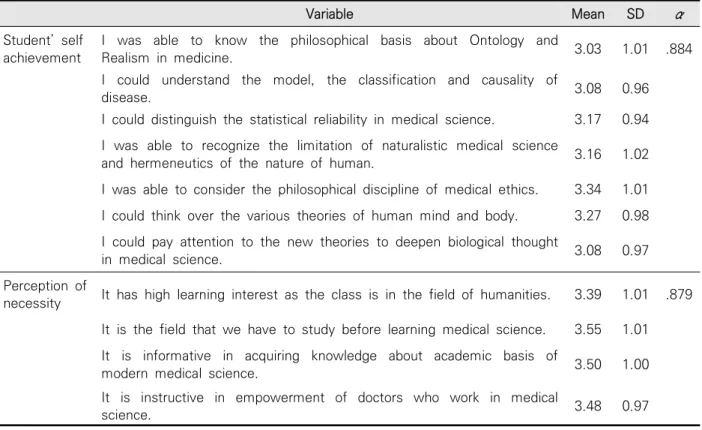
Table 1. Student' self achievement and perception of necessity of medical philosophy

(7)

1. General Characteristics of Subjects The total number of subjects was 250 students, including 43 first-year students and 63 2

nd

-year students in premedical study; and 54 first-year students and 45 2

nd

-year students and 45 3

rd

-year students in medical school. There were 171 males and 79 females.

2. Philosophy of Medicine Course Satisfaction In comparison of satisfaction by detailed topics of the philosophy of medicine course, the aver- age of the response to "I was able to consider the philosophical discipline of medical ethics"

was the highest at 3.34 (SD = 1.01), and the aver- age of the response to "I was able to know the

philosophical basis about Ontology and Realism in medicine" was the lowest at 3.03 (SD = 1.01) (Table 1).

3. Perception for the Needs of Philosophy of Medicine Education

In the case of the perception of the need for the philosophy of medicine education, the aver- age of response for "It is the field that we have to study before learning medical science" was the highest at 3.55 (SD = 1.01) and the average of response of "It has high learning interest as the class is in the field of humanities" was the lowest at 3.39 (SD = 1.01) (Table 1).

Variable Item Mean SD α

Conctents profitability

It is useful in acquiring refinement and developing the personality of

a doctor. 3.60 0.96 .823

It is useful in applying diversely to research field of basic medical

scientist. 3.10 0.97

It is useful in dealing with the medical situation that a doctor faces

at the hospital. 3.17 1.06

It is useful in multidisciplinary approach with study close to medicine

and applications. 3.30 1.00

Method profitability

Presentation, discussion and writing are the appropriate ways to

learn philosophy of medicine. 3.68 0.98 .874

It gives motivation to make students take an active part in class. 3.38 1.03 It can be an effective way of learning through self learning skills. 3.22 0.99 It has high learning interest and efficiency that can be acquired from

communication and activities among small group members. 3.21 1.04 The way of the presentation and discussion broadens the thought

and knowledge. 3.36 0.99

We can master logical thinking and creative writing through writing

essay. 3.29 0.99

SD: Standard deviation

Table 2. Perception of students on profitability of contents and education method of medical philosophy 

(8)

4. Perception for Benefits of Contents and Methods of the Philosophy of Medicine Course

For perception for benefits of the philosophy of medicine course contents, the average of the response for "It is useful in acquiring refinement and developing the personality of a doctor" was the highest at 3.60 (SD = 0.96), and the average of the response for "It is useful in applying di- versely to research field of basic medical scien- tist" was the lowest at 3.10 (SD = 0.97). In case of benefit perception for methods, the average of the response for "Presentation, discussion and writing are the appropriate ways to learn philos- ophy of medicine" was the highest at 3.68 (SD

= 0.98) and the average of the response for "It has high learning interest and efficiency that can be acquired from communication and activ- ities among small group members" was the lowest at 3.21 (SD = 1.04) (Table 2).

5. Satisfaction for the philosophy of medicine course

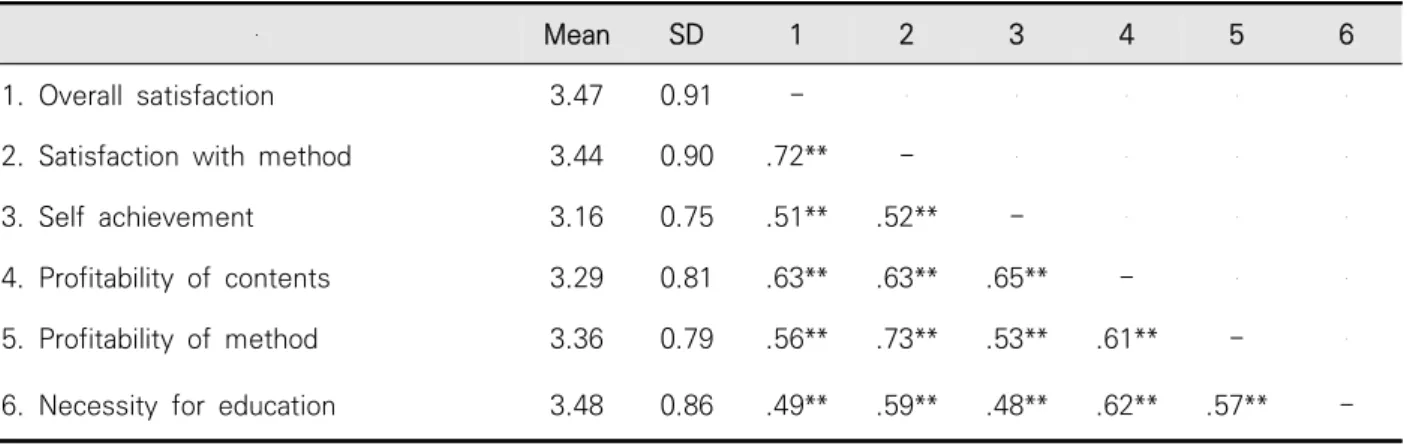
In order to find the variables that affect the overall satisfaction for group discussion style of the philosophy of medicine course and sat- isfaction for the teaching methods, a cross-cor- relation between satisfaction, achievement and perception was examined. The overall sat- isfaction for the group discussion style of the philosophy of medicine course Satisfaction with method self achievement (r = 0.51, P < 0.01), profitability of contents (r = 0.63, P < 0.01), profit- ability of method (r = 0.56, P < 0.01) and necessity for education (r = 0.49, P < 0.01). The satisfaction for the teaching method of the philosophy of medicine course also Satisfaction with method self achievement (r = 0.52, P < 0.01), profitability of contents (r = 0.63, P < 0.01), profitability of method (r = 0.73, P < 0.01) and necessity for education (r = 0.59, P < 0.01) (Table 3).

  Mean SD 1 2 3 4 5 6

1. Overall satisfaction 3.47 0.91 -          

2. Satisfaction with method 3.44 0.90 .72** -        

3. Self achievement 3.16 0.75 .51** .52** -      

4. Profitability of contents 3.29 0.81 .63** .63** .65** -    

5. Profitability of method 3.36 0.79 .56** .73** .53** .61** -  

6. Necessity for education 3.48 0.86 .49** .59** .48** .62** .57** -

SD: Standard deviation

** P < 0.01

Table 3. Correlation analysis between students' satisfaction, self-achievement and perception

(9)

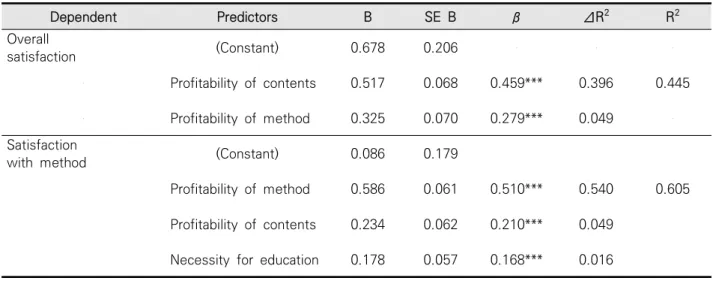
To see how variables showing a significant cor- relation with satisfaction explain each of the satisfaction levels, the overall satisfaction and teaching methods satisfaction were set as the dependent variable, achievement, perception for content benefits, perception for method ben- efits and perception for education needs which showed mutual relationship with the dependent variables were set as independent variables and the stepwise multiple regression analysis was conducted. The perception for content benefits (β = 0.46) and perception for method benefit (β = 0.28) were found to be variables that de- scribed the overall satisfaction, and these varia- bles have been shown to explain 44.5% of the total variance of overall satisfaction. In other words, as the contents and methods of the dis- cussion style of philosophy of medicine course

were considered as beneficial, the overall sat- isfaction to the discussion style of the philosophy of medicine course was higher (Table 4). For satisfaction for teaching methods, the percep- tion for method benefits (β = 0.51), perception for content benefits (β = 0.21) and perception for education needs (β = 0.17) were shown as the explained variables and these variables have been shown to explain 60.5% of the total variance of overall satisfaction. That means that as the contents and methods of the philosophy of medi- cine course were considered to be beneficial and it was recognized that there is a need for educa- tion, the satisfaction with teaching methods of the philosophy of medicine course were higher (Table 4).

6. Satisfaction with Elements of Discussion

Dependent Predictors B SE B β ΔR

2

R

2

Overall

satisfaction (Constant) 0.678 0.206      

  Profitability of contents 0.517 0.068 0.459*** 0.396 0.445

  Profitability of method 0.325 0.070 0.279*** 0.049  

Satisfaction

with method (Constant) 0.086 0.179

Profitability of method 0.586 0.061 0.510*** 0.540 0.605 Profitability of contents 0.234 0.062 0.210*** 0.049

Necessity for education 0.178 0.057 0.168*** 0.016 SE: Standard error

** P < 0.01, *** P < 0.001

Table 4. Stepwise regression analysis for student' overall satisfaction and satisfaction with method

(10)

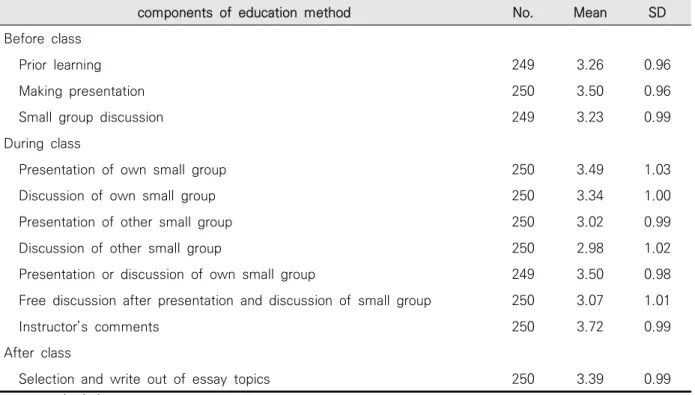
To determine the most helpful process in the learning among the discussion style of the philos- ophy of medicine courses, the element of each course was measured and analyzed for its useful- ness with a 5-point scale of Likert scale. As a result of analysis, the average of response for

"the professor's comments in class" was 3.72 (SD

= 0.99), which showed the highest satisfaction and the average of the response for "discussion of other small groups" was 2.98 (SD = 1.02), which showed the lowest satisfaction. Overall, while satisfaction for presentation and discussion of a small group to which they belonged, along with their own presentation, was high, the sat- isfaction for the presentation and discussion of

other small groups and the whole class discussion was low (Table 5).

DISCUSSION

Over the last 20 years, the importance of a humanities education has been highlighted from various perspectives. Medicine is both science and medical techniques at the same time, which means medicine includes the scientific aspects and practical aspects together. The philosophy of medicine refers to the field of philosophical exploration of the nature of Medicine.

7

From the perspective of "medical techniques" as tech-

components of education method No. Mean SD

Before class

Prior learning 249 3.26 0.96

Making presentation 250 3.50 0.96

Small group discussion 249 3.23 0.99

During class

Presentation of own small group 250 3.49 1.03

Discussion of own small group 250 3.34 1.00

Presentation of other small group 250 3.02 0.99

Discussion of other small group 250 2.98 1.02

Presentation or discussion of own small group 249 3.50 0.98

Free discussion after presentation and discussion of small group 250 3.07 1.01

Instructor’s comments 250 3.72 0.99

After class

Selection and write out of essay topics 250 3.39 0.99

SD: Standard deviation

** P < 0.01, *** P < 0.001

Table 5. Student Satisfaction with components of education method

(11)

niques of healing, medicine is recognized as a science. However, medicine is a field of study focusing on humans where physicians are faced with many ethical dilemmas. In their actual prac- tices they often encounter situations where they have to determine what to do for the patients and what action is best for the patients. In resolv- ing the ethical issues that they inevitably encoun- ter along with the issues raised by ever developing medical techniques, one cannot deny that this topic has become vitally important. This field covers many practically important issues in phi- losophy, medicine, law, sociology, public policy, education and other related fields. In medical education, training medical scientists who rec- ognize the philosophical basis of modern medi- cine along with being able to interpret the social, ethical and biological paradigms became an im- portant duty of medical schools.

Our medical school has continuously devel- oped and improved our courses in humanities and social sciences education to meet the needs of contemporary medical education. Existing subjects include: the medical doctor and leader- ship, or professionalism and education for value area reflecting the patient-doctor-society and identity of the university. Since 2010, the human- ity and social sciences curriculum included phi- losophy, literature and arts, sociology and com- munication fields. This curriculum is distributed

over the course of six years, including 2 years of premedical study and 4 years of medical school, and is composed according to each medi- cal humanities education field. The education areas of the medical humanities are: first,

‘humanities and art’, second, ‘medical commu- nication’, third ‘medicine and society’, and fourth ‘identity and value’. The philosophy of medicine education is targeted to first-year pre- medical students in the 'humanities and art' area.

The philosophy of medicine course used the

"Philosophy of Medicine: an Introduction" as a main textbook which covers the pure philosoph- ical approaches such as ontology and epistemol- ogy, hermeneutics, and sociology into the medicine.

7

In this study the areas extracted to survey achievement included philosophical top- ics covered in this textbook, statistics, herme- neutics and sociology, theories of mind and body, philosophical level of ethics and modern bio- logical theory.

In the case of the need for the philosophy of medicine education, the highest response was

"It is the basic area that needs to know before learning the medicine", and the least response was "Since it is humanities class, it has high inter- ests". For perception of benefits of the philosophy of medicine course contents, the response of

"It is useful to acquire culture and to build the

character as a physician" was the highest and

(12)

the response of "It is useful to apply variously for study fields of basic medicine" was the lowest.

This can be inferred to be associated with think- ing about the study of the medicine or recognition for a career in medical students. Recently, as the importance of humanities and social sciences education in medical education has been high- lighted in various perspectives, the qualitative and quantitative levels of humanities and social sciences or medical humanities are continuously increasing. However, the science of medicine has still remained focused in the biological per- spective of human diseases, and the medical stu- dents are accustomed to training and assessment tailored to professional performance based on the knowledge and skills. In this atmosphere, the philosophy of medicine is viewed as one of challenges that they have to go through before learning real medicine. In addition, this may be caused by the narrow-minded viewpoint that many students enter medical school with and who without any worries or exploration regard- ing their career take it for granted that they would become clinicians.

Through this study, the overall satisfaction, perception and achievement of medical students for presentation and group discussion style of the philosophy of medicine course were rela- tively high regardless of grade level or sex.

However there were differences depending on

course contents and teaching components. First, for students perception for the benefit of philos- ophy of medicine course methods, the percep- tion for "Presentation, discussion and writing are appropriate methods to learn the philosophy of medicine" was the highest, while the perception for "It has high learning interests and effective- ness obtained from the communication and ac- tivities between members of the small group"

was the lowest. That is, the group discussion method was considered as positive, but the bene- fits of individual small group activities were con- sidered as relatively low. In particular, it could be seen in the same context that from the sat- isfaction survey by elements of discussion class, the satisfaction to the presentation and dis- cussion of other small groups was the lowest.

These results were similar to existing study results which had low satisfaction for the individual dis- cussion preparation and participation but high satisfaction was shown in the discussion teaching method.

6,8

In the past, in the course evaluation performed by students right after the philosophy of medicine course was finished, students sug- gested that "The clear instructions on the dis- cussion method is needed" and "Before small group discussion, it is necessary to provide the discussion topic in advance"for improvement.

In the past studies investigated the requirements

needed for effective small group discussion, stu-

(13)

dents suggested that the positive small group atmosphere, active participation of group mem- bers and mutual relationships were important.

9,10

Kim

11

stated that it is necessary to experience 5 kinds of group dynamics such as being friendly, making rules, encountering, implementing and encouraging in order to have effective small group activities. Particularly, the learning abil- ities or motivation of members in the small group can be varied and due to these diversities effec- tive discussion class may be impacted and the participation and satisfaction for the class may be decreased. Therefore, one way to increase the satisfaction of discussion is to distribute the roles between group members and set the rules the before starting a small group discussion. As a result, we started instructing students in order to increase participation and introduce the roles of each member right before the presentation and discussion at the class. Thus, a small group in which all the members participated jointly by taking various roles was more active in pre- sentation and discussion and more effective in topic selection and delivery process than the small group that had relatively low participation by members. For such relevance, a separate fo- cused study with respect to the academic ach- ievement of a small group would be need in the future.

On the other hand, in the study of character-

istics of discussion materials that effect the medi- cal humanities discussion course, the most effec- tive factors on course participation and sat- isfaction of students were ‘understanding and interest of discussion materials’.

12

In fact, in or- der to increase the interest on a topic in the classroom, the topic was given in advance and this allowed students to find additional resources on a voluntary basis. The small groups that per- formed the advance learning with various meth- ods and various additional materials had higher understanding on the discussion topics as in- dividuals and in small groups and the discussion activity of small group was much more active.

Therefore, to improve the participation of dis- cussion further, considering that it is a class with first-year premedical students, it is important to consider the methods to present various mate- rials more specifically and to induce more inter- ests in the topic beside just the main textbook.

These methods are expected not only to im-

prove the perception and satisfaction for dis-

cussion in class, but also to reduce the changes

in the learning preference of students who want

to increase the professor's comment. In this sat-

isfaction survey by elements of discussion class

of students, the satisfaction on the professor’s

comment in the classroom showed the highest

results. From the class evaluation of students,

students wanted to increase the professor's com-

(14)

ments and also to provide the instruction for discussion. These results show high possibility that students prefer learning from the passive lecture style that follows the familiar lecture for- mat and instructions of the professor to that of learning based on autonomy and voluntary study even in the presentation and discussion style class. However, on the other hand, students may want to increase the comments of professor in the class because the fields of medicine and phi- losophy are new to them and the contents are difficult for most of them. It is expected that in order to conduct active discussion classes, it is vital to select the topics in advance, to prepare the discussion with enough time, and present various discussion materials tailored to the level of first-year premedical students with the main classroom textbook. These key steps can draw more interests in the classroom and improve the understanding by students.

Since the survey for this study was targeted to 5 grade levels of students, we examine if there were any changes in achievement, perception and satisfaction on the philosophy of medicine course in students who had demands of achieve- ment in various learning areas through the vari- ous periods including pre-medicine, basic medi- cine, clinical medicine and clinical training.

However, there was no significant difference in the survey results depending on the grade. This

suggests that not many students have the oppor- tunity to access the specific situation that needs philosophical thinking and execution or appli- cation among humanistic elements during medi- cal education. If philosophical thinking is re- flected in the medical education focused on knowledge and skills such as the present, the level is likely to be applied in the ethical decisions necessary for the situation of medical inter- ventions in clinical practice.

In this study, the survey for factors that affect achievement of classroom performance in the philosophy of medicine was not conducted.

However, by analyzing these factors, it is neces- sary to put effort in improving the achievement level and satisfaction of the presentation and discussion style philosophy of medicine courses based on these results. To improve active student participation, it is thought that proactive in- duction of interests for small group activity is necessary and more specific contents and meth- ods and various source materials for the class need to be proposed and fully utilized.

REFFRENCES

1. Koo MS. A Comparative study on the integrative

curriculum of liberal social medicine in major med-

ical schools. Journal of Curriculum Integration

(15)

2010;4:115-48.

2. Meng KH. Teaching medical humanities in Korean medical school: tasks and prospect. Korean J Med Educ 2007;19:5-11.

3. An JH, Kwon I, Lee SN, Han JJ, Jeong JE. Study on the medical humanities and social sciences curriculum in Korean medical school: current teaching status and learning subjects. Korean J Med Educ 2008;20:133-44.

4. Martens, E. Einführung in die Didaktik der Phliosophie. Trans. by Lee, K. S. Seoul: Seokwangsa;

1983.

5. Choi KS. Teaching medical ethics and critical thinking. Korean J Med Ethics Educ 2004;7:232-46.

6. Joh HK, Shin JS. Student satisfaction and self-as- sessment after small group discussion in a medical ethics education program. Korean J Med Educ

2009;21:243-57.

7. Wulff HR, Pedersen SA, Rosenberg R. Philosophy of Medicine. second Edition. Blackwell Science Inc. Trans. by Lee, J. C. Seoul; Arke 2007 8. Park EK, Shin JS, Ahn CR, Sung MH, Kwon I. Medical

Ethics Education using “Student Symposium”.

Korean J Med Ethics Educ 2002;5:143-50.

9. Steinert Y. Student perceptions of effective small group teaching. Med Educ 2004;38:286-93.

10. Kitchen M. Facilitating small groups: how to en- courage student learning. Clin Teach 2012;9:3-8.

11. Kim S. How to apply small group teaching method.

Korean J Med Educ 2014;26:83-6.

12. Ahn JH, Jeon WT. Analysis of the characteristics

of discussion materials that promote group dis-

cussion in the medical humanities. Korean J Med

Educ 2011;23:253-62.

수치

Table  1.  Student'  self  achievement  and  perception  of  necessity  of  medical  philosophy
Table  2.  Perception  of  students  on  profitability  of  contents  and  education  method  of  medical  philosophy 
Table  3.  Correlation  analysis  between  students'  satisfaction,  self-achievement  and  perception
Table  4.  Stepwise  regression  analysis  for  student'  overall  satisfaction  and  satisfaction  with  method
+2

참조

관련 문서

The purpose of this study was to analyze the relations between the leader-member exchange relationship, job satisfaction, and organizational citizenship behavior of sports

Relationship between Medical Service Satisfaction and Customer's Loyalty for Secondary Hospital in Rural Areas.. 2012 년

Objective: The purpose of this study was to investigate the effect of clinical practice satisfaction on professional self-concept among dental hygiene students.. Methods:

The purpose of this study is to analyze the interest and self-confidence of middle school students in learning English grammar and to examine the

This study examined the achievement, satisfaction and interest of an English grammar class based on flipped learning in order to find out the effect of

The purpose of this study was to examine the parents' perceptions on the current status, effects and satisfaction of personal assistant service for students

The Medical accident and the

In this study, a family of middle school students the health, self-resilience, recreation and leisure satisfaction and satisfaction with school life were