MTHFR C677T Polymorphism as a Risk Factor for Vascular Calcification in Chronic Hemodialysis Patients
Polymorphism of 5,10-methylenetetrahydrofolate reductase (MTHFR) C677T is one of the suggested risk factors for atherosclerosis. However, few studies have reported on the relationship between MTHFR C677T polymorphism and vascular calcification (VC) in chronic hemodialysis patients. We investigated the relationship between the MTHFR C677T polymorphism and VC in 152 chronic hemodialysis patients. Patients with a TT genotype exhibited significantly higher VC scores than patients expressing CC and CT (P = 0.002).
The prevalence of peripheral vascular disease increased with the incidence of MTHFR C677T mutations for all patients, and the incidence of cerebrovascular accidents also increased with the presence of mutations for young patients (≤ 60 yr) (P < 0.05). Patients with CT and TT genotypes had adjusted odds ratios for VC of 1.39 and 1.58, respectively (P < 0.05).
In summary, these data suggest that the MTHFR C677T polymorphism affects the degree of VC in chronic hemodialysis patients.
Key Words: Methylenetetrahydrofolate Reductase (MTHFR); Renal Dialysis; Homocysteine;
Vascular Calcification So-Young Lee1, Hoe-young Kim1,
Kyung Mi Park1, Stephen Yon Gu Lee1, Seong Geun Hong2, Hyung-Jong Kim1, and Dong Ho Yang1
Departments of 1Internal Medicine and 2Laboratory Medicine, Bundang CHA General Hospital, College of Medicine, CHA University, Seongnam, Korea Received: 27 August 2010
Accepted: 13 December 2010 Address for Correspondence:
Dong Ho Yang, MD
Department of Internal Medicine, Bundang CHA General Hospital, CHA University, 59 Yatap-ro, Bundang-gu, Seongnam 463-712, Korea
Tel: +82.31-780-5896, Fax: +82.31-780-5219 E-mail: [email protected]
This study was supported by grants from National Research Foundation of Korea in 2010.
DOI: 10.3346/jkms.2011.26.3.461 • J Korean Med Sci 2011; 26: 461-465 Nephrology
Vascular calcification (VC) is a common manifestation of end- stage renal disease (ESRD) (1, 2). The presence of VC is associ- ated with aortic stiffness and is predictive of subsequent cardio- vascular disease (CVD) and increased mortality (2). The exact pathophysiology of VC in ESRD patients is unclear. Recent stud- ies have reported that VC is an active process regulated by vari- ous genes and proteins (2). The 5,10-methylenetetrahydrofolate reductase (MTHFR) C677T polymorphism is associated with decreasing enzyme activity and increasing homocysteine (Hcy) levels (3). Elevated plasma Hcy is one of the suggested risk fac- tors for atherosclerosis due to endothelial dysfunction and oxi- dative stress (4). There is evidence for an association between increased plasma Hcy and the MTHFR polymorphism with an increased risk for developing CVD (5, 6). However, few studies have reported on the relationship between the MTHFR C677T polymorphism and VC in patients on chronic hemodialysis.
Therefore, the goal of this study was to evaluate the degree of VC (7) and analyze the association with the MTHFR C677T poly- morphism.
After obtaining approval from the Institutional Review Board of Bundang CHA General Hospital, we recruited 152 patients.
Inclusion criteria were ages 20-90 yr and the diagnosis of ESRD in patients that received chronic hemodialysis treatments for more than 3 months. Patients with acute infectious diseases or unstable vital signs were excluded. All patients provided written informed consent.
VC was evaluated by examining plain radiography of the pel- vis and hands (7). The total final scores ranged from 0 to 8. Arte- rial stiffness was assessed using a commercially available device (VP-2000, Colin Corporation, Komaki, Japan) that measures the pulse wave velocity (PWV). Pulse wave forms were obtained from the carotid and femoral artery sites.
Genomic DNA was extracted from peripheral blood leuko- cytes using Puregene DNA extraction kits (QIAGEN, Valencia, CA, USA) according to the manufacturer’s protocols. The MTHFR C677T genotypes were identified as previously described (8).
A routine clinical workup of all patients within 1 month of en- rollment included fasting blood samples before the mid-week dialysis. Hcy levels were measured by chemiluminescence im- munoassay. The level of total intact parathyroid hormone (iPTH) was evaluated by electrochemiluminescence immunoassay.
Statistical comparison between the groups was performed using the independent samples t-test, ANOVA, and chi-square tests. Predictive factors for VC were examined using logistic re- gression analysis. P values less than 0.05 were considered statis- tically significant.
In terms of patients’ genotypes, 28.9% had CC, 47.4% had CT, and 23.7% had TT (Table 1). The patients with the TT genotype had higher VC scores than patients with the CC or CT genotype (P = 0.002). The TT genotype tended to be associated with a high- er PWV, pulse pressure (PP), and prevalence of CVD; however, the differences were not statistically significant. Only the preva-
lence of peripheral vascular disease (PVD) was significantly in- creased in patients with a T allele (P = 0.006). The study group was divided into two subgroups by 60 yr of age, based on a me- dian age of 56.5 yr; the mean ages of the subgroups were 47.38 ± 9.4 and 69.83 ± 6.2 yr. In young patients (≤ 60 yr), MTHFR C677T mutations were associated with higher VC scores (P = 0.004). In young patients, MTHFR C677T mutations were a significant pre- dictive factor for cerebrovascular accident (CVA) (P = 0.031) and PVD (P = 0.006), except ischemic heart disease. The MTH- FR C677T polymorphism was not associated with plasma Hcy levels.
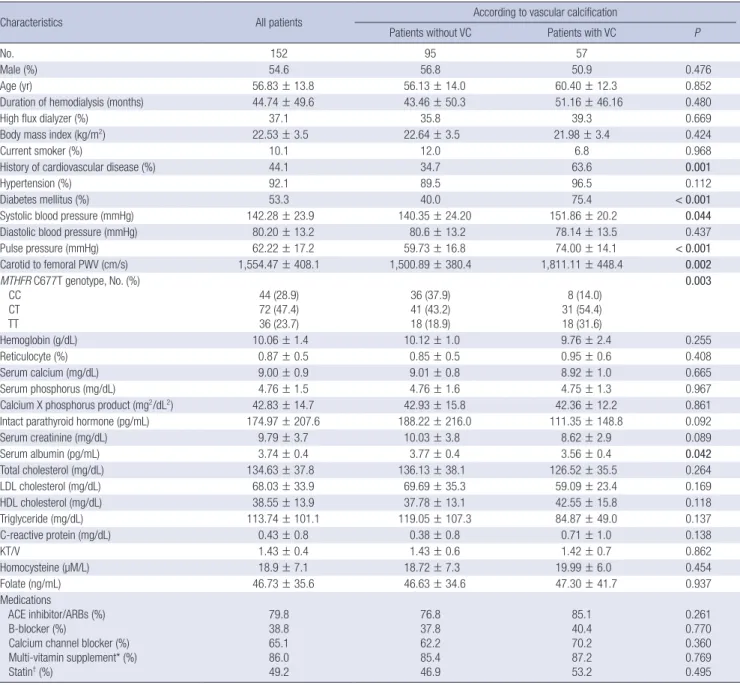
A total of 57 (37.5%) patients presented with VC. Extensive VC scores (> 3) were observed in 25 (16.4%) of all patients. Table 2 provides data indicating that the existence of VC was associated with a higher frequency of CVD and diabetes (P = 0.001). Pati- ents with VC had significantly higher systolic blood pressures, PWVs, and PPs (P < 0.05). The mean albumin levels were signif- icantly lower in patients with VC. The frequencies of the MTHFR C677T mutation significantly differed between patients with or without VC (P = 0.003). However, the plasma Hcy levels did not significantly differ between the subgroups.
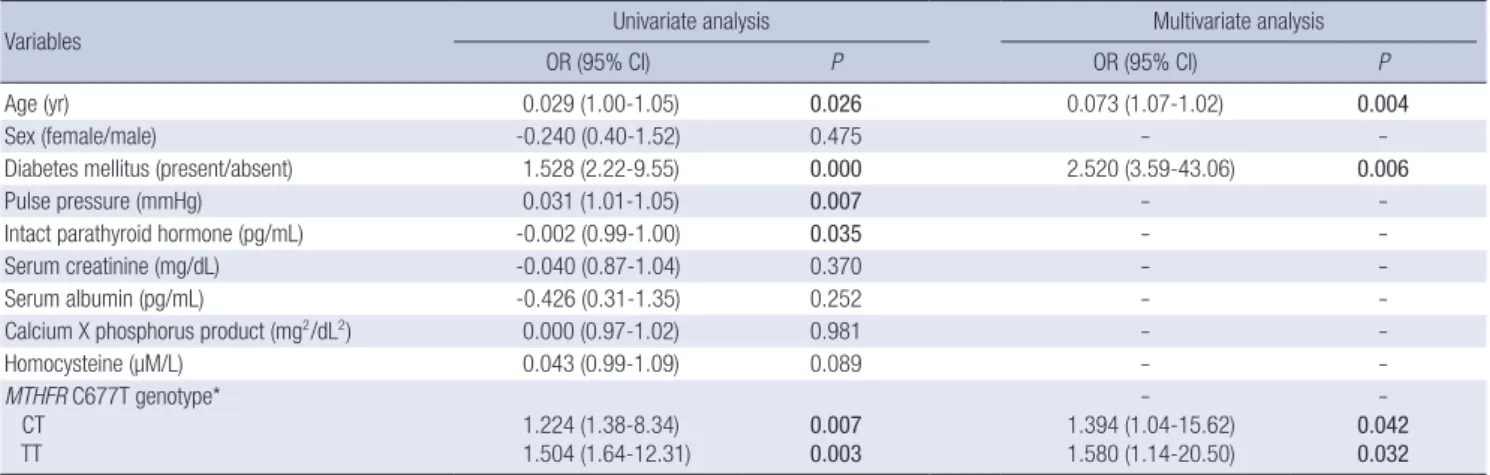
To identify predictors of VC, multiple logistic regression anal- ysis was performed using the existence of VC as the dependent variable and 10 selected variables, including age and gender, as the independent variables. Age, diabetes, and MTHFR C677T mutations were determined to be independent predictors of the existence of VC (Table 3). The adjusted odds ratio (OR) for the TT genotype for the risk of extensive VC score (> 3) was 1.66 (95% confidence interval [CI]; 1.41-19.47, P = 0.013) for all pa- tients, and 2.41 (95% CI; 1.70-73.29, P = 0.012) for patients young- er than 60 years of age (data not shown).
The results of this study suggest that there is a strong relation- ship between the incidence of MTHFR C677T mutations and VC
in patients with ESRD on chronic hemodialysis. Compared to patients with the CC genotype, patients with CT and TT geno- types had adjusted ORs for VC of 1.39 and 1.58, respectively (P = 0.042 and 0.032). In the subgroup analysis, the correlation of the MTHFR C677T mutation and VC persisted in young patients (≤
60 yr) (Table 1). A similar trend of increased VC scores, although not significant, was observed for the older patient group (> 60 yr). These results suggest that the harmful effect of having a mu- tant T allele at nucleotide position 677 may be diluted with age, which is another strong risk factor for VC.
The possible association between a genetic polymorphism and the development of VC has been of recent interest to inves- tigators (8). A better understanding of the pathogenesis contrib- uting to the increased VC in ESRD patients can provide a better perspective on the high cardiovascular mortality, which is par- tially explained by the traditional risk factors. Several recent re- ports have suggested that the MTHFR C677T polymorphism (9) is associated with the development of CVD in patients with ESRD.
This is the first study to statistically evaluate the relationship be- tween the extent of VC and MTHFR C677T polymorphism.
The mediator of vascular injury has been presumed to be plasma Hcy levels (10), which are increased in patients with mu- tant T allele (5). However, in this study, plasma Hcy levels were not associated with the MTHFR C677T polymorphism and VC.
There are several possible explanations for these findings. Sev- eral randomized trials focused on reducing Hcy levels in the general population (11) or in patients with ESRD (12) failed to improve outcome. Perhaps, lifetime exposure to increased Hcy levels cannot be remedied by a few years of partial restoration of Hcy levels to normal. Alternatively, high Hcy levels may sim- ply mark rather than mediate the injury caused by impaired MTHFR activity. Recently, the levels of tissue 5-methyl-tetrahy- drofolate (5-MTHF), rather than plasma or tissue levels of Hcy, Table 1. Clinical characteristics according to MTHFR C677T genotypes
Genotypes No. of
cases (%) Age (yr) Hcy
(µmol/L) VC Score
(0-8) PWV
(cm/s) CVD (%) IHD (%) CVA (%) PVD (%) All patients
CC CT TT P value
44 (28.9) 72 (47.4) 36 (23.7)
61.61 ± 12.4*
54.24 ± 14.1 56.17 ± 13.6
0.018
16.74 ± 5.5 20.17 ± 8.3 18.91 ± 5.7
0.051
0.59 ± 1.5 1.32 ± 2.1 2.33 ± 2.7†
0.002
1,592.93 ± 394.1 1,503.38 ± 407.0 1,613.79 ± 425.0
0.432
38.6 41.7 55.6 0.142
38.6 41.7 55.6 0.142
31.8 29.2 44.4 0.268
2.3 12.5 22.2 0.006 Patients younger than 60 yr old
CC CT TT P value
18 (20.5) 46 (52.3) 24 (27.3)
49.72 ± 8.8 45.89 ± 10.0
48.46 ± 8.3 0.278
17.25 ± 5.5 20.24 ± 9.2 18.92 ± 5.1
0.381
0.33 ± 1.0 0.91 ± 1.6 2.29 ± 2.8†
0.004
1,573.10 ± 441.0 1,443.59 ± 404.8 1,595.36 ± 384.5
0.351
27.8 28.3 35.2 0.057
11.1 17.4 25.0 0.245
22.2 19.6 50.0 0.031
1.2 6.5 25.0 0.006 Patients older than 60 yr old
CC CT TT P value
26 (40.6) 26 (40.6) 12 (18.8)
69.85 ± 6.5 69.00 ± 6.5 71.58 ± 7.3
0.505
16.39 ± 5.6 20.05 ± 6.5 18.91 ± 7.5
0.124
0.77 ± 1.7 2.04 ± 2.7 2.42 ± 2.5 0.069
1,611.35 ± 360.9 1,613.51 ± 398.0 1,654.76 ± 527.6
0.499
46.2 65.4 58.3 0.331
26.9 30.8 41.7 0.390
38.5 46.2 33.3 0.915
3.8 23.1 16.7 0.152
*P < 0.05 vs CT and TT genotype by one-way ANOVA with LSD post hoc comparison; †P < 0.05 vs CC and CT genotype by one-way ANOVA with LSD post hoc comparison.
Results are expressed as means ± SD or number of observations (percentage). CVA, cerebrovascular accidents; CVD, cardiovascular disease including ischemic heart disease, cerebrovascular accident, and peripheral vascular disease; Hcy, homocysteine; IHD, ischemic heart disease; MTHFR, 5,10-methylenetetrahydrofolate reductase; PVD, peripheral vascular disease; PWV, pulse wave velocity; VC Score, vascular calcification score.
Table 2. Clinical characteristics according to the existence of vascular calcification
Characteristics All patients According to vascular calcification
Patients without VC Patients with VC P
No. 152 95 57
Male (%) 54.6 56.8 50.9 0.476
Age (yr) 56.83 ± 13.8 56.13 ± 14.0 60.40 ± 12.3 0.852
Duration of hemodialysis (months) 44.74 ± 49.6 43.46 ± 50.3 51.16 ± 46.16 0.480
High flux dialyzer (%) 37.1 35.8 39.3 0.669
Body mass index (kg/m2) 22.53 ± 3.5 22.64 ± 3.5 21.98 ± 3.4 0.424
Current smoker (%) 10.1 12.0 6.8 0.968
History of cardiovascular disease (%) 44.1 34.7 63.6 0.001
Hypertension (%) 92.1 89.5 96.5 0.112
Diabetes mellitus (%) 53.3 40.0 75.4 < 0.001
Systolic blood pressure (mmHg) 142.28 ± 23.9 140.35 ± 24.20 151.86 ± 20.2 0.044
Diastolic blood pressure (mmHg) 80.20 ± 13.2 80.6 ± 13.2 78.14 ± 13.5 0.437
Pulse pressure (mmHg) 62.22 ± 17.2 59.73 ± 16.8 74.00 ± 14.1 < 0.001
Carotid to femoral PWV (cm/s) 1,554.47 ± 408.1 1,500.89 ± 380.4 1,811.11 ± 448.4 0.002
MTHFR C677T genotype, No. (%) CC
CT TT
44 (28.9) 72 (47.4) 36 (23.7)
36 (37.9) 41 (43.2) 18 (18.9)
8 (14.0) 31 (54.4) 18 (31.6)
0.003
Hemoglobin (g/dL) 10.06 ± 1.4 10.12 ± 1.0 9.76 ± 2.4 0.255
Reticulocyte (%) 0.87 ± 0.5 0.85 ± 0.5 0.95 ± 0.6 0.408
Serum calcium (mg/dL) 9.00 ± 0.9 9.01 ± 0.8 8.92 ± 1.0 0.665
Serum phosphorus (mg/dL) 4.76 ± 1.5 4.76 ± 1.6 4.75 ± 1.3 0.967
Calcium X phosphorus product (mg2/dL2) 42.83 ± 14.7 42.93 ± 15.8 42.36 ± 12.2 0.861
Intact parathyroid hormone (pg/mL) 174.97 ± 207.6 188.22 ± 216.0 111.35 ± 148.8 0.092
Serum creatinine (mg/dL) 9.79 ± 3.7 10.03 ± 3.8 8.62 ± 2.9 0.089
Serum albumin (pg/mL) 3.74 ± 0.4 3.77 ± 0.4 3.56 ± 0.4 0.042
Total cholesterol (mg/dL) 134.63 ± 37.8 136.13 ± 38.1 126.52 ± 35.5 0.264
LDL cholesterol (mg/dL) 68.03 ± 33.9 69.69 ± 35.3 59.09 ± 23.4 0.169
HDL cholesterol (mg/dL) 38.55 ± 13.9 37.78 ± 13.1 42.55 ± 15.8 0.118
Triglyceride (mg/dL) 113.74 ± 101.1 119.05 ± 107.3 84.87 ± 49.0 0.137
C-reactive protein (mg/dL) 0.43 ± 0.8 0.38 ± 0.8 0.71 ± 1.0 0.138
KT/V 1.43 ± 0.4 1.43 ± 0.6 1.42 ± 0.7 0.862
Homocysteine (µM/L) 18.9 ± 7.1 18.72 ± 7.3 19.99 ± 6.0 0.454
Folate (ng/mL) 46.73 ± 35.6 46.63 ± 34.6 47.30 ± 41.7 0.937
Medications
ACE inhibitor/ARBs (%) B-blocker (%)
Calcium channel blocker (%) Multi-vitamin supplement* (%) Statin† (%)
79.8 38.8 65.1 86.0 49.2
76.8 37.8 62.2 85.4 46.9
85.1 40.4 70.2 87.2 53.2
0.261 0.770 0.360 0.769 0.495 Statistically significant values P < 0.05 in bold. *Multi-vitamin supplement contained 10 mg pyridoxine HCl, 1.5 mg thiamine nitrate, 6 µg cyanocobalamine, 1.7 mg riboflavin, 60 mg ascorbic acid, 1,000 µg folic acid, 300 µg biotin, 20 mg nicotinamide, and ca. 10 mg pantothenic acid; †Cholesterol-lowering HMG-CoA reductase inhibitor. Results are expressed as means ± SD or number of observations (percentage). ACE, angiotensin-converting enzyme; ARBs, angiotensin II receptor blockers; HDL, high-density lipoprotein;
LDL, low-density lipoprotein; MTHFR, 5,10-methylenetetrahydrofolate reductase; PWV, pulse wave velocity; VC, vascular calcification.
have been suggested to play a role in regulating endothelial func- tion (13).
VC was present in 37.5% of the study participants, which is in- consistent with the rate of 74.8% reported in a study evaluating chronic hemodialysis patients using the same VC scoring meth- od (7, 14). In this study, mean patient age was 56.83 ± 13.8 yr, which is lower than the mean patient age reported in the previ- ous study (14). Unfortunately, there are limited data available on VC in Asian patients assessed using a simple radiogdraphy calcification score.
There was no significant relationship between MTHFR C677T
polymorphism and CVD in this study. In the ESRD population, evidence for an association of the MTHFR C677T mutation with CVD is also inconsistent (9). Since ESRD patients carry a heavy cardiovascular disease burden, these conflicting results may re- flect confounding by various risk factors. Thus, in our study, the mean age of the patients with the CC genotype was greater than those of the patients with CT or TT. In addition, methodological limitations constrain the interpretation of the findings from our small-sized cross-sectional study. The prevalence of PVD in- creased with the incidence of MTHFR C677T mutation for all patients, and the CVA also significantly increased for the young
Table 3. Factors associated with vascular calcification in logistic regression analysis
Variables Univariate analysis Multivariate analysis
OR (95% CI) P OR (95% CI) P
Age (yr) 0.029 (1.00-1.05) 0.026 0.073 (1.07-1.02) 0.004
Sex (female/male) -0.240 (0.40-1.52) 0.475 - -
Diabetes mellitus (present/absent) 1.528 (2.22-9.55) 0.000 2.520 (3.59-43.06) 0.006
Pulse pressure (mmHg) 0.031 (1.01-1.05) 0.007 - -
Intact parathyroid hormone (pg/mL) -0.002 (0.99-1.00) 0.035 - -
Serum creatinine (mg/dL) -0.040 (0.87-1.04) 0.370 - -
Serum albumin (pg/mL) -0.426 (0.31-1.35) 0.252 - -
Calcium X phosphorus product (mg2/dL2) 0.000 (0.97-1.02) 0.981 - -
Homocysteine (µM/L) 0.043 (0.99-1.09) 0.089 - -
MTHFR C677T genotype*
CT
TT 1.224 (1.38-8.34)
1.504 (1.64-12.31) 0.007 0.003
- 1.394 (1.04-15.62) 1.580 (1.14-20.50)
- 0.042 0.032 Statistically significant values P < 0.05 in bold. *CC, CT, and TT genotypes were assigned the values of 0, 1, and 2, respectively. MTHFR, 5,10-methylenetetrahydrofolate reductase; CI, confidence interval; OR, odds ratio.
patients (≤ 60 yr). Further studies using a larger population are required to confirm these findings.
The MTHFR 677TT genotype was not associated with the PWV in this study. It is possible that the association of the MTH- FR genotype with the PWV was attenuated by several therapeu- tic interventions such as correction of uremia (15), hypertension (16), hyperhomocysteinemia (17), or the use of rennin-angio- tensin-aldosterone system antagonists (18), statins (19) and/or beta blockers (20).
This study has several limitations. It was a small-sized cross- sectional study. No variability was determined by repeated mea- sures of the Hcy or PWV parameters. However, individual inves- tigators, who were blind to the clinical data, independently re- ported the VC and PWV measurements. Dietary calcium intake was not quantified, and the 25-hydroxy vitamin D levels were not determined, which would have been useful for assessing VC in the ESRD population.
In conclusion, the present study indicates that the MTHFR C677T mutation is an important factor influencing VC in chron- ic hemodialysis patients. However, further large-scale studies are required to fully characterize the relationship between the extent of VC and MTHFR C677T mutational status.
REFERENCES
1. Braun J, Oldendorf M, Moshage W, Heidler R, Zeitler E, Luft FC. Elec- tron beam computed tomography in the evaluation of cardiac calcifica- tion in chronic dialysis patients. Am J Kidney Dis 1996; 27: 394-401.
2. London GM, Marchais SJ, Guérin AP, Métivier F. Arteriosclerosis, vascular calcifications and cardiovascular disease in uremia. Curr Opin Nephrol Hypertens 2005; 14: 525-31.
3. Frosst P, Blom HJ, Milos R, Goyette P, Sheppard CA, Matthews RG, Boers GJ, den Heijer M, Kluijtmans LA, van den Heuvel LP, Rozen R. A candi- date genetic risk factor for vascular disease: a common mutation in meth- ylenetetrahydrofolate reductase. Nat Genet 1995; 10: 111-3.
4. Spark JI, Laws P, Fitridge R. The incidence of hyperhomocysteinaemia in
vascular patients. Eur J Vasc Endovasc Surg 2003; 26: 558-61.
5. Wald DS, Wald NJ, Morris JK, Law M. Folic acid, homocysteine, and car- diovascular disease: judging causality in the face of inconclusive trial ev- idence. BMJ 2006; 333: 1114-7.
6. Khandanpour N, Willis G, Meyer FJ , Armon MP, Loke YK, Wright AJ, Finglas PM, Jennings BA. Peripheral arterial disease and methylenetet- rahydrofolate reductase (MTHFR) C677T mutations: a case-control study and meta-analysis. J Vasc Surg 2009; 49: 711-8.
7. Adragão T, Pires A, Birne R, Curto JD, Lucas C, Gonçalves M, Negrão AP. A plain X-ray vascular calcification score is associated with arterial stiffness and mortality in dialysis patients. Nephrol Dial Transplant 2009;
24: 997-1002.
8. Cozzolino M, Biondi ML, Galassi A, Cusi D, Brancaccio D, Gallieni M.
Vascular calcification and cardiovascular outcome in dialysis patients:
the role of gene polymorphisms. Blood Purif 2010; 29: 347-51.
9. Jamison RL, Shih MC, Humphries DE, Guarino PD, Kaufman JS, Gold- farb DS, Warren SR, Gaziano JM, Lavori P; Veterans Affairs Site Investi- gators. Effect of the MTHFR C677T and A1298C polymorphisms on sur- vival in patients with advanced CKD and ESRD: a prospective study.
Am J Kidney Dis 2009; 53: 779-89.
10. Friedman AN, Bostom AG, Selhub J, Levey AS, Rosenberg IH. The kid- ney and homocysteine metabolism. J Am Soc Nephrol 2001; 12: 2181-9.
11. Ebbing M, Bleie Ø, Ueland PM, Nordrehaug JE, Nilsen DW, Vollset SE, Refsum H, Pedersen EK, Nygård O. Mortality and cardiovascular events in patients treated with homocysteine-lowering B vitamins after coronary angiography: a randomized controlled trial. JAMA 2008; 300: 795-804.
12. Jamison RL, Hartigan P, Kaufman JS, Goldfarb DS, Warren SR, Guarino PD, Gaziano JM; Veterans Affairs Site Investigators. Effect of homocyste- ine lowering on mortality and vascular disease in advanced chronic kid- ney disease and end-stage renal disease: a randomized controlled trial.
JAMA 2007; 298: 1163-70.
13. Antoniades C, Shirodaria C, Leeson P, Baarholm OA, Van-Assche T, Cunnington C, Pillai R, Ratnatunga C, Tousoulis D, Stefanadis C, Ref- sum H, Channon KM. MTHFR 677 C>T Polymorphism reveals func- tional importance for 5-methyltetrahydrofolate, not homocysteine, in regulation of vascular redox state and endothelial function in human atherosclerosis. Circulation 2009; 119: 2507-15.
14. Adragao T, Pires A, Lucas C, Birne R, Magalhaes L, Gonçalves M, Negrao
AP. A simple vascular calcification score predicts cardiovascular risk in haemodialysis patients. Nephrol Dial Transplant 2004; 19: 1480-8.
15. Annuk M, Zilmer M, Lind L, Linde T, Fellström B. Oxidative stress and endothelial function in chronic renal failure. J Am Soc Nephrol 2001; 12:
2747-52.
16. Agabiti-Rosei E, Heagerty AM, Rizzoni D. Effects of antihypertensive treatment on small artery remodelling. J Hypertens 2009; 27: 1107-14.
17. Levy D, Hwang SJ, Kayalar A, Benjamin EJ, Vasan RS, Parise H, Larson MG, Wang TJ, Selhub J, Jacques PF, Vita JA, Keyes MJ, Mitchell GF. Asso- ciations of plasma natriuretic peptide, adrenomedullin, and homocyste- ine levels with alterations in arterial stiffness: the Framingham Heart Study. Circulation 2007; 115: 3079-85.
18. Ichihara A, Hayashi M, Kaneshiro Y, Takemitsu T, Homma K, Kanno Y, Yoshizawa M, Furukawa T, Takenaka T, Saruta T. Low doses of losartan and trandolapril improve arterial stiffness in hemodialysis patients. Am J Kidney Dis 2005; 45: 866-74.
19. Ferrier KE, Muhlmann MH, Baguet JP, Cameron JD, Jennings GL, Dart AM, Kingwell BA. Intensive cholesterol reduction lowers blood pressure and large artery stiffness in isolated systolic hypertension. J Am Coll Car- diol 2002; 39: 1020-5.
20. Mahmud A, Feely J. Beta-blockers reduce aortic stiffness in hypertension but nebivolol, not atenolol, reduces wave reflection. Am J Hypertens 2008;
21: 663-7.