Combined Foliar Spray of Boron, Calcium, and Silicon can Influence Quality and Shelf Life of Cherry Tomato in Modified Atmosphere Packaging
Mohammad Zahirul Islam
1,2, Mahmuda Akter Mele
1, Su Jeong Han
1, Ju Young Kim
1, Choi In-Lee
1,2, Jae Su Yoon
1, Hyuk Sung Yoon
1, Jong-Man Park
1, Il-Seop Kim
1, Ki-Young Choi
3, Ho- Min Kang
1,2*
1Department of Horticulture, Kangwon National University, Chuncheon 24341, Korea
2Agriculture and Life Science Research Institute, Kangwon National University, Chuncheon 24341, Korea
3Department of Controlled Agriculture, Kangwon National University, Chuncheon 24341, Korea
Abstract. This study was analyzed the effects of boron (B), calcium (Ca), silicon (Si) on quality and shelf life of
‘Unicorn’ cherry tomato at the light red maturity-stage. The storage conditions were modified atmosphere packaging (MAP) by oxygen transmission rate (OTR) packaging film at 5oC, 11oC, and 24oC. Respiration and ethylene produc- tion were the lowest in B + Ca + Si -treated tomato fruits. The lowest fresh weight loss and the longest shelf life resulted from the B + Ca + Si treatment. And the firmness was enhanced by B + Ca + Si treatment at harvest time, and it was retained after storage at 5oC, 11oC, and 24oC. Significantly lower soluble solids, lycopene, and color development were found at B + Ca + Si-treated tomato fruits compared with control after storage. Moreover, the highest titratable acidity and vitamin C content were observed in B + Ca + Si-treated tomato fruits after storage.
From the above results, it was concluded that B + Ca + Si combined treatment can delay the maturity of cherry tomato after harvesting, and retained the firmness and prolong the shelf life.
Additional key words : ethylene, firmness, lycopene, respiration, soluble solids, vitamin C.
Introduction
Firmness is maintained due to an interaction of Ca in cell walls, where it binds to pectins and forms bridges between pectic acids, and as a result, the fruits get intact middle lamella (Madani et al., 2014). Ca increase fruit tissue by reducing respiration, maintaining ascorbic acid and mem- brane that maintained antioxidant ability, and thus fruits get firmness (Wang et al., 2014). Silicon (Si) is also a func- tional plant nutrient, and its deficiency in crops has been reported since 1970s (Laing et al., 2006) and it can increases the tomato fruits firmness (Weerahewa and David, 2015). Boron (B) is another vital element that influ- ences cell wall formation to maintain the firmness of pear fruit (Khalaj et al., 2017). Si elicited polyphenol that can induce related genes and enzymes in the metabolic path- ways, and avocado fruit’s increase the ability against stress, and reduced lipid peroxidation, lessened electrolyte leak- age and increased catalase activity (Tesfay et al., 2011).
Modified atmosphere packaging (MAP) of fresh prod-
ucts can modify the micro atmosphere inside package, by natural reciprocation of two processes; the respiration of the product and the conveyance of gases in the packaging that leads to high carbon dioxide and low oxygen atmo- sphere (Mahajan, et al., 2007). Proper MAP can retain postharvest quality and shelf life (Islam et al., 2014).
Macro and micronutrients exist in the nutrient solution, however there was no combined foliar spray information about B + Ca + Si. Moreover, no information that directly compared cherry tomato quality and shelf life after B + Ca + Si pre-harvest treatment and MAP postharvest storage at 5oC, 11oC, and 24oC. The aim of this present research was to increase the cherry tomato quality and shelf life by using B + Ca + Si pre-harvest treatment and MAP storage as a postharvest condition at 5oC, 11oC, and 24oC.
Materials and Methods
Cherry tomatoes (Solanum lycopersicum cv. ‘Unicorn’) had grown in hydroponic system during summer at a plas- tic house in Korea. The supplied nutrient solution EC and pH were 2.3 dS·m-1 and 5.8-6.2, respectively. Foliar spray treatments were started after bearing three trusses of tomato plants and they carried out once a week for five weeks.
*Corresponding author: [email protected]
*Received May 29, 2017; Revised August 29, 2017;
*Accepted September 05, 2017
These treatments were : 1M calcium from calcium chlo- ride (Goutam et al., 2010) + 20mM Si from silicon dioxide (Conceicao et al., 2014), and 4.85mM boron from boric acid (Davis et al., 2003) + 1 M calcium from calcium chlo- ride + 20mM Si from silicon dioxide. A tap water used as a control. Harvested light red maturity-stage tomatoes were used to measure the harvest time quality at room tempera- ture (20oC), and the rest were kept at 5oC and 11oC with 20,000cc/m2 day atm oxygen transmission rate (OTR) packaging film as a MAP, and at 24oC with 40,000cc OTR packaging film as a MAP with 85% relative humidity to measure the fruit quality and shelf life.
Carbon dioxide and oxygen were measured by a PBI Dansensor (Check Mate 9900, Denmark). A GC-2010 Shi- madzu chromatograph (Shimadzu Corporation, Japan), and equipped with a BP 20 wax column (30m× 0.25mm
× 0.25μm; SGE Analytical Science, Australia) and with a flame ionization detector was used to analyze ethylene. The detector and injector, ovens and carrier gas (N2) flow rate were 127oC, 50oC, and 0.67mL/s, respectively (Mele et al., 2017).
Tomatoes fresh weight loss was measured by subtracting the tomato weights from their earlier measured weights and presented as percent of weight loss during the storage period. Tomatoes visual quality was observed on a scale of 1 to 5 (1 = very bad, 2 = bad, 3 = good, marketable, 4 = very good, and 5 = excellent) at 5oC, 11oC, and 24oC by five panel members based on visual quality determinants such as mold growth, decay, shriveling, smoothness, shini- ness, and similarity (Jeong and Watkins, 2010). The firm- ness of tomato was measured by a rheometer (Sun Scientific Co. Ltd., Japan). Skin color values of tomatoes were analyzed by a chroma meter which model is CR-400 (Konica Minolta Sensing, Inc., Japan). In the chroma meter, a* and b* represented the degree of redness and yel- lowness, respectively (Mele et al., 2017). In this research, tomato redness was recorded as an a*/b* value. The lyco- pene content was measured according to Fish et al. (2002), with a UV spectrophotometer (Shimadzu Corporation, Tokyo, Japan). The titratable acidity and soluble solid was measured by a DL22 food and beverage analyzer (Metter Toledo Ltd., Korea) and a refractometer (Atago USA Inc., USA), respectively. Vitamin C was analyzed by a HPLC (Waters Associates, Milford, MA, USA) which furnished by a C18 column (4.6cm × 250mm × 5μm; Agilent, USA) at 265nm (Mele et al., 2017). The mobile phase was 1
(100% MeOH): 9 (0.1M KH2PO4) with a 1.0mL min-1 flow rate. A 20μL supernatant sample was prepared from 5%
metaphosphoric acid of 2g frozen homogenized tomato which filtered through a 0.20μL regenerated cellulose membrane.
Statistical analysis. The statistical analysis of all data was done by SPSS V. 16 (SPSS Inc., Chicago, USA), and the significant differences of the mean values were exam- ined following the one-way ANOVA of Duncan’s multiple range test (DMRT).
Result and Discussions
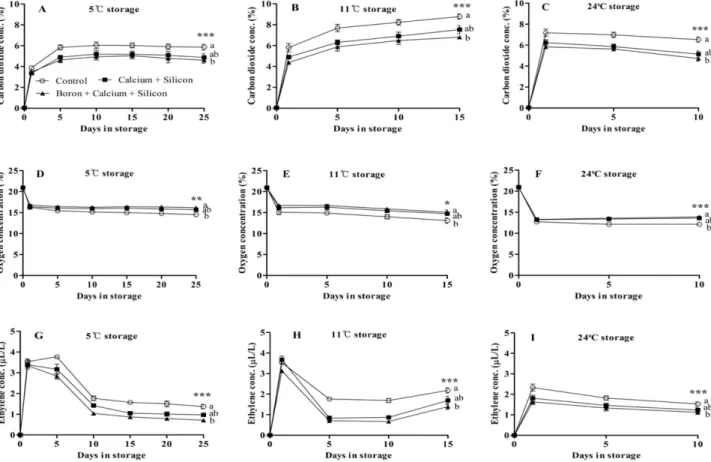
B + Ca + Si-treatment had the lowest carbon dioxide and the highest oxygen concentration which leads to fresh tomato fruits. At 10oC–15oC, 3%–5% oxygen and 3%–5%
carbon dioxide is a recommended MA atmosphere for ripe tomatoes during transport and/or storage (Kader, 2002), and our result at 5oC and 11oC was close to these findings.
The current study agrees with Islam et al. (2014), that the proper MA condition at 5oC, 11oC and 24oC is 5%–9% car- bon dioxide and 13%–16% oxygen, 5%–12% carbon diox- ide and 11%–16% oxygen, and 9%–11% carbon dioxide and 12%–14% oxygen, respectively in tomato fruits. The carbon dioxide and oxygen composition of B + Ca + Si- treated tomatoes was similar to the tomatoes in a MA con- dition with 20,000 cc at 5oC and 11oC, and 40,000 cc at 24oC (Fig. 1).
The control tomato fruits had the highest ethylene pro- duction; as a result, the tomatoes rapidly turned red and had a shorter shelf life. Ethylene reduced the kiwifruit firm- ness (Jabbar and East, 2016), and 0.5 ppm was threshold in tomato for ethylene action (Kader, 2002). The B + Ca + Si- treated tomato fruits maintained lower ethylene produc- tion; as a result, the tomatoes had a prolonged shelf life (Fig. 1).
The fresh weight loss of B + Ca + Si-treated tomato fruits at 5oC, 11oC, and 24oC had 0.24%, 0.22%, and 0.48%, respectively, which can help prolong the shelf life by maintaining fresh tomato fruits (Fig. 2). As the storage temperatures increased, so the fresh weight loss was increased, and this happened because higher temperature leads to higher respiration and evaporation (Islam et al., 2014). The lowest fresh weight loss had in B + Ca + Si – treated tomato fruits because of lower transpiration (mois- ture loss), and lower respiration. This is in agreement with
Romero-Aranda et al. (2006), which the hydrophilic nature of Si maintains moisture in tomato fruit tissues by building a barrier to protect moisture loss through the cuticle via crystals deposited in the epidermal cells.
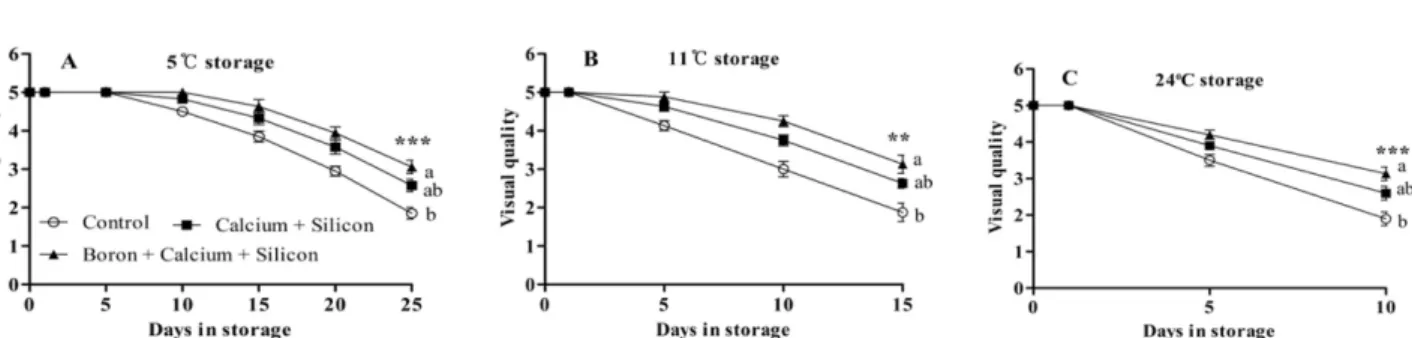
The B + Ca + Si-treated tomato fruits had the longest shelf life because they maintained their marketable visual quality (≥3) and freshness. The control, Ca + Si-, and B +
Ca + Si-treated tomato fruits had shelf life of 19, 23, and 25 days, respectively, at 5oC. Moreover, control, Ca + Si-, and B + Ca + Si-treatment maintained ten, 13, and 15 days shelf life, accordingly at 11oC. At 24oC, the control, Ca + Si-, and B + Ca + Si-treated tomato fruits had shelf life of 6, 8, and 10 days, respectively (Fig. 3). Senescent changes resulting in losses in physicochemical and nutritional quali- Fig. 1. Carbon dioxide (A, B and C), oxygen (D, E and F) and ethylene concentration (G, H and I) of cherry tomatoes at different storage temperatures. Data pointed by the mean ± standard error (n = 5). *, **, ***; significant at p≤0.05, 0.01 and 0.001 of Duncan’s multiple range tests (DMRT).
Fig. 2. Fresh weight loss (A, B and C) of tomatoes at 5oC, 11oC, and 24oC storage temperatures. Data pointed by the mean ± standard error (n = 10). *, **,***; significant at p≤0.05, 0.01and 0.001, respectively of Duncan’s multiple range tests (DMRT)
ties can be inhibited, and the fruit storage life could be markedly prolonged (Pila et al., 2010). B + Ca + Si treat- ment improve the shelf life of tomatoes by lowering respi- ration, shriveling, and internal breakdown. High temperatures influence the tomato’s respiration rate, which does not prolong the shelf life (Islam et al., 2012).
The Ca + Si -treated tomato fruits showed higher firm- ness compared with control both harvest time and after storage. Moreover, the B + Ca + Si -treated tomato fruits showed the highest firmness among the treatments both harvest time and after storage. The B maintained the Ca- pectate associations (Davis et al., 2003) and Ca treatment increased the Ca-pectate by maintaining middle lamella (Hepler and Winship, 2010) which increase the tomato fruits firmness. The B + Ca + Si-treated tomato fruits may cross-link pectin molecules in plant cell walls, and the metal binding stabilizes the cell-wall structure by the pec- tin network. B + Ca + Si-treated tomato fruits showed the highest firmness due to lower respiration, ethylene produc- tion, and color development. The B + Ca + Si-treated tomato maintained their firmness, which is desirable for
long-time storage (Table 1).
There was no significant difference in quality parame- ters (color, lycopene, soluble solids, titratable acidity and vitamin C) at harvest time among the treatments, as we selected same maturity-stage fruits (light red) to do this experiment, but these fruits showed significant differences after storage in all storage temperatures.
Color is important to sellers, buyers, and consumers when choosing tomato fruits. The B + Ca + Si-treated tomato fruits had lower color development than the other treatments due to lower respiration and ethylene produc- tion which help to prolong the shelf life. During fruit ripen- ing, loss of tissue permeability and membrane integrity (Panarese et al., 2012) and color development leads the ripeness (Islam et al., 2013) that influenced by carbon diox- ide and ethylene, thus deteriorates tomato quality and shortens the shelf life.
The maturity stages of tomato fruits influence the lyco- pene content. The B + Ca + Si-treated tomato fruits had the lowest lycopene content among the treatments (Table 1).
There is a big difference in the lycopene content in red- Fig. 3. Visual quality (A, B and C) of tomatoes at 5oC, 11oC, and 24oC storage temperatures. The visual quality was observed on the scale 1-5 (5: excellent, 4: very good, 3: good, marketable, 2: bad and 1: waste) during at 5oC storage. Data pointed by the mean ± standard error (n = 10). **; ***; significant at p≤0.01 and 0.001, respectively of Duncan’s multiple range tests (DMRT).
Table 1. Firmness, color and lycopene of cherry tomato which treated by boron (B), calcium (Ca) and silicon (Si) with MAP (20,000 cc OTR packaging film at 5oC and 11oC, and 40,000 cc OTR packaging film at 24oC).
Treatments Firmness
(N)
Color (a*/b*)
Lycopene (mg /kg FW) Storage temp. Harvest 5oC
(25days) 11oC (15days)
24oC
(10days) Harvest 5oC (25days)
11oC (15days)
24oC
(10days) Harvest 5oC (25days)
11oC (15days)
24oC (10days) Control 18.97bz 12.50b 15.87b 14.09b 0.41a 0.57a 0.67a 0.77a 86.89a 119.12a 140.67a 160.56a Ca + Si 22.17ab 15.18ab 17.62ab 16.15ab 0.41a 0.55ab 0.64ab 0.75ab 85.28a 109.44ab 132.28ab 152.71ab B + Ca + Si 24.31a 16.92a 18.22a 17.63a 0.42a 0.52b 0.60b 0.72b 84.73a 104.99b 126.52b 144.63b
P values *** *** ** *** NS ** ** ** NS * * *
ZMean assay within columns of Duncan’s multiple range tests (DMRT) (n=5). NS, *, **, ***: not significant, and significant at p ≤ 0.05, 0.01 and 0.001, respectively.
and deep-red-stage tomato fruits(Brandt et al., 2006). The control had rapid color development; thus, the fruits lost quality, market value, and shelf life quickly. However, the control had the highest soluble solids after storage and this is in agreement with Nath et al. (2012), that soluble solids may increase because of excessive moisture loss thus stim- ulate the hydrolysis of carbohydrates to soluble sugars.
Moreover, Ca treatment maintains the lowest metabolic activity during fruit storage (Goutam et al., 2010). B + Ca + Si-treated tomato fruit can form a protective barrier, and the tissue permeability and cellular metabolic changes which can slow down color development, lycopene, and soluble solids by lowering respiration, ethylene production and ripening, consequently tomatoes get prolonged shelf life.
The B + Ca + Si-treated tomato fruits had higher titrat- able acidity and vitamin C content than the other treat- ments (Table 2). Higher acidity retained by Ca-treatment due to delay ripening process and low respiration rate during storage period in Guava (Goutam et al., 2010).
Moreover, the reduced rate of metabolic activities has implication for better vitamin C (Tigist et al., 2013). The titratable acidity and vitamin C content were maintained in the B + C + Si-treated tomato fruits after storage because of lower respiration, ethylene production, ripening, and metabolic activities.
Conclusion
B + Ca + Si pre-harvest treatment and MAP storage as a postharvest condition was evaluated to know the cherry tomato quality and shelf life at 5oC, 11oC, and 24oC. The application of B + Ca + Si increases fruit firmness at har- vest time. B + Ca + Si treatment decreases carbon dioxide,
ethylene, fresh weight loss, color, lycopene, and soluble solids during storage in all storage temperatures. More- over, B + Ca + Si-treated tomato fruits retained their oxy- gen level, visual quality, firmness, titratable acidity, and vitamin C content in all storage temperatures. The B + Ca + Si treatment could help improve the cherry tomato qual- ity, shelf life and may offer an economical value to the grower, seller, buyer, and/or consumer.
Acknowledgements
This research was supported by Export Promotion Tech- nology Development Program (314027-3), IPET (Korea Institute of Planning and Evaluation for Technology in Food, Agriculture, Forestry and Fisheries), Ministry of Agriculture, Food and Rural Affairs, Korea.
Literature Cited
Brandt, S., Z. Pek, E. Barna, A.Lugasi, and L. Helyes. 2006.
Lycopene content and colour of ripening tomatoes as affected by environmental conditions. J. Sci. Food Agric.
86:568-572.
Davis, J.M., D.C. Sanders, P.V. Nelson, L. Lengnick, and W.J.
Sperry. 2003. Boron improves growth, yield, quality, and nutrient content of tomato. J. Am. Soc. Hortic. Sci.128:441- 446.
Conceicao, C.S., K.C.S. Felix, R.L.R. Mariano, E.V.
Medeiros, and E.B. Souza. 2014. Combined effect of yeast and silicon on the control of bacterial fruit blotch in melon.
Sci. Hort. 174:164-170.
Fish, W.W., P. Perkins-Veazie, and J.K. Collins. 2002. A quan- titative assay for lycopene that utilizes reduced volumes of organic solvents. J. Food Comp. Anal. 15:309-317.
Goutam, M., H.S. Dhaliwal, and B.V.C. Mahajan. 2010. Effect Table 2. Soluble solids, titratable acidity and vitamin C content of cherry tomato which treated by boron (B), calcium (Ca) and silicon (Si)
with MAP (20,000 cc OTR packaging film at 5oC and 11oC, and 40,000 cc OTR packaging film at 24oC).
Treatments Soluble solids (oBrix)
Titratable acidity (% citric acid)
Vitamin C (mg /100g FW) Storage temp. Harvest 5oC
(25days) 11oC (15days)
24oC
(10days) Harvest 5oC (25days)
11oC (15days)
24oC
(10days) Harvest 5oC (25days)
11oC (15days)
24oC (10days) Control 7.27az 7.50a 7.57a 7.59a 0.68a 0.57b 0.38b 0.37b 15.69a 8.75b 12.65b 9.94b Ca + Si 7.16a 7.25ab 7.35ab 7.37ab 0.69a 0.64ab 0.45ab 0.42ab 16.74a 10.13ab 14.41ab 12.05ab B + Ca + Si 7.11a 7.19b 7.23b 7.28b 0.71a 0.69a 0.53a 0.51a 16.98a 11.15a 15.62a 13.65a
P values NS * * ** NS ** ** ** NS * * **
ZMean assay within columns of Duncan’s multiple range tests (DMRT) (n=5). NS, *, **: not significant, and significant at p ≤ 0.05, and 0.01, respectively.
of pre-harvest calcium sprays on post-harvest life of winter guava (Psidium guajava L.). J. Food Sci. Technol.
47(5):501-506.
Hepler, P.K. and J.L. Winship. 2010. Calcium at the cell wall- cytoplast interface. J. Integr. Plant Biol. 52(2):147-160.
Islam, M.Z., Y.S. Kim, and H.M. Kang. 2012. Effect of tem- perature on the quality and storability of cherry tomato during commercial handling condition. J. Bio-Environ. Con- trol. 21(2):88-94.
Islam, M.Z., J.P. Baek, Y.S. Kim, and H.M. Kang. 2013. Char- acteristics of chilling symptoms of cherry tomato compared to beefsteak tomato harvested at different ripening stages. J.
Pure Appl. Microbio. 7:703-709.
Islam, M.Z., M.A. Mele, H.J. Lee, K.S. Lee, S.M. Hong, M.J.
Jeong, I.S. Kim, S.K. Hong, I.L. Choi, J.P. Baek and H.M.
Kang. 2014. Selection of non-perforated breathable film to enhance storability of cherry tomato for modified atmo- sphere storage at different temperatures. Protected Hort.
Plant Fac. 23:116-122.
Jabbar, A. and A.R. East. 2016. Quantifying the ethylene induced softening and low temperature breakdown of ‘Hay- ward’ kiwifruit in storage. Postharvest Biol. Technol.
113:87-94.
Jeong, C.S. and C.B. Watkins. 2010. Effects of mixed gas in active MA packaging on marketability maintenance at sim- ulated tomato fruits marketing. Hort. Environ. Biotechnol.
51(3):184-188.
Kader, A. A. 2002. Postharvest technology of horticultural crops, p.1-519. Third edition, Publication 3329, Davis: Uni- versity of California.
Khalaj, K., N. Ahmadi, and M. K. Souri. 2017. Improvement of postharvest quality of Asian pear fruits by foliar applica- tion of boron and calcium. Hortic. 3(15):1-8.
Laing, M.D., M. Gatarayiha, and A. Adandonon. 2006. Sili- con use for pest control in agriculture: A review. Proc. S.
Afr. Sug. Technol. Ass. 80:278-286.
Madani, B., M.T.M. Mohamed, C.B. Watkins, J. Kadir, Y.
Awang, and T.R. Shojaei. 2014. Preharvest calcium chlo- ride sprays affect ripening of Eksotika II’papaya fruits during cold storage. Sci. Hort. 171:6-13.
Mahajan, V.P., F.A.R. Oliveira, J.C. Montanez, and J. Frias.
2007. Development of user-friendly software for design of modified atmosphere packaging for fresh and fresh-cut pro- duce. Innov. Food Sci. Emerg. Technol. 8:84-92.
Mele M.A., M.Z. Islam, J.P. Baek, and H.M. Kang. 2017.
Quality, storability, and essential oil content of Ligularia fischeri during modified atmosphere packaging storage. J.
Food Sci. Technol. 54(3):743 -750.
Nath, A., C.D. Bidyut, S. Akath, R.K. Patel, D. Paul, L.K.
Misra and H. Ojha. 2012. Extension of shelf life of pear fruits using different packaging materials. J. Food Sci. Tech- nol. 49(5):556-563.
Panarese, V., U. Tylewicz, P. Santagapita, P. Rocculi, and M.
Dalla Rosa. 2012. Isothermal and differential scanning calo- rimetries to evaluate structural and metabolic alterations of osmo-dehydrated kiwifruit as a function of ripening stage.
Innov. Food Sci. Emerg. Technol. 15:66-71.
Pila, N., N.B. Gol, and T.V.R. Rao. 2010. Effect of post-har- vest treatments on physicochemical characteristics and shelf life of tomato (Lycopersicon esculentum Mill.) fruits during storage. Am-Euras. J. Agric. Environ. Sci. 9:470-479.
Romero-Aranda, M.R., O. Jurado, and J. Cuartero. 2006. Sili- con alleviates the deleterious salt effect on tomato plant growth by improving plant water status. J. Plant Physiol.
163:847-855.
Tesfay, S.Z., I. Bertling, and J.P. Bower. 2011. Effects of post- harvest potassium silicate application on phenolics and other anti-oxidant systems aligned to avocado fruit quality. Post- harvest Biol. Technol. 60:92-99.
Tigist, M., T.S. Workneh, and K. Woldetsadik. 2013. Effects of variety on the quality of tomato stored under ambient conditions. J. Food Sci. Technol. 50(3):477-486.
Weerahewa, D. and D. David. 2015. Effect of silicon and potassium on tomato anthracnose and on the postharvest quality of tomato fruit (Lycopersicon esculentum Mill.). J.
Natl. Sci. Found Sri. 43 (3):273-280.
Wang, Y., X. Xie and L.E. Long. 2014. The effect of posthar- vest calcium application in hydro-cooling water on tissue calcium content, biochemical changes, and quality attri- butes of sweet cherry fruit. Food Chem. 16:22-30.
붕소, 칼슘, 규소의 복합 엽면시비가 방울토마토의 품질과 MAP 조건에서 저장성에 미치는 영향
이슬람 모하메드 조히룰
1,2· 밀리 마하무다 악터
1· 한수정
1· 김주영
1· 최인이
1,2· 윤재수
1윤혁성
1· 박종만
1· 김일섭
1· 최기영
3· 강호민
1,2*
1강원대학교 원예학과, 2강원대학교 농업생명과학연구원, 3강원대학교 시설농업학과
적 요. 방울토마토의 수경재배 중 붕소+칼슘+규소 및 칼슘+규소의 복합 엽면시비가 수확 후 품질과 MAP
저장 중 저장성에 미치는 영향을 알아보고자 본 연구를 실시하였다. 엽면시비한 방울 토마토(‘Unicorn’)는 반숙 과 상태에서 수확하여 산소투과성 필름으로 포장한 5oC, 11oC, 그리고 24oC에서 25일, 15일, 10일간 저장하였 다. 붕소+칼슘+규소 복합처리한 방울토마토가 3가지 저장온도 모두에서 호흡과 에틸렌 발생이 억제되어 MAP 저장중 가장 낮은 생체중 감소와 가장 높은 외관상 품질을 보였다. 수확 후 조사한 방울토마토의 경도, 산도, 비타민 C 함량은 붕소+칼슘+규소 복합처리에서 가장 높았으며, 3가지 온도 모두에서 MAP 저장 후에도 모두 높게 유지되었다. 그러나 과피색, 라이코펜 함량과 당도는 수확 후에는 엽면시비 처리로 차이가 없었으나, 3가 지 온도 모두 붕소+칼슘+규소 복합처리에서 가장 낮은 수치를 보였다. 이상의 결과로 볼 때 붕소+칼슘+규소 복합처리는 방울토마토의 수확후 생리 작용을 억제하고 경도, 산도, 비타민 C 함량을 높여 저장성을 향상시키 는 것으로 판단되었다
추가 주제어 :에틸렌, 경도, 라이코펜, 호흡, 당도, 비타민 C.