INTRODUCTION
Cladocerans are small-sized crustaceans that occur in all freshwater habitats and can be abun- dant enough to form conspicuous swarms. They occupy a key position in freshwater communities both as important herbivores eating algae and bacteria and as a major prey item of f ish, birds or other predators (Dodson and Frey, 1991). Nu- merous investigators have been interested in these animals through the various f ields of bio- logy including taxonomy, ecology, environmental toxicology, embryology and developmental bio- logy, physiology and biochemistry, and genetics, etc. (see Yoon, 1993).
In the cladoceran taxonomy it had been tradi- tionally accepted that the most species could be
world-widely distributed through the dispersal by means of the ephippium.
However, since Frey (1973) introduced new me- thods and the f irst serious evaluation of the the- ory of cosmopolitanism, many vigorous studies to reexamine previous works have been performed over various cladoceran taxa. It has been shown that many previous descriptions often concerned either species complexes or intraspecif ic units, and is believed that most described species need revision (see Korovchinsky, 1996).
Simocephalus Schödler is one of the common group of daphniid cladocerans found in littoral aquatic vegetation all over the world. Members of the genus have frequently been investigated as the subjects in the various limnological and ecological studies (Ferrari et al., 1991; Brock et al., 1992; Bertilsson et al., 1995; Koksvik, 1995;
* Corresponding author: Tel & Fax: 82-62-230-7018, E-mail: [email protected]
─
─ 152 ──
Taxonomic Review of the Cladoceran Genus Simocephalus (Branchiopoda, Anomopoda, Daphnidae) in Korea, with
Redescription of Simocephalus mixtus
Yoon, Seong Myeong*and Won Kim1 (Department of Biology Education, College of Education,
Chosun University, Kwangju 501-759, Korea, 1Department of Molecular Biology, College of Natural Sciences, Seoul National University, Seoul 151-742, Korea)
한국산 시모물벼룩속 (새각강, 이지목, 물벼룩과) 종들의 분류학적 검토와 요술시모물벼룩 (Simocephalus mixtus)의 재기재. 윤성명*∙김 원1 (조선대학교 사범대학 생물교육과, 1서울 대학교 자연과학대학 분자생물학과)
1981년5월부터1999년 6월까지 남한의97개 지소의 다양한 담수역에서 채집된 표본들에 근거하 여 요술시모물벼룩(Simocephalus mixtus Sars)을 재기재하였으며, 한국에서의 시모물벼룩속 종들 의 과거 기록들을 검토하였다. 이 종은 최근까지 극동아시아 지역에서 긴눈시모물벼룩(S. vetulus (O.F. Müller)) 및 S. vetuloides Sars와 분류학적으로 혼동되었거나 오동정되었던 종이다. 본 종은 갑각의 후배각이 낮고 넓게 돌출하였고, 갑각의 등쪽 가장자리의 뒷부분이 팽창하였으며, 머리의 부리에 가까운 배쪽 가장자리 부위가 깊게 함몰되어 있고, 길쭉한 모양의 단안을 가지며, 후복부 발톱의 기부에 빗모양의 가시군이 없다는 점에서 근연종들과 구별된다.
Key words : Redescription, Taxonomic review, Simocephalus mixtus, Korea
Lauridsen et al., 1996). Though having long his- tory, the taxonomy of the genus had remained unsatisfactory before the recent work by Orlova- Bienkowskaja (1998). She redescribed and revis- ed more than 60 previously recorded species and/
or subspecies of the genus Simocephalus, and described two new species by the reexamination of previous works and materials. Through this study a lot of previously recorded species were synonymized and regarded as the invalid ones, and some were turned out to be the species groups. Presently 20 species of the genus are known as the valid ones in the world (Orlova- Bienkowskaja, 1988).
In the Far East total four Simocephalus spec- ies were recorded from Far Eastern China (Ch- iang and Du, 1979), Japan (Ueno, 1927a; Mizuno and Takahashi, 1991), and Korea (Yoon and Kim, 1987; Kim, 1988). Among them invalid records of S. vetulus (O.F. Müller, 1776) were included in the present point of view (Orlova-Bienkowskaja, 1988). Most of all the previous works were lack- ing precise descriptions and detailed drawings of the species, insuff icient to tell their status exac- tly. The Far Eastern Simocephalus is therefore in need of the reinvestigation including the rede- scriptions of recorded species.
When studying cladoceran fauna, the senior author of the present study found out that S.
mixtus Sars, 1903, new to Korean fauna, was widely distributed in Korea. He also suspected that most records of S. vetulus in the Far East were probably the erroneous ones of S. mixtus.
In the present paper S. mixtus from Korea is re- described, and the taxonomy of the genus Sim- ocephalus in the Far East is discussed.
MATERIALS AND METHODS
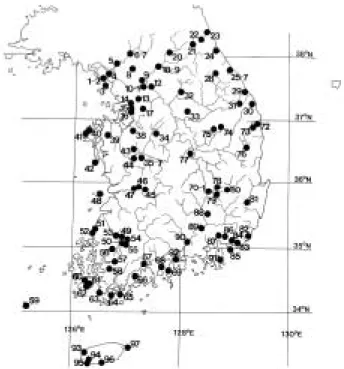
The materials of Simocephalus were collected from the various freshwater habitats such as rice-fields, lakes, rivers, streams, and reservoirs of 97 localities in south Korea during the period from May 1981 to June 1999 (Fig. 1). Collections were made with a conical plankton net and a dipnet (both 155µm in mesh size). Samples were f ixed with 10% formalin, and preserved in 4%
formalin.
The samples were inventoried to determine the presence and the reproductive state of the spec- ies under a Olympus stereomicroscope. Each specimen was transferred to a drop of glycerol in
a reversed slide for subsequent study. Tempo- rary mounts of whole specimens in glycerol were used for the measurements and the drawings of intact animals and their parts. Whole bodies were dissected with tungsten needles to examine antennules, antennae, carapaces, trunk limbs, postabdomens, postabdominal claws, and other parts. Drawing and measuring were made with a Olympus compound microscope attached by the drawing tube system. All specimens examined are deposited in the senior author’s collection.
More than 20 parthenogenetic female speci- mens were examined in every samples collected from 97 localities of the present study. The appendix includes the station number, its loca- lity and other informations. Collectors were not referred when the specimens were collected by the authors themselves.
RESULTS AND DISCUSSION 1. Redescription of species
Simocephalus mixtus Sars, 1903 요술시모물벼 룩(신칭) (Figs. 2, 3)
Simocephalus mixtus Sars, 1903, p. 174, Pl. 6, Figs. 4, 4a; Orlova-Bienkowskaja, 1998, p. 11, Fig. 23.
Fig. 1. Localities from which the specimens were collect- ed.
Simocephalus vetulus (non O.F. Müller, 1776):
Ueno, 1927a, p. 281; 1927b, p. 160, Fig. 2; Chiang and Du, 1979, p. 125, Fig. 80; Du and Mizuno, 1981, p. 62, Fig. 25; Negrea, 1983, p. 138, Fig.
55H (part); Yoon and Kim, 1987, p. 184, Fig. 4a- d; Kim, 1988, p. 55, Figs. 19, 20; Mizuno and Takahashi, 1991, p. 143.
Simocephalus elizabethae (non King, 1853):
Manuilova, 1964, p. 148, Fig. 50.
Simocephalus vetuloides (non Sars, 1898): Chi- ang and Du, 1979, p. 126, Fig. 81; Michael and Sharma, 1988, p. 75, Fig. 21e.
Material Examined: Numerous specimens of parthenogenetic females collected from every 97 localities listed in the ‘Appendix’.
Parthenogenetic female: General shape (Fig.
2a). Body bilaterally compressed, almost oval in outline of lateral view. In lateral view, head short and wide, distinctly separated from body by indentation at dorsocephalic suture; ventral margin deeply concave. Dorsal margin of cara- pace strongly expanded posteriorly. Dorso-pos- terior caparace angle distinct. Color yellowish or red-brown.
Carapace (Figs. 2a-c). Surface reticulated; reti- culation consisting of oblique stripes somewhat intersecting in most parts of carapace, and of irregular polygons along marginal area (Figs. 2a, c). Dorsal margin arched in middle, strongly expanded posteriorly, smoothly connected anteri- orly to that of head shield, and distinctly indent- ed near posterior end forming prominent dorso- posterior carapace angle with posterior part of ventral margin; dorso-posterior carapace angle short and very wide. Ventral margin nearly stra- ight and posterior margin evenly curved. Dorsal, posterior and ventral margins ornamented with denticles; denticles on region from midway of dorsal margin to dorso-posterior carapace angle strong and naked, arranged in 2 rows, while those on posterior and ventral margins very weak and indistinct, f inned with wide transpar- ent membrane, and arranged in 1 row along margin (Figs. 2a, c). Inner surface with row of plumose setae on ventral margin, followed by row of minute spinules groups on posterior mar- gins, and with 3~5 serrated denticles near ven- tro-posterior carapace angle (Fig. 2c).
Head (Fig. 2a). Comparatively small and short;
length about 1/5 of carapace length. Anterior and dorsal margins evenly curved, ventral margin deeply depressed near rostrum; width increasing
conspicuously into proximal part. Rostrum long and pointed. Frons rounded, right-angled and without denticles. Eye large, shifted ventrally and f illing apart in short distance from anterior margin. Ocellus elongate, arrow-shaped.
Antennule (Fig. 2d). Tubular, having 9 aesthet- es unequal in length at distal end and 1 sensory papilla arising from tubular mound on anterior proximal side.
Antenna (Fig. 2e). Small, slightly shorter than half of carapace length. Antennal formula 0(0)- 0(1)-1(0)-3(0)/1(0)-1(0)-3(0); approximate leng- th ratios of exopod segments relative to basipod length 0.10, 0.35, 0.30 and 0.20, endopod seg- ments 0.40, 0.30, and 0.25. Basipod having 1 sharp and long spine on outer lateral side near distal end and with 3 plumose sensory setae; two of which originating from outer lateral side near base of segment, while other one present on di- stal end between 2 rami of endopod and exopod.
Each of all segments covered with transverse rows of f ine setules along whole length, and with transverse row of small spinules at distal end.
Exopod and endopod segments with clumps of hairs on inner surfaces.
Trunk limbs. Five trunk limbs of general forms of genus (f igures not given).
Postabdomen (Fig. 2f ). Large, slightly tapering into postabdominal claw; dorsal margin some- what protruding in middle and indented distally;
ventral margin expanded proximally; distal mar- gin strongly depressed to forming large anal bay on dorsal half, and making prominent supra- anal angle with distal part of dorsal margin. Dis- tal margin provided with 2 rows of anal teeth increasing in size distally; each row comprising 10~13 curved teeth, distal 3~5 of which orna- mented with f ine setules and others smooth; cur- vature somewhat increasing in distal teeth; area near bases of anal teeth with groups of minute setules. Dosal and dorso-lateral surface covered with clusters of very f ine spinules. Abdominal setae very short, slightly longer than postabdo- minal claws. Abdominal processes well develop- ed, 2 in number; f irst process sparsely setulosed while second nearly naked.
Postabdominal claw (Fig. 2g). Large, bent dor- sally at about proximal 2/3 of length, without basal pecten of spines. Dorsal margin from base to tip having row of minute spinules arranged along concave dorsal edge. Ventral surface with semicircular row of f ine spinules near base. Ven-
tral margin smooth, without any ornamenta- tions.
Variation: Variabilities, especially on the shape of carapace, according to age could be easily found (Fig. 3). In immature parthenogenetic females, the brood pouch is small and the dorsal carapace margin is nearly straight. The promi- nence on the dorso-posterior carapace angle is not distinct. Mature females have a distinct dor-
so-posterior carapace angle prominence. The shape of brood pouch in mature female depends on the number of eggs and on the developmental stage of embryos. This much effect the whole shape of individuals. The head grows slower than the carapace. Ocellus is always elongate, but the size and the shape are more or less vari- able to individuals within populations, without the relation to age.
Fig. 2. Simocephalus mixtus Sars, lateral view of parthenogenetic female. a, habitus; b, carapace surface near dorso- posterior carapace angle; c, inner view of carapace near ventro-posterior carapace angle; d, antennule; e, antenna;
f, postabdomen; g, distal part of postabdomen. Scales: a = 0.5 mm; b-g = 0.1 mm.
Size: Length range (from anteriormost part of head to posteriormost part of carapace) of ma- ture parthenogenetic females carrying eggs is 1.11~2.04 mm.
Remarks: This species was usually recorded under the name of S. vetulus (O.F. Müller) or S.
vetuloides Sars in the Far East (Ueno, 1927a, b;
Chiang and Du, 1979; Du and Mizuno, 1981;
Yoon and Kim, 1987; Kim, 1988; Mizuno and Takahashi, 1991). Though most previous descrip- tions and drawings are incomplete, they make it possible to recognize the species from diagnostic features such as short and wide dorso-posterior carapace angle prominence, distally protruding dorsal margin of the carapace, deep depression of the ventral head margin near the rostrum, and the elongate ocellus.
Distribution: Asia including the Far East (Ru- ssia, Korea, China, Japan), Eastern Europe, Nor- th Africa, North America.
2. Taxonomic review and ecological note In Korea, Yoon and Kim (1987) f irst described Korean populations of two Simocephalus species, S. vetulus (O.F. Müller, 1776) and S. exspinosus (Koch, 1841), and Kim (1988) presented the taxonomic key for Korean cladocerans including additional species, S. serrulatus (Koch, 1841).
After these, only S. vetulus was dealt in several limnological studies (Yoo and Lim, 1991; Ha et al., 1995; Kim, 1996; Lim et al., 1997), further taxonomic study has not been made. So total thr- ee Simocephalus species are reported in Korea.
Among them, S. vetulus is known to be common and widely distributed over various types of lotic and lentic freshwater habitats, while other two species are very rare and usually restricted to the lentic habitats of ponds and reservoirs (Yoon and Kim, 1987; Kim, 1988). All of above three species are also recorded from China and Japan,
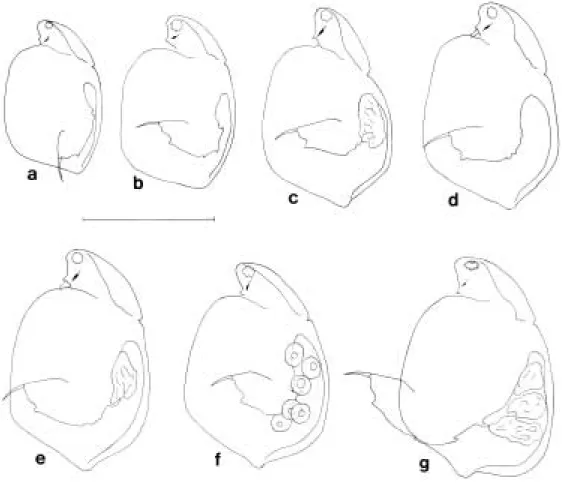
Fig. 3. Variability of Simocephalus mixtus Sars in parthenogenetic female. a-e, population collected from a small reservoir in Kwangju; f, population from the rice-f ields in Yongin, Ky ˇonggi-do; g, population from the Kanjung reservoir in Wanju, Ch ˇollabuk-do.
and another species, S. vetuloides Sars, 1898, is recorded from China in the Far East (Chiang and Du, 1979; Mizuno and Takahashi, 1991).
Because based on the theory of cosmopolitani- sm, previous works in Korea were not made carefully and including many erroneous informa- tions as those in other countries were. Recently it was proved that many Simocephalus species had been incorrectly described under different names and a lot of different species were errone- ously recorded under the same name in the world (see Orlova-Bienkowskaja, 1988). Among three species recorded from Korea, S. vetulus has long been known as the representative of world- widely distributed species, but it’s practical geo- graphic range seems to be restricted to Europe and North Africa (Orlova-Bienkowskaja, 1988).
So the previous reports of S. vetulus from the Far East including Korea are questionable and un- substantiated.
Only a few characters such as the shape of the frons of head, the ornamentation of postabdomi- nal claw, and the protuberance of the dorsal margin of carapace have been used for discrimi- nating Simocephalus species in the Far East (Chinag and Du, 1979; Yoon and Kim, 1987;
Kim, 1988; Mizuno and Takahashi, 1991). All the previous descriptions and drawings are very short and somewhat doubtful. Previous authors overlooked several important characteristic fea- tures found on the carapace and the head, while exaggerated some variabilities like the number of anal teeth in the present point of view. Such problems included in the monograph of China (Chiang and Du, 1979), the representative work in this region, were recently pointed out by seve- ral authors over various cladoceran taxa includ- ing Simocephalus (Korinek, 1987; Orlova-Bien- kowskaja, 1988; Korovchinsky and Mirabdullaev, 1995). Though having insuff icient informations, the previous reports in the Far East show a re- markable characteristic feature of S. exspinosus and S. serrulatus, respectively. That is, the basal pecten of postabdominal claw in S. exspinosus and the frons having denticles in S. serrulatus are well noticeable (Chinag and Du, 1979; Yoon and Kim, 1987; Kim, 1988; Mizuno and Takaha- shi, 1991).
According to recent work by Orlova-Bienkows- kaja (1988), each of above features is one of the most useful characteristics in discriminating the species from other related species, respectively.
From this with the consideration of other general shapes presented, previous records of the two species are acceptable. The previous reports also show that the species recorded as S. vetulus has a noticeable feature of the short and wide dorso- posterior carapace angle prominence. Another record of S. vetuloides from China shows the same feature. The two species could not be dis- tinguishable from each other in any parts of des- criptions and drawings except in the outline dif- ference of the dorsal margin of carapace (Ueno, 1927b; Chiang and Du, 1979; Du and Mizuno, 1981; Yoon and Kim, 1987; Kim, 1988; Mizuno and Takahashi, 1991). Considering the variabi- lity for the shape of dorsal carapace margin according to age in Simocephalus species, there is a high possibility that the two species are the same one.
In the present study, the authors examined the Korean Simocephalus materials that have a short and wide prominence on the dorso-pos- terior carapace angle. The materials included a part of previous authors’ specimens dealt as S.
vetulus (Yoon and Kim, 1987; Kim, 1988). They superficially seemed to be composed of two differ- ent groups in the protrusion of dorsal carapace margin, the vetulus-type and the vetuloides- type referred to Chiang and Du (1979), but any other distinguishable features between the two were not found. So the authors investigated the variability, especially on the shape of carapace, in the present study (Fig. 3). It was found that above two types of individuals were usually mix- ed up within every large population samples exa- mined. It also appeared that the differences of individuals were mostly the ref lections of differ- ent growth stages. In immature parthenogenetic females, the brood pouch was small and the dor- sal carapace margin was nearly straight. The prominence on the dorso-posterior carapace an- gle was relatively not distinct (Figs. 3a-d). But mature female had a distinct dorso-posterior carapace angle prominence. The shape of brood pouch in mature female depended on the number of eggs and on the developmental stage of embr- yos. It much effected the whole shape of indivi- duals (Figs. 3e-g). All the Korean materials were eventually turned out to be S. mixtus Sars. This result strongly supports that previous records of both S. vetulus and S. vetuloides are erroneous ones of S. mixtus in the Far East.
Simocephalus mixtus was f irst described from
the Sudjil-gol river in Mongolia by Sars (1903).
It was characterized by smooth and rounded frons of head, elongate ocellus, and protruding dorsal carapace margin in the original descrip- tion (Sars, 1903). After the f irst description, S.
mixtus had frequently been considered to be a synonym of S. vetulus or that of S. elizabethae (King, 1853) (Manuilova, 1964; Negrea, 1984).
Recently Orlova-Bienkowskaja (1988) revealed that S. mixtus differs from both S. vetulus and S.
elizabethae with examining the type materials.
S. mixtus is now regarded as one of the most widely distributed Simocephalus species in the world (Orlova-Bienkowskaja, 1988).
Diagnostic features of S. mixtus are presently known as follows: (1) frons of head is smooth, without denticles, (2) ventral head margin near the rostrum is strongly depressed, (3) ocellus is elongate, (4) dorso-posterior carapace angle pro- minence is distinct, but short and wide, (5) dor- sal margin of carapace is protruding posteriorly, and (6) postabdominal claw is lacking the pecten of denticles. S. mixtus especially has a close re- semblances with S. vetulus, but it differs from the latter by the larger prominence on the dorso -posterior carapace angle, the strong depression on the ventral head margin near the rostrum, and the large protrusion of the dorsal margin of carapace in mature female. S. vetuloides is also closely related to S. mixtus in having that the dorsal carapace margin is expanded posteriorly.
But it is differentiated from the latter by the high and narrow prominence on the dorso-pos- terior carapace angle. Previous record of S. vetu- loides in China (Chiang and Du, 1979), which shows a large but short and wide prominence on the dorso-posterior carapace angle, is therefore turned to be a erroneous one of S. mixtus. On the other hand, S. mixtus can be easily distinguish- able from S. exspinosus by having the naked postabdominal claw without pecten, and from S.
serrulatus by having the smooth frons of head without denticles (Manuilova, 1964; Negrea, 1984; Orlova-Bienkowskaja, 1988).
The Korean materials are well accorded with those of other countries reported recently (Orlova -Bienkowskaja, 1988). Any remarkable differ- ences or variations could not be observed except that of carapace shape mentioned above. Especi- ally the structures of all the trunk limbs are the typical ones of the genus. Only minor variability of the ocellus in the elongation and the shape can
be found (Fig. 3). It seems to be an accidental variation to individuals within populations, with- out the relation to age.
In conclusion, the above results show that only three species, S. mixtus, S. exspinosus and S.
serrulatus, are presently acceptable in the Far East. However, there is a possibility that another species remains to be known because the taxono- my of Simocephalus is still very poor and needed further study in this region.
Among three species, S. mixtus is one of the most common species among the littoral clado- cerans in various freshwater habitats including rice-f ields, swamps, bogs, streams, ponds, lake waters, reservoirs and rivers in Korea (see Ap- pendix). It much prefers small waters to large ones, and usually lives in the aquatic vegetation in large water bodies.
It can be found throughout all seasons except the period of freezing in the permanent water bodies (see Appendix). Individuals of the species often swarm in large water bodies such as reser- voirs and rivers in warm season.
ABSTRACT
Simocephalus mixtus Sars was redescribed and illustrated from Korea. It had been frequently confused with S. vetulus (O.F. Müller) and S.
vetuloides Sars in the Far East. Redescription was based on the materials collected from vari- ous freshwater habitats at 97 localities in South Korea during the period from May 1981 to June 1999. Previous records of Simocephalus species from Korea were examined. S. mixtus is well dis- tinguishable from other related species by hav- ing short and wide dorso-posterior carapace an- gle prominence, distally protruding dorsal mar- gin of carapace, deep depression of the ventral head margin near the rostrum, elongate ocellus, and postabdominal claw lacking the basal pecten of denticles.
ACKNOWLEDGEMENTS
This study was supported by research funds from Chosun University, 1996.
REFERENCES
Bertilsson, J., B. Berzins and B. Pejler. 1995. Occur- rence of limnic micro-crustaceans in relation to
temperature and oxygen. Hydrobiologia 299: 163 -167.
Brock, T.C.M., S.J.H. Crum, R. van Wijngaarden, B.J. Budde, J. Tijink, A. Zuppelli and P. Leeu- wangh. 1992. Fate and effects of the insecticide Dursban 4E in indoor Elodea-dominated and macrophyte-free freshwater model ecosystems: I.
Fate and primary effects of active ingredient chl- orpyrifos. Arch. Environ. Contam. Toxicol. 23: 69- 84.
Chiang, S.C. and N.S. Du. 1979. Fauna Sinica, Cru- stacea, Freshwater Cladocera. Science Press, Pek- ing, pp. 297 (in Chinese).
Dodson, S.I. and D.G. Frey. 1991. Cladocera and other Branchiopoda, p. 723-786. In: Ecology and Classif ication of North American Freshwater Invertebrates (J.H. Thorps and A.P. Covich, eds.).
Academic Press, New York.
Du, N.S. and T. Mizuno. 1981. Remarks on Fresh- water Cladocerans of China and Japan. Tatara Publ., Kyoto, pp. 209 (in Japanese).
Ferrari, I., A. Bachiorri, F.G. Margaritora and V.
Rossi. 1991. Succession of cladocerans in a nor- thern Italian ricefield. Hydrobiologia 225: 309- 318.
Frey, D.G. 1973. Comparative morphology and bio- logy of three species of Eurycercus (Chydoridae, Cladocera) with a description of Eurycercus macr- acanthus sp. nov. Int. Revue ges. Hydrobiol. 58:
221-267.
Ha, H.J., S.T. Kim, J.U. Choi, S.H. Min, T.Y. Jang and G.H. Kim. 1995. Acute toxicity on water f leas and Photobacterium phophoreum for heavy me- tals. Korean J. Lim. 28: 369-376 (in Korean).
Kim, I.H. 1988. Key to the Korean freshwater Cla- docera. Korean J. Syst. Zool. Special Issue 2: 43- 65 (in Korean).
Kim, I.H. 1996. Occurrence of the planktonic crusta- ceans in relation to pH in the rice f ields of the ea- stern Korea. Korean J. Lim. 29: 233-240 (in Kor- ean).
Koksvik, J.I. 1995. Seasonal occurrence and diel locomotor activity in littoral Cladocera in a meso- humic lake in Norway. Hydrobiologia 307: 193- 201.
Korinek, V. 1987. Revision of three species of the genus Diaphanosoma Fischer, 1890. Hydrobiolo- gia 145: 35-45.
Korovchinsky, M.M. 1996. How many species of Cla- docera are there? Hydrobiologia 321: 191-204.
Korovchinsky, M.M. and I.M. Mirabdullaev. 1995. A new species of the genus Diaphanosoma Fischer, 1850 (Crustacea: Daphniiforms: Sididae) from Central Asia and China. Hydrobiologia 304: 235- 242.
Lauridsen, T.L., L.J. Pedersen, E. Jeppesen and M. S ndergaard. 1996. The importance of macrophyte bed size for cladoceran composition and horizontal migration in a shallow lake. J. Plankton Res. 18:
2283-2294.
Lim, B.J., B.C. Kim, K.I. Yoo and J.K. Yoo. 1997.
Changes in zooplankton community during the blue-green algal bloom in the Nakdong River.
Korean J. Lim. 30: 337-346 (in Korean).
Manuilova, E.F. 1964. Vetviatousye Rachki Fauny SSSR (Cladocera). Nauka Publ. Moscow, pp. 326.
Michael, R.G. and B.K. Sharma. 1988. Fauna of In- dia, Indian Cladocera (Crustacea: Branchiopoda:
Cladocera). Zoological Survey of India Publicat- ions, Calcutta, pp. 262.
Mizuno, T. and E. Takahashi. 1991. An Illustrated Guide to Freshwater Zooplakton in Japan. Tokai Univ. Publ., Tokyo, pp. 532 (in Japanese).
Negrea, St. 1983. Cladodera, Fauna Republicii Socia- liste Romania, 4(12). Academiei, Bucuresti, pp.
399.
Orlova-Bienkowskaja, M.J. 1998. A revision of the cladoceran genus Simocephalus (Crustacea, Daph- niidae). Bull. nat. Hist. Mus. Lond. (Zool.) 64: 1- 62.
Sars, G.O. 1903. On the crustacean fauna of Central Asia, Part II, Cladocera. Ann. Mus. Zool. St. Pe- tersburg. 8: 157-194 (English Translation by Isr- ael Program Scientific Translation, Jerusalem).
Ueno, M. 1927a. The freshwater Branchiopoda of Japan I. Mem. Coll. Sci. Kyoto Imp. Univ. Ser. B 2: 259-311.
Ueno, M. 1927b. On some freshwater branchiopods from China. Annot. Zool. Japon. 11: 157-163.
Yoo, K.I. and B.J. Lim. 1991. Seasonal variation in the zooplankton community structure of the lower Han River system. Korean J. Lim. 24: 85-91 (in Korean).
Yoon, S.M. and H.S. Kim. 1987. A systematic study on the freshwater Cladocera from Korea. Korean J. Syst. Zool. 3: 175-207 (in Korean).
Yoon, S.M. 1993. The Systematics and Molecular Evolution of the Korean Branchiopods (Crustacea, Branchiopoda). Ph.D. Thesis, Seoul National Uni- versity, Seoul, pp. 364.
APPENDIX.
Station list
Inch’ˇon: sta 1, rice-f ields at T ˇoks ˇong-ri, Pul ˇun-myˇon, Kanghwa-gun, Apr. 24, 1991, H.B. Kong; sta 2, rice-f ields at Shinhy ˇon-ri, Pul ˇun-my ˇon, Kanghwa-gun, Apr. 26, 1991, M.K. Shin; sta 3, rice-fields at Chungsan-dong, Y ˇongjong Is., Ongjin-gun, Mar. 22, 1996, C.Y. Chang.
Kyˇonggi-do: sta 4, rice-fields at Kunha-ri, W ˇolgot-myˇon, Kimp’o-gun, Sep. 10, 1990, K.S. Min; sta 5, Imjin-gang at My ˇondong-ri, Munsan-ˇup, P’aju-gun, May 6, 1988, C.Y. Chang; sta 6, a small reservoir at Ch ˇongok-ri, Ch ˇongok-ˇup, Y ˇonch’ ˇon-gun, May 6, 1988, C.Y. Chang; sta 7, Hant’an-gang at Changt’an-ri, Ch’ ˇongsan-my ˇon, Y ˇonch’ ˇon-gun, May 6, 1988, C.Y. Chang; sta 8, rice-fields at Changhy ˇon-ri, Chinj ˇop-my ˇon, Namyangju-shi, May 5, 1991; sta 9, rice-fields at Mukhy ˇon-ri, Hwado-ˇup, Namyangju-shi, Jun. 6, 1989, C.B. Kim; sta 10, Han-gang at Choan-ri, Choan-my ˇon, Namyangju-shi, Jul. 15, 1984, C.Y. Chang; sta 11, Han-gang at Yangsu-ri, Yangs ˇo-my ˇon, Yangp’y ˇong-gun, Aug. 11, 1991; sta 12, Han-gang at Yangg ˇun-ri, Yangp’y ˇong-ˇup, Yangp’y ˇong-gun, Apr. 24, 1994; sta 13, rice-f ields at Chubuk- ri, Yangji-my ˇon, Yongin-shi, May 20, 1996; sta 14, rice-fields at Py ˇongj ˇom-ri, T’aean-ˇup, Hwas ˇong-gun, Apr. 28, 1996;
sta 15, rice-f ields at Such’ ˇong-dong, Osan-shi, Apr. 21, 1991; sta 16, rice-f ields at S ˇoj’ ˇong-dong, Songt’an-shi, Apr. 21, 1991; sta 17, Kosam reservoir at Kosam-my ˇon, Ans ˇong-gun, Jul. 21, 1986.
Kangwˇon-do: sta 18, Kongji-ch’ ˇon, Ch’unch’ ˇon-shi, Aug. 16, 1990; sta 19, a pond in Kangwon Univ., Ch’unch’ ˇon-shi, Oct. 31, 1981, I.H. Kim; sta 20, P’aroho, Gandong-my ˇon, Hwach’ ˇon-gun, Jun. 22, 1986; sta 21, rice-fields at Shinnam-ri, Nam-my ˇon, Inje-gun, May 22, 1996; sta 22, a swamp at Paektam valley in S ˇorak-san, Aug. 28, 1994; sta 23, a swamp near Songjiho, Chukwang-my ˇon, Kos ˇong-gun, Jul. 18, 1996, I.H. Kim; sta 24, rice-fields at Namae-ri, Hy ˇongnam- my ˇon, Yangyang-gun, May 24, 1981, I.H. Kim; sta 25, Ky ˇongp’ oho, Kangr ˇung-shi, Jun. 22, 1986; sta 26, rice-f ields at Chiby ˇon-dong, Kangr ˇung-shi, May 24, 1986, I.H. Kim; sta 27, Namdaech’ ˇon, Kangr ˇung-shi, Jun. 1, 1981, I.H. Kim; sta 28, a stream at Yongp’y ˇong, H ˇoinggye-my ˇon, Py ˇongch’ang-gun, Jun. 26, 1986, I.H. Kim; sta 29, rice-fields at Kyo-dong, Samch’ ˇok-shi, May 2, 1991; sta 30, rice-fields at Imwon-ri, Wond ˇok-ˇup, Samch’ ˇok-shi, Jun. 8, 1986, I.H. Kim; sta 31, rice-f ields at N ˇukku-ri, Togye-ˇup, Samch’ ˇok-shi, May 5, 1987; sta 32, a stream at Mugye-ri, S ˇowon-my ˇon, Hoings ˇong- gun, Jul. 20, 1986, I.H. Kim.
Ch’ungch’ˇongbuk-do: sta 33, rice-f ields at Kuhak-ri, Pongyang-ˇup, Chech’ ˇon-shi, Jun. 24, 1986, I.H. Kim; sta 34, rice-f ields near My ˇongamji, Ch’ ˇongju-shi, Jun. 14, 1986, I.H. Kim.
Taejˇon: sta 35, Gapch’ ˇon at Guam-dong, Yus ˇong-gu, May 3, 1999; sta 36, Gapch’ ˇon at Ch ˇonmin-dong, Yus ˇong-gu, May 3, 1999; sta 37, a stream at Hakha-dong, Yus ˇong-gu, Aug. 25, 1990, C.Y. Chang.
Ch’ungch’ˇongnam-do: sta 38, Ans ˇo reservoir, Ch’ ˇonan-shi, Jun. 4, 1988, K.S. Min; sta 39, Muhanch’ ˇon at Changjae- ri, Kwangshi-my ˇon, Yesan-gun, Sep. 15, 1996; sta 40, Ilho reservoir, W ˇonbuk-my ˇon, Taean-gun, May 24, 1996; sta 41, a pond at the Ch’ ˇollip’o Tree Garden, Sow ˇon-my ˇon, Taean-gun, Oct. 7, 1985; sta 42, rice-f ields in W ˇonsan Is., Och’ ˇon- my ˇon, Pory ˇong-shi, Aug. 1, 1986; sta 43, rice-fields at Pomul-ri, Ch ˇongam-my ˇon, Kongju-shi, Apr. 28, 1996; sta 44, rice-fields at Chungjang-ri, Kyeryong-my ˇon, Kongju-shi, Aug. 25, 1990, C.Y. Chang.
Chˇollabuk-do: sta 45, Kanjung reservoir, Yongjin-my ˇon, Wanju-gun, Apr. 20, 1991; sta 46, Mangy ˇong-gang at Nak- p’ y ˇong-ri, Pongdong-ˇup, Iksan-shi, May 4, 1999; sta 47, Mangy ˇong-gang at Yongj ˇong-dong, Ch ˇonju-shi, May 4, 1999;
sta 48, rice-fields in S ˇonyu Is., Kunsan-shi, May 6, 1986.
Kwangju: sta 49, Y ˇongsan-gang at Yonggang-dong, Puk-gu, Apr. 24, 1996; sta 50, a small reservoir at Ch’ ˇongok-dong, Tong-gu, Apr. 17, 1996.
Chˇollanam-do: sta 51, rice-fields at Songam-ri, Y ˇomsan-my ˇon, Y ˇonggwang-gun, Aug. 6, 1996; sta 52, rice-fields at Yaw ˇol-ri, Y ˇomsan-my ˇon, Y ˇonggwang-gun, Aug. 6, 1996; sta 53, rice-fields at Punhyang-ri, Nam-my ˇon, Changs ˇong- gun, May 18, 1996; sta 54, rice-fields at Y ˇonch’ ˇon-ri, Nam-my ˇon, Tamyang-gun, Apr. 17, 1996; sta 55, Kwangjuho, Kos ˇo -my ˇon, Tamyang-gun, Nov. 27, 1995; sta 56, Y ˇongsan-gang at Y ˇongsanp’o, Naju-shi, Apr. 28, 1997; sta 57, rice-fields at Kaesin-ri, Y ˇongam-ˇup, Y ˇongam-gun, Jul. 28, 1988, K.S. Min; sta 58, W ˇolnam reservoir, S ˇongj ˇon-my ˇon, Y ˇongam-gun, Jul. 22, 1994; sta 59, a bog in Soh ˇuksan Is., Shinan-gun, Aug. 26, 1987, C.B. Kim; sta 60, rice-f ields atˇupnae-ri, Chindo- ˇup, Chindo-gun, Jun. 4, 1996; sta 61, Osan reservoir, Kogun-my ˇon, Chindo-gun, Nov. 1, 1994; sta 62, rice-fields at Hyangdong-ri, Kogun-my ˇon, Chindo-gun, Jun. 5, 1996; sta 63, rice-fields at Songho-ri, Songji-my ˇon, Haenam-gun, Jun. 2, 1990; sta 64, a pond at Wando Fishery High School, Wando-ˇup, Wando-gun, Jul. 8, 1986, I.H. Kim; sta 65, rice- fields in Shinji Is., Wando-gun, Jun. 15, 1996; sta 66, Haktong reservoir, Tod ˇok-my ˇon, Koh ˇung-gun, Jan. 30, 1991, C.Y.
Chang; sta 67, rice-f ields at Hoij ˇong-ri, P ˇolgyo-ˇuop, Pos ˇong-gun, Sep. 18, 1989; sta 68, rice-f ields at Chusam-dong, Y ˇoch’ ˇon-shi, Apr. 25, 1990; sta 69, rice-fields at Seguji, Tolsan Is., Y ˇoch’ ˇon-shi, Apr. 26, 1990.
Taegu: sta 70, K ˇumho-gang at Tongho-dong, Tong-gu, Jun. 19, 1999; sta 71, K ˇumho-gang at P’aldal-dong, Puk-gu, Jun. 19, 1999.
Kyˇongsangbuk-do: sta 72, a bog at Y ˇonji-ri, Uljin-ˇup, Uljin-gun, May 7, 1987, M.O. Song; sta 73, S ˇongryugul, Uljin, May 14, 1988, K.S. Min; sta 74, rice-fields at Soro-ri, Ch’unyang-my ˇon, Ponghwa-gun, May 5, 1987; sta 75, rice-f ields at Kang-dong, Y ˇongju-shi, Jul. 4, 1986, I.H. Kim; sta 76, Map’ ˇongch’ ˇon at W ˇolmak-dong, Ch’ ˇongsong-ˇup, Ch’ ˇongsong- gun, May 27, 1988, C.Y. Chang; sta 77, a well at K ˇumsan-dong, Haep’y ˇong-my ˇon, S ˇonsan-gun, Apr. 17, 1991, C.Y.
Chang; sta 78, Hayangch’ ˇon at Hayang-ˇup, Ky ˇongsan-shi, Sep. 20, 1996; sta 79, rice-f ields at Naeri-ri, Chinryang- my ˇon, Ky ˇongsan-shi, Sep. 20, 1996; sta 80, K ˇumho-gang, K ˇumho-ˇup, Y ˇongch’ ˇon-shi, Jun. 19, 1999; sta 81, Pomun reservoir, Ky ˇongju-shi, May 29, 1988, C.Y. Chang.
Pusan: sta 82, rice-f ields at Songj ˇong-dong, Haeundae-gu, Apr. 3, 1994; sta 83, Naktong-gang at Noksan-dong, Kangs ˇo-gu, Aug. 10, 1987, M.O. Song; sta 84, Maekto-gang at My ˇongji-dong, Kangs ˇo-gu, Aug. 7, 1986; sta 85, a spring at Nulch’a-dong in Kad ˇok Is., Kangs ˇo-gu, Sep. 23, 1987.
Kyˇongsangnam-do: sta 86, rice-f ields at Mangch’ ˇon-ri, Hanrim-my ˇon, Kimhae-shi, May 29, 1991; sta 87, rice-fields at Shinbang-ri, Tong-my ˇon, Ch’angw ˇon-shi, May 29, 1991; sta 88, Up’onˇup, Ibang-my ˇon, Ch’angny ˇong-gun, Jun. 26, 1988, M.O. Song; sta 89, Chilnaln ˇup, P ˇopsu-my ˇon, Haman-gun, Apr. 4, 1989; sta. 90, a swamp at Kaho-dong, Chinju- shi, Jul. 6, 1986, I.H. Kim; sta 91, rice-fields at Manch’i-ri, Ilun-my ˇon, K ˇoje-shi, May 5, 1989; sta 92, rice-f ields at Och’ ˇon-ri, S ˇolch’ ˇon-my ˇon, Namhae-gun, Jul. 20, 1990.
Cheju-do: sta 93, rice-fields at Yongsu-ri, Hangy ˇong-my ˇon, Namjeju-gun, Feb. 10, 1987; sta 94, a swamp at Pos ˇong- ri, Taej ˇong-ˇup, Namjeju-gun, Nov. 1, 1986, I.H. Kim; sta 95, rice-fields at Tumo-ri, Taej ˇong-ˇup, Namjeju-gun, Apr. 26, 1990, K.S. Min; sta 96, a swamp near Ch’ ˇonjiy ˇon, S ˇoguip’o-shi, Feb. 10, 1987; sta 97, a bog in U Is., Feb. 2, 1987.
APPENDIX. Continued.