Effects of Ethylsalicylic Acid on Growth and Rubisco/Rubisco Activase in Tobacco Plant Cultured under Cadmium Treatment in vitro
Kwang Soo Roh* and Qiu Jie Cui
Department of Biology, Keimyung University, Daegu 704-701, Korea
Received February 6, 2014 /Revised April 3, 2014 /Accepted May 7, 2014
Growth induced by cadmium (Cd) and ethylsalicylic acid (ESA) and the effect of ESA on rubisco/ru- bisco activase were studied in tobacco. The effect of denaturants on rubisco/rubisco activase was also investigated. In order to determine optimal concentration of ESA for growth of tobacco, tobacco was treated with 10
-6-10 mM. It was found that its growth was the highest at 10
-4mM ESA. In the experi- ment using control, Cd treated group, ESA treated group, and Cd and ESA mixture group, ESA alone showed the highest growth and Cd showed the lowest growth. Cd treated group was the lowest in both rubisco/rubisco activase content and activity. ESA reduced the rubisco/rubisco activase content, but increased their activity. The activity of rubisco was inhibited by treating L-cysteine, urea, thiourea, β -mercaptoethanol, and EDTA other than guanidine-HCl in control group. L-cysteine, urea, thiourea, and guanidine-HCl treatments showed no change, but β-mercaptoethanol and EDTA increased rubisco activase activity. In conclusion, ESA inhibited the content of rubisco and promoted its activity, where- as promoted the content of rubisco activase and inhibited its activity. In addition, the content and ac- tivity of rubisco and rubisco activase inhibited by Cd were recovered by ESA. The activity of rubisco and rubisco activase by Cd and ESA was inhibited by the denaturant and the recovery of ESA in- hibited by Cd was lost by the denaturant.
Key words : Cadmium, denaturant, ethylsalicylic acid, rubisco, rubisco activase, tobacco
*Corresponding author
*Tel : +82-53-580-5207, Fax : +82-53-580-5164
*E-mail : [email protected]
This is an Open-Access article distributed under the terms of the Creative Commons Attribution Non-Commercial License (http://creativecommons.org/licenses/by-nc/3.0) which permits unrestricted non-commercial use, distribution, and reproduction in any medium, provided the original work is properly cited.
Journal of Life Science 2014 Vol. 24. No. 5. 558~566 DOI : http://dx.doi.org/10.5352/JLS.2014.24.5.558
Introduction
Rubisco (ribulose 1,5-bisphosphate carboxylase/oxygen- ase) is an enzyme involving a reaction generating PGA (phosphoglycerate) from RuBP (ribulose 1,5-bisphosphate) and CO
2, a carbon fixation during dark reaction of photosyn- thesis [3]. Rubisco, which is the most abundant protein in plant, is located in stroma and accounts for about 15% of total chloroplast protein [8]. Rubisco has 560 kDa of molec- ular weight and consists of 8 large subunits with 55 kDa of molecular weight and 8 small subunits with 15 kDa of molecular weight. The large subunits are encoded from chloroplast genes and the small subunits are encoded from nuclear genes and then they are assembled in the chloroplast after protein synthesis [26].
Rubisco activase acts as a chaperone to control the activity of rubisco [16]. This enzyme keeps rubisco to be highly ac-
tive in vivo and has activity of ATPase [12] and controlled by rubisco activase under presence of RuBP and ATP [21, 34]. In addition, the rubisco activase plays a role in dissociat- ing several kinds of sugar phosphate bound to active region of rubisco [9].
The heavy metal cadmium (Cd) is one of the major envi- ronmental contaminants [17]. When present at elevated lev- els in water and soil it is readily absorbed by root systems and accumulated mainly in the vacuoles to higher concen- tration, thereby inducing reduced growth and impaired me- tabolism in plants [29]. Cd delays development and differ- entiation in plant and is known as a substance disturbing metabolism of nucleic acids and proteins as well as photo- synthesis, photorespiration, and nitrogen metabolism [24].
Ethylsalicylic acid (ESA) is a chemically synthesized de-
rivative of salicylic acid (SA) [23] which alleviates the heavy
metal ion toxicity, and has antibiotic activity [6]. ESA has
166 Da of molecular weight and is a colorless fluid, which
changes to yellow under light [13]. Although ESA can be
mixed with ethanol and ether, it is not a material synthesized
naturally in plant and that can be synthesized chemically
by reaction with ethanol. Poly [bis (ethyl salicylate) phos-
phazenes] and poly [bis (ethyl salicylate diethylamino)
phosphazenes] synthesized from ESA are not only applied
- Note -
to biocompatibility, soft tissue artificial organ, chemical ther- apy model and drug delivery system in biomedical area, but also classified into degradable material due to their charac- teristics [1, 2].
Like these, although reports on ESA synthesis and its de- rivatives and antibacterial action for ESA have been known [6], there is no report on plant growth, rubisco, and rubisco activase by ESA in tobacco. In previous study, we de- termined that influence of SA on Cd induced rubisco/ru- bisco activase, and effect of denaturants on its activity in tobacco grown in vitro were studied [30]. Therefore in this study, an effect of ESA on Cd was studied by identifying the effect of ESA on growth of tobacco and rubisco/rubisco activase and effects of denaturants on its activity.
Materials and Methods Apparatus and chemicals
Refrigerator centrifuge (Kontron T-324, Korea), fraction collector (Bio-Rad 2110, CA, USA), UV-VIS spectropho- tometer (GeneQuant 100, GE Heal thcare, England), and ELISA microplate reader (Bio-Rad 680, CA, USA) were used in our study. All chemicals were obtained from Sigma- Aldrich (St. Louis, MO, USA) unless noted otherwise.
Tobacco culture and growth
Tobacco (Nicotiana tabacum L.) seeds sterilized in 70%
(v/v) ethanol and 3% (v/v) sodium hypochlorite solution were germinated and grown aseptically in MS agar medium [14]. Four week-old shoots were cut into 3 cm segments for use as explants. For determination of optimal concentration of ESA, three explants were placed on an induction MS me- dium of 10
-6mM – 10 mM ESA concentrations, respectively and then cultured for 10 weeks. For measurement of effect of ESA and Cd on growth, rubisco and rubisco activase, ex- plants were cultured in MS medium of control (without Cd and ESA), 10
-4mM ESA, Cd (0.2 mM CdCl
2·2.5H
2O), ESA + Cd for 12 weeks at 26±1℃ under a 16-h light (800 μ M/m
2/s PFD) and 8-h dark photoperiod [20]. Fully ex- panded leaves from mature plants were used for experiments. All experiments were independently triplicated.
Isolation of rubisco and rubisco activase
Isolation of rubisco and rubisco activase from tobacco leaves was used the methods from Wang et al. [31]. Frozen leaf tissue was grounded in the extraction buffer containing
50 mM BTP (pH 7.0), 10 mM NaHCO
3, 10 mM MgCl
2, 1 mM EDTA, 0.5 mM ATP, 10 mM DTT, 1 mM PMSF, 1 mM benzamidine, 0.01 mM leupeptin, 1.5% PVPP, and 3 mM MBT. The leaf slurry was filtered through four layers of cheesecloth and one layer of Miracloth. Filtered solution was centrifuged at 30,000x g for 40 min. Ammonium sulfate pow- der was slowly added into the supernatant to 35% saturation stirring for 30 min. The supernatant containing rubisco and pellet containing rubisco activase were collected by cen- trifugation at 8,000x g for 10 min, respectively. The super- natant collected was brought to 55% saturation of ammo- nium sulfate by addition of powder. The pellect collected by centrifugation at 8,000x g for 10 min was resuspended in 20 mM BTP (pH 7.0) containing 0.2 mM ATP, 10 mM MgCl
2and 2 mM MBT (buffer A), and 50% PEG-10K was added to a final concentration of 18%. The precipitate was collected by centrifugation at 8,000× g for 10 min.
Resuspended solution in buffer A was applied to a Q-Sepharose column equilibrated with 20 mM Tris (pH 7.5), 10 mM MgCl
2, and 10 mM NaHCO
3. The column washed with the same buffer containing 0.1 M NaCl was eluted with a linear gradient from 0.1 to 0.5 M NaCl at a flow rate of 1.5 ml/min. 3 ml fractions were pooled to provide for assay of rubisco content and activity.
50% (w/v) PEG-10K was added into the buffer A re- suspended pellet obtained above to the final concentration to 18%, stirred 5 min, and centrifuged at 8,000 × g for 10 min. The pellet was dissovled in buffer A. Solution was cleared by spinning at 20,000x g for 10 min. Pellet was re- suspended again in buffer. The collected supernatants were applied to a Q-Sepharose column equilibrated with 20 mM BTP (pH 7.0). The column washed with 20 mM BTP (pH 7.0) was eluted with a linear gradient from 0 to 0.5 M NaCl in 20 mM BTP (pH 7.0) at a flow rate of 1 ml/min. 3 ml fractions were pooled to provide for assay of rubisco activase content and activity. All processing were done at 4℃ except as indicated.
Measurement of content and activity of rubisco Rubisco content was determined at 280 nm spectrophoto- metrically, and calculated by the following equation [32]:
Content (mg/ml) = A
280× 0.61. Rubisco activity was de-
termined spectrophotometrically by NADH oxidation at 340
nm [18]. The reaction mixture contained 1 M Tris buffer (pH
7.8), 0.006 M NADH, 0.1 M GSH, 0.5% glyceraldehyde-
3-phosphate dehydrogenase, 0.025 M 3-phosphoglycerate
Fig. 1. The fresh weight of tobacco plant cultured on MS me- dium containing various concentrations of ESA for 10 weeks.
kinase, 0.05% α-glycerophosphate dehydrogenase-triose phosphate isomerase, 0.025 M RuBP, 0.2 M ATP, 0.5 M MgCl
2, 0.5 M KHCO
3, and isolated rubisco solution. One unit of enzyme was defined as the amount of enzyme producing 1 μM of RuBP per min.
Measurement of content and activity of rubisco activase
Rubisco activase content was determined at 595 nm by the method of Bradford [4] using bovine serum albumin as a standard. Rubisco activase activity was determined as the ability to produce ADP at 340 nm [19]. The isolated rubisco activase solution was added to the activation reaction mix- ture containing 50 mM Tricine (pH 8.0), 20 mM KCl, 10 mM MgCl
2, 1 mM ATP, 1 mM phosphoenolpyruvate, 0.3 mM NADH, 40 units/ml pyruvate kinase, and 40 units/ml lac- tate dehydrogenase. One unit was defined as the amount that catalyzed the cleavage of 1 μM ATP per min.
Measurement of activity of rubisco and rubisco activase by denaturants
10 mM L-cysteine, 10 mM β-mercaptoethanol, 10 mM EDTA, 10 mM urea, 10 mM thiourea, and 10 mM guani- dine-HCl as denaturants were used in this study. Activity of rubisco and rubisco activase was determined by 6 dena- turants using reaction mixture of measurement of rubisco and rubisco activase activity, respectively. Results were cal- culated presuming the activity of denaturants untreated con- trol as 100%.
Statistical analysis
Data were analyzed using a one-way analysis of variance (ANOVA) accompanied with Tukey's tests and Student's t-test (SPSS for Windows, Ver. 21). Standard error between replicates was also calculated.
Results
Effects of ESA on growth of tobacco plant To measure total fresh weights to compare growth of to- bacco depending on ESA concentration after in vitro culture in MS media containing no ESA and MS media containing ESA from 10
-6mM to 10 mM of ESA, it was found that total fresh weight was 9.2 g in control, 13 g at 10
-6mM, 13 g at 10
-5mM, 17 g at 10
-4mM, 11 g at 10
-3mM, 8 g at 10
-2mM, 8 g at 10
-1mM, 4.2 g at 1 mM, and 2.76 g at 10 mM.
Thus it was suggested that the plants had the highest value
of fresh weight and its weight decreased when the ESA con- centration increases more over 10
-2mM. The 10
-4mM ESA obtained from this result was used as optimal concentration (Fig. 1).
Influences of Cd and ESA on growth of tobacco plant
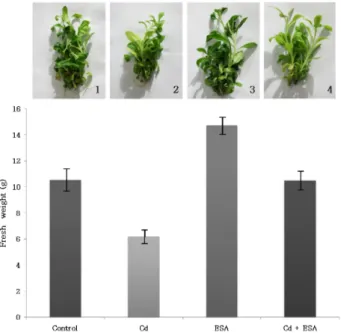
Effects of ESA and Cd on tobacco growth were studied through in vitro culture of tobacco in MS medium. The growth of ESA treated group was the best and the growth of Cd treated group was the lowest. The control and the mixed group showed similar growth results. As results of comparing growth between the Cd treated group and con- trol, it was found that the growth of Cd treated group was lower and the growth of ESA treated group was higher in comparison of growth between the control and ESA treated group. In addition in comparing growth between the Cd treated group and the Cd and ESA mixed group, the Cd treated group showed lower growth. As results of compar- ing growth among the Cd treated group, the ESA treated group, and the Cd and ESA mixed group, it was identified that ESA recovered growth inhibition by Cd (Fig. 2 upper).
In order to confirm the above results, total fresh weights were measured in tobacco. It was identified that the results were in same trend to the results of Fig. 2 upper as 10.495 g of the control, 6.195 g of the Cd treated group, 15.538 g of the ESA treated group, and 10.495 g of the Cd and ESA mixed group (Fig. 2 lower).
Influences of Cd and ESA on content and activity of rubisco
It was found that the content of rubisco was 0.05 mg/ml
Fig. 2. Effect of Cd and ESA on growth of tobacco plants. Total fresh weight of tobacco plant was determined. in vitro culture of tobacco was performed on MS medium with- out Cd + ESA (control, 1), with Cd (2), 10
-4mM ESA (3), and Cd + ESA (4), respectively, for 12 weeks.
Fig. 3. Effect of Cd and ESA on content of rubisco in tobacco leaves. Plants were cultured on MS medium without Cd + ESA (control), with Cd, 10
-4mM ESA, and Cd + ESA, respectively.
Fig. 4. Effect of Cd and ESA on activity of rubisco in tobacco leaves. Plants were cultured on MS medium without Cd + ESA (control), with Cd, 10
-4mM ESA and Cd + ESA, respectively.
in the control, 0.01 mg/ml in the Cd treated group, 0.02 mg/ml in the ESA treated group, and 0.02 mg/ml in the Cd and ESA mixed group, so the content of the control was the best and the Cd treated group showed the lowest content. The ESA treated group and the mixed group showed same content. As results of comparing the content between the Cd treated group and the control, it was found that the content of Cd treated group was lower and the ESA treated group showed lower content in comparison of growth between the control and the ESA treated group. In addition in comparing content between Cd treated group and Cd and ESA mixed group, the Cd and ESA mixed group showed higher content. As results of comparing content among the Cd treated group, the ESA treated group, and the Cd and ESA mixed group, it was identified that ESA recovered growth inhibition by Cd but did not reach the level of control (Fig. 3).
It was found that the activity of rubisco was 0.280 unit/ml in the control, 0.274 unit/ml in the Cd treated group, 0.304 unit/ml in the ESA treated group, and 0.280 unit/ml in the Cd and ESA mixed group, so the activity of the ESA treated group was the best and the Cd treated group showed the lowest activity. The ESA treated group and the mixed group showed same activity. The activity of control and Cd and ESA mixed group was same. In comparing the activity be-
tween the Cd treated group and the control, the Cd treated group showed lower activity and in comparing activity be- tween the ESA treated group and the control, the EST treated group sowed higher activity. In addition, in comparing ac- tivity between the ESA treated group and the Cd and ESA mixed group, it was found that the ESA treated group showed higher growth. As results of comparing the activity among the Cd treated group, the ESA treated group, and the Cd and ESA mixed group, it was identified that ESA recovered activity inhibition by Cd up to the level of control (Fig. 4).
Influences of Cd and ESA on content and activity of rubisco activase
It was suggested that the content of rubisco activase was
Fig. 5. Effect of Cd and ESA on content of rubisco activase in tobacco leaves. Plants were cultured on MS medium without Cd + ESA (control), with Cd, 10
-4mM ESA, and Cd + ESA, respectively.
Fig. 6. Effect of Cd and ESA on activity of rubisco activase in tobacco leaves. Plants were cultured on MS medium without Cd + ESA (control), with Cd, 10
-4mM ESA, and Cd + ESA, respectively.
greater in order of ESA > control > Cd + ESA > Cd treated group, as 0.013 mg/ml in the control, 0.010 mg/ml in the Cd treated group, 0.015 mg/ml in the ESA treated group, and 0.011 mg/ml in the Cd and ESA mixed group. As results of comparing the content between the Cd treated group and the control, it was found that the content of Cd treated group was lower and the ESA treated group showed higher content in comparison of content between the control and the ESA treated group. In addition, in comparing the content be- tween the Cd treated group and the Cd and ESA mixed group, the Cd and ESA mixed group showed higher content.
As results of comparing content among the Cd treated group, the ESA treated group, and the Cd and ESA mixed group, it was identified that ESA recovered growth in- hibition by Cd, but did not reach the level of control (Fig.
5).
It was suggested that the activity of rubisco activase was greater in order of control > ESA > Cd + ESA > Cd treated group, as 0.278 unit/ml in the control, 0.250 unit/ml in the Cd treated group, 0.269 unit/ml in the ESA treated group, and 0.265 unit/ml in the Cd and ESA mixed group. In com- paring the activity between the Cd treated group and the control group, the Cd treated group showed lower activity and in comparing the activity between the ESA treated group and the control, the ESA treated group showed lower activity. In addition, when comparing the activity between the ESA treated group and the Cd and ESA mixed group, it was found that the ESA treated group showed higher activity. As results of comparing the activity among the Cd treated group, the ESA treated group, and the Cd and ESA
mixed group, it was identified that ESA recovered growth inhibition by Cd, but did not reach the level of control (Fig.
6).
Influences of denaturants on rubisco activity To determine the effects of denaturant on the activity of rubisco, it was found that for control, the activity of rubisco was 83% in L-cysteine, 79% in β-mercaptoethanol, 79% in EDTA, 75% in urea, 83% in thiourea, and 100% in guani- dine-HCl; for the Cd treated group, it was 46% in L-cysteine, 38% in β-mercaptoethanol, 46% in EDTA, 50% in urea, 46%
in thiourea, and 50% in guanidine-HCl; for the ESA treated
group, it was 42% in L-cysteine, 42% in β-mercaptoethanol,
46% in EDTA, 46% in urea, 46% in thiourea, and 62% in
guanidine-HCl, and; for the Cd and ESA mixed group, it
was 46% in L-cysteine, 50% in β-mercaptoethanol, 58% in
EDTA, 50% in urea, 67% in thiourea, and 54% in guani-
dine-HCl. It was suggested that all the 5 types of denaturant
inhibited the activity of rubisco in control, the activity of
rubisco was inhibited by L-cysteine, urea, thiourea, β-mer-
captoethanol, and EDTA except guanidine-HCl. In the ESA
treated group, higher activity was shown than the Cd treated
group in thiourea and β-mercaptoethanol. In comparing the
activity between the Cd treated group and the Cd and ESA
mixed group, it was found that the Cd and ESA mixed group
showed higher activity in the other denaturants except
L-cysteine and urea (Table 1). As shown in the above, it was
shown that the activity of rubisco by Cd and ESA was in-
hibited by denaturants and recovery effect of ESA against
Cd was lost by the denaturants.
Table 1. Effects of denaturants on rubisco activity Denaturants Rubisco activity (%)
Control
1Cd
2ESA
3Cd+ESA L-Cysteine
β -Mercaptoethanol EDTA
Urea Thiourea Guanidine-HCl
83 79 79 75 100 83
46 38 46 50 46 50
42 42 46 46 62 50
46 50 58 50 67 54
1
no treated with Cd and ESA
2
0.2 mM CdCl
22.5H
2O
3
10
-4mM ESA
Table 2. Effects of denaturants on rubisco activase activity Denaturants Rubisco activase activity (%)
Control
1Cd
2ESA
3Cd+ESA L-Cysteine
β -Mercaptoethanol EDTA
Urea Thiourea Guanidine-HCl
100 120 120 100 100 100
60 60 60 60 50 40
60 40 60 60 60 60
60 80 60 60 60 60
1
no treated with Cd and ESA
2
0.2 mM CdCl
22.5H
2O
3