• 검색 결과가 없습니다.

The Effect of Soil Texture on Fruits and Growth Properties in Rabbiteye Blueberries

N/A
N/A
Protected

Academic year: 2021

Share "The Effect of Soil Texture on Fruits and Growth Properties in Rabbiteye Blueberries"

Copied!
6
0
0

로드 중.... (전체 텍스트 보기)

전체 글

(1)

The Effect of Soil Texture on Fruits and Growth Properties in Rabbiteye Blueberries

Hong-lim Kim, Yong-Bum Kwack, Mock-hee Lee, Won-Byoung Chae

1

, Youn-Young Hur

2

, and Jin-Gook Kim

3,4

*

Namhae branch, NIHHS, RDA, Namhae 52430, Korea

1

Vegetable Research Division, NIHHS, RDA, Wanju 55365, Korea

2

Fruit Research Division, NIHHS, RDA, Wanju 55365, Korea

3

Department of Horticulture, Gyeongsang National University, Jinju 52828, Korea

4

Insti. of Agric. & Life Sci., Gyeongsang National University, Jinju 52828, Korea

(Received: September 15 2015, Revised: October 25 2015, Accepted: November 3 2015)

This study was conducted to compare the plant growth and fruit quality of blueberries grown in different soil textures of Korea, in order to utilize the results for stable production and soil improvement. Rabbiteye blueberry cultivars ‘Tifblue’ and ‘Baldwin’ were planted and grown for three years from 2013 in wagner pot (1 2000 a -1 ) in a greenhouse of Namhae Sub-station, Institute of Horticultural and Herbal Science. The plants were grown in four soil textures, sand, sandy loam, loam and silt loam, and nutrient uptake and growth characteristics of plants were investigated. Leaf nitrogen and phosphorus contents of two cultivars grown in different soil textures ranged between 8.6 to 10.5 g kg -1 , which was lower than appropriate level for rabbiteye blueberry. However, the contents of potassium, calcium and magnesium in leaves were appropriate levels as 2.29~3.62 g kg -1 , 4.46~5.46 g kg -1 and 1.45~2.12 g kg -1 , respectively. Nitrogen and phosphate contents in leaves were higher in the two cultivars grown in silt loam soil. There was no significant difference in plant volume and root dry weight among four soil textures in two cultivars. However, dry weight of leaves and branches were highest in loam soil. Fruit production was highest in loam and silt loam soil in two cultivars, showing negative correlation with the amount of sand in soil. However, sugar and acidity showed no correlation with sand content in soil. These results show the limit to the blueberry growth in soil that has no nutrient holding capacity; however, most of Korean soils that have good nutrient holding capacity can produce competitive fruits if the drainage is improved.

Key words: Soil texture, Rabbiteye blueberry, Growth properties

Effect of soil texture on the fruit properties and yields of rabbiteye blueberry cultivars.

Soil texture Fruit weight Soluble solids Titratable acidity Yield

‘Baldwin’

g berry

-1

°Bx % g bush

-1

Silt loam 1.75

ns†

15.5

a

0.47

b

1,901

a

Loam 1.96 14.9

ab

0.67

a

1,691

a

Sandy loam 1.88 15.8

a

0.65

a

958

b

Sand 2.18 12.4

b

0.65

a

947

b

‘Tifblue’ Silt loam 1.31

b

14.5

ns

0.63

b

1,066

a

Loam 1.18

b

14.9 0.73

a

1,058

a

Sandy loam 1.36

b

17.2 0.67

ab

607

ab

Sand 1.93

a

15.9 0.71

ab

246

ab

Mean separation within columns by Duncan’s multiple range test at p=0.05.

1)

*Corresponding author: Phone: +82557721918, Fax: +82557721919, E-mail: [email protected]

§

Acknowledgement: This study was funded by a research program (PJ00924401) of Rural Development Administration (RDA), Korea.

(2)

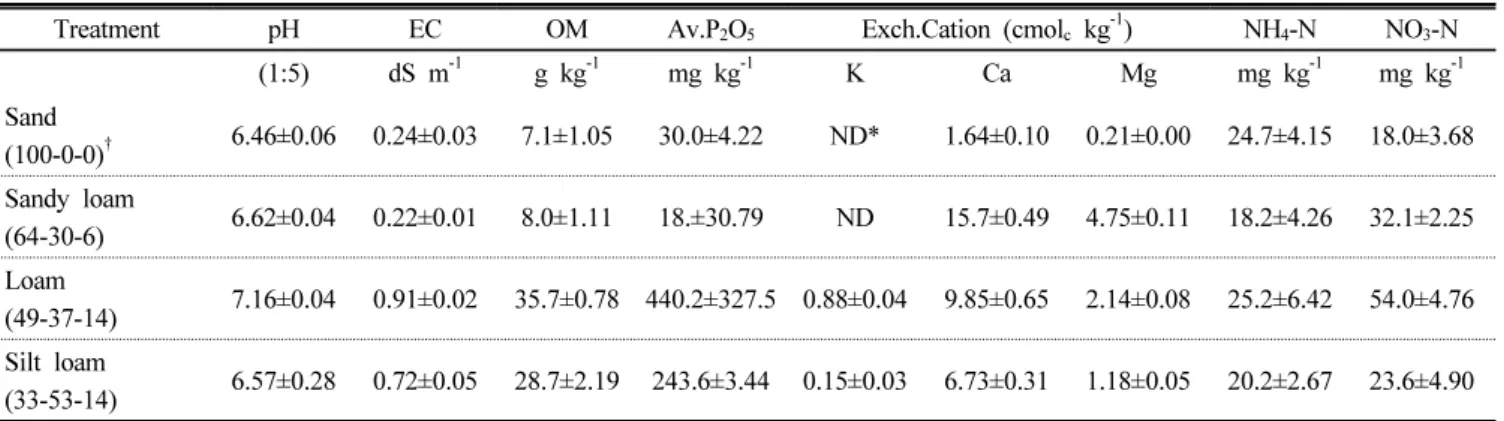
Table 1. Physicochemical properties of soil used in experiment.

Treatment pH EC OM Av.P

2

O

5

Exch.Cation (cmol

c

kg

-1

) NH

4

-N NO

3

-N (1:5) dS m

-1

g kg

-1

mg kg

-1

K Ca Mg mg kg

-1

mg kg

-1

Sand

(100-0-0)

6.46±0.06 0.24±0.03 7.1±1.05 30.0±4.22 ND* 1.64±0.10 0.21±0.00 24.7±4.15 18.0±3.68 Sandy loam

(64-30-6) 6.62±0.04 0.22±0.01 8.0±1.11 18.±30.79 ND 15.7±0.49 4.75±0.11 18.2±4.26 32.1±2.25 Loam

(49-37-14) 7.16±0.04 0.91±0.02 35.7±0.78 440.2±327.5 0.88±0.04 9.85±0.65 2.14±0.08 25.2±6.42 54.0±4.76 Silt loam

(33-53-14) 6.57±0.28 0.72±0.05 28.7±2.19 243.6±3.44 0.15±0.03 6.73±0.31 1.18±0.05 20.2±2.67 23.6±4.90

(Sand,%-Silt,%-Clay,%)

*Not detected

Introduction

블루베리는 크게 북부형 (Vaccinium corymbosum L.)과 남부형 (Vaccinium corymbosum hybrid)하이부쉬 그리고 래빗아이 블루베리 (Vaccinium ashei Reade)로 구분된다 (Spiers et al., 1985). 이들 블루베리는 뿌리털이 없고 근권 이 얕아 양·수분 이용능력이 매우 제한적이라는 기본 특성 에는 큰 차이가 없다 (Abbott and Gough, 1987; Coville, 1910; Gough, 1994; Jaco bs et al., 1982; Korcak, 1989).

이런 특성은 블루베리의 자생지가, 산성요구특성과는 별개 로, 양분의 농도가 일정하고 기상과 액상의 순환이 잘 이루 어지는 호수나 이탄습지의 가장자리에 왜 집중되는지를 잘 설명해 준다 (Brown and Draper, 1980; Cain and Eck, 1966; Haynes and Swift, 1985; Holmes, 1960). 결국 이와 같은 생태적 제한성은 신규 재배농가에게 배수성이 높거나 모래함량이 많은 토양에 재식하도록 강요하고 있다 (Coville, 1910; Haynes and Swift, 1985; Kim et al., 2010; Korcak, 1989).

한편, 국내 농경지 토양의 표토 토성은 사양토, 양토 그 리고 미사질양토가 비슷한 비율로 전체 토성의 90%를 차지 하고 있다 (Kang et al., 2012, 2014; Kim and Jo, 1998;

Kim et al., 2003). 이들 토성은 점토함량이 약 20~30%이 하로 비슷한 반면, 모래와 미사의 함량차가 크다. 모래함량 의 증가는 원활한 배수 및 통기 환경을 제공하지만, 점토와 미사에 비해 표면적이 적어 양· 수분 공급이 제한적이다.

반면 점토와 미사의 함량증가는 상대적으로 배수가 불량해 지는 단점을 가지고 있다 (Billings, 1987; Davidson and Lefebvre, 1993; Sands and Bowen, 1978; Sands et al., 1979; Theodorou et al., 1991; Yapa et al., 1988). 토성의 종류 즉 입자의 구성비율은 유기물의 무기화 (Hassink et al., 1993), 입단구조 (Mamedov et al., 2007; Tisdall and Oades, 1982), 미생물 군집구조의 다양성 (Bach et al., 2010; Chau et al., 2011) 등 토양 물리적, 생물학적 안정성

에 큰 영향을 준다 (Juma, 1993). 따라서 이와 같은 모재토 양의 토성차이는 토양 개량방향과 재식품종의 선정 등 예정 지 관리와 재식방법에 큰 영향을 줄 것으로 판단된다. 그러 나 국내외 블루베리 재배토양의 연구는 주로 유기물과 토양 반응에 대한 연구에 집중되고 있어 토성에 따른 직접적인 생육 및 과실특성에 대한 연구는 미미한 실정이다.

따라서 본 연구는 국내 주요 토성에 따른 블루베리의 생 장과 과실특성을 비교함으로써 블루베리 안정생산을 위한 기초 자료로 활용하고자 한다.

Materials and Methods

작물재배 내력 본 연구는 국립원예특작과학원 남해출

장소 시설하우스에서 2012부터 3년간 2년생 ‘Tifblue’와

‘Baldwin’ 래빗아이 블루베리를 1 2000 a

-1

wagner pot (0.05 m

2

)에 재식하여 수행하였다. 시험에 사용된 토양의 종류는 Sand, Sandy loam, Loam 그리고 Silt loam 4종류의 토성을 이용하였다 (Table 1).

각 시험포트의 양분관리는 미시간 주립대학에서 제공하 는 시비량을 바탕으로 유안 (질소)-과석 (인산)-황산칼리 (칼리)를 각각 66.7 g-82 g-31 g m

-2

year

-1

(14 g plant

-1

)을 시용하였으며, 질소와 칼리는 기비 60%, 추비 40%로 분할 하여 시비하였고, 인산은 전량 기비 하였다 (Hanson and Hancock, 1996).

토양 및 식물체 분석 블루베리의 생장특성은 수고,

수관면적 그리고 건물중을 조사하였다. 수고는 줄기의 지제

부에서 선단 끝까지의 길이를, 수관면적은 수고와 가장 넓

은 두 방향의 수폭을 측정하여 부피로 수치화 하였다. 건물

중과 엽중 무기성분 조사를 위한 식물체 시료는 10월 하순에

채취하여 총 질소는 Kjeldahl법으로, 인산은 Vanadate법으

로, 칼슘 등 무기성분은 습식분해후 ICP로 분석하였다 (RDA,

2000). 과실의 당도는 굴절당도계로, 산함량은 0.1N NaOH

(3)

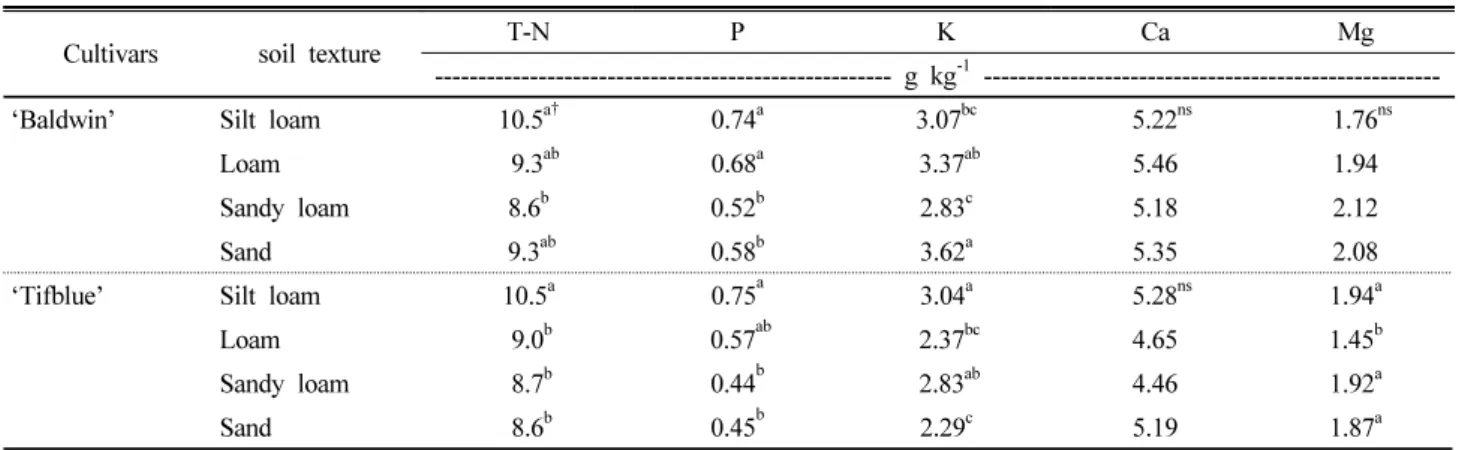
Table 2. Effect of soil texture on the content of nutrients in leaves of rabbiteye blueberry cultivars.

Cultivars soil texture T-N P K Ca Mg

--- g kg

-1

---

‘Baldwin’ Silt loam 10.5

a†

0.74

a

3.07

bc

5.22

ns

1.76

ns

Loam 9.3

ab

0.68

a

3.37

ab

5.46 1.94

Sandy loam 8.6

b

0.52

b

2.83

c

5.18 2.12

Sand 9.3

ab

0.58

b

3.62

a

5.35 2.08

‘Tifblue’ Silt loam 10.5

a

0.75

a

3.04

a

5.28

ns

1.94

a

Loam 9.0

b

0.57

ab

2.37

bc

4.65 1.45

b

Sandy loam 8.7

b

0.44

b

2.83

ab

4.46 1.92

a

Sand 8.6

b

0.45

b

2.29

c

5.19 1.87

a

Mean separation within columns by Duncan’s multiple range test at p=0.05.

측정법으로 조사하였다. 토양 pH, 유기물함량, Av.P

2

O

5

, NO

3

-N, NH

4

-N 그리고 치환성 양이온 등은 농촌진흥청 토 양화학분석법에 준하여, pH는 초자전극법, 유효인산은 Lancaster법, 유기물함량은 Tyurin법, NO

3

-N와 NH

4

-N는 Kjeldahl법, 양이온은 ICP를 이용하여 분석하였다. 토양의 입경구분은 5% sodium hexametaphosphate로 분산후 USDA방법에 의하여 분류하였다 (Day, 1965).

통계분석 본 실험의 처리는 완전임의배치 3반복으로 이루어졌으며, 조사된 데이터는 통계분석 패키지인 SAS 9.2, Enterprise 4.3 (SAS Institute, Inc., Cary, N.C., USA) 을 이용하여 분산분석과 던컨의 다중검정비교 (P=0.05)를 실시하였다.

Results and Discussion

각 토성별 엽중 무기성분 함량은 Table 2와 같다. 토성별 두 품종의 엽중 무기성분 함량은 래빗아이 블루베리의 추천 수준보다 질소와 인산함량은 낮았으나, 칼륨과 칼슘 그리고 마그네슘 함량은 범위에 포함되었다 (Hancock and Reta- males, 2012). ‘Baldwin’품종의 토성별 엽중 질소와 칼륨함 량은 각각 미사질양토와 사토에서 높았으며, 인산함량은 미 사질양토와 양토에서 높았다. 반면 칼슘과 마그네슘 함량은 토성간 차이를 나타내지 않았다. ‘Tifblue’ 품종의 엽중 질소 와 인산 그리고 칼륨함량은 미사질양토에서 높았으며, 마그 네슘 함량은 양토에서 가장 낮았다. 두 품종의 양분흡수량 은 대체로 미사질양토와 양토에서 높은 경향을 보여 토성별 보비력 차이가 영향을 주었다고 판단된다(Silver et al.

2000).

사질토양과 비교하여 점질토양에서 질소와 인산의 높은 흡수량은 담배 (Shi et al., 2009), 땅콩 (Zhao et al., 2015) 그리고 토마토 (Oyinlola and Jinadu, 2012)에서도 유사하 였다. 반면 블루베리 유목은 사질토양에서 높은 경향이었다

(Korcak, 1986a,b; Korcak et al., 1982). 블루베리를 포함 한 작물의 질소이용은 유기물의 무기화 과정 (Janssen, 1996; Mengel, 1996)과 암모니아의 질산화작용 (Hart et al., 1994)이 요구되기 때문에 토양미생물 활성이 상대적으 로 높은 점질토양이 사질토양보다 유리하다 (Bittar et al., 2013). 반면 블루베리 유목과의 차이는 토성간 보비력 보다 는 유목기의 단기적 뿌리발달에 따른 표면적 차이로 보이며 (Kooistra et al., 1992; Lee et al., 2006; Veen et al., 1992), 사토와 사양토에서 높은 경향을 나타낸 엽중 마그네 슘 함량은 토성의 특성보다는 칼륨 함량에 영향을 받은 것 으로 판단된다 (Christenson et al., 1973; Leggett and Gilbert, 1969).

토성에 따른 두 품종의 생장량은 Table 3과 같다. 재식 3 년차 두 품종의 수고와 수관면적은 각각 104~135 cm과 0.75~1.24 m

3

의 범위였으며, 수고는 통계적으로 유의차가 없었지만 모래함량이 높을수록 감소하는 경향을 보였다. 한 편 토성별 뿌리 건물중은 두 품종 모두 통계적 유의차를 나 타내지 않았다. 반면 ‘Baldwin’ 품종의 줄기 건물중은 주당 153g을 나타낸 양토가 가장 높았으며, 미사질양토와 사토 그리고 사양토 순이었다. ‘Tifblue’ 품종 역시 양토에서 가장 높은 생장량을 나타냈고, 사토에서 가장 낮았다. 엽 건물중 역시 토성별 줄기 생장패턴과 비슷한 경향으로, 양토에서

‘Baldwin’ 품종과 ‘Tifblue’ 품종이 각각 60.7 g bush

-1

과 93.3 g bush

-1

으로 가장 높았다. 전체 식물체의 총 건물중 역시 두 품종 모두 양토에서 가장 좋은 생육을 나타냈다.

Erb and Draper (1993)는 1년생 묘를 모래함량이 95%인 사토와 59%인 사질식양토에 재식한 결과 사토에서 더 높은 생육을 얻어 보비력 보다는 배수성이 더 높은 생장 증대요 인으로 조사되었지만, 이는 사토의 유기물함량이 상대적으 로 높아 부족한 보비력을 보충했기 때문으로 판단된다.

Table 3에서 나타난 사토의 생장하락은, 블루베리의 낮

은 양분요구량이 일반화된 사실이지만, 보비력이 확보되지

않은 배수성은 생장에 한계점을 갖는다는 것을 보여주고 있

(4)

Table 3. Effect of soil texture on the growth properties of rabbiteye blueberry cultivars.

Soil texture Plant height (cm)

Plant volume (m

3

)

Dry Weight (g/bush)

Stem Root Leaf Total

‘Baldwin’ Silt loam 135

ns†

1.24

ns

128

ab

23.8

ns

47.0

b

199

ab

Loam 122 1.10 153

a

19.8 60.7

a

234

a

Sandy loam 118 0.75 97

b

19.0 46.8

b

163

b

Sand 116 1.17 101

b

18.5 58.7

ab

179

b

‘Tifblue’ Silt loam 133

ns

1.18

ns

123

b

14.0

ns

68.2

b

205

b

Loam 127 1.73 195

a

26.3 93.3

a

315

a

Sandy loam 121 0.89 100

b

29.5 48.2

b

178

b

Sand 104 1.47 93

b

27.0 66.0

b

186

b

Mean separation within columns by Duncan’s multiple range test at p=0.05.

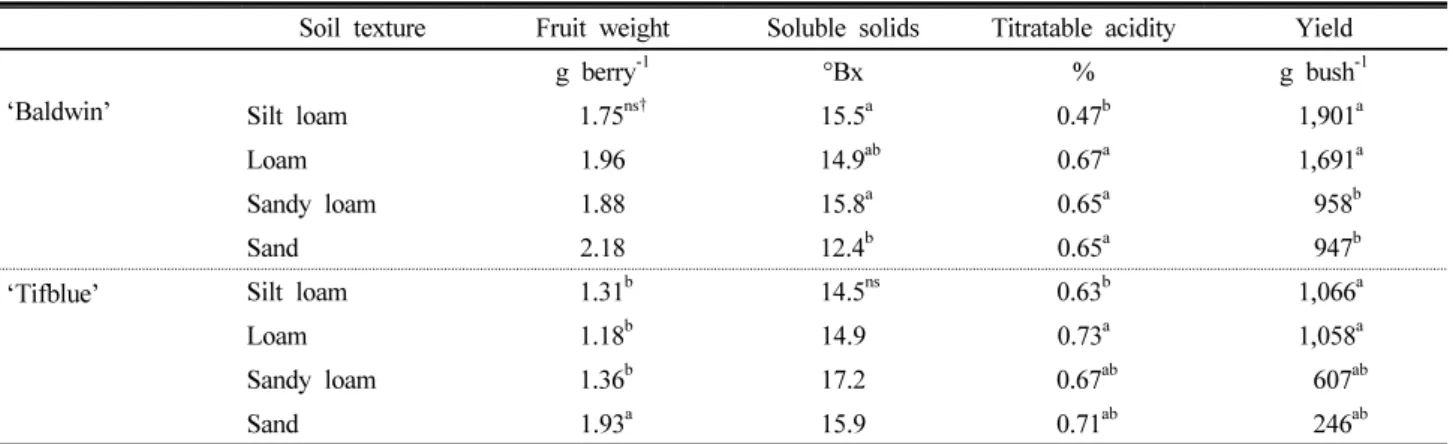
Table 4. Effect of soil texture on the fruit properties and yields of rabbiteye blueberry cultivars.

Soil texture Fruit weight Soluble solids Titratable acidity Yield

‘Baldwin’

g berry

-1

°Bx % g bush

-1

Silt loam 1.75

ns†

15.5

a

0.47

b

1,901

a

Loam 1.96 14.9

ab

0.67

a

1,691

a

Sandy loam 1.88 15.8

a

0.65

a

958

b

Sand 2.18 12.4

b

0.65

a

947

b

‘Tifblue’ Silt loam 1.31

b

14.5

ns

0.63

b

1,066

a

Loam 1.18

b

14.9 0.73

a

1,058

a

Sandy loam 1.36

b

17.2 0.67

ab

607

ab

Sand 1.93

a

15.9 0.71

ab

246

ab

Mean separation within columns by Duncan’s multiple range test at p=0.05.

다 (Coville, 1910; Korcak, 1989; Hanson and Hancock, 1996; Haynes and Swift, 1985)

토성에 따른 품종별 과실품질을 조사한 결과는 Table 4 와 같다. ‘Baldwin’ 품종의 과중은 토성간 유의성 있는 차이 를 보이지 않았다. ‘Tifblue’ 품종의 과중은 사토에서 1.93 g berry

-1

으로 가장 높았고, 사양토와 미사질양토 그리고 양 토 순으로 낮았다. 반면 수량은 과중과 반대로 사토에서 가 장 낮았다. ‘Baldwin’의 토성별 수량은 미사질양토와 양토 에서 각각 1,901 g과 1,691 g으로 높았으며, 사토와 사양토 는 900 g수준으로 상대적으로 낮았다. ‘Tifblue’ 품종에서는 통계적으로 유의차는 없었지만 같은 경향을 나타냈다. 특히 모래함량이 증가할수록 수량이 감소하는 경향이 뚜렷하였 으며, 수량이 가장 높은 미사질양토와 사토의 수량차는 약 4배 정도 였다. ‘Baldwin’ 품종의 과실 당함량은 미사질양토 와 사양토가 16°Brix 수준으로 사토와 양토보다 높았으나,

‘Tifblue’ 품종의 당함량은 통계적 유의차가 없었다. 토성별 산함량은 두 품종 모두 미사질양토에서 가장 낮았으며,

‘Tifblue’ 품종은 양토에서 가장 높았다.

블루베리는 1년생 가지에 꽃눈이 착생되기 때문에 과실 수는 전년도의 생육량 즉, 가지발생 및 발달에 영향을 받는 다 (Gough et al., 1978). 따라서 사토와 사양토의 낮은 생

산량은 상대적으로 낮은 보비력에 의한 누적된 생육하락이 원인이라 판단된다 (Table 3).

블루베리 재배토양은 물리적으로 통기 및 배수성이 가장 중요한 생장제한 요인으로 알려져 있기 때문에 모래함량이 높은 토양환경을 추천해오고 있다 (Coville, 1910; Gough, 1994). 사토의 높은 통기성은 취약한 보비력에 의해 Table 3 과 4와 같이 낮은 생육특성을 유도하며, 안정된 블루베리 생 장을 위해서는 유기물 증대를 통한 보비력 확보가 필요하다.

그러나 유기물함량이 높은 사질토양은 한랭한 지역에서 일 반적이며, 한국과 같은 온대지방은 유기물 분해가 빨라 유기 물이 다량 축적된 사토를 확보하기 매우 어렵다 (Goncalves et al, 1994; Singh and Gupta, 1977). 이와 같은 국내 토양 환경과 좋은 배수조건을 위해서는 기존토양의 개량보다는 난분해성 유기물과 인공상토에 의존하도록 하는 결과를 가 져왔다.

한편 북미지역 주산단지에 해당하는 미국 오레곤과 남미 의 주산지인 칠레 오소르노의 토성은 식양토와 양토가 주요 토성으로 국내 토성과 차이가 없다 (Kim and Jo, 1998;

Kim et al., 2003; Retamales and Hancock, 2012). 반면,

이들지역의 토양 유기물 함량은 약 30~130 g kg

-1

수준으로

(Retamales and Hancock, 2012), 국내 농경지 평균 유기물

(5)

함량인 24 g kg

-1

보다 상대적으로 높은 수준이다 (Kang et al., 2012, 2014).

이상의 결과를 종합해보면, 높은 보비력을 갖춘 국내 토 양은 보다 좋은 배수조건을 유지해주는 것과 토양경량화를 통하여 충분히 경쟁력 있는 품질과 생산량을 확보해 줄수 있다는 가능성을 확인해주고 있다.

Conclusion

본 연구는 경남 남해에 소재한 국립원예특작과학원 남해 출장소 시설하우스에서 수행하였다. 시험품종은 ‘Tifblue’와

‘Baldwin’ 래빗아이 블루베리를 wagner pot (0.05 m

2

)에 재 식하여 2013년부터 3년간 수행하였다. 시험에 사용된 토성 의 종류는 사토, 사양토, 양토 그리고 미사질양토 4종류이 며, 양분흡수량과 생육특성을 조사하였다. 토성별 두 품종 의 엽중 질소와 인산함량은 8.6~10.5 g kg

-1

범위를 보여 래 빗아이 블루베리의 적정 수준보다 낮았으나, 칼륨과 칼슘 그리고 마그네슘 함량은 각각 2.29~3.62 g kg

-1

, 4.46~5.46 g kg

-1

그리고 1.45~2.12 g kg

-1

의 범위로 적정 수준에 포함 되었다. 엽중 질소와 인산함량은 두 품종 모두 미사질양토 에서 높았다. 품종별 수관면적과 뿌리 건물중은 두 품종 모 두 토성간 유의차가 없었다. 반면, 엽과 줄기 건물중은 양토 에서 가장 높았다. 과실생산량은 두 품종 모두 양토와 미사 질양토에서 높았으며, 모래함량과 부의 상관관계를 나타냈 다. 그러나 토성별 과실의 당과 산함량은 품종과 모래함량 에 따른 일정한 경향이 나타나지 않았다.

이상의 결과는 통기성이 중요한 블루베리 역시 보비력이 확보되지 않은 토양은 생장에 한계를 갖는다는 것을 알려주 고 있으며, 반대로 보비력이 확보된 국내 주요 토성은 배수 조건이 양호한 방향으로 개선된다면 충분히 경쟁력 있는 과 실생산이 가능하다는 것을 알려주고 있다.

References

Abbott, J.D. and R.E. Gough. 1987. Seasonal development of highbush blueberry roots under sawdust mulch. J. Am. Soc.

Hortic. Sci. 112:60-62.

Bach, E.M., S.G. Baer, C.K. Meyer, and J. Six. 2010. Soil texture affects soil microbial and structural recovery during grassland restoration. Soil Biol. Biochem. 42(12):2182-2191.

Billings, W.D. 1987. Carbon balance of Alaskan tundra and taiga ecosystems: past, present, and future. Quat Sci Rev.

6:165-177.

Bittar, I.M.B., A.D.S. Ferreira, and G.F. Correa. 2013.

Influence of soil texture on microbial activity, carbon decomposition and mineralization of litter in soils of the brazilian cerrado under incubation. Biosci. J. 29(6):1952- 1960.

Brown, J.C. and A.D. Draper. 1980. Differential response of blueberry (Vaccinium) progenies to pH and subsequent use of iron. J. Am. Soc. Hortic. Sci. 105:20-24.

Cain, J.C. and P. Eck. 1966. Blueberry and cranberry. In: N.F.

Childers (Editor), Temperate and Tropical Fruit Nutrition.

Horticultural Publications. New Brunswick. NJ. pp.101-129.

Chau, J.F., A.C. Bagtzoglou, and M.R. Willig. 2011. The effect of soil texture on richness and diversity of bacterial communities. Environ. Forensics. 12(4):333-341.

Christenson, D.R., R.P. White, and E.C. Doll. 1973. Yields and magnesium uptake by plants as affected by soil pH and calcium levels. Agron. J. 65(2):205-206.

Coville, E.V. 1910. Experiments in blueberry culture. US Department of Agriculture Bulletin No. 193.

Davidson, E.A. and P.A. Lefebvre. 1993. Estimating regional carbon stocks and spatially covarying edaphic factors using soil maps at three scales. Biogeochemistry. 22:107-131.

Day, P.R. 1965. Soil texture. Methods of soil analysis. Part, 2, 545-567.

Erb, W.A., A.D. Draper, and H.J. Swartz. 1993. Relation between moisture stress and mineral soil tolerance in blueberries. J. Am. Soc. Hortic. Sci. 118(1):130-134.

Goncalves, J.L.M. and J.C. Carlyle. 1994. Modelling the influence of moisture and temperature on net nitrogen mineralization in a forested sandy soil. Soil Biol. Biochem.

26(11):1557-1564.

Gough, R.E. 1994. The highbush blueberry and its management.

Food Products Press, New York. USA, pp.11-25.

Gough R.E., V.G. Shutak, and R.L. Hauke. 1978. Growth and development of highbush blueberry II. reporductive growth, hostological studies. J. Am. Soc. Hortic. Sci. 103:476-479.

Hanson, E. and J. Hancock. 1996. Managing the nutrition of highbush blueberries. Extension Bulletin E-2011, Michigan State University.

Hart, S.C., J.M. Stark, E.A. Davidson, and M.K. Firestone.

1994. Nitrogen mineralization, immobilization, and nitri- fication. In: (eds), Methods of Soil Analysis: Biochemical and Microbiological Properties. SSSA, Madison, WI, pp.

985-1018.

Hassink, J., L.A. Bouwman, K.B.Z. Wart, J. Bloem, and L.

Brussaard. 1993. Relationships between soil texture, physical protection of organic matter, soil biota, and C and N mineralization in grassland soils. Geoderma. 57(1):105-128.

Haynes, R.J. and R.S. Swift. 1985. Effects of soil acidi- fication on the chemical extractability of Fe, Mn, Zn and Cu and the growth and micronutrient uptake of highbush blueberry plants. Plant Soil. 84:201-212.

Holmes, R.S. 1960. Effect of phosphorus and pH on iron chlorosis of the blueberry in water culture. Soil Sci. 90:374- 379.

Jacobs, L.A., F.G. Davies, and J.M. Kimbrough. 1982.

Mycorrhizal distribution in Florida rabbiteye blueberries.

(6)

HortScience. 17:951-953.

Janssen, B.H. 1996. Nitrogen mineralization in relation to C:N ratio and ecomposability of organic materials. Plant Soil.

181:39-45.

Juma, N.G. 1993. Interrelationships between soil structure/

texture, soil biota/soil organic matter and crop production.

Geoderma. 57(1):3-30.

Kang, S.S., A.S. Roh, S.C. Choi, Y S. Kim, H.J. Kim, M.T.

Choi, B.K. Ahn, H.W. Kim, H.K. Kim, J.H. Park, Y.H. Lee, S.H. Yang, J.S. Ryu, Y.S. Jang, M.S. Kim, Y.K. Sonn, C.H.

Lee, S.G. Ha, D.B. Lee, and Y.H. Kim. 2012. Status and changes in chemical properties of paddy soil in Korea.

Korean J. Soil Sci. Fert. 45(6):968-972.

Kang, S.S., A.S. Roh, B.S. Yoon, H.J. Kim, M.T. Choi, B.G.

Ahn, H.K. Kim, S.J. Park, Y.H. Lee, S.H. Yang, J.S. Ryu, Y.G. Sohn, M.S. Kim, M.S. Kong, C.H. Lee, T.K. Oh, D.B.

Lee, Y.H. Kim, Y.B. Lee, Y.S. Kim, and S.S. Lee. 2014.

Status and Change in Soil Chemical Properties of Upland in Korea from 2001 to 2013, In 20th WORLD CONGRESS OF SOIL SCIENCE. p.516-516.

Kim, H.L., H.D. Kim, J.G. Kim, Y.B. Kwack, and Y.H. Choi.

2010. Effect of organic substrates mixture ratio on 2- year-old highbush blueberry growth and soil chemical properties. Korean J. Soil Sci. Fert. 43(6):858-863.

Kim, H.L., J.H. LIm, B.K. Sohn, and Y.J. Kim. 2003.

Chemical properties of cut-flower rose-growing soils in plastic film houses. Korean J. Soil Sci. Fert. 36(3):113-118.

Kim, l.Y. and I.S. Jo. 1998. Soil Physics. vol. 31: 7-18.

Korcak, R.F. 1986. Adaptability of blueberry species to various soil types. Growth and Initial Fruiting. J. Am. Soc.

Hortic. Sci. 111(6):816-821.

Kooistra, M.J., D. Schoonderbeek, F.R. Boone, B.W. Veen, and M. Van Noordwijk. 1992. Root-soil contact of maize, as measured by a thin-section technique. Plant Soil. 139(1):

119-129.

Korcak, R.F. 1989. Variation in nutrient requirements of blueberries and other calcifuges. HortScience: 24(4):573- 578.

Korcak, R.F., G.J. Galletta, and A. Draper. 1982. Response of blueberry seedlings to a range of soil types. J. Am. Soc.

Hortic. Sci.:1153-1160.

Lee, Y.H., J.H. Choi, J.H. Shin, J.Y. Heo, H.Y. Shin, and S.M. Kim. 2009. Effect of soil texture on quality and quantity of leaf in tea plant. J. Kor. Tea Soc. 15(2):65-71.

Leggett, J.E. and W.A. Gilbert. 1969. "Magnesium uptake by soybeans. Plant Physiol. 44(8):1182-1186.

Mamedov, A.I., S. Beckmann, C. Huang, and G.J. Levy.

2007. Aggregate stability as affected by polyacrylamide molecular weight, soil texture, and water quality. Soil Sci.

Soc. Am. J. 71(6):1909-1918.

Mengel, K. 1996. Turnover of organic nitrogen in soils and its availability to crops. Plant Soil. 181(1):83-93.

Oyinlola, E.Y. and S.A. Jinadu. 2012. Growth, yield and nutrient concentration of tomato as affected by soil textures and nitrogen. Asian J. Agric. Res. 6(1):39-45.

Retamales, J.B. and J.F. Hancock. 2012. Blueberries (Vol.

21). p.107, 120, Cabi. USA.

RDA. 2000. Methods of analysis of soil and plant. National Institute of Agricultural Science and Technology. Rural Development Administration. Korea.

Sands, R. and G.D. Bowen. 1978. Compaction of sandy soils in radiata pine forests: II. Effects of compaction on root configuration and growth of radiata pine seedlings. Aust.

For. Res. 8:163-170.

Sands, R., E.L .Greacen, and C.J. Gerard. 1979. Compaction of sandy soils in radiata pine forests. I. A penetrometer study. Aust. J. Soil Res. 17:101-113.

Shi, J.X., F.P. Wang, X. Chen, and Z.H. Li. 2009. Nitrogen Absorption and Accumulation of Tobacco Plants Planted in Yellow Soil Texture Southwest China. J. Agric. Sci. 22(3):

697-701.

Silver, W.L., J. Neff, M. McGroddy, E. Veldkamp, M. Keller, and R. Cosme. 2000. Effects of soil texture on belowground carbon and nutrient storage in a lowland Amazonian forest ecosystem. Ecosystems. 3(2):193-209.

Singh, J.S. and S.R. Gupta. 1977. Plant decomposition and soil respiration in terrestrial ecosystems. Botan. Rev. 43(4):

449-528.

Spiers, J.M., J.H. Braswell, and C.P. Hegwood Jr. 1985.

Establishment and maintenance of rabbiteye blueberries.

Miss. Agr. & For. Expt. Sta. Bul. 941.

Theodorou, C., J.N. Cameron, and G.D. Bowen. 1991.

Growth of roots of different Pinus radiata genotypes in soil at different strength and aeration. Aust. For. 54:52-59.

Tisdall, J.M. and J.M. Oades. 1982. Organic matter and water-stable aggregates in soils. J. Soil Sci. 33(2):141-163.

Veen, B.W., M. Van Noordwijk, P. De Willigen, F.R. Boone, and M.J. Kooistra. 1992. Root-soil contact of maize, as measured by a thin-section technique. Plant Soil. 139(1):

131-138.

Yapa, L.G., D.D. Fritton, and S.T. Willatt. 1988. Effects of soil strength on root growth under different water condition.

Plant Soil. 109:9-16.

Zhao, C., L. Jia, X. Zhang, M. Wang, Y.F. Wang, and J.R.

Mcgiffen. 2015. Study on nitrogen accumulation charac- teristics of peanuts in different texture soils. Res. Crops.

16(2):250-257.

수치

Table 1. Physicochemical properties of soil used in experiment.
Table 2. Effect of soil texture on the content of nutrients in leaves of rabbiteye blueberry cultivars.
Table 4. Effect of soil texture on the fruit properties and yields of rabbiteye blueberry cultivars.

참조

관련 문서

The aim of this study was to compare the effect on bone regeneration relative to maintenance period of PTFE membrane in rabbit calcarial defects.. Eight adult

In this study, two experiments were conducted to understand the effects of additional charge on the detailed growth mechanism of Alq 3 and to determine the effect of

In this context, this study compared and analyzed a variety of soil decontamination methods used to evaluate the wide-area soil contaminated with Cs:

To obtain data for the optimal growth conditions for crops in this intelligent plant growing system, sensors were used to measure and control the

In the present study, the behavior of Mg sheet with strain rates will be observed and the effect of microstructure, texture and PB treatment on high rate tensile

Effect of amino acid addition in culture media on the mycelial growth and g-aminobutyric acid (GABA) production of Sparassis latifolia..

The purpose of this study was to examine the effects of a swimming program for 12 weeks on health-related physical fitness and growth hormone in

In this study, the numeral analysis has been conducted to verify the effect on behavior of abutment and under ground when Lightweight Air-trapped soil(ATS)