Korean Journal of Environmental Agriculture
Korean J Environ Agric (2013) Online ISSN: 2233-4173
Vol. 32, No. 3, pp. 240-243 http://dx.doi.org/10.5338/KJEA.2013.32.3.240 Print ISSN: 1225-3537
알로에 베라( A. vera )와 알로에 사포나리아( A. saponaria )로 부터 효모의 분리 및 계통분석
최성창, 김명욱, 김종식*
경북해양바이오산업연구원
Selective Isolation and Phylogeny of the Yeast Species Associated with Aloe vera and Aloe saponaria
Sungchang Choi, Myung‐Uk Kim, Jong‐Shik Kim
*(Gyeongbuk Institute for Marine Bio‐Industry, Uljin, Republic of Korea)
Received: 22 July 2013 / Revised: 21 August 2013 / Accepted: 21 September 2013
ⓒ 2012 The Korean Society of Environmental Agriculture
This is an Open-Access article distributed under the terms of the Creative Commons Attribution Non-Commercial License (http://creativecommons.org/licenses/by-nc/3.0) which permits unrestricted non-commercial use, distribution, and reproduction in any medium, provided the original work is properly cited.
*교신저자(Corresponding author),
Phone: 82‐54‐780‐3451; Fax: 82‐54‐780‐3469;
E-mail: [email protected]
240
Abstract
BACKGROUND: Several yeast species have potential applications in biotechnology and the identification of such yeast species is of great interest. The first step in the identification of yeasts is the establishment of an effective isolation method. Thus, we compared the efficacy of different yeast media in the isolation of yeast associated with Aloe vera and Aloe saponaria.
METHODS AND RESULTS: In this study, we spread homogenized A. vera and A. saponaria leaves onto 4 different yeast selective media containing chloramphenicol, streptomycin, Triton X‐100 and L‐sorbose. We observed high selectivity for yeast and many colonies on media. We isolated 67 yeast strains from A. vera and 42 yeast strains from A. saponaria. We used phylogenetic analysis to identify the yeast isolates based on ITS region sequencing and performed sequence analysis on representative isolates from each agar plate. Further, we compared the sequences obtained with reference sequences. The yeast species
isolated from A. vera were as follows: 56 isolates of Meyerozyma, 9 isolates of Cryptococcus, and 1 isolate each of Rhodotorula and Sporobolomyces. Those isolated from A. saponaria were as follows: 41 isolates of Rhodosporidium and 1 isolate of Sporobolomyces.
CONCLUSION(S): All the isolates obtained using large agar plate containing chloramphenicol, streptomycin, Triton X‐100 and L‐sorbose were identified as yeast.
Therefore, we concluded that this method is useful for selective screening of yeast species.
Key Words: Aloe saponaria, Aloe vera, ITS gene, Yeast screening method
서 론
알로에는 식물분류학상 백합과에 속하는 상록의 다년초로 서 다육질의 열대 약용식물이다(Reynolds, 2004). CO
2의 수 용과 고정단계를 시간에 따라 분리하여 광합성을 하는 대표 적인 CAM (Crassulacean Acid Metabolism) 식물의 하나 이며, 전 세계적으로 약 400 여종이 알려져있지만 건강식품 및 화장품용으로 사용되는 알로에 종은 5~6종에 불과하다 (Grindlay and Reynolds, 1986; Kluge et al ., 1979;
Reynolds and Dweck, 1999).
Open Access
Short Communication
Selective Isolation and Phylogeny of the Yeast Species Associated with Aloe vera and Aloe saponaria 241
알로에는 다당류, 지베렐린 등과 같은 많은 성분을 포함하 지만 종에 따라 95% ~ 99%는 물이므로 유효 고형분의 함량 은 매우 낮다(Grindlay and Reynolds, 1986; Reynolds and Dweck, 1999). 알로에 겔의 가장 풍부한 성분은 가용 성 단당 및 복합 다당의 탄수화물이고, 알로에 외피 바로 밑 에 위치한 유관속의 유세포에는 노란색 액즙의 삼출물 성분 들이 존재하며, 약 300여종의 알로에로부터 80여종의 화합물 이 동정되었다(Rodriguez et al ., 2010).
Aloe vera 는 화상식물, 응급조치식물 및 의약식물로 불리 어져 왔으며 건강식품, 화장품 및 민간의약으로도 널리 사용 되어 왔다(Reynolds, 2004). 또한 Aloe saponaria 는 화상, 상처, 위궤양, 및 위장장애 등의 민간치료제로 사용되어왔고, 알로에 알레르기에 대한 위험성이 적으며, 유일하게 ‐7℃ 이 하에서도 생육할 수 있는 것으로 알려졌다(Yagi et al. , 1982;
Sampedroa et al. , 2004).
효모는 토양, 수생환경, 식물체, 곤충, 극한 환경 등의 다 양한 환경에서 서식하고 있으며(Botha, 2011; Raspor and Zupan, 2006), 음료, 약품, 효소, 농업 및 산업에 중요한 영 향을 미치고 있으며, 인류의 식생활에 많은 이익을 주고 있다 (Deak, 2009; Tamang and Fleet, 2009). 이와 같은 효모의 연구를 수행하기 위해서는 세균과 곰팡이의 배양을 억제하고 효모만을 분리하는 기술이 요구된다. 하지만 효모를 선택적으 로 분리해내기 위해서는 어떻게 세균과 곰팡이의 생장을 억 제하고 효모만을 배양 및 분리할 수 있을 것인가가 관건일 것 이다. 본 연구에서는 세균 및 곰팡이를 억제하는 방법으로 항 생제 등의 화합물질을 이용해서 세균 및 곰팡이를 억제하고 알로에에 정착하고 있는 효모군집 분석을 수행하였다. 알로에 로부터 효모의 분석은 거의 연구되지 않았으므로 그 결과가 유용할 것이며, 효모를 활용하는 산업 분야에서 중요한 기초 데이터로서 이용될 것으로 사료된다.
재료 및 방법
효모분리법
본 연구에 사용된 알로에는 알로에 베라( A. vera )와 알로 에 사포나리아( A. saponaria ) 두 가지 종류로 이들 각각은 거제알로에팜(www.aloes.co.kr)에서 우편으로 구입하였으 며, 샘플 채취는 크린벤치내에서 멸균 처리된 가위와 핀셋을 사용하여 각 알로에 잎의 끝, 몸통, 뿌리 세 부분에서 고르게 채취하였으며 세 개체의 알로에의 동일한 부위에서 채취하였 다. 채취한 샘플은 0.1 M potassium phosphate buffer를 사용하여 3회 washing 하여 멸균된 용기에 실험 전까지 보 관하였다. 효모 screening용 배지는 DG18 agar (Dichloran
‐Glycerol 18%, MBcell, Seoul), DOB with CSM agar (MP bio, CA, USA), GPY agar (4% glucose, 0.5%
peptone, 0.5% yeast extract, 1.5% agar), SCG agar (Sabouraud Glucose Agar, MBcell)를 이용하여 배양하였 다. 특히 효모의 생육에 영향을 미치지 않고 세균의 억제를 위해서 각각의 배지에 chloramphenicol과 streptomycin을
100 mg/L씩을, 그리고 곰팡이 생육을 억제하기 위해서 Triton X‐100 0.1%와 L‐sorbose 0.4%를 첨가하였다.
먼저 DG18, DOB with CSM, GPY, SCG agar 배지를 멸균하여, 245 x 245 x 25 mm 크기의 사각 플레이트에(Nunc Bio‐Assay Dish, Thermo Scientific, Roskilde, Denmark) 분주하여 고체 배지를 준비한다. 채취한 샘플을 파쇄하기에 알맞은 크기로 잘게 절제한 다음 멸균된 용기에 넣고 최종 볼 륨이 10 mL이 되도록 10 mM potassium phosphate buffer를 첨가한 후 멸균가능한 homogenizer (T10 basis, IKA, Germany)를 이용하여 파쇄한다. 이와 같이 잘 파쇄 된 알로에 원액 1 mL를 배지에 멸균된 유리 도말봉을 이용 하여 도말한 후 25℃ 배양기에 2 ~ 5 일간 배양한다.
Sequence 분석 및 계통해석
위와 같이 배양된 각각의 플레이트에서 효모만 선별하여 단일 균주를 얻기 위해 3차 분리까지 실시하였다. 배양된 적 정 콜로니수의 플레이트로부터 전체의 효모를 분리하였다. 분 리된 단일 균주들은 InstaGene Matrix (Bio‐Rad, Hercules, CA, USA)로 Genomic DNA를 추출하였으며, PCR은 EF‐
Taq DNA Polymerase (Solgent, Korea)로, 시퀀싱은 PRISM BigDye Terminator v3.1 Cycle Sequencing Kit (Applied Biosystems, Foster City, CA)를 써서 ABI PRISM 3730XL DNA analyzer (Applied Biosystems, Foster City, CA)로 ㈜마크로젠(서울)에서 분석을 수행하였 다. ITS영역의 ITS1 (5’‐TCCGTAGGTGAACCTGCG‐3’), ITS4 (5’‐TCCTCCGCTTATTGATATGC‐3’) primer (White et al ., 1990)를 사용한 sequence 분석 결과를 NCBI로부터 표준 균주 등의 관련 염기서열을 추출하여 Clustal W 프로 그램을 이용하여 alignment 하였다. 계통도는 MEGA version 5 (Tamura et al ., 2011)의 neighbor‐joining method (Saitou and Nei, 1987)를 이용하여 완성하였으며, 균주의 염기서열 정보를 GenBank에 등록하였으며 accession number ( A. saponaria : JN255410‐451, A. vera : JN255452‐518)를 부여 받았다.
결과 및 고찰
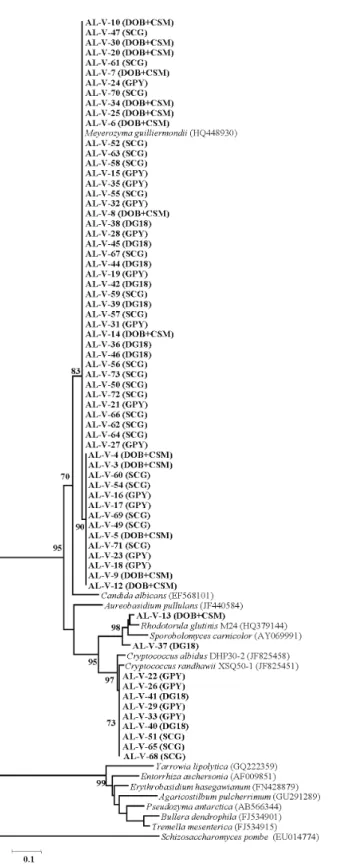
본 연구에서는 두 종류의 알로에에 서식하는 효모 균주를 분리하고 분류학적인 위치를 밝히고자 하였고 이를 위해 ITS 유전자의 염기서열 분석을 통한 계통학적 분석을 종합하여 A. vera 에서는 Meyerozyma (56균주), Rhodotorula (1균 주), Sporoblomyces (1균주), Cryptococcus (9균주)가 확 인되었다. 특히 Meyerozyma 의 경우는 크게 두 개의 clade 를 형성함을 알 수 있었다.
A. saponaria 에서는 Rhodosporidium (41균주), Sporobolomyces (1균주)로 분포 되었다(Fig.1, Fig.2). A.
saponaria 에 정착하고 있는 효모의 종류가 Rhodosporidium
과 Sporobolomyces 의 두 종류의 효모 속으로 극히 한정되
어있음이 본 연구에서 밝혀졌다. 이는 알로에의 수분함량이
CHOI et al.
242
Fig. 1. Molecular phylogenetic tree constructed by neighbor‐joining method using the sequences of representative yeast isolates from
Aloe vera
and related yeast. Isolated media are indicated in parentheses. The numerals represent the confidence levels from 1000 replicate bootstrap samplings (frequencies of less than 75% are not indicated).Fig. 2. Molecular phylogenetic tree constructed by neighbor‐joining method using the sequences of representative yeast isolates from
Aloe saponaria
and related yeast. Isolated media are indicated in parentheses. The numerals represent the confidence levels from 100 replicate bootstrap samplings (frequencies of less than 75% are not indicated).Selective Isolation and Phylogeny of the Yeast Species Associated with Aloe vera and Aloe saponaria 243