Print ISSN: 2288-4637 / Online ISSN 2288-4645 doi:10.13106/jafeb.2021.vol8.no7.0365
Momentum Strategies and Stock Returns:
A Case of Saudi Stock Market*
Muhammad Asif KHAN
1, Ramiz Ur REHMAN
2, Muhammad Ishfaq AHMAD
3, Majed Al HARTHI
4Received: March 20, 2021 Revised: May 22, 2021 Accepted: June 17, 2021
Abstract
This paper investigates the presence of momentum profits in the Saudi stock market. The study applied a quantitative method by utilizing monthly closing prices of 194 listed firms on Tadawal (Saudi Stock Market). The data from January 2010 to February 2019 is taken from the Tadawal market database for analysis. The sample is further divided into two equal sub-samples based on the structural changes that occurred in the Saudi stock market. Moreover, the high- and low-value traded portfolios are also constructed to examine the presence of momentum profits. Sixteen investment strategies are formed for each sample. The results show a very strong presence of momentum profits in the Saudi stock market for the full sample as well as for the sub-samples. The momentum profits are observed for a longer investment horizon. The results confirm that the short or medium-term formation of portfolios produces negative momentum returns for high-value traded stocks.
The low-value traded stocks portfolios give similar results to the full sample results in terms of momentum profits. The results suggest that an investor should keep an eye on the past performance of desired stocks for at least three-nine months in which they are willing to invest.
Keywords: Momentum Profits, Value Traded Stocks, Emerging Market, Frontier Market JEL Classification Code: G14, G15, G11
1. Introduction
The prime interest of the financial market’s investors is the predictability of stock return. In early 1970, it was broadly concluded that stock returns are unpredictable at large. Later on, during 1980, the efficiency of stock markets was seriously questioned when the researchers found the predictability of stock returns (De Bondt & Thaler, 1985). Jegadeesh and f (1993) further confirmed the regularities and predictability of stock returns during the 1990s. In developed markets, the presence of momentum profits is strong evidence of stock predictability. According to Jegadeesh and Titman (1993) buying recent outperforming stocks (winners) and selling current underperforming stocks (losers) is called momentum because outperforming securities always remain winners, and underperforming securities remain losers.
The presence of momentum profits in developed markets is also documented in recent studies (Fama & French, 2012; Novy-Marx, 2012). Jegadeesh and Titman (1993) documented that higher returns firms with three months to 1-year time horizons remained higher returns firms over low returns firms for the same time horizon. De Bondt and Thaler
*Acknowledgements:
This project was funded by the Deanship of Scientific Research (DSR) at King Abdulaziz University, Jeddah, under grant no. (G: 245- 849-1441). The authors, therefore, acknowledge with thanks DSR for technical and financial support.
1
First Author. [1] Associate Professor, College of Business (Rabigh), King Abdulaziz University, Saudi Arabia. Email: mabkhan@kau.
edu.sa [2] Senior Lecturer, Faculty of Business and Law, Newcastle Business School, Northumbria University, United Kingdom.
Email: [email protected]
2
Associate Professor, Management Sciences, Lahore Business School, The University of Lahore, Pakistan.
Email: [email protected]
3
Corresponding Author. Associate Professor, Management Sciences, Lahore Business School, The University of Lahore, Pakistan [Postal Address: 1-Km Raiwind Road, Lahore, Lahore, Punjab, 54000, Pakistan] Email: [email protected]
4
Assistant Professor, College of Business (Rabigh), King Abdulaziz University, Saudi Arabia [Postal Address: King Abdul Aziz University, Jeddah, Saudi Arabia] Email: [email protected]
© Copyright: The Author(s)
This is an Open Access article distributed under the terms of the Creative Commons Attribution Non-Commercial License (https://creativecommons.org/licenses/by-nc/4.0/) which permits unrestricted non-commercial use, distribution, and reproduction in any medium, provided the original work is properly cited.
(1985) found return reversals over longer horizons. Over long-time horizons of three to five years, firms with poor returns performed well over firms with good returns for the same time horizons. Literature explained this phenomenon through market overreaction to information or microstructure biases. Dubois and Bacmann (1998) suggested that over- reaction to firm-specific information causes abnormal profits of a short-term contrarian. The lead-lag structure arises from investors’ delayed reaction to common factors.
They empirically showed that abnormal contrarian profit is due to overreaction to specific information, and not due to lead-lag structure.
Daniel et al. (1998) and Hong and Stein (1999) briefly presented the behavioral explanations for the link between stock market over- and under-reaction and momentum profits. Hong and Stein (1999) argued that there are two types of investors, one is smart (well informed), and the other is a technical analyst. Smart investors react to new information first, followed by technical investors, resulting in driving the stock price in the same direction. The stock prices go up in two stages; initially, under-reaction and occurrence of momentum profits later on in the case of positive news released about the firm. Daniel et al. (1998) believed that investors have their own information and rely on their stock selection skills very highly. This overconfidence causes over-valuation of stock prices when investors overreact to new information. The market realizes in the long run that stock is over-valued, therefore makes necessary corrections.
It causes momentum profits initially and contrarian profits in longer horizons.
The presence of momentum profits is mostly studied in the context of developed markets in previous literature (Jegadeesh & Titman, 1993). However, researchers have turned the focus on momentum profits in the emerging and developing markets since the start of the twenty-first century Sehgal & Jain, 2011, 2015; Syamni et al., 2021). Most of these studies find the presence of short-term momentum profits in emerging and developing markets. However, few studies explain the cause of short/long-term momentum profits in these markets, especially in the Middle East markets context.
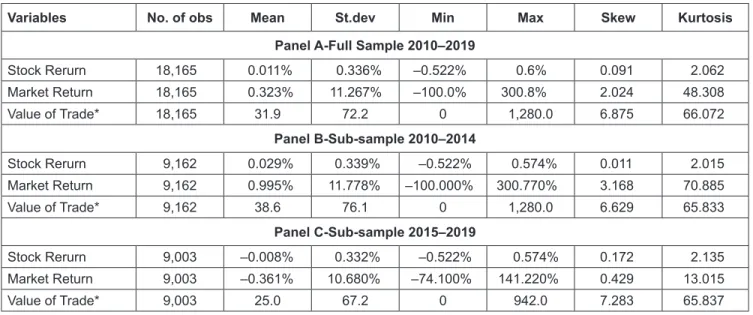
The current study examines the short, intermediate, and long- term momentum profits in the Saudi Arabian stock market during 2010–2019 following the momentum strategies of Jegadeesh and Titman (1993). It also examines how high- and low-value traded stock affects the momentum profits in the short, intermediate, and long run.
Moreover, the study compares the results of the full- sample period with equally divided sub-sample period results in terms of momentum profits. The sample split into two sub-sample is based on the structural changes that occurred in the Saudi stock market during these periods.
The Saudi Arabian stock market is one of the largest markets in the Middle East region, with a market capitalization of
USD 456 billion in 2017. Moreover, some recent development in the Saudi Arabian capital market makes this investigation more interesting, as the government eased foreign ownership rules in the share market. Further, the Saudi Stock market becomes increasingly important for global investors due to
“Vision 2030” by Crown Prince Mohammad Bin Salman to make the economy more diversified.
The remainder of the paper as follows. A brief survey of the relevant literature provides in section 2. Section 3 discusses the data and methodology used in the study.
Section 4 analyzes the results. Section 5 concludes the paper.
2. Review of Literature
The efficient market hypothesis (EMH) explains that there should be no transaction costs in trading assets; costless information is available to all the participants, and securities are fairly priced based on current information. Malkiel and Fama (1970) proposed three models to describe EMH: the
“fair game” model, the sub martingale model, and the random walk model. The fair game model states that an asset’s estimated returns depend on the level of risk of this asset; the sub martingale model states that an asset’s estimated future value is always equal or greater to the current price of this asset; last, the random walk model affirms that the evolution of the price of an asset follows a “random walk pattern”: in other terms, it always reflects the information available at this time. However, the efficient market hypothesis theory has been challenged by many authors (De Bondt & Thaler, 1985; Fama & French, 2012; Gharaibeh, 2021; Jegadeesh
& Titman, 1993; Novy-Marx, 2012). Among the arguments against the efficient market hypothesis (EMH), one empirical anomaly is often stated: the asset price reversal or continuation; it is also called contrarian or momentum profit.
The presence of momentum profits in the US market was first identified by Jegadeesh and Titman (1993) for the investment horizon of three to 12 months. Many researchers have followed the approach of Jegadeesh and Titman (1993) and provided evidence of momentum returns, in short, medium, and long term investment horizon. In these papers, the research shows that momentum profits are related to the volume of trade, size of firms, investor’s behavior, credit ratings, and growth volatility of firms. Fama and French (2012) found that momentum profits decrease from smaller to bigger stocks in almost all markets, including North America, Asia Pacific, and Europe, except Japan.
It is also evident in the recent literature that a medium-
term investment horizon based on past performance produces
momentum profits for big and liquid stocks (Novy-Marx,
2012). Some researchers also explain the behavioral aspects
of investors, which cause momentum phenomena in the
financial markets. For example, Chui et al. (2010) argued
that individualism, cultural or psychological factors are also
related to momentum profits. Researchers also believe that the state of the market is one of the potential sources of momentum profits. They find that when markets go up, then it produces momentum returns (Daniel et al., 1998).
The presence of momentum returns in the International markets is confirmed by several studies, but some studies find that short-term trading strategies are not profitable in Pacific Basin markets except Japan and Hong Kong (McInish et al., 2008). Some studies also examine momentum profits in the emerging and frontier markets. The emerging markets are different from the developed markets in several ways. These aspects include weak institutionalization, market illiquidity, and presence of non-institutional investors, expensive information, and weak corporate governance. Moreover, the emerging market is also different from the developed market with respect to culture, religion, and political biases. Mǿrck et al. (2000) examined that stocks move in the same direction in the emerging market as compared to developed markets due to political influences and private property rights.
Some studies found mixed results about moment effects in Indian stock markets. Sehgal and Jain (2011) reported the presence of momentum returns in the Indian markets for the investment horizon of three to six months. Sehgal and Balakrishnan (2002) examined short-term momentum and long-term reversal effects in the Indian stock market.
Chowdhury (2016) examined the momentum effect in the Saudi Arabia market over 1
stJan 2000 to 31
stDecember 2015. The results revealed that 871% is the monthly average momentum return of Saudi Arabia for 16 years from January 2000 to December 2015. Further, he found that cross-sectional contrarian and time-series momentum profits are present in the Saudi Arabian stock market. Still, cross-sectional contrarian return has a higher value than time-series momentum gains. However, there are few studies conducted on other GCC countries about momentum effects.
The findings of these papers are relevant to the Saudi market since Saudi Arabia is one of the members of the GCC region.
Gharaibeh (2021) examined the Amman Stock exchange across 23 indices from 2005 to 2015. The results showed that late strategy has higher returns as compared to early- stage strategy, but the CAPM model is unable to explain this return.
Saudi Arabia is a frontier market, and the presence of momentum profits in this market is highly relevant for international investors. It is considered a frontier market because of some restrictions on international investors.
Otherwise, it has the full potential to become an emerging market. Since the Saudi markets were opened to foreign investors in June 2015, it is therefore expected that it will be upgraded to the world standard. Thus, academicians and practitioners overwhelmingly attempt to investigate contrarian and momentum profits in this market. This paper also attempts to find out the momentum effect in
the Saudi market during the last decade from 2010–2019.
Most importantly, it examines the momentum returns after the liberalization of Saudi’s stock market and the entry of foreign investors in 2015.
3. Method and Design
The sample period for this study ranges from January 2010 to March 2019. The study includes 194 listed firms on the Tadawal Stock Exchange, Saudi Arabian stock market, from all sectors except mutual funds and other financial certificates. The selection of firms is based on the consistency of firms being listed on the Saudi stock exchange throughout the sample period. The monthly stock price data are collected from the Tadawal database. The monthly stock returns are calculated based on two consecutive months closing stock prices.
1
closing Price Monthly Returns Log
closing Price
tt
t −