Influence of thermo-physical properties on solutal convection by physical vapor transport of Hg 2 Cl 2 -N 2 system: Part I - solutal convection
Geug-Tae Kim
†and Young Joo Kim *
Department of Nano-Bio Chemical Engineering, Hannam University, Daejeon 305-811, Korea
*Bioinformatics Research Center, Korea Research Institute of Bioscience and Biotechnology, Daejeon 305-806, Korea (Received May 11, 2010)
(Revised May 31, 2010) (Accepted June 4, 2010)
Abstract For typical governing dimensionless parameters of Ar = 5, Pr = 1.16, Le = 0.14, Pe = 3.57, Cv = 1.02, Gr
s= 2.65 × 10
6, the effects of thermo physical properties such as a molecular weight, a binary diffusivity coefficient, a partial pressure of component B on solutally buoyancy-driven convection (solutal Grashof number Gr
s= 2.65 × 10
6) are theoretically investigated for further understanding and insight into an essence of solutal convection occurring in the vapor phase during the physical vapor transport of a Hg
2Cl
2-N
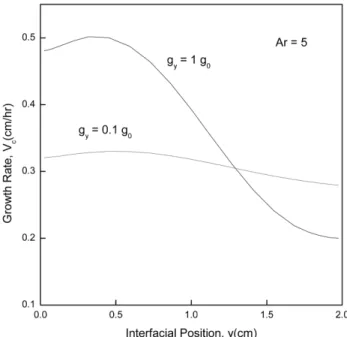
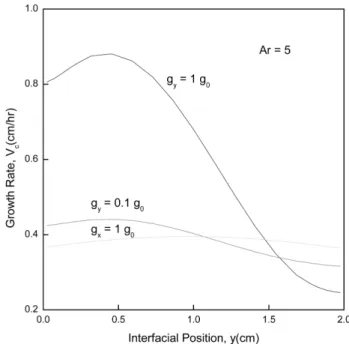
2system. The solutally buoyancy-driven convection is significantly affected by any significant disparity in the molecular weight of the crystal components and the impurity gas of nitrogen. The solutal convection in a vertical orientation is found to be more suppressed than a tenth reduction of gravitational accelerations in a horizontal orientation. For crystal growth parameters under consideration, the greater uniformity in the growth rate is obtained for either solutal convection mode in a vertical orientation or thermal convection mode in horizontal geometry.
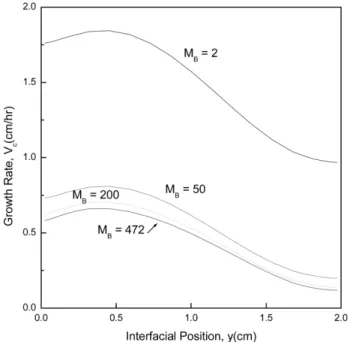
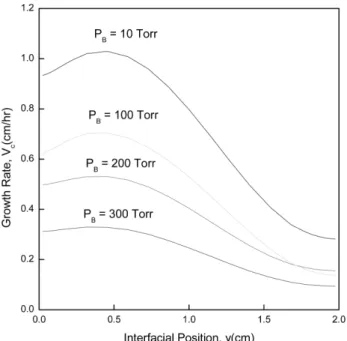
The growth rate is also found to be first order exponentially decayed for 10 ≤ P
B≤ 200 Torr.
Key words Mercurous chloride, Solutal convection, Nitrogen and physical vapor transport (PVT)
1. Introduction
Mercurous chloride (Hg
2Cl
2) materials are important for applications in acousto-optic and opto-electronic devices such as Bragg cells, X-ray detectors operating at ambi- ent temperature [1]. In general, single crystal of Hg
2Cl
2can be grown in sealed ampoules by the physical vapor transport (referred as PVT hereafter) based on a subli- mation-condensation mechanism. Convection inevitably occurs in the vapor phase during the PVT due to a ther- mal gradient between the source and the crystal region and, thus induces problems ranging from crystal inho- mogeneity to structural imperfection. Therefore, in order to analyze and control the PVT process accurately, and also make significant improvements in the process, it is essential to investigate the essence of convection occur- ring in the vapor phase during the PVT process. In par- ticular, for the system where the molecular weight of component A is much larger than that of B,the solutally induced buoyancy-driven convection (solutal convec- tion) becomes significantly important.
Rosenberger’s research group [2] examined the effects of convection during the PVT process inside vertical
cylindrical enclosures for a time-independent system, and showed that even in the absence of gravity, convec- tion can be present, causing nonuniform concentration gradients. They emphasized the role of geometry in the analysis of the effects of convection. As such these fun- damentally constitute steady state two-dimensional mod- els. The steady state models are limited to low Rayleigh number applications, because the oscillation of the flow field occurs as the Rayleigh number increases. To address the issue of unsteady flows in PVT, Duval [3] performed a numerical study on transient thermal convection in the PVT processing of Hg
2Cl
2for a vertical rectangular enclo- sure with insulated temperature boundary conditions for Rayleigh numbers up to 10
6. Nadarajah et al . [4] addressed the effects of solutal convection for any significant dis- parity in the molecular weights of the crystal compo- nents and the inert gas. Zhou et al . [5] reported that the traditional approach of calculating the mass flux assum- ing one-dimensional flow for low vapor pressure systems is indeed correct. Rosenberger et al . [6] studied three- dimensional numerical modeling of the PVT yielded quantitative agreement with measured transport rates of iodine through octofluorocyclobutane (C
4F
8) as inert back- ground gas in horizontal cylindrical ampoules. More recently the systematic studies on the convective effects during the physical vapor transport of mercurous chlo- ride materials have been performed in applications of
†
Corresponding author
†
Tel: +82-42-629-8837
†
Fax: +82-42-629-8835
†