KSEG Conference / April 7 - 9, 2011 / Jeju / Korea
- 253 -
A development of designing equation for multispecies solute transport in a Permeable Reactive Barriier-Aquifer
system
Huali Chen1)*, Eungyu Park1)
1)Department of Geology, Kyungpook National University
* Corresponding Author: [email protected]
Key words: PRB, multi-species transport, designing-equation, analytical solution.
1. Introduction
The permeable reactive barrier (PRB) is one of the most popular technologies for remediating contaminated groundwater. One of the key design tasks is to determine the PRB thickness needed to provide the residence time to reduce the concentrations of target compounds to the desired effluent concentration. There were several models already developed to delineate the optimized thickness of a PRB, but different from the condition at the PRB-aquifer interface used [Tratnyek et al. 1997; van Genuchten and Alves 1982; Eykholt et al. 1999; Rabideau et al. 2005]. Due to the natural attenuation in the down-gradient aquifer to further reduce contaminant concentrations prior to reaching a compliance point, a multidomain approach of an up-gradient PRB and a down-gradient aquifer is applied for a transient semi-analytical solution evaluating PRB performance [Park and Zhan 2009]. These analytical model are all used for solving single-species transport problem for PRB performance, but they have limited use at complex field sites due to most filed problems involve multiple reactive contaminants. The objective of this work is to develop one-dimensional ADE solutions of PRB-aquifer system by incorporating multispecies solute transport on the basis of multidomain approach of an up-gradient PRB and a down-gradient aquifer. The validity in multi-domains configuration of the transformation approach used in Sun et al. [1999] and Clement [2001] will be also provided.
2. Model Development 2.1 Model setting
The governing equation of solute transport in the PRB domain coupled by a linear reaction network (e.g., PCE(1) → TCE(2) → DCE(3) → VC(4)) is given as the following advection-dispersion equation (ADE):
2
( 1) ( 1) 2
Bi Bi Bi
B B B Bi B i B i Bi Bi
c c c
R D u y c c
t x x l - - l
¶ ¶ 
- + = -
¶ ¶ ¶ , (i=1,2,…,n) (1) and
the governing equation of solute transport in the down-gradient aquifer domain coupled by a linear reaction network is:
KSEG Conference / April 7 - 9, 2011 / Jeju / Korea
- 254 -
2
( 1) ( 1) 2
Li Li Li
L L L Li L i L i Li Li
c c c
R D u y c c
t x x l - - l
¶ ¶ 
- + = -
¶ ¶ ¶ , (i=1,2,…,n) (2)
where c is the i-th species concentration [ML-3]; R is the species retardation factor for a liner sorption case [‒]; D is the longitudinal dispersion coefficient [L2T-1]; u is the flow velocity [LT-1]; li is the i-th species first-order reaction coefficient [T-1]; yi is the amount of species I produced from its immediate parent species i-1 [MM-1]; subscript B referring to the PRB domain; subscript L referring to the aquifer domain; x is the spatial variable along the flow direction [L]; t is time [T]; and n is the number of species [‒] (n=4 for the given example of PCE→TCE→DCE→VC serial reaction case). At the entrance face of the PRB domain, the solute concentration is a function of time:
0( )
Bi
Bi Bi Bi i
x B
n D c qc qc t
x = -
¶ - = -
¶ , (i=1,2,…,n) (3)
where c0i(t) is the concentration given at the entrance face of the PRB which is either a constant or a temporally variable; nB is the porosity of the PRB; and q is the specific discharge, which is constant within both the PRB and the aquifer domains (the groundwater flow velocities in the PRB and the aquifer are related as uBnB=uLnL=q, where nB and nL are porosities of the PRB and the aquifer domains, respectively). Before the introduction of the contaminants, it is assumed that the PRB and the down-gradient aquifer are without the contamination, cBi(t=0) = cLi(t=0) = 0. Both the contaminant mass flux and the concentration are continuous at the exit PRB-aquifer interface:
0 0
Bi x Li x
c = =c = , (i=1,2,…,n) and (4)
0 0
Bi Li
B B Bi L L Li
x x
c c
n D qc n D qc
x = x =
¶ 
- = -
¶ ¶ ,(i=1,2,…,n). (5)
No-flux boundary condition is assumed at the positive infinity from the exit face of the PRB is:
Li 0
x
c x =¥
¶ =
¶ , (i=1, 2, …, n). (6)
2.2 Analytical Solution
In this study, the analytical technique of Clement [2001] is employed to develop multispecies transport solutions. Using the similarity transformation, the multi-species concentrations can be transformated as
1
B B B
b = S -c ,and b = SL L-1cL , (7)
where the matrix for the transformation are [Clement,2001]
KSEG Conference / April 7 - 9, 2011 / Jeju / Korea
- 255 -
1 ( 1)
1 2
1
2 2
( 1) ( 1)
1 ( 1) 2 ( 1)
1 1 1
( 1) ( 1) ( 1)
1 2 1
1 0 0 0
1 0 0
0 0
1 0
1 S
B m Bm
m Bm B
B n n
B m Bm B m Bm
m Bm B n m Bm B n
n n n
B m Bm B m Bm B m Bm
m Bm Bn m Bm Bn m n Bm Bn
y
y y
y y y
l
l l
l l
l l l l
l l l
l l l l l l
+
=
-
- -
+ +
= - = -
- - -
+ + +
= = = -
æ ö
ç ÷
ç ÷
ç - ÷
ç ÷
ç ÷
= ç ÷
ç ÷
- -
ç ÷
ç ÷
çç - - -
è ø
Õ
Õ Õ
Õ Õ Õ
L L
M M O
L
L ÷
÷ ,
1 ( 1)
1 2
1
2 2
( 1) ( 1)
1 ( 1) 2 ( 1)
1 1 1
( 1) ( 1) ( 1)
1 2 1
1 0 0 0
1 0 0
0 0
1 0
1 S
L m Lm
m Lm L
L n n
L m Lm L m Lm
m Lm L n m Lm L n
n n n
L m Lm L m Lm L m Lm
m Lm Ln m Lm Ln m n Lm Ln
y
y y
y y y
l
l l
l l
l l l l
l l l
l l l l l l
+
=
-
- -
+ +
= - = -
- - -
+ + +
= = = -
æ ö
ç ÷
ç ÷
ç - ÷
ç ÷
ç ÷
= ç ÷
ç ÷
- -
ç ÷
ç ÷
çç - - -
è ø
Õ
Õ Õ
Õ Õ Õ
L L
M M O
L
L ÷
÷ .(8)
After the back-transformation of the solutions in the transformed domain to the real domain, the multi-species transport are given as
B B B
c = S b , and c = S bL L L , (9)
where the matrix for the back transformation are [Clement,2001]
1 ( 1)
1 1 ( 1)
2 2
( 1) ( 1)
1 1 ( 1) 2 2 ( 1)
1 1 1
( 1) ( 1) ( 1)
1 1 ( 1) 2 2 ( 1) 1 (1) ( 1)
1 0 0 0
1 0 0
0 0
1 0
1 S
B m Bm
m B B m
B n n
B m Bm B m Bm
m B B m m B B m
n n n
B m Bm B m Bm B m Bm
m B B m m B B m m n B n B m
y
y y
y y y
l
l l
l l
l l l l
l l l
l l l l l l
+
= +
- -
+ +
= + = +
- - -
+ + +
= + = + = - - +
- -
=
- -
- -
- - -
- - -
Õ
Õ Õ
Õ Õ Õ
L
L
M M O
L
L
æ ö
ç ÷
ç ÷
ç ÷
ç ÷
ç ÷
ç ÷
ç ÷
ç ÷
ç ÷
ç ÷
ç ÷
è ø
,
1 ( 1)
1 1 ( 1)
2 2
( 1) ( 1)
1 1 ( 1) 2 2 ( 1)
1 1 1
( 1) ( 1) ( 1)
1 1 ( 1) 2 2 ( 1) 1 (1) ( 1)
1 0 0 0
1 0 0
0 0
1 0
1 S
L m Lm
m L L m
L n n
L m Lm L m Lm
m L L m m L L m
n n n
L m Lm L m Lm L m Lm
m L L m m L L m m n L n L m
y
y y
y y y
l
l l
l l
l l l l
l l l
l l l l l l
+
= +
- -
+ +
= + = +
- - -
+ + +
= + = + = - - +
- -
=
- -
- -
- - -
- - -
Õ
Õ Õ
Õ Õ Õ
L L
M M O
L L
æ ö
ç ÷
ç ÷
ç ÷
ç ÷
ç ÷
ç ÷
ç ÷
ç ÷
ç ÷
ç ÷
ç ÷
è ø
.(10)
2.3 Designing Equation
The purpose of the PRB is to allow its medium to react and to retard the contaminant while minimizing dispersive outgoing fluxes. Therefore, the first-order reaction in the PRB is expected to be dominating and the dispersion in the PRB is expected to be a secondary effect, leading to a Bν0 value that might be much greater than 1. Under this condition, Eq. (9) can be simplified, and B can be separated from other parameters:
Breq=max(Breq1, Breq2,…,Breqn), (11)
0 0
2 ln
2
im B
reqi
B B i i
D c
B u D b a
u
æ æ ö ö
= - ççè çè ÷ø+ ÷÷ø , (12)
where Breqi indicates the required PRB thickness for each species concentration at the compliance plane of xcomp to be the maximum contaminated level cMCL of each species.
a=ln(u0uB+2DLqw0u0+qdw0uB+2DBu02)−ln(4uBu0),
L B
n q =n
, BL
D d=D
,
2
0 2
4
B Bi
i
B B
u D D u = +l
,
2
0 4 2
Li L i
L L
u
D D
w = +l
,
1
2
1 1 1
0 ( 1)
m m
B L L M L MCL
n m nm
c c
c c
- - -
-
æ ö
ç ÷
ç ÷
ç ÷ =
ç ÷
ç ÷
ç ÷
è ø
S S A S c M
, 0 01 02 0
2 2 2
exp , exp , , exp
2 2 2
L L L L L L n
comp comp comp
L L L
L M
u D u D u D
diag x x x
D D D
w w w
- - -
= é æ ö æ ö æ öù
ê ç ÷ ç ÷ ç ÷ú
è ø è ø è ø
ë û
A L
.
3. Results
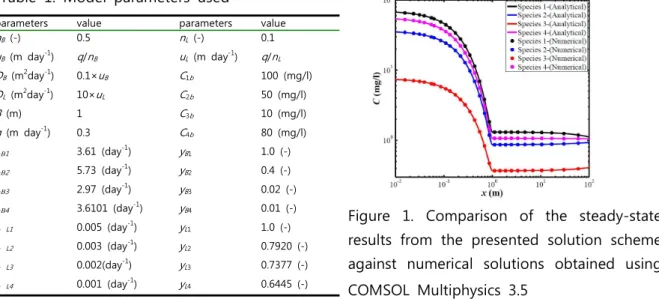
A single sequential reaction of species 1→2→3→4 (e.g., PCE→TCE→DCE→VC) is considered as a case study to compare the analytical solutions against numerical solutions obtained using COMSOL Multiphysics 3.5. The concentration distributions predicted by this analytical model are almost identical to those predicted by the numerical model. The validity in multi-domain of the analytical technology of Clement [2001] and Sun et al. [1999] for multispecies transport solutions is confirmed.
KSEG Conference / April 7 - 9, 2011 / Jeju / Korea
- 256 -
parameters value parameters value
nB (-) 0.5 nL (-) 0.1
uB (m day-1) q/nB uL (m day-1) q/nL
DB (m2day-1) 0.1×uB C1b 100 (mg/l)
DL (m2day-1) 10×uL C2b 50 (mg/l)
B (m) 1 C3b 10 (mg/l)
q (m day-1) 0.3 C4b 80 (mg/l)
lB1 3.61 (day-1) yB1 1.0 (-)
lB2 5.73 (day-1) yB2 0.4 (-)
lB3 2.97 (day-1) yB3 0.02 (-)
lB4 3.6101 (day-1) yB4 0.01 (-)
l L1 0.005 (day-1) yL1 1.0 (-)
l L2 0.003 (day-1) yL2 0.7920 (-)
l L3 0.002(day-1) yL3 0.7377 (-)
l L4 0.001 (day-1) yL4 0.6445 (-)
4. Conclusions
In this study, multispecies solute transport in a PRB-aquifer system is addressed through mathematical modeling. The results of the presented solution scheme compared well with the results from a numerical solution computed using numerical reactive transport code COMSOL3.5. Multi-domains configuration of the transformation approach used in Sun et al.
(1999) and Clement (2001) is validated. A new PRB designing model of multispecies is developed. The proposed analytical solution provides meaningful designing insights for the PRB installation.
Table 1. Model parameters used
Figure 1. Comparison of the steady-state results from the presented solution scheme against numerical solutions obtained using COMSOL Multiphysics 3.5
References
Clement, T.P. 2001, Generalized solution to multispecies transport equations coupled with a first-order reaction network, Water Resour. Res., Vol. 37, No.1, pp.167-163.
Eykholt, G.R., Elder, C.R., and Benson, C.H. 1999, Effects of aquifer heterogeneity and reaction mechanism uncertainty on a reactive barrier, J. Hazard. Mat., Vol. 68, No.1–2, pp.73–96.
Park, E. and Zhan H. 2009, One-dimensional solute transport in a permeable reactive barrier-aquifer system, Water Resour. Res., 45, W07502, doi:10.1029/2008WR007155.
Rabideau, A.J., Suribhatla, R., and Craig J.R. 2005, Analytical models for the design of iron-based permeable reactive barriers, J. Environ. Eng., Vol. 131, No.11, pp.1589–1597.
Sun, Y., Petersen, J.N., Clement, T.P. and Skeen R. S. 1999, Development of analytical solutions for multispecies transport with serial and parallel reactions, Water Resour. Res., Vol.35, No.1, pp.185–
190.
Tratnyek, P. G., Johnson, T. L., Scherer, M. M., and Eykholt, G. R. 1997, Remediating ground water with zero-valent metals: Chemical considerations in barrier design, Ground Water Monit. Rem., Vol.17, No.4, 108–114.
Van Genuchten, M. T. and Alves, W. J. 1982, Analytical solutions of the one-dimensional convective -dispersive solute transport equation, Tech. Bull. U.S. Department of Agriculture, 1661, pp.149.