조숙 대립 다수성 풋땅콩 ‘자선’
배석복1* ・ 박장환1・ 심강보2・ 하태정2・ 이명희1・ 황정동1・ 백인열1・ 이종기2
1국립식량과학원 기능성작물부, 2농촌진흥청
A New Early Maturing and High Yielding Peanut Variety ‘Jaseon’
for Vegetable Use
Suk-Bok Pae
1*, Chang-Hwan Park
1, Kang-Bo Shim
2, Tae-Joung Ha
2, Myung-Hee Lee
1, Chung-Dong Hwang
1, In-Youl Baek
1, and Jong-Ki Lee
21
Department of Functional Crop Science, NICS, RDA, Milyang 627-803, Korea
2
Rural Development Administration RDA, Suwon, 441-100, Korea
Abstract : A new peanut variety ‘Jaseon’ (Arachis hypogaea ssp. fastigiata.) was developed by the Department of Functional Crop, NICS, in Milyang in 2011. This was developed from the cross between the large grain cultivar ‘YG60’ and the short stem cultivar ‘YG55’. ‘Jaseon’, which is a Shinpung plant type, has 11 branch number and 43 cm in main stem length. Each pod has two grains with brown testa and long-ellipse shaped large kernel and its 100 seed weight was 98 g in the regional yield trials (RYT). ‘Jaseon’ showed 43.2% of crude oil and 43.0% of oleic acid composition in dry peanut, and had 25.0 mg/g of Sucrose and 4.4 mg/g of tannin content in fresh peanut. In the regional yield trials, ‘Jaseon’ was outyielded by 15% with 10.21 MT/ha for fresh pod and by 11% with 4.37 MT/ha for dry grain, compared those of check variety.
Keywords : Peanut variety, Jaseon, Arachis hypogaea, Shinpung type, High yielding variety
*Corresponding author (E-mail: [email protected], Tel: +82-55-350- 1215, Fax: +82-55-353-3050)
(Received on May 27, 2014. Revised on August 19, 2014.
Accepted on September 4, 2014.)
307
http://dx.doi.org/10.9787/KJBS.2014.46.3.307 Print ISSN: 0250-3360
Copyright ⓒ 2014 by the Korean Society of Breeding Science
This is an Open-Access article distributed under the terms of the Creative Commons Attribution Non-Commercial License (http://creativecommons.org/licenses/by-nc/3.0) which permits unrestricted non-commercial use, distribution, and reproduction in any medium, provided the original work is properly cited.
서 언
땅콩은 50% 정도의 지방과 25% 정도의 단백질을 함유하 고 있어서 콩과 함께 가장 중요한 기름, 단백질 공급 작물로 서 금후 세계적인 소비확대가 기대되는 작물이다. 우리나라 땅콩의 안전재배를 위해서는 생리·생태적으로 150일 이상의 생육기간과 3,300℃이상의 적산온도가 필요하여 비닐멀칭을 통해 파종시기를 앞당김으로써 땅콩생육에 필요한 유효온도 를 확보하고 있다. 그러나 비닐피복 재배는 생력화를 위한 기 계화 일관작업의 장애요인이 되고 있어 개선책이 요망된다 (Lee et al. 1989). 개화시작 후 100~110일 이후에 종실용 땅콩을 수확하는 관행적인 재배방식에 비해 개화 후 80~90 일경에 생땅콩으로 수확하여 출하하여 소비되는 풋땅콩은 영
남지역을 중심으로 생산과 소비가 이루어져 왔으나 근년에는 소비자의 선호도도 높고 소득도 종실용 땅콩 보다 높아 재배 가 전국적으로 확대되고 있다(Kim 2003).
풋땅콩 품종개발에 있어서 초기에는 풋땅콩 품종이 없어서 기존품종 중에서 협모양과 맛을 고려하여 ‘새들’땅콩을 선정 하였다(Ko et al. 1999, Lee et al. 1999). 최근에는 땅콩의 초 형간 생리적 특성을 고려하여 조숙 고품질 다수성 풋땅콩 품 종을 육성하기에 이르렀다(Pae et al. 1997, Pae et al. 2004, Pae et al. 2008). 재배법 연구로는 풋땅콩 기계수확을 위해 대형 컴바인을 이용한 생력시험을 하였고(Park et al. 1999), 파종기는 남부지역에서 비닐피복재배로 3월 하순까지 앞 당 길 수 있었고 6월중․하순까지 파종기간을 연장할 수 있음이 구명되어 2모작 작부체계에서 풋땅콩이 겨울작물-풋땅콩, 풋 땅콩-가을채소 등 전․후작물로 재배가 가능하게 되었고(Moon et al. 1989, Pae et al. 2002), 2모작 풋땅콩으로 6월 만파 재 배시 버지니아 초형이 신풍 초형 보다 양호한 수량성을 나타 내었다(Chung et al. 1985, Kim 2003, Pae et al. 2007). 또
Year ’01 ’02 ’03 ’04 ’05 ’06 ’07 ’08 ’09 ’10 ’11
Generation Cross F
1F
2F
3F
4F
5F
6F
7F
8F
9F
10YG60 1 1
. . 1
× → YG243 → B → 10 → 4 → 2 → PYT → AYT → Jaseon (Milyang 45)
. .
YG55 . 5 3
17
Procedure Crossing Bulk Line selection PYT
z& AYT
yRYT
xz
PYT: preliminary yield trial
y
AYT: Advanced yield trial
x
RYT : regional yield trial
Fig. 1. Pedigree diagram of a new peanut variety ‘Jaseon’.
Milyang4
YG60 Sinnamkwang
Jaseon (Miyang45) HYQ(CG)S-10
Suwon101 YG55
Fig. 2. Genealogical diagram of ‘Jaseon’.
한 앞으로는 높은 고 올레산 땅콩, 검정종피 땅콩 등 소비자 기호에 상응하여 외국과의 차별성이 높은 기능성 땅콩을 육 성하고자 한다.
본 국립식량과학원 기능성작물부에서는 간식 및 풋땅콩에 적합한 대립 땅콩 품종을 육성하기 위하여 노력한 결과, 조숙 종이며 수량성도 높은 풋땅콩 신품종 ‘자선’를 육성하게 되었 기에 이 품종의 육성경위와 주요특성을 요약 보고하는 바이다.
재료 및 방법
본시험은 2009-2011까지 3년간 4개 지역(청원, 익산, 대 구, 밀양)에서 지역적응시험을 수행하여 표준품종 ‘팔광’과 대비하여 ‘자선’(밀양45호) 의 생육특성 및 수량성을 비교 검 토하였다(RDA 2011). 각 지역에서 시험에 공시한 품종은 4 월 30일에 파종하였다. 시비량은 ha당 N-P2O5-K2O로서 30- 100-100 kg을, 석회와 퇴비는 각각 1 ton과 10 ton을 전량기 비로 시용하였다. 재식거리는 조간거리 40 cm, 휴간거리 60
cm, 주간거리는 25 cm로서 즉 ha당 80,000 주로 하였다. 비 닐피복은 흑색유공비닐을 이용하였는데 그 비닐규격은 푹 110 cm, 두께 0.015 mm 필름 위에 조간거리 40 cm, 주간거 리 25 cm 간격엘 5 cm 구멍크기의 비닐을 이용하였다. 재배 는 2립 파종하여 출현 후 솎음 작업을 통하여 1주1본으로 재 배하였다. 풋땅콩 수확은 개화후 80 일에 굴취하여 협의 표면 에 그물무늬가 뚜렷하여 상품가치가 있는 협을 성숙협으로 하여 풋땅콩 무게를 환산하였고, 그 협을 다시 햇볕에 풍건하 여 종실수량 및 수량구성요소를 조사하였다. 4개 지역에서 동 시에 수행한 생육 및 수량특성 조사방법은 지역적응시험 조 사기준에 준하여 실시하였다(RDA 2011).
결과 및 고찰
육성경위
‘자선’은 국내 소비자 선호도가 높은 간식용 풋땅콩을 육성 코자 조숙 양질 내재해 대립 다수성 품종 육성에 목표를 두고
Table 1. Inherent characteristics of a new peanut variety ‘Jaseon’.
Variety Plant type Pod setting Leaf color Seeds/pot Seed shape Testa color Jaseon
Palkwang
Shinpung Virginia
Main stem &
Branch Branch
Dark green Green
2 2
Long ellipse Long ellipse
Brown Light Brown
Table 2. Agronomic characteristics of a new peanut variety ‘Jaseon’.
Variety Flowering
date
Main stem height (cm)
Branch length (cm)
No. of branch/plant Jaseon
Palkwang
June 14 June 13
43 50
48 59
11 20
Table 3. Pod and seed characteristics of a new peanut variety ‘Jaseon’.
Variety No. of pods/plant Matured pods (%)
Shelling ratio (%)
100 seed wt.
(g)
Seeds/
pod
pod constriction (1-9) Jaseon
Palkwang
35 37
80 80
74 75
98 82
1.70 1.714
2 3
Table 4. Fresh pod and seed characteristics of a new peanut variety ‘Jaseon’.
Variety fresh pods no./plant Pod wt.
(g/100 pod)
Good quality pod (%)
Shelling ratio (%)
100 seed wt.
(g) Jaseon
Palkwang
35 37
361 275
93 89
70 70
147 132
계통육종법으로 선발 육성된 신품종으로 직립 대립인 ‘YG60’를 모본으로 하고 조숙 단경인 ‘YG55’를 부본으로 하여 2001년에 인공교배한 후 계통육성 과정을 거쳐 선발되었다.
2007년부터 2년간 생산력검정시험을 거쳐 2009부터 3년간
‘밀양45호’의 계통명으로 지역적응시험을 실시하였다(Fig. 1, Fig. 2). 그 결과 ‘밀양45호’는 조숙 대립 내병 다수성으로 그 우수성이 인정되어 2011년 12월 농촌진흥청 신품종선정위원 회에서 신품종으로 선정하고 ‘자선’로 명명되었다.
주요특성
고유특성
‘자선’의 고유 특성은 Table 1에서 보는 바와 같이 분지수 가 많은 버지니아형인 ‘팔광’땅콩과 달리 직립·대립이며 분지 수가 적은 신풍초형(Lee et al. 1989)으로 분지와 주경에서 착협한다. 잎은 짙은 녹색이고, 협당립수는 2립이고, 종피색 은 갈색이며, 종실형태는 장타원형이며 대립종에 속한다.
일반특성
지상부 생육특성
‘자선’은 ‘팔광’땅콩에 비해 개화기가 6월14일로서 1일 늦 고, 경장은 43 cm, 분지장은 48 cm로서 각각 7 cm, 11 cm 정 도 짧고, 분지수가 적은 소분지 직립 초형을 나타낸다(Table 2).
지금까지 땅콩육종에서 후기의 도복감소와 결실성 향상을 위 한 단경화 결과로 볼 수 있다.
지하부 특성 1) 협실특성
‘자선’은 ‘팔광’땅콩에 비해 성숙협수는 35개로서 2개 적으 나, 성숙협비율은 80%로 같고, 100립중은 98 g으로 16 g 무 거운 대립종이다(Table 3). 풋땅콩의 수량성은 협의 크기에 비례해 증가하는 경향(Pae et al. 2007)을 보여 다수성을 위해
‘자선’의 협 크기가 증가한 것으로 보인다.
2) 풋땅콩 협실특성
‘자선’은 ‘팔광’땅콩에 비해 풋협수는 35개로서 2개 적으
Table 5. Resistance to major disease, insect and lodging of ‘Jaseon’.
Variety Disease degree (0~9)
zInsect damage
(0~9)
yLodging (0~9)
xC. arachidicola C. personatum P. arachidicola S. rolfsii
Jaseon Daekwang
3 1
1 3
1 3
1 3
1 1
1 7
z
0; None, 1; 0.1~10%, 3; 10.1~20%, 5; 20.1-30%, 7; 30.1-50%, 9; over 50.1%
y
0; None, 1; 0.1~2%, 3; 20.1~5%, 5; 5.1-10%, 7; 10.1-30%, 9; over 30.1%
x
0; None, 1; under 5%, 3; 10-20%, 5; 30-40%, 7; 50-60%, 9; over 70%
Table 6. Oil and protein content and fatty acid composition in kernels of a new peanut variety ‘Jaseon’.
Variety Protein (%)
Oil (%)
Fatty acid composition (%)
Pal. Ste. Ole. Lin. Ara. Beh.
Jaseon Palkwang
26.3 28.6
43.2 43.7
12.1 11.3
4.22 4.2
43.0 41.6
35.6 38.5
2.1 1.4
2.6 2.2
Table 7. Physiochemistric characteristics of boiled vegetable peanut of a new variety ‘Jaseon’.
Variety Sucrose
(mg/g)
Stachyose (mg/g)
Resveratrol (㎍/g)
Tannin (mg/g)
Hardness (g/19.6 mm
2) Jaseon
Palkwang
25.0 24.5
2.1 2.3
0.17 0.13
4.4 4.3
1,997 1,893
Table 8. Preliminary yield trails of a new peanut variety ‘Jaseon’.
Variety Fresh pod yield (MT/ha) Kernel yield (MT/ha)
’07 ’08 Mean Index ’07 ’08 Mean Index
Jaseon Palkwang
11.38 9.35
10.31 7.48
11.07 8.42
131 100
4.94 4.08
3.26 2.96
4.10 3.52
116 100
나, 풋협중과 상품협비율(93%)이 높은 특성을 가지고 있다(Table 4).
내재해성
포장조건에서 ‘자선’의 주요 병해 및 도복에 대한 저항성 정 도는 Table 5에서와 같이 갈반병(Cercospora arachidicola)은
‘팔광’에 비해 약하나 흑반병(Cercospodium personatum), 그물무늬병(Phoma arachidicola), 흰비단병(S. rolfsii) 등 전 반적으로 강한 것으로 나타났다. 문제가 되는 담배거세미등에 대한 충해저항성은 같은 수준이며, 생육후기의 도복의 저항성 은 ‘팔광’땅콩에 비해 현저히 개선되었다(Table 5). 분지수가 적은 신풍형 초형에서 수확기에 약한 흑반병과 그물무늬병 (Pae et al. 2004) 등 병해에 대한 저항성이 개선되었다.
품질특성
풋땅콩 수확 후 건조 종실에서 ‘자선’은 조단백 함량은 26.3%로서 ‘팔광’에 비해 2.3% 낮으나 조지방 함량(43.2%) 과 지방산조성은 팔광땅콩과 비슷한 수준이다(Table 6). 유리 당과 탄닌 함량이 ‘팔광’과 비슷한 수준이며, 삶았을 때 풋땅 콩의 경도가 높아 조숙특성을 보이고 있다(Table 7).
수량성
2007년부터 2008년까지 2개년간 실시한 생산력검정시험 결과 Table 8에서와 같이 ha당 평균 풋땅콩은 11,07ton, 종실 수량은 4.10 ton으로 팔광땅콩 대비 각각 31%, 16% 증수되 었다.
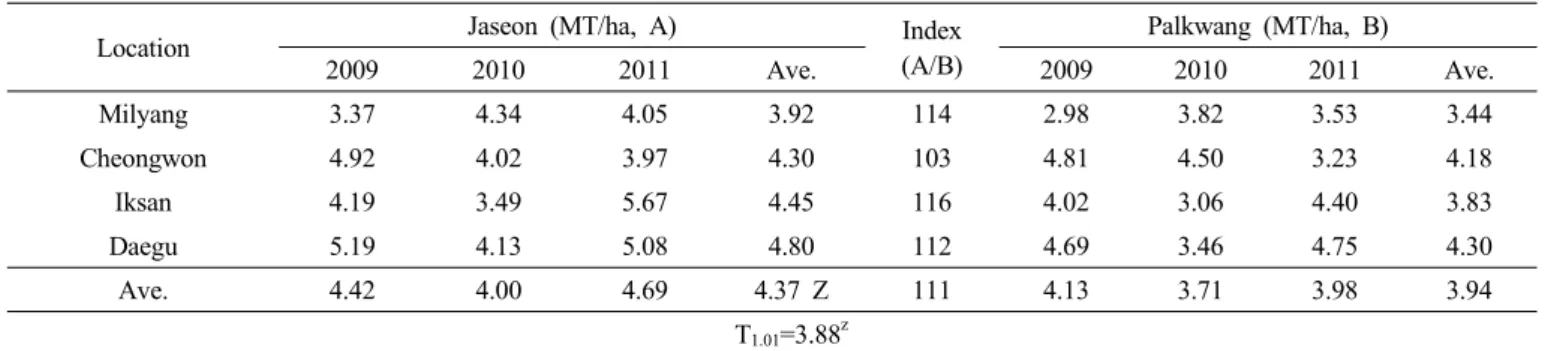
2009년부터 2011년까지 3개년간 전국 4개 지역에서 실시 된 지역적응시험 결과 ha당 평균 풋땅콩 수량성은 10.21 ton,
Fig. 3. Peanut cultivar ‘Jaseon’ (Right).
Table 9. Fresh pod yield potential of ‘Jaseon’ in regional yield trial for 3 years.
Location Jaseon (MT/10a, A) Index
(A/B)
Palkwang (MT/10, B)
2009 2010 2011 Ave. 2009 2010 2011 Ave.
Milyang 8.91 11.87 10.23 10.34 116 8.01 10.62 8.09 8.91
Cheongwon 11.50 10.78 9.33 10.54 110 10.30 11.30 7.06 9.55
Iksan 8.73 8.48 9.29 8.83 119 7.11 7.32 7.77 7.40
Daegu 12.89 10.04 10.44 11.12 115 10.41 8.05 10.62 9.69
Ave. 10.51 10.29 9.82 10.21 115 8.96 9.32 8.39 8.89
T
1.01=5.28
zz
It means significantly different between cultivars at 0.01% level
Table 10. Grain yield potential of ‘Jaseon’ in regional yield trial for 3 years.
Location Jaseon (MT/ha, A) Index
(A/B)
Palkwang (MT/ha, B)
2009 2010 2011 Ave. 2009 2010 2011 Ave.
Milyang 3.37 4.34 4.05 3.92 114 2.98 3.82 3.53 3.44
Cheongwon 4.92 4.02 3.97 4.30 103 4.81 4.50 3.23 4.18
Iksan 4.19 3.49 5.67 4.45 116 4.02 3.06 4.40 3.83
Daegu 5.19 4.13 5.08 4.80 112 4.69 3.46 4.75 4.30
Ave. 4.42 4.00 4.69 4.37 Z 111 4.13 3.71 3.98 3.94
T
1.01=3.88
zz
It means significantly different between cultivars at 0.01% level
건조 종실 수량성은 4.37 ton 정도로서 ‘팔광’땅콩 대비 각각 15%, 11% 높았다. 증수요인으로는 대립이며 협당립수, 100 립중 등이 높고 등숙이 양호한 것에 기인된 것으로 생각되었 다(Table 9, Table 10).적응지역 및 재배상의 유의점
‘자선’의 적응지역은 경기북부 및 강원도를 제외한 전국 땅
콩 재배지이며 재배상 유의점으로는 대립종의 특성상 4월 하 순~5월 상순 적기파종이 되어야 한다. ‘자선’ 은 초기에 개 화가 많은 신풍초형(Pae et al. 1997)으로 충분한 개화수 확 보, 자방병의 지하침투와 대립종 성숙을 원활히 하기 위한 적 습 및 병충해 방제를 철저히 하며 개화 후 80일경 적기에 수 확하여야 수량 특성 발휘에 유리하다.
적 요
간식용 대립 땅콩의 선호도가 높음에 따라 대립 양질 다수 성 신품종 육성을 위하여 직립 대립인 ‘YG60’과 조숙 단경인
‘YG55’를 인공교배하여 ‘Jaseon’육성하였다. ‘자선’은 신풍 초형으로 초기 개화가 많고 잎이 농녹색이며 지상부 생장습 성은 직립 소분지성이다. 주당 협수는 35개로서 팔광땅콩에 비해 2개 적으나 풋협중이 무겁고, 상품협비율(93%)이 높고, 100립중이 98 g인 대립품종이다. 생육후기까지 도복에 비교 적 강한 특성을 나타내며 흑반병, 그물무늬병, 흰비단병에 비 교적 강하다. ‘자선’의 조단백 함량이 26.3%, 조지방 함량이 43.2%이고 양질지방산인 올레산과 리놀산을 78.6% 함유하 고 있다. ‘자선’은 3년간 지역적응시험 결과 전국평균 풋땅콩 수량이 10.21 ton/ha로서 팔광땅콩에 비하여 15% 증수하였 고 건조 종실중은 4.37 ton/ha로서 11% 증수하였다. ‘자선’은 대립종이므로 적기에 파종하고, 충분한 성숙을 위하여 성숙기 병해 방제에 유의해야 하며 강원도와 산간 고냉지를 제외한 지역에서 적응성이 높은 품종이다.
사 사
본 논문은 농촌진흥청 아제다 과제(PJ010159012014)의지 원에 의해 이루어진 연구결과의 일부임.
REFERENCES