
Laparoscopic pancreaticoduodenectomy in pancreatic ductal adenocarcinoma
5
0
0
전체 글
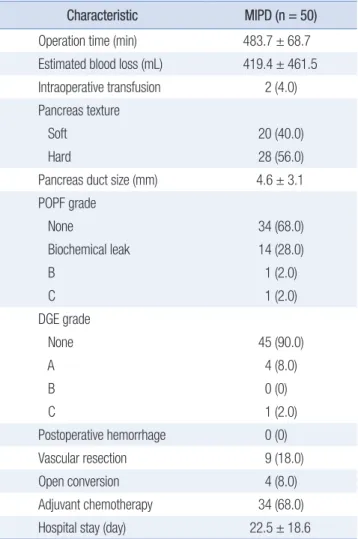
(2) 170. Munseok Choi et al.. LPD for pancreatic cancer is technically difficult, (2) only a few qualified surgeons are available, and (3) a very small proportion of patients with pancreatic cancer are eligible for this intervention. In this article, a surgical approach to LPD for pancreatic head cancer was described, and recent updates on short-term oncologic outcomes were brief ly summarized.. MATERIALS AND METHODS We previously described our surgical LPD technique for periampullary tumors [2,3]. In this section, additional oncologic concepts are introduced to develop a surgical strategy for LPD. Finally, our institutional experiences with LPD for pancreatic head cancer are presented. The relevant video clip is provided with this article (Supplementary Video 1).. Extent of surgery Several important prospective RCTs have determined the optimal extent of surgical resection for pancreatic cancer [4]. Standard PD was not considered inferior and had comparable oncologic outcomes to LPD in treating resectable pancreatic cancers. Hence, LPD with standard dissection is considered technically available, feasible, and safe for well-selected pancreatic head cancers.. Superior mesenteric artery lateral margin The pancreatic neck margins, retroperitoneal margins, and superior mesenteric artery (SMA) lateral margin should be carefully obtained during PD, as pancreatic cancer cells, regardless of location, can invade and infiltrate pancreatic nerve tissues leading to the major arteries—the SMA, common hepatic artery, and celiac axis [5]. Recently, we reported the potential application of indo-. cyanine green (ICG) to secure the SMA lateral margin during LPD. ICG (5 mg/2 cm3) was prepared and intravenously injected when dissecting uncinate process of the pancreas [6].. Combined vascular resection PD combined with venous resection (VR) is no longer contraindicated for pancreatic head cancer. However, patients who underwent PD-VR exhibited higher rates of complications, including in-hospital and 30-day mortality [7]. Therefore, LPD-VR needs to be performed by experienced surgeons in eligible patients. Various techniques of VR (tangential vs. segmental) and reconstruction (end-to-end vs. inter-position graft) have been reported, but not concluded which one is superior on perioperative outcome [8]. Despite demonstrating the safety and feasibility of LPD with combined resection of the superior mesenteric-splenic-portal venous conf luence in treating pancreatic cancer, we acknowledge the difficulty in performing this technique. Therefore, we prefer venous tangential resection to segmental resection in LPD for pancreatic cancer to enhance patient safety (Fig. 1).. RESULTS General characteristics of patients From June 2014 to November 2020, the medical records of 50 patients, of which 44 underwent LPD and six underwent robotassisted LPD for pancreatic head cancer were collected and reviewed. The clinical characteristics of the patients are summarized in Table 1.. Perioperative outcomes The perioperative outcomes are summarized in Table 2. The mean operation time was 483.7 ± 68.7 minutes and the mean. BD CHA. BD. PV. SV. IVC PV LRV. SMA. RRA PV Ao SMV. A. B. Fig. 1. Laparoscopic view after resection of pancreatic head cancer. (A) Segmental resection of the portal vein (PV) and end-to-end anastomosis, anastomosis site (white arrows). (B) Tangential resection of the PV, stump of resection (white arrows). BD, bile duct; SMA, superior mesenteric artery; CHA, common hepatic artery; LRV, left renal vein; SMV, superior mesenteric vein; Ao, aorta; IVC, inferior vena cava; SV, splenic vein. Journal of Minimally Invasive Surgery Vol. 24 24.. No. 3, 2021.
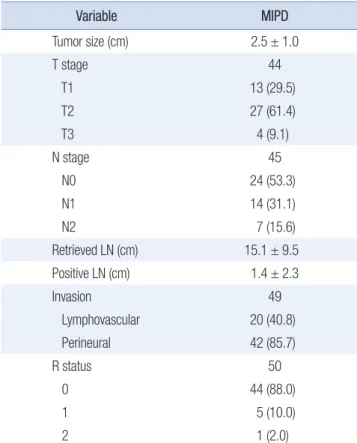
(3) 171. Laparoscopic pancreaticoduodenectomy in pancreatic ductal adenocarcinoma. estimated blood loss was 419.4 ± 461.5 mL. The mean pancreatic duct size was 4.6 ± 3.1 mm. Among the patients, nine (18.0%) underwent LPD-VR, 20 (40.0%) had a soft pancreas, and two patients (4.0%) developed a postoperative pancreatic fistula.. Short-term oncologic outcomes Table 3 shows the pathological characteristics. In the overall cohort, the mean tumor and lymph node sizes were 2.5 ± 1.0 cm and 15.1 ± 9.5 cm, respectively. Among the patients, 44 (88.0%) had R0 status, five (10.0%) underwent R1 resection, and one (2.0%) underwent R2 resection.. DISCUSSION LPD for pancreatic head cancer has theoretical advantages. First, a minimally invasive surgery can enhance postoperative recovery, thereby preserving the patient’s functional capacity and initiating adjuvant chemotherapy promptly. Second, LPD has frequently reduced intraoperative bleeding, thus lowering the risk of an intraoperative transfusion, which is known to adversely impact patient survival [9]. Although margin-negative radical pancreatectomy is most effective in treating pancreatic cancer, more than 80% of pancreatic cancer patients have unresectable tumors at the time of diagnosis. However, considering future advancements facilitating early diagnosis, the number of stage I and stage II patients, having tumors confined to the pancreas, is expected to increase. Therefore, the oncologic role of LPD should be reevaluated be-. cause most patients with stage I and II pancreatic cancer could undergo LPD using the described surgical strategy. We have previously reviewed the potential feasibility of LPD for pancreatic head cancer [10]. We found that LPD can provide equivalent or superior short-term oncologic outcomes and comparable long-term survival outcomes to those of the standard procedure, suggesting its technical feasibility and oncologic safety as a treatment method [3]. Although RCTs are regarded as the highest level of evidence, other circumstances should be considered. We therefore acknowledge some skepticism on whether RCTs can serve as the fundamental basis in choosing the appropriate treatment for patients. This is true for complex treatment modalities, such as LPD. Therefore, despite the retrospective study design, previous experiences and decisions of expert surgeons on treating their patients should still be considered. However, a successful RCT could be useful in choosing an appropriate surgical approach for pancreatic cancer patients. Table 2. Perioperative outcomes. Characteristic. MIPD (n = 50). Operation time (min). 483.7 ± 68.7. Estimated blood loss (mL). 419.4 ± 461.5. Intraoperative transfusion. 2 (4.0). Pancreas texture Soft. 20 (40.0). Hard. 28 (56.0). Pancreas duct size (mm). 4.6 ± 3.1. POPF grade Table 1. General characteristics of patients. Characteristic No. of patients Sex, male/female. MIPD 50 21 (42.0)/29 (58.0). Age (yr). 66.3 ± 8.8. Preoperative BMI (kg/m2). 23.4 ± 2.5. ASA PS classification I. 2 (4.0). II. 17 (34.0). III. 31 (62.0). Preoperative CA 19-9 (U/mL) Neoadjuvant CCRT. 227.4 ± 435.4 7 (14.0). Data are expressed as number only, mean ± standard deviation, or number (%). MIPD, minimally invasive pancreatoduodenectomy; BMI, body mass index; ASA, American Society of Anesthesiologists; PS, physical status; CA 19-9, carbohydrate antigen 19-9; CCRT, concurrent chemoradiotherapy.. None. 34 (68.0). Biochemical leak. 14 (28.0). B. 1 (2.0). C. 1 (2.0). DGE grade None. 45 (90.0). A. 4 (8.0). B. 0 (0). C. 1 (2.0). Postoperative hemorrhage. 0 (0). Vascular resection. 9 (18.0). Open conversion. 4 (8.0). Adjuvant chemotherapy Hospital stay (day). 34 (68.0) 22.5 ± 18.6. Data are expressed as mean ± standard deviation or number (%). MIPD, minimally invasive pancreatoduodenectomy; POPF, postoperative pancreatic fistula; DGE, delayed gastric emptying. www.e-jmis.org.
(4) 172. Munseok Choi et al.. Table 3. Short-term oncologic outcome. Conflict of interest. Variable Tumor size (cm). MIPD 2.5 ± 1.0. T stage. 44. T1. 13 (29.5). T2. 27 (61.4). T3. 4 (9.1). N stage. 45. N0. 24 (53.3). N1. 14 (31.1). N2. 7 (15.6). Retrieved LN (cm). 15.1 ± 9.5. Positive LN (cm). 1.4 ± 2.3. Invasion. 49. Lymphovascular. 20 (40.8). Perineural. 42 (85.7). R status. 50. 0. 44 (88.0). 1. 5 (10.0). 2. 1 (2.0). Data are expressed as mean ± standard deviation, number only, or number (%). MIPD, minimally invasive pancreatoduodenectomy; LN, lymph node.. Thus, we recommend a more careful clinical investigation into the potential application of LPD in pancreatic cancers.. NOTES Ethical statements The study was conducted in compliance with the principles of the Declaration of Helsinki and the study protocol was reviewed and approved by Institutional Review Board (IRB) of Yonsei University College of Medicine (registered on July 16, 2019; registration number: 2019-1411-001). A waiver of informed consent was approved by the IRB.. Authors’ contributions Conceptualization: CMK Visualization: WJL, HKH, SHK, SYR Writing–original draft: MC Writing–review & editing: WJL, HKH, SHK, SYR, CMK All authors read and approved the final manuscript. Journal of Minimally Invasive Surgery Vol. 24 24.. No. 3, 2021. All authors have no conf licts of interest to declare.. Funding/support None.. ORCID Munseok Choi, https://orcid.org/0000-0002-9844-4747 Seoung Yoon Rho, https://orcid.org/0000-0002-1265-826X Sung Hyun Kim, https://orcid.org/0000-0001-7683-9687 Ho Kyoung Hwang, https://orcid.org/0000-0003-4064-7776 Woo Jung Lee, https://orcid.org/0000-0001-9273-261X Chang Moo Kang, https://orcid.org/0000-0002-5382-4658. Supplementary materials Supplementary materials can be found via https://doi.org/10.7602/ jmis.2021.24.3.169.. REFERENCES 1. Kang CM, Lee SH, Chung MJ, Hwang HK, Lee WJ. Laparoscopic pancreatic reconstruction technique following laparoscopic pancreaticoduodenectomy. J Hepatobiliary Pancreat Sci 2015;22:202-210. 2. Navarro JG, Kang CM. Pitfalls for laparoscopic pancreaticoduodenectomy: Need for a stepwise approach. Ann Gastroenterol Surg 2019;3:254-268. 3. Choi M, Hwang HK, Rho SY, Lee WJ, Kang CM. Comparing laparoscopic and open pancreaticoduodenectomy in patients with pancreatic head cancer: oncologic outcomes and inflammatory scores. J Hepatobiliary Pancreat Sci 2020;27:124-131. 4. Wang W, He Y, Wu L, Ye L, Yao L, Tang Z. Efficacy of extended versus standard lymphadenectomy in pancreatoduodenectomy for pancreatic head adenocarcinoma. An update meta-analysis. Pancreatology 2019;19:1074-1080. 5. Yi SQ, Miwa K, Ohta T, et al. Innervation of the pancreas from the perspective of perineural invasion of pancreatic cancer. Pancreas 2003;27:225-229. 6. Rho SY, Kim JS, Chong JU, et al. Indocyanine green perfusion imaging-guided laparoscopic pancreaticoduodenectomy: potential application in retroperitoneal margin dissection. J Gastrointest Surg 2018;22:1470-1474. 7. Peng L, Zhou Z, Cao Z, Wu W, Xiao W, Cao J. Long-term oncological outcomes in laparoscopic versus open pancreaticoduodenectomy for pancreatic cancer: a systematic review and meta-analysis. J Laparoendosc Adv Surg Tech A 2019;29:759-769. 8. Kendrick ML, Sclabas GM. Major venous resection during total lapa-.
(5) Laparoscopic pancreaticoduodenectomy in pancreatic ductal adenocarcinoma. roscopic pancreaticoduodenectomy. HPB (Oxford) 2011;13:454-458. 9. Kim SY, Choi M, Hwang HK, Rho SY, Lee WJ, Kang CM. Intraoperative transfusion is independently associated with a worse prognosis in resected pancreatic cancer-a retrospective cohort analysis. J Clin. 173 Med 2020;9:689. 10. Kang CM, Lee WJ. Is laparoscopic pancreaticoduodenectomy feasible for pancreatic ductal adenocarcinoma? Cancers (Basel) 2020;12:3430.. www.e-jmis.org.
(6)
수치
관련 문서
In this paper, we propose a method to guarantee the system life as passive elements by using high efficiency operation and analog devices by tracking
Superior tensile properties were obtained, and heat treatment time could be shortened by the austenitizing treatment at A C1 +30∼40℃ followed by
Therefore, gravity concentration treatment followed by citric acid leaching could remove successfully heavy metals contaminants from the contaminated soil.. KEY
A Study on the Educational Modeling Contents for Introduction to Engineering Design by the Creative
The purpose of this study was to compare the emergence cough in 50% (EC 50 ) and 95% (EC 95 ) of remifentanil in effect-site TCI for suppressing emergence cough
Grape S, Kirkham KR, Akiki L, Albrecht E: Transversus abdominis plane block versus local anesthetic wound infiltration for optimal analgesia after
confidence intervals of pancreatic cancer incidence by increase of total cholesterol levels (10 mg/dL) during the past 3 years; Table S2: Multivariable odds ratios and
DKA has been suggested to be a poor prognostic factor for glycemic control, as it exacerbates the depletion of pancreatic islet cells, 17) worsens residual β-cell function, 18)
