Impact of Monovalent Cations on the Rheology of Cellulose Nanofibrils
Rahmini
1, Soyoung Juhn
2, Hyun-A Seong
3‡, Soo-Jeong Shin
4†Received October 10, 2019; Received in revised form November 7, 2019; Accepted March 2, 2020
ABSTRACT
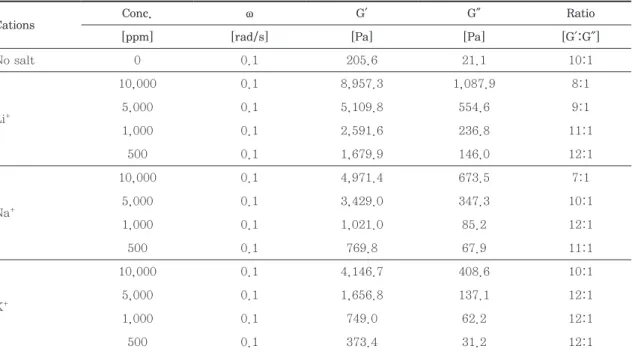
In this study, we investigated the rheological properties of 1.5% cellulose nanofibril (CNF) with various concentrations of monovalent ions using a rheometer at 25℃. Monovalent ions (Na
+, K
+, and Li
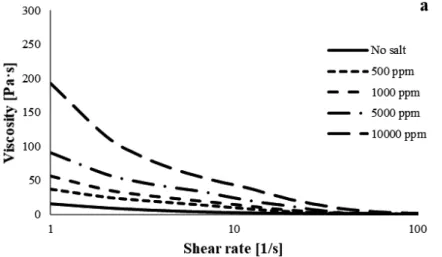
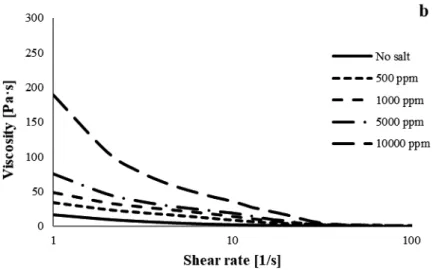
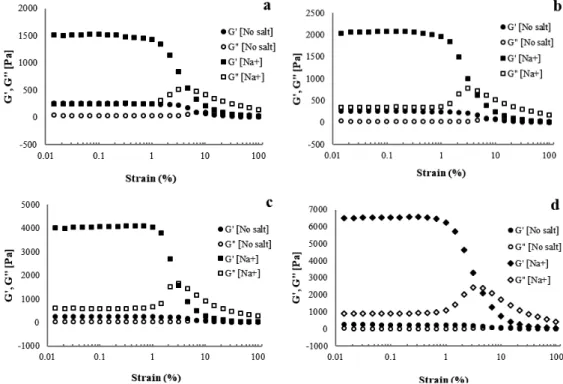
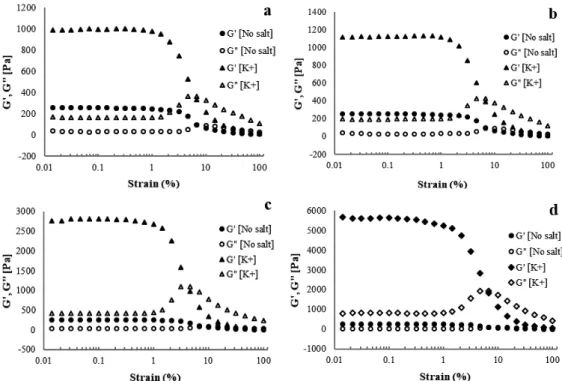
+) were used for the ionic crosslinking of CNFs. The shear viscosity, storage moduli (G′), and loss moduli (G″) of 1.5% CNFs with various added cations were measured at concentrations of 500, 1,000, 5,000, and 10,000 ppm. The presence of cat- ions in CNFs significantly induced strong hydrogels: As the cation concentration in- creased from 500 to 10,000 ppm, the viscosity, storage moduli, and loss moduli increased as well. All samples exhibited shear-thinning behavior with a monotonically decreased viscosity and an increased shear rate. Regarding hydrogel strength, we found that Li
+>Na
+>K
+because of the different radii of the cations and interfibrillar bridging on the hydrogels. We concluded that the rheological properties of CNFs with various concentra- tions of monovalent ions differ depending on the ionic radius and concentration of each cation. Further research is proposed to determine the maximum strengths of hydrogels with added cations.
Keywords: Ccellulose nanofibrils, rheology, storage modulus, loss modulus, monovalent cation, ionic cross-linking
Printed in Korea http://dx.doi.org/10.7584/JKTAPPI.2020.04.52.2.12
1 Department of Wood and Paper Science, Chungbuk National University, Cheongju, 28644, Republic of Korea, Student 2 Nature Costech Inc., Cheongju, 28578, Republic of Korea, Director for R&D
3 Department of Biochemistry, Chungbuk National University, Cheongju, 28644, Republic of Korea, Professor
4 Department of Wood and Paper Science, Chungbuk National University, Cheongju, 28644, Republic of Korea, Professor
† Corresponding Author: E-mail: [email protected] (Address: Department of Wood and Paper Science, Chungbuk National University, Cheongju, 28644, Republic of Korea)
‡ Co-corresponding Author: E-mail: [email protected] (Address: Department of Biochemistry, Chungbuk National Uni- versity, Cheongju, 28644, Republic of Korea)