This is an Open Access article distributed under the terms of the Creative Commons Attribution Non-Commercial License (http: //creativecommons.org/licenses/by- nc/4.0/) which permits unrestricted non-commercial use, distribution, and reproduction in any medium, provided the original work is properly cited.
Copyright: © 2019 Korean Journal of Agricultural Science
https://doi.org/10.7744/kjoas.20190049
PLANT&FOREST
Investigation of harvest time of paddy rice for green whole rice grains considering
transplanting time and nitrogen fertilization
Jin-Woong Cho*
Department of Crop Science, Chungnam National University, Daejeon 34134, Korea
*Corresponding author: [email protected]
Abstract
This study was conducted to investigate the growth characteristics and yield of whole green rice grains during the ripening period. These were investigated using Hopumbyeo and Unkwangbyeo at two transplanting times and with two kinds of nitrogen fertilization. The transplanting times were May 30 and June 20, respectively, using 30-day seedling culture and transplanting conducted with 3 - 4 plants per hill in planting space of 15 cm × 30 cm.
During nitrogen fertilization, 9 kg and 18 kg was used, respectively. The harvest of the green whole rice grains was carried out on the 15th, 20th, 25th, 30th, and 40th day after the heading date. The clum length was greater with later planting and with application of more nitrogen.
The rice yield was higher with nitrogen fertilization of 18 kg/10 a when transplanted on May 30 for Hupumbyeo, and for Unkwangbyeo, was higher at 9 kg/10 a nitrogen fertilization when transplanted on May 30. The protein content of Hopumbyeo was higher when the nitrogen fertilizer was 18 kg/10 a, and that of Unkwangbyeo was lower than that when transplanting on June 20. The greenness was not related to the nitrogen fertilization level when transplanted on May 20 but for later transplanting, the greenness was higher when the nitrogen application was increased, and the greenness was the greatest about 30 days after the heading date.
Keywords: green whole rice grain, nitrogen fertilization, transplanting time
Introduction
최근 웰빙(well-being)붐에 따라 기능성 유색미와 통곡물(whole grain) 등에 관한 관심이 높아지 고 있다. 특히, 통곡물은 수확한 곡물의 겨층, 배유, 씨눈이 손상되지 않도록 최소한으로 도정하 거나 도정하지 않은 곡물로서 섬유소, 비타민, 철분, 마그네슘 등의 함량이 도정곡물에 비하여 월등히 높아 심혈관, 고혈압, 체질량지수, 비만, 당뇨병 등에 긍정적인 효과가 있다고 알려져 있 어(Munter et al., 2007; Harland and Garton, 2008; Mellen et al., 2008; Vijver et al., 2009; Tighe et al., 2010;
Kochar et al., 2012) 최근 선진국은 비정맥 식품인 일정량의 현미, 통밀, 통보리 및 귀리 등 도정하 지 않은 곡물을 먹을 것을 권장하고 있다.
통곡물은 섬유소, 비타민 B, 비타민 E, 철분, 마그네슘 등을 함유하고 있으며 식이섬유소의 양 OPEN ACCESS
Accepted: July 30, 2019 Revised: July 22, 2019 Received: January 16, 2019 DOI:
Citation: Cho JW. 2019. Investigation of harvest time of paddy rice for green whole rice grains considering transplanting time and nitrogen fertilization. Korean Journal of Agricultural Science. https://
doi.org/10.7744/kjoas.20190049
은 도정한 곡물의 약 4배 이상을 가지고 있어 비만, 뇌졸중, 심장병, 당뇨와 암의 위험을 낮추는 것으로 알려져 있다. 안 토시아닌에 있는 시안닌은 복수암과 고형암의 발육을 저지한다고도 알려져 있다(Park et al., 2008). 그러나 통곡물은 질 감이 거칠고, 소화율이 낮아 완숙기에 수확되는 통곡물과 달리 호숙기에 수확 및 가공한 녹색상태의 통곡물에 대한 연 구가 진행되어 왔다(Won and Cho, 2015; Choi et al., 2016). 녹색통곡물은 식감이 부드럽고, 유리당, 아미노산, 무기질, 베 타글루칸 등이 다량 함유되어 있는데 특히 methionine, lysine 및 thonine 등의 함량이 많고 그 외에 비타민 C, β-carotene, α- 와 β-tocopherol 등의 함량이 월등히 높은 함량은 보였다고 하여(Ju et al., 2007; Kim et al., 2007b; Yang et al., 2012; Gan et al., 2015) 녹색통곡물은 새로운 식량 형태로의 가공 활용성이 높은 것으로 알려져 있다(Bae et al., 2011; Paik et al., 2013). 녹 색통곡물을 생산하기 위한 적정한 수확시기는 밀이 출수 후 33일경(Kim et al., 2007a), 쌀보리는 출수 후 26 - 27일(Ju et al.,
2007), 유색벼인 녹원찰벼는 출수 후 35 - 37일(Lee et al., 2012), 일반벼는 출수 후 15 - 25일(Won and Cho, 2015), 및 15 - 25일 의 보리(Gan et al., 2015)가 제시되고 있다.
본 연구는 쌀을 녹색의 상태가 유지되는 호숙기에 수확 할 목적으로 벼 이앙시기와 질소시비량에 따른 녹색통곡물 용 벼의 특성을 알아보고자 본 연구를 수행하였다.
Materials and methods
공시재료
본 실험은 충남대학교 농업생명과학대학 부속 농장 벼포장에서 실시하였다. 공시재료는 조생종인 운광벼와 중·만 생종인 호품벼를 공시하여 사용하였다.
재배방법
파종시기는 4월 30일과 5월 20일에 상자당 200 g씩 파종하여 약 30일간 육묘한 후 본답에 5월 30일과 6월 20일에 재식 거리를 30 cm × 15 cm 간격으로 기계이앙을 실시하였다.
시비량은 10 a당 질소시비는 9 kg와 18 kg로 구분하여 기비로 50%, 분얼비 20%, 이삭비 30%씩 각각 분시하였으며, 인 산은 4.5 kg을 전량 기비로 시비하였고 칼륨은 5.7 kg을 기비와 수비로 70%와 30%를 분시하였다. 시험구는 난괴법 3반 복으로 하여 수행하였다.
생육조사
벼 출수 후 생육조사는 출수 후 15, 20, 25, 30, 40일에 간장, 수장, 엽면적등 지상부 생육조사와 현미를 대상으로 천립중 과 수량을 조사하였으며 성숙기 이후에 수량 및 수량구성요소를 각각 조사하였다.
색도
출수 후 15, 25, 40일에 겨를 제거한 벼 종실을 대상으로 분석하였다. 색도는 색차계(JC801, Color techno co., Japan)를 사 용하여 L (lightness), a (redness: +, greeness: -), b (yellowness: +, blueness: -)값으로 분석하였다.
통계 분석
통계프로그램 SAS (v. 9.2, SAS Institute, Cary, USA)를 이용하여 형질 특성들 간 평균비교, 분산분석을 수행하였다.
Results and discussion
출수 및 온도 특성
조생종인 운광벼는 5월 30일 이앙의 9 kg/10 a의 질소시비에는 7월 31일에 출수하여 출수일수는 63일, 5월 30일 이앙 의 18 kg/10 a 질소시비에는 7월 29일에 출수하여 출수일수는 61일이였고, 6월 20일 이앙은 질소시비량에 관계없이 8월 11일에 각각 출수하여 출수일수는 53일이였다(Table 1).
중만생종인 호품벼는 5월 30일 이앙은 질소시비량에 관계없이 8월 13일에 각각 출수하여 포장생육일수는 79일이였 고, 6월 20일 이앙의 5월 30일 이앙의 9 kg/10 a의 질소시비에는 8월 22일에 출수하여 출수일수는 65일이였고, 6월 20일 이앙의 18 kg/10 a 질소시비에는 8월 21일에 출수하여 포장생육일수는 64일이였다. 이앙시기가 늦어질수록 포장생육일 수는 단축되었으며 단축 정도는 운광벼에 비해 호품벼에서 컸고, 질소시비량에 따라서는 차이가 거의 없었다. 두 품종 간의 차이를 보인 것은 숙기의 생태적 차이인 것으로 보인다. Yoshida and Hara (1977)는 이앙시기가 늦어질수록 본답생 육일수가 짧아진 원인은 고온 단일작물인 벼가 14시간 이상의 장일조건보다 10시간 이하의 단일조건에서 또한 저온에 서보다 고온에서 출수 개화가 촉진되기 때문이라고 하였다.
한편, 출수기부터 성숙기까지의 적산온도는 이앙시기가 적기이앙 시기인 5월 30일이 6월 20일에 이앙할 때보다 높은 평균온도를 보였으며, 운광벼보다 호품벼가 더 높은 평균온도를 보였다. 두 품종 모두 이앙시기가 늦은 6월 20일에 이 앙하였을 때 등숙기 평균온도가 높은 이유는 이앙 당시 만기이앙할 때 평균기온이 상대적으로 높아지고, 일장이 짧아 지는 조건 때문으로 생각된다. 그러나 질시시비량에 따른 벼 등숙기의 적산온도는 큰 차이를 보이지 않았다.
수량 및 수량 구성요소
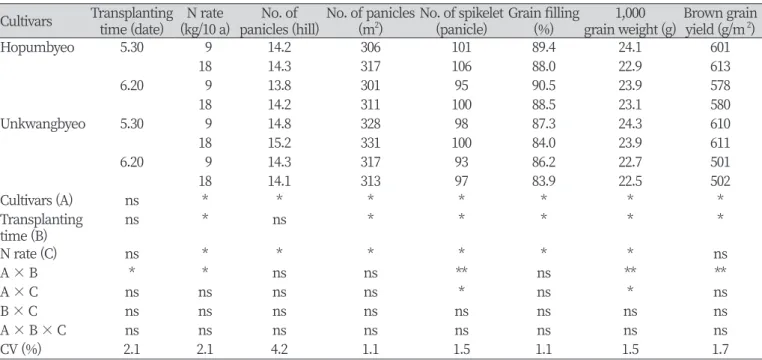
이앙시기와 질소시비량에 따른 벼 수량 및 수량구성요소에 미치는 영향은 Table 2와 같다. 이앙시기와 질소시비량에 따른 수량 및 수량구성요소를 품종 간에는 주당 경수를 제외하고 단위면적당 이삭수, 이삭당 영화수, 등숙율, 1,000립중 그리고 단위면적당 수량은 유의성이 인정되었다. 이앙시기에 따라서는 등숙율, 1,000립중, 수량 등에서 유의성이 인정 되었으며 등숙율, 천립중, 현미수량은 5월 30일 이앙했을 때 보다 6월 20일 이앙할 경우 감소되었다. 질소시비량에 따른 유의성은 주당 경수, 이삭수, 영화수, 등숙율 및 천립중에서 보였으며 1,000립중은 질소시비량이 높으며 감소되고 수량 은 증가되는 경향을 보였다.
이앙시기에 따른 품종간 1,000립중 차이를 살펴보면 중만생종인 호품벼는 5월 30일 이앙했을 때보다 6월 20일 이앙 했을 경우 약 0.2 g 의 감소를 보였으며 운광벼는 약 1.9 g 감소를 보였고 질소시비량에 의해서도 감소되는 경향을 보였 Table 1. Heading date, emergence to heading date and accumulated temperature during ripening period of two rice cultivars with two transplanting times and nitrogen level.
Varieties Transplanting time (date) N rate
(kg/10 a)Heading
date Emergence to
heading date (day) Average temp. transplanting to
heading date (℃) Accumulated temp. during ripening period (℃)
Hopumbyeo 5.30 9 8.13 79 24.9 937
18 8.13 79 24.9 937
6.20 9 8.22 65 26.3 857
18 8.21 64 26.3 857
Unkwangbyeo 5.30 9 7.31 63 24.9 1,043
18 7.29 61 24.7 1,061
6.20 9 8.11 53 26.6 955
18 8.11 53 26.6 955
다. 수량을 살펴보면 호품벼는 5월 30일 9 kg의 질소시비량으로 재배했을 때 약 m2당 601 g였으나 6월 30일 같은 질소시 비량일 때 578 g으로 약 23 g 감소되었다. 운광벼는 5월 30일 이앙시기와 9 kg의 질소시비량이 577 g에서 6월 20일 이앙시 기와 9 kg의 질소시비량이 약 501 g으로 약 66 g의 큰 수량 감소를 보여 만식재배일 경우 중만생종보다 조생종 품종이 수 량 감소가 더 크다는 것을 알 수 있었다. 이와 같이 조생종에서 이앙시기 및 질소시비 효과가 적은 이유는 고온에 의해 등숙에 지장이 있다는Yoshida and Hara (1977)의 결과로 볼 때 일장보다 온도의 영향을 더 크게 받아 등숙불량이 주 원인 으로 생각된다.
등숙기간 종실 특성
이앙시기와 질소시비량을 달리하여 출수 후 등숙기간 동안의 천립중과 현미수량을 살펴보면 등숙이 진행되면서 천 립중과 현미수량은 증가하는 경향을 보였다(Fig. 1). 벼의 등숙기간 중 호숙기는 일반적으로 출수 후 약 25일경으로 이 시기의 천립중을 살펴보면 호품벼는 적기이앙시 출수 후 25 - 30일에서는 18.2 - 23.3 g을 보였고, 6월 20일 이앙에서 9 kg/10 a 질소시비였을 때 가장 높은 천립중을 나타내었다. 운광벼는 25 - 30일에 16.8 - 21.5 g의 천립중을 보였고, 5월 30일 이앙의 9 kg/10 a 질소시비에서 가장 높은 천립중을 나타냈다.
호품벼의 현미수량은 25 - 30일 일 때 최소 441.0 g/m2에서 최대 606.6 g/m2의 수량을 보였고, 운광벼는 최소 410.8 g/m2 에서 최대 592.5 g/m2의 수량을 나타냈다. 호품벼는 5월 30일 이앙의 18 kg/10 a 질소시비에서 가장 좋은 수량을 보였고, 운광벼는 5월 30일 이앙의 9 kg/10 a 질소시비에서 가장 좋은 수량을 보였다. 호품벼는 18 kg/10 a 로 질소시비하였을 경 우 높은 수량성을 볼 수 있었고, 운광벼는 5월 30일에 이앙할 때 6월 20일 이앙할 때 보다 높은 수량을 보였다.
색도 평가
Fig. 2는 호품벼와 운광벼의 출수 후 일수에 따른 녹색통쌀의 성숙정도로 5월 30일에 이앙한 것은 질소시비량에 따른
Table 2. The yield and yield components of two rice cultivars with two transplanting time and nitrogen level.
Cultivars Transplanting time (date) N rate
(kg/10 a) No. of
panicles (hill) No. of panicles
(m2) No. of spikelet
(panicle) Grain filling
(%) 1,000
grain weight (g) Brown grain yield (g/m 2)
Hopumbyeo 5.30 9 14.2 306 101 89.4 24.1 601
18 14.3 317 106 88.0 22.9 613
6.20 9 13.8 301 95 90.5 23.9 578
18 14.2 311 100 88.5 23.1 580
Unkwangbyeo 5.30 9 14.8 328 98 87.3 24.3 610
18 15.2 331 100 84.0 23.9 611
6.20 9 14.3 317 93 86.2 22.7 501
18 14.1 313 97 83.9 22.5 502
Cultivars (A) ns * * * * * * *
Transplanting
time (B) ns * ns * * * * *
N rate (C) ns * * * * * * ns
A × B * * ns ns ** ns ** **
A × C ns ns ns ns * ns * ns
B × C ns ns ns ns ns ns ns ns
A × B × C ns ns ns ns ns ns ns ns
CV (%) 2.1 2.1 4.2 1.1 1.5 1.1 1.5 1.7
*, ** are statistically significant at the 0.05 and 0.01 probability levels, respectively. ns = not significant.
색도 차이를 볼 수 없었으나 6월 20일에 이앙한 것은 두 품종 모두 질소시비량이 많을 때 색이 진함을 볼 수 있었다. 따라 서 녹색통살을 생산할 목적으로 재배할 경우 만식재배일 때는 질소시비량을 증시하여 재배하여 할 것으로 생각된다.
Fig. 1. 1,000 grain weight and Brown grain yield during ripening period of two rice cultivars with two transplanting times and nitrogen levels. A, Hupumbyeo; B, Unkwangbyeo. ○, transplanting time on 30 May and N level of 9 kg/10 a; ●, transplanting time on 30 May and N level of 18 kg/10 a; □, transplanting time on 20 Jun and N level 9 kg/10 a; ■, transplanting time on 20 Jun and N level of 18 kg/10 a; DAH, days after heading date.
Fig. 2. The differences of characteristics in rice grain at different days after heading date (DAH) with two transplanting time and nitrogen levels. A, Hopumbyeo; B, Unkwangbyeo; a, transplanting time on 30 May and N level of 9 kg/10 a; b, transplanting time on 30 May and N level of 18 kg/10 a; c, transplanting time on 20 Jun and N level 9 kg/10 a; d, transplanting time on 20 Jun and N level of 18 kg/10 a.
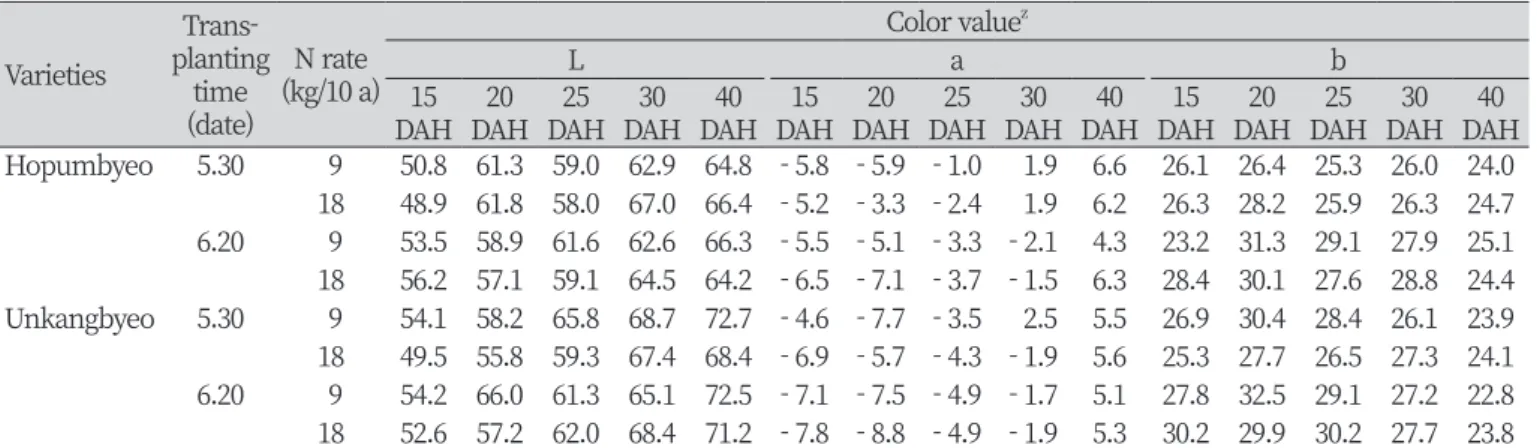
한편, 출수 후 40일까지 등숙기간의 색도는 Table 3과 같다. a값은 출수 후 30일 까지 - 값을 나타내었는데 출수 후 40일 이후로는 이앙시기 및 질소시비량에 관계없이 + 값을 나타내어 녹색도가 거의 없음을 나타내었다.
수확시기가 늦어질수록 녹색미 비율은 현저히 낮아져 수확시기에 영향을 많이 받는 것을 보였다. (Lee et al., 2007) 의 보고와 같이 등숙기의 평균기온이 높으면 생리적 성숙기의 단축으로 인하여 수확일까지의 기간이 길어지면서 엽록소 의 분해가 빠르게 진행되어 녹색이 황색으로 변하였기 때문이며(Kim et al., 2007b; Choi et al., 2016), Lee and Lee (2008)도 출수 후 수확기까지의 기간이 짧은 수록 녹색이 더 진하다고 보고하였다.
L, a, b 값은 모든 품종에서 파종 및 수확시기가 같아도 차이가 있었으며 수확 날짜의 차이에 따라 색도의 변화가 크게 나타나는 것으로 알 수 있었다. 호품벼는 5월 30일 이앙의 적기재배보다 6월 20일 이앙의 만식재배가 녹색도가 출수 후 20 - 30일이 더 낮은 - 값을 보였고 18 kg의 질소시비를 하였을 경우가 더 낮은 - 값을 볼 수 있었고, 운광벼는 이앙시기에 는 큰 차이를 보이지 않았으나 18 kg의 질소시비를 하였을 때 더 낮은 - 값을 보여 호숙기에 수확하여 녹색통쌀을 생산 할 경우 질소시비량을 증시하고 중만생종을 이용할 때는 만식재배를 할 때 효과적이라고 생각된다.
Conclusion
녹색통곡물로 이용하기 위하여 이앙시기와 질소시비량을 달리하여 호품벼와 운광벼을 대상으로 벼 출수 후 등숙기 간 동안의 주요 생육특성과 수량을 조사한 결과 간장은 대체적으로 이앙시기가 늦고, 질소시비량이 높을 때 더 컸으며 현미수량은 5월 30일 이앙의 18 kg/10 a 질소시비를 할 때 가장 많았고, 운광벼는 5월 30일 이앙할 때 9 kg/10 a 질소시비 가 가장 많았다. 호품벼는 종실의 단백질함량은 질소시비량이 18 kg/10 a일 때 단백질함량이 높았으며 운광벼는 5월 30 일 이앙이 6월 20일 이앙보다 단백질 함량이 낮았으며 질소시비량이 18 kg/10 a일 때 단백질함량이 더 높았다. 녹색도는 이앙시기가 5월 30일 때는 질소시비량과 관계없었으나 6월 20일 이앙할 때는 질소시비량이 많으면 녹색도가 더 높았으 며, 특히 출수 후 30일경에 녹색도가 가장 높았다.
Table 3. Color values of rice grain during ripening period after heading date with two transplanting times and nitrogen levels.
Varieties
Trans- planting
(date)time
N rate (kg/10 a)
Color valuez
L a b
DAH15 20 DAH 25
DAH 30 DAH 40
DAH 15 DAH 20
DAH 25 DAH 30
DAH 40 DAH 15
DAH 20 DAH 25
DAH 30 DAH 40 Hopumbyeo 5.30 9 50.8 61.3 59.0 62.9 64.8 - 5.8 - 5.9 - 1.0 1.9 6.6 26.1 26.4 25.3 26.0 24.0DAH 18 48.9 61.8 58.0 67.0 66.4 - 5.2 - 3.3 - 2.4 1.9 6.2 26.3 28.2 25.9 26.3 24.7 6.20 9 53.5 58.9 61.6 62.6 66.3 - 5.5 - 5.1 - 3.3 - 2.1 4.3 23.2 31.3 29.1 27.9 25.1 18 56.2 57.1 59.1 64.5 64.2 - 6.5 - 7.1 - 3.7 - 1.5 6.3 28.4 30.1 27.6 28.8 24.4 Unkangbyeo 5.30 9 54.1 58.2 65.8 68.7 72.7 - 4.6 - 7.7 - 3.5 2.5 5.5 26.9 30.4 28.4 26.1 23.9 18 49.5 55.8 59.3 67.4 68.4 - 6.9 - 5.7 - 4.3 - 1.9 5.6 25.3 27.7 26.5 27.3 24.1 6.20 9 54.2 66.0 61.3 65.1 72.5 - 7.1 - 7.5 - 4.9 - 1.7 5.1 27.8 32.5 29.1 27.2 22.8 18 52.6 57.2 62.0 68.4 71.2 - 7.8 - 8.8 - 4.9 - 1.9 5.3 30.2 29.9 30.2 27.7 23.8
z Measured by Minolta Chroma Meter (CR-200), and the ‘L’ scale (0 - 100) mean lightness, that is, blackness when 0 and whiteness when 100, the ‘a’ scale (-80 -100) redness when positive and greenness when negative, and the ‘b’ scale (± 70) yellowness when positive and blueness when negative. DAH, days after heading date.
Acknowledgments
본 논문은 2017년 충남대학교 학술연구비 지원에 의해 일부 수행된 결과입니다.
Authors Information
Jin-Woong Cho, Department of Crop Science, Collage of Agricultural & life sciences, Chungnam National University, Professor.
References
Bae HC, Renchinkhand G, Ku JH, Nam MS. 2011. Characterization of fermented milk added with green whole grains of barley, wheat, glutinous rice and common rice powders. CNU Journal of agricultural Science 38:485-491. [in Korean]
Choi KH, Chang YJ, Song YE, Seo SY, Kang CH, Yoo YJ, Lee KK, Song YJ, Kim CK, Cho JW. 2016. Comparison of the characteristics of wheat cultivars used for whole green wheat grain production. Korean Journal Crop Science 61:257-263. [in Korean]
Gan L, Wang XY, Yang D, Shin JA, Lee KT, Lee JH, Yamakawa T, Cho JW. 2015. Comparison of nutritional composition of premature, mature and de-hulled barley in Korea. Journal of Faculty Agriculture Kyushu University 60:57-63.
Harland JI, Garton LE. 2008. Whole grain intake as a marker of healthy body weight and adiposity. Public Health Nutrition 11:554-563.
Ju JI, Lee KS, Min HI, Lee BJ, Kwon BG, Gu JH, Oh MJ. 2007. Changes in physicochemical characteristics of green barley according to days after heading. Korean Journal Crop Science 52:36-44. [in Korean]
Kim KS, Choi YP, Kim ST, Choi HG, Chung CT, Kim BK, Yu JH, Lee HB. 2007b. Study on Colored Rice - Ⅲ.
Major growth characteristics for the promising lines of colored rice developed from genetic resources.
CNU Journal of Agricultural Science 34:125-129. [in Korean]
Kim MC, Lee KS, Lee BJ, Kwon BG, Ju JI, Gu JH, Oh M. 2007a. Changes in the physicochemical characteristics of green wheat during maturation. Journal of Korean Society Food Science Nutrition 36:1307-1313. [in Korean]
Kochar J, Gaziano JM, Djousse L. 2012. Breakfast cereals and risk of hypertension in the physicians’ health study I. Clinical Nutrition 31:89-92.
Lee HH, Chu SH, Kang MS, Liu SH, Kim CH, Ko HK. 2007. Change of kernel-greenness under different storage conditions after harvest in green-kerneled rice. Korean Journal of Breeding Science 39:155- 159. [in Korean]
Lee KK, Cho SH, Lee DR, Song YE, Song YJ, Lee JH, Choi IY. 2012. Change of yield and greenness of
“Nonwonchalbyeo” under different date of transplanting and harvesting. Korean Journal Crop Science 57:137-143. [in Korean]
Lee YS, Lee JK. 2008. Date of harvest and transplanting of pigmented rice. Chungcheongbuk-do ARES.
Research Report 1-9. [in Korean]
Mellen PB, Walch TF, Herrington DM. 2008. Whole grain intake and cardiovascular disease: A meta- analysis. Nutrition, Metabolism and Cardiovascular Disease 18:283-290.
Munter JS, Hu FB, Spiegelman D, Franz M, Dam RM. 2007. Whole grain, bran, and germ intake and risk of type 2 diabetes: A prospective cohort study and systematic review. Plos Medicine 4:261.
Paik SH, Lee ES, Hong ST, Ku JH, Nam MS. 2013. Quality characteristics of short bread cookies with added green whole grain rice powder. CNU Journal of Agricultural Science 40:377-383. [in Korean]
Park YS, Kim SK, Chang HI. 2008. Isolation of antocyanin from black rice (Heugjinjubyeo) and screening of its antioxidant activities. Korean Journal of Microbiology and Biotechnology 36:55-60. [in Korean]
Tighe P, Duthie G, Vaughan N, Brittenden J, Simpson WG, Duthie S, Mutch W, Wahle K, Horgan G, Thies F. 2010. Effect of increased consumption of whole-grain foods on blood pressure and other cardiovascular risk markers in healthy middle-aged persons: A randomized controlled trial. American Journal Clinical Nutrition 92:733-740.
Vijver LP, Bosch LM, Brandt PA, Goldbohm RA. 2009. Whole-grain consumption, dietary fibre intake and body mass index in the Netherlands cohort study. Nutrition Journal 8:15.
Won JY, Cho JW. 2015. Comparison of characteristics among rice varieties for whole green rice grain production. Korean Journal Crop Science 60:442-447. [in Korean]
Yang D, Shin JA, Gan LJ, Zhu XM, Hong ST, Sung CK, Cho JW, Ku JH, Lee K. 2012. Comparison of nutritional compounds in premature green and mature yellow whole grain wheat in Korea. Cereal Chemistry 89:284-288.
Yoshida S, Hara T. 1977. Effects of air temperature and light on grain filling of an Indica and a Japonica rice under controlled enviromental conditions. Soil Science and Plant Nutrition 23:93-107.