42(6), 964~968(2013) http://dx.doi.org/10.3746/jkfn.2013.42.6.964
Hydrocolloids가 쌀만두피 특성에 미치는 영향
임은지․최수정․이은정†
삼성정밀화학
Effect of Hydrocolloids on the Quality of Rice Dumpling Skins
Eun Ji Lim, Sujung Choi, and Eun Jung Lee† Samsung Fine Chemicals Co., Ltd., Incheon 405-820, Korea
Abstract
This study investigated the formation of rice dumpling skins with various food additives to improve their texture. Rice (Millyang260 and Hanarum) was obtained from the Rural Development Administration. Rice was milled through an air classifying mill (ACM), and hydroxypropyl methylcellulose (HPMC), xanthan gum, guar gum, carrageenan, or propylene glycol alginate (PGA) was used as food additives. The effects of hydrocolloids on textural were evaluated and rice dumpling skin prepared with additives showed significantly higher values than the control for cooking properties and texture. The presence of hydrocolloids in rice dumpling skin appeared to decrease its weight and volume after cooking. Textural properties of rice dumpling skin with hydrocolloids were similar to the control regardless of cooking condition.
Key words: rice dumpling skin, hydroxypropyl methylcellulose, hydrocolloids, rice flour
†
Corresponding author. E-mail: [email protected]
†
Phone: 82-32-899-0842, Fax: 82-32-816-4504
서 론
쌀은 우리나라 및 아시아에서 주로 주식으로 이용되는 곡 물이다. 과거에는 쌀 생산이 수요보다 공급이 매우 부족하여 쌀을 주식 이외의 용도로 사용하는 것을 국가에서 금하기도 하였다. 그러나 기술의 발달과 산업의 발달에 의해 쌀 생산 량이 증가하였으며, 또한 식생활이 다양화됨에 따라 쌀의 소비가 감소하여 현재 쌀의 재고 및 농가 보호가 필요한 상 황이 발생되고 있다. 이러한 이유로 현재 쌀을 이용한 가공 식품 개발에 관한 연구가 진행되고 있다(1-6). 또한 기존 쌀 은 주식용 쌀 품종으로 개발되었기에 가공적성이 좋지 않아 가공용 쌀 품종 개발에도 많은 연구를 진행 중에 있다(7-19).
쌀의 특성에 의해 가공 적성능이 떨어짐에 따라 쌀의 품질 한계를 뛰어넘기 위한 식품 소재를 첨가함으로 품질을 향상 하려는 노력이 되고 있다. 다양한 소재들 중에 hydrocolloids 를 이용하여 gluten 대체 및 보습성, 노화억제, 냉해동 안정 성 등의 품질 개선을 통한 쌀 가공 제품 개발이 활발하게 진행되고 있다. 최근에는 가공을 통한 cellulose의 유도체들 을 이용, 기능성을 갖는 cellulose 제품들도 적용되고 있다 (20-22). 특히 HPMC(hydroxypropyl methylcellulose)는 다 양한 기능을 부여됨에 따라 다양한 분야에 적용되고 있으며 새로운 소재로 관심을 갖게 되었다. HPMC는 cellulose 주사 슬에 메틸기와 히드록시프로필기의 치환도에 따라 다양한
타입으로 구분되어지며, 식품 첨가물로 천연 펄프를 이용하 여 제조된 소재로 90% 이상의 식이섬유를 함유, 식품에서 다양한 기능성을 나타내고 있다. HPMC의 기능은 필름 형성 능, 우화안정성, 보형성, 겔형성능, 보습성, 윤활성, 냉해동 안정성 등의 특징을 나타냄을 언급하고 있다(22). 따라서 본 연구에서는 쌀의 품종과 hydrocolloids 첨가에 따른 쌀만두 피의 가공 적성 및 조리 특성 변화를 알아보기 위해 연구를 진행하였다.
재료 및 방법
쌀 및 hydrocolloids
쌀은 농촌진흥청에서 공급받은 밀양260호, 한아름을 건식 분쇄하여 사용하였다. 반죽의 품질개선을 위한 hydrocol- loids는 HPMC(AnyAddy
Ⓡ, Samsung Fine Chemicals Co., Incheon, Korea), xanthan gum(Shandong Fufeng Fermen- tation Co., China), guar gum(Lotus Gums&Chemical Co., India), carrageenan(Marcel Trading Co., Philippines) 및 propylene glycol alginate(PGA)를 사용하여 실험을 진행하 였으며, 미강유(CJ제일제당, 인천), 정제염(한주소금, 울산) 등을 사용하였다.
쌀가루 제조
쌀가루는 air classifying mill(ACM185, Hankook Crusher
0 2 4 6 8 10
0.0 3.9 59.0 890.1
Particle diameter (μm)
Volume distribution (%) .
Millyang260 Hanarum Medium flour
Fig. 1. Particle size distribution of rice powder and wheat powder.
Table 1. Flour composition used in rice dumpling skin (%)
Sample
1)Rice flour HPMC Xanthan gum Guar gum Carrageenan PGA Water Oil Salt
Millyang 260
Control MHX MHG MHC MHP
100 100 100 100 100
0 1 1 1 1
0.3 0 0 0 0
0 0 0.3 0
0
0 0 0.3 0
0
0 0 0 0 0.3
55 55 55 55 55
3 3 3 3 3
1 1 1 1 1
Hanarum
Control HHX HHG HHC HHP
100 100 100 100 100
0 1 1 1 1
0 0.3 0
0 0
0 0.3 0
0 0
0 0 0 0.3 0
0 0 0 0.3 0
55 55 55 55 55
3 3 3 3 3
1 1 1 1 1
1)
MHX, Millyang260-HPMC-Xanthan gum; MHG, Millyang260-HPMC-Guar gum; MHC, Millyang260-HPMC-Carrageenan; MHP, Millyang260-HPMC-PGA; HHX, Hanarum-HPMC-Xanthan gum; HHG, Hanarum-HPMC-Guar gum; HHC, Hanarum-HPMC- Carrageenan; HHP, Hanarum-HPMC-PGA.
Co., Incheon, Korea)을 이용하여 blower motor 3,600 rpm, 분쇄기 motor 3,000 rpm, 분급기 motor 900 rpm 및 스크류 motor 5 rpm의 조건으로 분쇄하였다. 위의 기류 분쇄 방법 은 기류에 의해 원료 입자를 서로 충돌시키거나 또는 분쇄기 내부 벽면 등에 부딪히게 하여 분쇄하는 원리로 전분 손상률 이 적은(13) 건식방법으로 시료 분쇄에 사용하였다.
쌀가루 수분함량 및 입도 분포
분쇄한 쌀가루의 수분 측정은 적외선 수분 측정기(MA 150, Sartorius, Göttingen, Germany)를 이용하였으며, 입도 분포는 입도분석기(LA-950V2, HORIBA, Kyoto, Japan)를 이용하여 측정하였다.
쌀만두피 제조
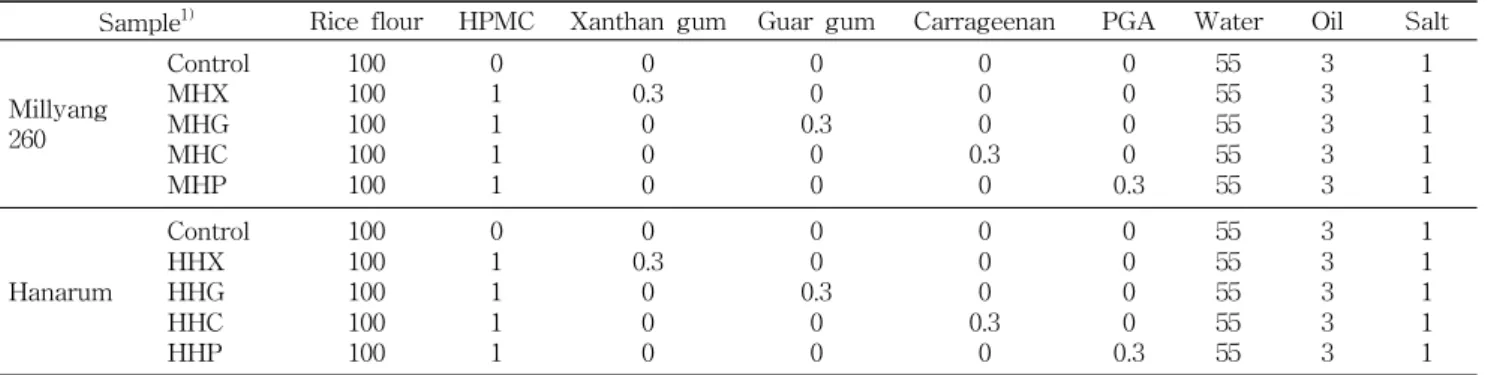
쌀만두피의 배합비는 Table 1과 같다. 쌀만두피 제조 공 정은 가루 소재의 1차 혼합 후(쌀가루, 소금, HPMC 및 검류 등) 열수 및 유제를 가하여 반죽기(5K5SS, KitchenAid, USA)로 3분간 반죽한 후 제면기(Atlas150 & Pastabike, Marcato, Italy)를 이용하여 두께 0.1 mm, 직경 30 mm의 원형 만두피를 제조하였다.
쌀만두피 조리 특성
쌀만두피의 조리는 전기 찜기(VC102670, Tefal, France) 를 이용하여 동량의 물(1 L)을 이용하여 수증기가 올라온 후 3분간 가열, 무게 변화를 측정하였다(14,15).
무게 증가율(%)= 조리 후 중량-조리 전 중량 조리 전 중량 × 100
쌀만두피 조직감 측정
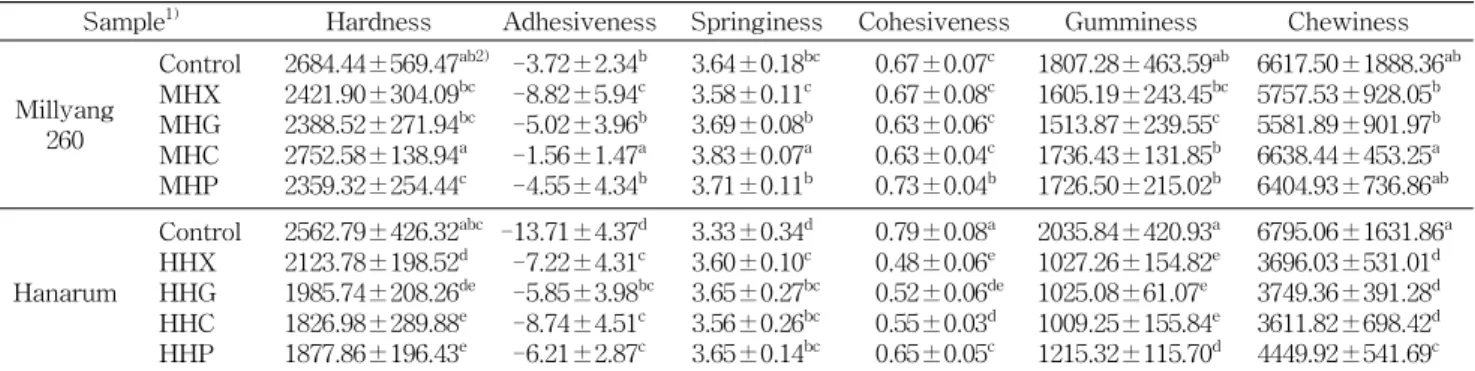
쌀만두피의 조직감 측정은 texture analyzer(TA.XTPlus, Stable Micro Systems, Surrey, UK)를 이용하였다. 측정 조 건은 5 mm diameter cylinder를 이용하여 strain 75%으로 test speed 1.0 mm/sec, post-test speed 1.0 mm/sec로 TPA (two bite test, texture profile analysis) 테스트를 통하여 각 시료의 경도(hardness), 부착성(adhesiveness), 탄성 (springiness), 응집성(cohesiveness), 점착성(gumminess)
및 씹힘성(chewiness)을 측정하였다.
통계분석
자료의 통계처리는 MINITAB(Minitab Inc., State Col- lege, PA, USA)을 이용하여 분산분석(ANOVA)과 Duncan 의 다중비교(Duncan's multiple range test)로 p<0.05 수준 에서 통계적 유의성을 검증하였다.
결과 및 고찰
쌀가루 수분함량 및 입도 분포
쌀가루의 수분 함량은 약 11%로 쌀 품종별 큰 유의차이는 보이지 않았다. 품종별 건식 분쇄 시 수분의 변화는 없는 것으로 생각되어진다. 쌀 품종별 쌀가루의 입도 분포는 Fig.
1과 같다. 밀양260호는 10~40 μm에서 완만하게 입도를 분 포하여 77.340 μm에서 피크를 보였으나, 한아름은 26.111 μ m와 77.340 μm에서 입도 분포를 확인할 수 있었다. 일반적 인 중력분의 입도 분포는 한아름과 유사한 26과 80 μm 정도 에서 피크를 확인할 수 있었으며, 밀양260호보다는 한아름 이 중력분의 입도와 비슷한 분포를 보였다.
쌀만두피 가공 적성 및 조리 특성
밀양260호와 한아름 쌀가루를 이용한 만두피 제조 시 hy-
Table 2. Cooking properties of cooked rice dumpling skin Sample
1)Increase of weight (%) Millyang 260
Control MHX MHG MHC MHP
3.12±0.95
cde2)4.84±0.88
a2.93±0.41
de2.44±0.32
ef2.53±0.37
eHanarum
Control HHX HHG HHC HHP
1.83±0.55
f2.77±0.45
de3.20±0.40
cd3.59±0.29
bc3.89±0.32
ab1)
MHX, Millyang260-HPMC-Xanthan gum; MHG, Millyang260- HPMC-Guar gum; MHC, Millyang260-HPMC-Carrageenan;
MHP, Millyang260-HPMC-PGA; HHX, Hanarum-HPMC- Xanthan gum; HHG, Hanarum-HPMC-Guar gum; HHC, Hanarum-HPMC-Carrageenan; HHP, Hanarum-HPMC-PGA.
2)
Mean±SD.
Means with different superscripts are significantly different at p<0.05 level by Duncan's multiple range test.
Table 3. Texture characteristics of cooked rice dumpling skin by texture analyzer
Sample
1)Hardness Adhesiveness Springiness Cohesiveness Gumminess Chewiness
Millyang 260
Control MHX MHG MHC MHP
2684.44±569.47
ab2)2421.90±304.09
bc2388.52±271.94
bc2752.58±138.94
a2359.32±254.44
c-3.72±2.34
b-8.82±5.94
c-5.02±3.96
b-1.56±1.47
a-4.55±4.34
b3.64±0.18
bc3.58±0.11
c3.69±0.08
b3.83±0.07
a3.71±0.11
b0.67±0.07
c0.67±0.08
c0.63±0.06
c0.63±0.04
c0.73±0.04
b1807.28±463.59
ab1605.19±243.45
bc1513.87±239.55
c1736.43±131.85
b1726.50±215.02
b6617.50±1888.36
ab5757.53±928.05
b5581.89±901.97
b6638.44±453.25
a6404.93±736.86
abHanarum
Control HHX HHG HHC HHP
2562.79±426.32
abc2123.78±198.52
d1985.74±208.26
de1826.98±289.88
e1877.86±196.43
e-13.71±4.37
d-7.22±4.31
c-5.85±3.98
bc-8.74±4.51
c-6.21±2.87
c3.33±0.34
d3.60±0.10
c3.65±0.27
bc3.56±0.26
bc3.65±0.14
bc0.79±0.08
a0.48±0.06
e0.52±0.06
de0.55±0.03
d0.65±0.05
c2035.84±420.93
a1027.26±154.82
e1025.08±61.07
e1009.25±155.84
e1215.32±115.70
d6795.06±1631.86
a3696.03±531.01
d3749.36±391.28
d3611.82±698.42
d4449.92±541.69
c1)
MHX, Millyang260-HPMC-Xanthan gum; MHG, Millyang260-HPMC-Guar gum; MHC, Millyang260-HPMC-Carrageenan; MHP, Millyang260-HPMC-PGA; HHX, Hanarum-HPMC-Xanthan gum; HHG, Hanarum-HPMC-Guar gum; HHC, Hanarum-HPMC- Carrageenan; HHP, Hanarum-HPMC-PGA.
2)
Mean±SD.
Means in the column with different superscripts are significantly different at p<0.05 level by Duncan's multiple range test.
drocolloids를 첨가하지 않은 만두피에서는 아밀로오스 함량 이 높은 고아미 품종인 밀양260호가 초다수성 품종인 한아 름보다 만두피 가공 적성능이 좋음을 알 수 있었다. 이는 아밀로오스 함량이 높은 쌀품종이 가공 적성능이 좋아진다 는 연구 결과와 비슷한 결과를 나타냈다(17,18). 또한 이러한 현상은 익반죽에 의한 아밀로펙틴이 부분적 호화에 의해 쌀 만두피의 점착성은 향상되어지나 끈적임이 발생되어 가공 적성능이 떨어지는 반면, 상대적으로 아밀로오스 함량이 높 은 밀양260호는 부분적 호화가 적게 일어나 면대 형성능이 향상되는 것으로 생각되어진다. 그러나 쌀가루만으로 반죽 을 제조 시, 앞에서 언급한 바와 같이 찢어짐이나 겉마름이 증가되어 만두피의 갈라짐이 발생되어 낮은 품질을 나타나 게 된다. 가공 적성능을 향상하기 위해 hydrocolloids를 첨가 하여 제조된 쌀만두피의 조리 후 특성 결과는 Table 2와 같 다. Hydrocolloids를 첨가하지 않은 쌀만두피의 조리 후 무 게 증가율은 밀양260호는 3.12, 한아름은 1.83으로 쌀품종에
따라 조리 특성이 다름을 확인할 수 있었다. 한아름 쌀가루 를 이용한 실험에서는 hydrocolloids 첨가군이 첨가하지 않 은 군보다 조리 후 무게가 증가하는 경향을 보였으나, 밀양 260 쌀가루에서는 HPMC와 xanthan gum 첨가 군을 제외하 고는 수분 증가량이 첨가하지 않은 군보다 낮아짐을 보였다.
따라서 Table 2에서 보이는 것과 같이 가공 및 조리 특성은 쌀 품종에 따라 hydrocolloids의 종류보다 쌀 품종과 hydro- colloids 간의 영향이 더 크다고 생각되어지며, 무게증가율은 수율을 향상시키고 상대적으로 재조리 시 조리 시간과 섭취 후 소화 시간을 단축할 수 있는 장점이 있다(19)는 연구 결과 들과 같이 본 연구에서도 무게 증가가 hydrocolloids를 첨가 한 군에서 증가함에 따라 이와 같은 장점은 기인될 수 있을 것으로 사료된다. 따라서 한아름에 HPMC와 PGA를 첨가한 군이 가장 효과가 있을 것으로 보인다. 또한 부피증가율의 경우 control 대비 HPMC가 첨가된 실험군에서 모두 동일하 게 낮은 증가율을 보였는데, 이는 HPMC가 조리 과정 중에 열에 의해 겔화 되면서 코팅막이 형성된다는 Lee 등(20)의 보고와 같았다. 따라서 HPMC를 쌀만두피에 첨가할 경우 조리시 물이 만두피로 많이 흡수되지 않아 만두피가 금방 퍼지고 부는 것을 막아줄 수 있을 것이라 생각된다.
쌀만두피 조직감
Hydrocolloids를 첨가한 쌀만두피의 조직감 특성을 측정
한 결과는 Table 3과 같다. 경도는 밀양260호에 HPMC와
carrageenan을 첨가한 군이 가장 높은 값을 나타냈으나 hy-
drocolloids를 첨가하지 않은 밀양260호 군과 큰 차이를 보이
지 않았으며, 일반적으로 hydrocolloids를 첨가함에 따라 경
도는 낮게 나타남을 알 수 있었다. 이는 무게증가율 결과와
관련을 보이며 가수량이 증가함에 따라 경도는 약해진 것으
로 생각되어진다. 그러나 Table 2의 밀양260호-HPMC-
xanthan gum 군에서 무게증가량이 가장 큼에도 불구하고
Table 3에서 hydrocolloids 미첨가 밀양260호 군에 비해 경
도가 낮은 값을 나타나는데 이는 hydrocolloids들의 유화 역
할 및 가소제 역할에 따른 전분의 조직 연화 및 아밀로오스 에 의한 구성 조직을 변화시킴에 따라 발생된 것으로 생각되 어진다(20-22). 만두피에서 가장 중요한 부착성 결과로는 쌀 품종에 의해 영향을 받는 것을 확인할 수 있었다. 특히, 한아 름 쌀 품종에 hydrocolloids 첨가함에 따라 부착성이 감소함 을 볼 수 있어 쌀의 아밀로펙틴과 아밀로오스 함량비가 중요 한 관련성을 갖는다 생각되어진다. 한아름 쌀만두피에서는 hydrocolloids 첨가에 따라 부착성이 감소함을 보였으나 밀 양260호보다는 더 크게 나타나와 부착성이 낮은 밀양260호 -HPMC-carrageenan 군이 가장 효과적인 것으로 나타났 다. 탄성은 hydrocolloids를 첨가한 경우 대체로 증가하는 경향을 보였으며, 응집성은 밀양260호와 한아름의 경우 hy- drocolloids를 첨가한 경우 낮은 경향을 보였다. 쌀만두피의 조리후 조직감 특성은 쌀 품종에 관계없이 hydrocolloids를 첨가한 경우에 경도가 낮고 탄성이 높게 나타나 부드러우면 서도 쫄깃한 조직감을 나타내고, 이는 HPMC를 첨가하면 전체적인 품질, 질감, 식감, 외관 등이 증가한다는 Purnima (23)의 결과와 일치하였다. 이 결과로 미루어 보아 밀양260 호와 한아름의 쌀만두피 제조 시 가공 적성 및 물성 차이는 입도에 의해 영향을 받는 것보다는 품종 차이에 의해 더 큰 영향을 받음을 알 수 있었다(Table 2, 3).
요 약
쌀품종에 따른 hydrocolloids를 첨가하여 쌀만두피를 제 조 시 쌀가루의 입도, 쌀만두피의 조리특성 및 조직감을 측 정한 결과, air classifying mill(ACM)을 이용하여 건식분쇄 한 쌀가루의 입도 분포는 중력분과 유사하였고, 평균입자크 기를 중심으로 조밀한 입자 분포를 나타내었다. 조리특성에 서 hydrocolloids를 첨가한 경우, 밀양260호의 무게증가율은 낮아졌으나 한아름은 증가하는 경향을 나타냈다. 만두피의 조리 후 조직감은 쌀 품종별로 차이가 나타남을 관찰할 수 있었으며, hydrocolloids를 첨가함에 따라 경도가 낮고 탄성 은 증가함을 알 수 있었다. Hydrocolloids를 첨가한 경우 첨 가하지 않은 군에 비해 가공 특성 및 조리 후 특성 모두 우수 함을 알 수 있었으며, 쌀 품종 및 첨가물의 종류에 따라 다른 특성을 관찰할 수 있어 쌀 품종별 이화학적 특성과 hydro- colloids와의 관계를 보다 더 많은 연구를 진행해보아야 할 것으로 생각되어진다.
감사의 글
본 연구는 농촌진흥청에서 시행한 공동연구사업(20120401- 030-508-06-00)의 결과로 진행하였으며 이에 감사드립니다.
문 헌