고체상 정제 및 HPLC/PDA에 의한 영유아식 중 나이아신의 분석
홍지은1†․김미란1․천상희1․채정영1․박은령1․문춘선1․곽인신2․김옥희1․이광호2
1경인지방식품의약품안전청 시험분석센터
2식품의약품안전청 식품평가부
Determination of Niacin in Infant Formula by Solid-phase Clean-up and HPLC with Photodiode Array Detector
Jee Eun Hong1†, Miran Kim1, Sanghee Cheon1, Jungyoung Chai1, Eun Ryong Park1, Chun Sun Mun1, In-Shin Gwak2, Ok-Hee Kim1, and Kwang Ho Lee2
1
Center for Food and Drug Analysis, Gyeongin Regional Food & Drug Adminstration, Incheon 402-835, Korea
2
Food Safety Evaluation Department, Korea Regional Food & Drug Adminstration, Seoul 122-704, Korea
Abstract
This study was performed to establish a rapid and simple analytical method for niacin (nicotinic acid and nicotinamide) using HPLC. A pretreatment method for the extraction and clean-up of niacin in infant formula sample and an instrumental condition for HPLC were optimized. Niacin was extracted by 5 mM hexanesulfonate with ultrasonication for 30 min. For the clean-up of the sample, the extract was applied to a HLB cartridge, and then niacin was eluted from the cartridge using 5 mL of 80% methanol after washing with 5 mL of n-hexane.
The total recoveries were 83~104% and relative standard deviation were in the range of 1.5~3.5% during the extraction and clean-up process. Niacin was determined by gradient elution with sodium hexanesulfonate/meth- anol buffer as a mobile phase and a photodiode array detector (260 nm). It showed a high linearity between the content of niacin and the peak area (r2=1.000) in the range of 0.02~10.0 mg/L of nicotinic acid and nicotinamide. The detection limit was 0.02 mg/L (0.2 mg/kg in the sample). The method was successfully applied for the determination of niacin in infant formula. Total niacin contents were in the range of 53.5~140.3 mg/kg.
Key words: niacin, HPLC, solid phase extraction, infant formula
†Corresponding author. E-mail: [email protected]
†Phone: 82-32-450-3323, Fax: 82-32-429-3388
서 론
나이아신은 비타민B 복합체의 한 종류로 니코틴산 (nicotinic acid)과 니코틴아미드(nicotinamide)의 생물활성 을 나타내는 유도체들을 통칭한다(1)(Fig. 1). 이것은 다양한 식품 중에 널리 존재하는 영양성분으로 동물의 간 ·닭고기, 쇠고기 등 육류, 효모, 콩류, 땅콩, 호두 등 견과류, 참치, 연어 등 어패류 등에 다량 함유되어 있다(2-5). 영유아식을 비롯 한 다양한 조제식품 또는 강화식품에 나이아신이 함유되어 있으며 일반적으로 용해도가 높은 니코틴아미드의 형태가 사용되고 있다. 나이아신은 펠라그라병의 예방 및 치료에 효과적이며, 말초혈관을 확장시켜 혈액순환 촉진하고 콜레 스테롤을 감소시키는 등의 효과가 있다(6,7). 또한 나이아신 이 부족할 경우 점막장애, 설사, 색소침착, 우울증, 불면, 두 통, 노이로제 등이 발생되는 것으로 알려져 있다(8,9).
식품 중에 존재하는 나이아신을 분석하는 방법으로 미생 물학적 방법, 비색법 및 크로마토그래피에 의한 기기분석법
Nicotinic acid Nicotine amide Nicotinic acid Nicotine amide Fig. 1. Chemical structures of nicotinic acid and nicotinamide.
등이 연구되어 왔다. Lactobacillus plantarum 등과 같이 나 이아신을 필수영양소로 이용하는 미생물의 증식을 이용해 최종적으로 탁도 또는 적정법으로 분석하는 미생물학적 방 법과(10,11) 케니히 반응에 의해 나이아신의 피리딘기를 cyanogen bromide와 반응시켜 흡광도를 측정하는 비색법 의 경우 가수분해를 거쳐 니코틴산의 형태로 전환시킨 후 분석을 실시한다(1,9). 최근 들어 크로마토그래피에 의한 기 기분석법이 다양하게 연구되고 있다(12-16). 특히 고성능액 체크로마토그래피(HPLC)와 모세관전기영동법(capillary
electrophoresis, CE)에 의하여 식품, 조제우유, 영아용 조제 식, 그리고 약품이나 건강기능식품 중에서의 나이아신의 분 석사례가 다수 보고되고 있다(17-20). 크로마토그래피법에 의한 식품 등에 함유된 나이아신을 분석하는 전처리방법에 대한 연구도 이루어지고 있다. Lahely 등에 의하면 1 N 염산 을 사용하여 110oC에서 2시간 동안 가수분해할 경우 육류 등에 함유되어 있는 나이아신의 분석이 가능한 것으로 보고 되고 있다(21). 또한 Juraja 등(22) 및 Ward와 Trenerry(23) 는 1 N NaOH를 사용하여 염기성 조건하에서 가수분해한 결과를 보고하였다. 그러나 이러한 전처리법은 장시간의 전 처리시간이 필요할 뿐 아니라 가수분해 과정을 통해 니코틴 아미드가 니코틴산으로 전환되므로 이 두 물질의 개별 정량 이 불가능하다는 단점이 있다. 따라서 본 연구에서는 가수분 해 과정을 거치지 않고 단시간에 나이아신을 분석할 수 있는 방법을 연구하고자 하였으며 시료 중에 포함된 방해성분을 제거하기 위한 정제 조건을 확립하고자 하였다.
재료 및 방법
실험재료
본 실험에 사용한 시료는 나이아신의 함량이 표시된 시중 에서 판매되는 영․유아식 50건을 구입하여 사용하였다. 정 성 및 정량분석을 위하여 사용된 표준품인 nicotinamide, nicotinic acid와 sodium hexanesulfonate는 Sigma 사(St.
Louis, MO, USA)로부터 구입하였고, 메탄올, n-hexane, 아 세토니트릴 등은 Burdick & Jackson사의 HPLC grade (Morristown, New Jersey, USA)를 구입하여 사용하였다.
초순수는 Elga사(Buckinghamshire, UK)의 pure system에 의해 18.0 MΩ 수준으로 정제된 물을 사용하였다. 정제과정 에서 사용된 MAX, MCX, WAX, C18 및 HLB 카트리지는 Waters사(Milford, Massachusetts, USA)에서 구입하여 사 용하였다.
시험용액 조제
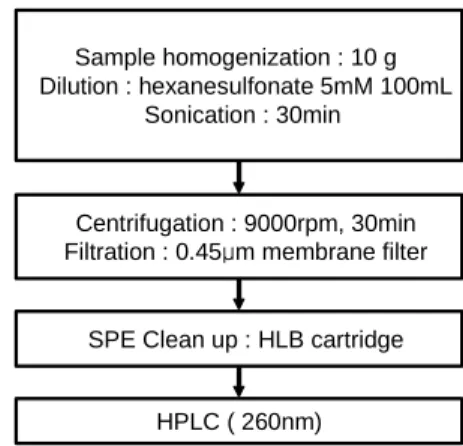
시료의 전처리 과정은 Fig. 2와 같다. 검체 10 g을 취한 후 5 mM hexanesulfonate 용액에 녹여 100 mL가 되도록 하였고, 이 용액을 30분간 초음파 추출하였다. 영아용 두유 는 5 mL을 취하고 5 mM hexanesulfonate 용액을 첨가하여 100 mL가 되도록 정용한 후 초음파 추출하였다. 추출액을 원심분리기(Allegra X-22R, Beckman Coulter Inc., Krefeld, Germany)를 사용하여 0oC, 9000 rpm에서 30분간 원심분리 하고, 상등액을 취해 membrane syringe filter(pore size 0.45 μm, 25 mm, Universal syringe filter, Hydrophilic Polypro- pylene, Eltop Korea, Seoul, Korea)로 여과하였다. 여과액의 정제를 위하여 HLB카트리지를 준비하고 카트리지에 5 mL 의 메탄올과 5 mL의 증류수를 연속으로 통과시킨 후 카트리 지에 여과액 10 mL를 통과시켜 나이아신이 카트리지에 흡
Sample homogenization : 10 g Dilution : hexanesulfonate 5mM 100mL
Sonication : 30min
Centrifugation : 9000rpm, 30min Filtration : 0.45μm membrane filter
SPE Clean up : HLB cartridge
HPLC ( 260nm)
Fig. 2. Schematic diagram of sample preparation for nicotinic acid and nicotinamide analysis using HPLC method.
착되도록 하였다. 카트리지는 5 mL의 n-hexane으로 세척하 였고 이어 80% 메탄올용액 5 mL을 사용하여 나이아신을 용출하였다. 용출액은 10 mL 메스플라스크에 모으고 증류 수를 가하여 10 mL로 하였다.
HPLC 분석조건
나이아신 분석에 사용한 HPLC는 Nanospace system (SI-2, Shiseido Fine Chemicals, Tokyo, Japan)이었으며, HPLC 분석조건은 Table 1과 같다. 분석칼럼은 Shiseido사 (Tokyo, Japan)의 Capcellpak UG120V(4.6×250 mm, 5 μm) 를 사용하였다.
회수율 실험
본 연구에서 사용한 전처리법을 이용하여 공시료에 표준 품 농도가 각각 10 mg/kg 및 100 mg/kg의 농도가 되게 첨가 하여 회수율 실험을 실시하였다. 각 시험은 3회 반복하였으 며 HPLC로 분석하여 얻어진 면적을 표준용액의 면적과 비 교하여 회수율을 구하였다.
검량선 및 검출한계 측정
니코틴산 및 니코틴아미드 표준용액을 희석하여 0.02~
10.0 mg/L의 농도가 되도록 제조한 후 HPLC에 10 μL씩 주입하여 얻은 피크의 넓이를 구하여 검량선을 작성하였다.
S/N ratio가 3이 되는 농도를 검출한계로 정하였으며 S/N ratio는 EZ Chrom Elite program(Shiseido, Tokyo, Japan) 을 사용하여 측정하였다.
Table 1. HPLC conditions for nicotinic acid and nicotinamide analysis
Column Mobile phase
Flow rate Injection volume Detector
Capcellpak UG120V, 4.6×250 mm, 5 μm A: 5 mM hexanesulfonate/0.1% acetic acid B: 35% (5 mM hexanesulfonate/
0.1% acetic acid)/65% MeOH
A : B=100:0 (3 min hold) → 3%/min → A : B=70:30 (7 min hold)
800 μL/min 10 μL
PDA detector, 260 nm
Nicotinic acid
Nicotine amide
Nicotine amide
Nicotine amide (a)
(b)
(c)
Nicotinic acid
Nicotine amide
Nicotine amide
Nicotine amide (a)
(b)
(c)
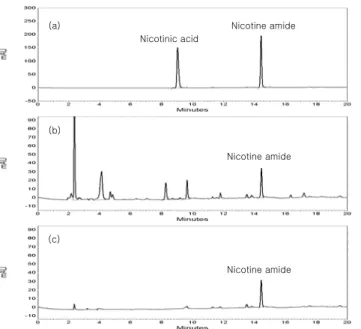
Fig. 3. HPLC chromatograms of nicotinic acid and nicotinamide.
(a) Standard. (b) Infant formula sample with extraction only. (c) Infant formula sample with extraction and clean-up.
Fig. 4. PDA spectrum of nicotinic acid and nicotinamide.
결과 및 고찰
나이아신의 HPLC 분석조건 검토
Fig. 3은 니코틴산과 니코틴아미드를 C18 역상 컬럼에서 PDA 검출기를 사용하여 분석한 결과이다. Table 1에 나타 낸 분석조건에 따라 5 mM hexanesulfonate와 5 mM hex- anesulfonate/65% MeOH 용액을 사용하여 기울기 용리를 실시한 결과 니코틴산이 8.1분, 니코틴아미드가 14.3분대에 각각 용리되었다. PDA 검출기를 이용하여 스펙트럼을 조사 한 결과, 니코틴산과 니코틴아미드 모두 260 nm에서 최대 흡광도를 나타내어 260 nm를 분석파장으로 선택하였다 (Fig. 4).
SPE를 이용한 정제조건 검토
액체추출법에 의해 추출된 용액을 고체상 추출법을 이용 하여 정제하는 조건을 조사하였다. 영유아식 중에 함유되어
Table 2. Recoveries of nicotinic acid and nicotinamide with various SPE cartridges
Solid-phase Recoveries (%)
Nicotinic acid Nicotinamide MAX
MCX WAX C18 HLB
0.0 0.0 0.0 34.4 96.3
39.5 102.3 0.0 104.5 105.6
MAX: mixed-mode (strong) anion exchange, MCX: mixed- mode (strong) cation exchange, WAX: weak anion exchange, C18: octadecyl, HLB: hydrophilic-lipophilic balance.
있는 방해물질을 제거하기 위하여 MAX, MCX, WAX, C18 및 HLB 등의 고체상카트리지를 통해 용출한 후 나이아신의 회수율 및 방해물질의 제거여부를 조사하였다.
Table 2에 나타난 바와 같이 MAX나 MCX 등 음이온 또 는 양이온교환방식의 고체상 또는 비극성고체상인 C18로는 니코틴산과 니코틴아미드를 동시에 정제할 수 없음을 확인 하였다. 반면 HLB 고체상을 사용할 경우 96.3~105.6%의 회수율을 나타내어 니코틴산 및 니코틴아미드 등 두 가지 물질을 동시에 흡착, 용출할 수 있는 것으로 나타났다. HLB 고체상은 N-vinylpyrrolidine과 divinylbenzene이 copoly- mer의 형태로 결합되어 있어 산성 및 염기성 물질을 포괄적 으로 흡착할 수 있는 것으로 알려져 있다. Fig. 3의 (b)와 (c)를 비교하면 액체추출법에 의해서만 전처리한 경우는 니 코틴산의 머무른 시간과 동일한 시간에 검출되는 방해성분 이 검출되었으나(b) HLB 고체상에 의해 정제한 후 HPLC로 분석한 경우 이러한 물질이 제거되었음을 확인할 수 있다(c).
HLB카트리지를 사용하고 n-헥산으로 세척한 후 용출액 의 조성 및 용출 양에 따른 회수율의 변화를 조사하였다.
먼저 용출액으로 메탄올과 증류수를 혼합하여 회수율을 조 사한 결과 Fig. 5에서 보인 바와 같이 메탄올 20~100%까 지는 거의 회수율이 동일한 것으로 나타났으며 100% 증류 수로 추출할 경우에는 40% 이하로 회수율이 낮게 나타났 다. 다음으로 용출액으로 80% 메탄올을 사용하고 용출 양 에 따라 회수율의 변화를 비교한 결과 용출양은 2 mL 이후 에는 큰 변화가 없는 것으로 나타났다. 이상의 연구 결과 HLB카트리지를 사용하고 n-hexane으로 세척한 후 80%
메탄올 2 mL 이상을 사용하여 용출하는 것으로 정제조건을 정하였다.
회수율 및 재현성 검토
회수율은 증류수에 니코틴산 및 니코틴아미드를 100 mg/kg과 10 mg/kg의 농도로 첨가한 후 추출과 정제과정을 거쳐 HPLC로 분석하여 검출되는 농도를 측정하였다. Table 3에 나타난 바와 같이 니코틴산과 니코틴아미드의 회수율은 100 mg/kg의 농도의 경우 84.7~104.5%, 10 mg/kg인 경우 는 83.1~101.6% 범위로 나타났으며 3회 반복 실험한 결과 의 상대표준편차는 1.5~3.5% 범위로 나타났다.
Table 4. Niacin contents in infant formula by HPLC
Sample No. of samples Niacin (as nicotiamide)
Labeled value Detected value RSD (%)
Fortified milk powder Fortified infant formula
Infant soy formula
20 20 10
70.4~119.7 mg/kg 53.5~140.3 mg/kg 9.7~16.0 mg/L
1.0~5.5 0.6~5.3 0.6~3.9
50.0 mg/kg 50.0~108.3 mg/kg
7.0~11.1 mg/L
0
40 80 120
100 80 60 40 20 0
MeOH (%)
R e co ve ri e s ( % ) .
Nicotinic acid Nicotinamide
(a)0 40 80 120
1 2 3 4 5 6 7
Eluent (mL)
R e co ve ri e s ( % ) .
Nicotinic acid Nicotinamide
(b)Fig. 5. Recoveries of nicotinic acid and nicotinamide by HLB cartridge. (a) Eluent fraction, (b) Eluent volume.
Table 3. Recoveries and relative standard deviation of nic- otinic acid and nicotinamide
Compounds Concentration (mg/kg)
Extraction
recoveries (%) RSD (%) Nicotinic acid
Nicotinamide
100 100
84.7 104.5
3.5 1.5 Nicotinic acid
Nicotinamide
10 10
83.1 101.6
2.4 2.2
검량선 및 검출한계 조사
0.02~10 mg/L 농도의 니코틴산과 니코틴아미드 표준용 액을 사용하여 HPLC로 분석하여 검량선을 작성하고 검출 한계를 조사하였으며, Fig. 6에 검량선을 나타내었다. 검량 선의 직선성은 상관계수(r2)가 1.000으로 매우 우수하게 나 타났으며, 검출한계는 0.02 mg/L 수준으로 나타났다. 이와 같은 검출한계는 시료에 적용할 경우 0.2 mg/kg 수준까지 검출이 가능한 것을 의미한다. 따라서 시판되는 영․유아식 중의 나이아신 함량을 감안할 때 충분이 검출이 가능하며
Nicotinic acid
y = 115765.2872 x + 2618.3366 R
2= 1.0000
0 200000 400000 600000 800000 1000000 1200000
0 2 4 6 8 10
Conc. (mg/L)
Ar e a
Nicotinamide
y = 143107.4607 x + 319.2462 R
2= 1.0000
0 400000 800000 1200000 1600000 2000000
0 2 4 6 8 10
Conc. (mg/L)
Ar e a
Fig. 6. Calibration curves of nicotinic acid and nicotinamide.
그 외에도 미량 함유되어 있는 식품 중의 나이아신 함량조사 에도 충분히 활용할 수 있을 것으로 기대된다.
시판중인 영유아식 중의 나이아신 모니터링
이상의 연구를 통해 확립된 나이아신의 분석법을 적용하 여 영․유아식 50건에 대해 함량조사를 실시하였다. 전 시료 에 대해 3회 반복 시험하여 검출량의 평균을 구하고 재현성 을 조사하였다. 영유아식은 조제분유 20건, 조제식 20건 및 영아용 두유 10건 등을 구입하여 분석하였다.
Table 4에서 보는 바와 같이 20건의 조제분유 중에서 70.4
~119.7 mg/kg, 20건의 영아용 및 성장기용 조제식 중에서 는 53.5~140.3 mg/kg 수준으로 나타났으며, 전체적으로 표 시량의 93~280% 수준으로 검출되었다. 또한 영아용 두유 10건에 대해서는 9.7~16.0 mg/L 수준으로 나타났고 10건 모두 표시량 이상으로 나이아신이 함유되어 있는 것으로 확 인되었다. 50건의 영유아식 시료를 3회 반복 시험한 상대표 준편차는 0.6~5.5% 범위로 나타나 본 시험법의 재현성이 매우 우수한 것을 확인하였다. 나이아신은 모두 니코틴아미 드 형태로 검출되었는데, 이는 영․유아식의 제조과정에서
미량영양성분을 첨가할 때 니코틴아미드의 형태로 첨가하 기 때문으로 사료된다.
이상의 분석 결과 대부분의 시판 영․유아식 제품에서 표 시량 수준 또는 그 이상의 함량으로 나이아신이 함유되어 있는 것을 확인할 수 있었으며, 본 연구의 기기분석법을 통 하여 영․유아식 제품 중에 존재하는 나이아신 분석이 가능 함을 확인하였다.
요 약
영유아식 중 나이아신의 기기분석법을 개발하고 영․유아 식 중의 나이아신의 함량을 조사하였다. 니코틴산 및 니코틴 아미드에 대해 액체 추출 및 고체상 정제과정을 통해 전처리 한 후 HPLC로 분석할 경우 83~104% 범위의 회수율과 1.5
~3.5% 범위의 재현성을 나타내었다. 또한 260 nm의 파장에 서 분석할 경우 0.02~10 mg/L 범위에서 검량선의 직선성이 1.0000 수준으로 매우 높게 나타났으며 영유아식 중의 검출 한계는 0.2 mg/kg 수준으로 나타났다. 총 50건의 영․유아식 에 대해 나이아신 함량을 모니터링한 결과 53.5~140.3 mg/kg 수준으로 나타났으며 3회 반복시험 시의 상대표준편 차는 0.6~5.5% 범위로 나타나 본 방법이 나이아신 분석에 유용한 방법임을 확인하였다.
감사의 글
본 연구는 2007년도 식품의약품안전청의 자체연구개발과 제의 연구개발비 지원(KFDA-07062영기안111)에 의하여 수행되었으며 이에 감사드립니다.
문 헌
1. Rose-Sallin C, Christopher J, Blake GD, Tagliaferri EG.
2001. Comparison of microbiological and high performance liquid chromatographic/fluorescence detection methods for determination of niacin in fortified food products. Food
Chem 73: 473-480.
2. Rural Development Administration. 2006. Food composi-
tion table. 7th ed.
3. Lebiedziska A, Szefer P. 2006. Vitamins B in grain and ce- real grain food, soy-products and seeds. Food Chem 95:
116-122.
4. Ball GFM. 1996. Niacin and tryptophan. In Bioavailability
and analysis of vitamins in foods. Chapman & Hall, London.
p 319-359.
5. Friedrich W. 1988. Niacin: nicotinic acid, nicotinamide, NAD(P). In Vitamins. Walter de Gruyter, Berlin. p 473-542.
6. Jackson JA, Burns MJ. 1974. Effects of cystine, niacin and taurine on cholesterol concentration in the Japanese quail with comments on bile acid metabolism. Comp Biochem
Physiol A Comp Physiol 48: 61-68.
7. Canner PL, Berge KG, Wenger NK. 1986. Fifteen year mor- tality in coronary drug project patients: long-term benefit with niacin. J Am Coll Cardiol 8: 1245-1255.
8. Williams A, Ramsden D. 2005. Nicotinamide: A double edged sword. Parkinsonism & Related Disorders 11:
413-420.
9. Elvehjem C, Koehn CJ. 1937. Relation of nicotinic acid and nicotinic acid amide and to canine black tongue. J Am Chem
Soc 59: 1767-1768.
10. Rose-Sallin C, Blake CJ, Genoud D, Tagliaferri EG. 2001.
Comparison of microbiological and HPLC-fluorescence de- tection methods for determination of niacin in fortified food products Food Chem 73: 473-480.
11. AOAC. 2000. Official Method of Analysis. 17th ed. AOAC Methods 985.34, 944.13, 968.32 and 975.41. Gaithersburg.
12. Chase GW Jr, Landen WO Jr, Soliman AG, Eitenmiller RR.
1993. Liquid chromatographic analysis of niacin in fortified food products. J AOAC Int 76: 390-393.
13. Vidal-Valverde C, Reche A. 1991. Determination of avail- able niacin in legumes and meat by high-performance liquid chromatography. J Agric Food Chem 39: 116-121.
14. LaCroix DE, Wolf WR, Vanderslice JT. 1999. Determination of niacin in infant formula and wheat flour by anion-ex- change liquid chromatography with solid-phase extraction cleanup. J AOAC Int 82: 128-133.
15. Mawatari KI, Iinuma F, Watanabe M. 1991. Determination of nicotinic acid and nicotinamide in human serum by high-performance liquid chromatography with postcolumn ultraviolet-irradiation and fluorescence detection. Anal Sci 7: 733-736.
16. Van Niekerk PJ, Smit CCS, Strydom ESP, Armbruster G.
1984. Comparison of a high-performance liquid chromato- graphic and microbiological method for the determination of niacin in foods. J Agric Food Chem 32: 304-307.
17. Iwaki M, Murakami E, Kakehi K. 2000. Chromatographic and capillary electrophoretic methods for the analysis of nicotinic acid and its metabolites. J Chromatogr B 747:
229-240.
18. Ward C, Trenerry V, Pant I. 1997. The application of capil- lary electrophoresis to the determination of total niacin in concentrated yeast spreads. Food Chem 58: 185-192.
19. Mallett D, Dayal S, Dear G, Pateman A. 2006. The determi- nation of nicotinic acid in plasma by mixed-mode liquid chromatography/tandem mass spectrometry following ion exchange solid phase extraction. J Pharm & Biomed Anal 41: 510-516.
20. Chen Z, Chen B, Yao S. 2006. High performance liquid chro- matography/electrospray ionization/mass spectrometry for the simultaneous determination of taurine and 10 water- soluble vitamins in multivitamin tablets. Anal Chim Acta 569: 169-175.
21. Lahely S, Bergaentzle M, Hasselmann C. 1999. Fluorimetric determination of niacin in foods by high performance liquid chromatography with post-column derivatization. Food
Chem 65: 129-133.
22. Juraja SM, Trenerry V, Millar RG, Scheelings P, Buick DR.
2006. APEAN training exercise: the determination of niacin in cereals by alkaline extraction and high performance liq- uid chromatography. J Food Compo Anal 16: 93-106.
23. Ward C, Trenerry V. 1997. The determination of niacin in cereals, meat and selected foods by capillary electrophoresis ad high performance liquid chromatography. Food Chem 60: 667-674.
(2008년 11월 12일 접수; 2008년 12월 10일 채택)