• 검색 결과가 없습니다.

A Study on Flexible Control and Design of Robot Hand Fingers with Eight Axes for Smart Factory

N/A
N/A
Protected

Academic year: 2021

Share "A Study on Flexible Control and Design of Robot Hand Fingers with Eight Axes for Smart Factory"

Copied!
7
0
0

로드 중.... (전체 텍스트 보기)

전체 글

(1)

A Study on Flexible Control and Design of Robot Hand Fingers with Eight Axes for Smart Factory

Hyun-Seok Sim

1

, Ho-Young Bae

1

, Du-Beum Kim

1

, Sung-Hyun Han

2*

<Abstract>

The focus of this paper is to design and control a three fingered hand system with eight axes for smart factory with an flexible controller, and to keep a useful big database for dynamic manipulation based on the experimental results. The weight of the hand module is only 1.2 kg, but flexible motion and powerful grasping are possible. To achieve such a flexible motion control of a robotic hand, we have developed a robust and precise fingered hand with a control system incorporating image recognition system in which we deal with the problems of not only accuracy and range of motion but also the flexibility of hand. The fingers are arranged so as to grasp both circular and prismatic objects. In order to achieve the light mechanism, we reduced the number of joints and fingers as much as possible. In this study, it was used three fingers with eight axes which is the optimal number to achieve a robust grasping diverse shape parts for smart factory.

Keywords : Hand Fingers, Handling and Grasping, Flexible Control, eight Joints, Smart factory

1 Graduate school, Kyungnam University, Korea. (E-mail: [email protected]) 2* Corresponding Author, Professor, Division of Mechanical Eng, Kyungnam University.

(E-mail: [email protected])

(2)

1. INTRODUCTION

The development of robotic hand finger for implementation of flexible operations in working cell space is grow and cover a relevant part of flexibility and mobility of hand fingers.

With this respect, as already demonstrated in the industrial environment, the end effector is a very simple device with poor sensoriality and limited operational capabilities. Besides the numerous prototypes of articulated robotic hands, developed in more than 20 years of research, mainly in academic environment, among many others, limited effort has been devoted to research and evaluate alternative solutions, maybe simpler from the mechanical point of view than a multi-fingered hand, but with sufficient dexterity to perform in any case non trivial operations on a wide range of objects.[1],[2]

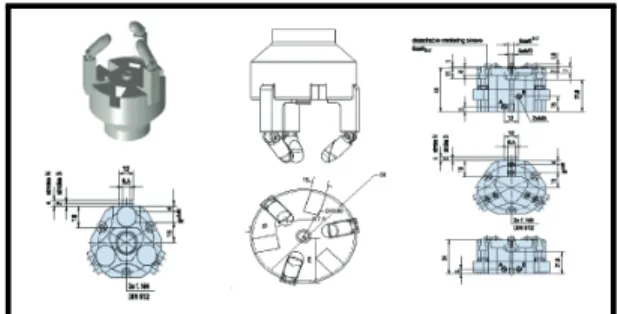
At the moment, this hand finger is installed on a six degree of freedom arm, see Fig. 1.

In order to emulate the capabilities of the arm and to develop suitable coordinating strategies taking into account the kinematics capabilities of the whole arm/hand finger system.

Therefore, referring specifically to the case of space applications, a scenario could be considered in which operations have to be performed in a no-gravity environment, where objects cannot be constrained and are therefore free to float in space.

2. HAND FINGER SYSTEM DESIGN

The hand finger has been designed considering its installation on the articulated robot arm proposed. This system aims to substitute the astronauts in periodical operations with a semiautonomous robotic device.[3]

The end-effectors for the robot manipulator needs therefore compactness, simplicity and reduced weight as well as capability of operation even on irregular floating objects.

Besides the 9 axes hand finger, main objective of this research, the overall robotic system consists of the following main components: a 8 axes arm with an “open control” a standard force/torque sensor at the wrist and a vision system.These components are schematically shown in Fig. 1

Fig. 1 The structure of hand finger

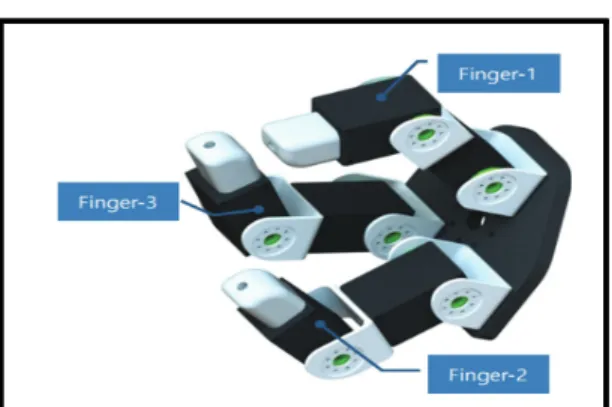
The hand finger has three 8 axes fingers.

In each finger, the finger tp and 1 finger

link can move on a linear trajectory by the

linear motor but the other finger links and

wrist part can move on an anger rotation

trajectory by the Coreless DC Motors. These

(3)

fingers are disposed radically, in a symmetric configuration as shown in Fig. 1. The Hand system has total 8 axes, enough for hand finger to catch many type of flexible subjects. This kinematics configuration has several interesting features, as described in details in, including the capability of firmly grasping objects with irregular shapes and with a rather wide range of dimensions.

In this manner, it is possible to control the motion of each finger, its distance from the object and the forces applied on it during the grasp.[4],[5],[6]

Fig. 2 The overall system of robot hand control

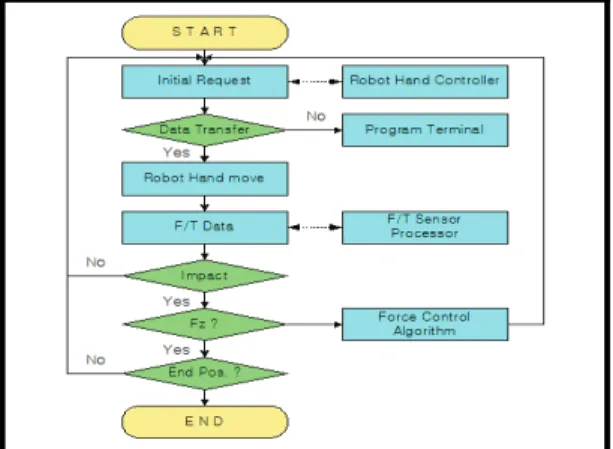
Fig. 3 The flowchart of robot hand control based on F/T sensor

3. FLEXIBLE CONTROL OF ROBOTIC HAND FINGERS

The real time control of the hand finger is based, at the moment, on standard HW/SW components. The control is performed with a DSP (TMS320C40) board connected to the motor drives and to an input board for the sensors. This board has been purposely designed because of the relatively high number of signals to be acquired in real-time.

Currently, the DSP is hosted on a PC. From the software point of view, besides a real-time kernel on the DSP board, an interface between the DSP and the PC has been developed, allowing using both real-time software and high-level environments for user interface.[7]

At the moment, the control system level has been implemented considering a simple logic switching between three classes of controllers: a position control (based on the position sensor), a proximity control (based on the proximity sensor) and the force control, based on the force/torque sensor.[8]

The set points and the controlled variables

of the servo loops are considered according

to two main modalities: position control or

proximity control. In the first case, the

absolute position of the fingertip is controlled

by planning the desired motion with a

fourth-order polynomial function and

assigning the desired motion time. The

controlled variable is the position x (the

radial distance from the center of symmetry

(4)

of the hand finger) of the fingertip obtained by means of the forward kinematics from the joint position measured by the Hall effect sensor.[9]

Fig. 4 Hand system and its fingers in configurations.

Motor type Coreless DC Motors Operating voltage [V] 24

Max. holding torque

[Kgf.cm] 19.0

Max. speed [deg/sec] 90

Weight [g] 55

Reach [mm] 450

Payload [kg] 1.0

Repeatability [mm] 0.5

Operating angle [deg] 355

Communication RS-485

Table 1. The actuator’s specification

In the second case, the controlled variable is the distance of the finger with respect to the approached object. This modality is activated when the finger is sufficiently close to the object. The controlled variable is now the distance from the object, as measured by the proximity sensor. This information can be used both to start the grasp of the object (if

all the fingers are at the same distance from it) or to maintain constant the distance between the finger and the object.

The Force/Torque control of each finger is based on a classical PI controller, a difficulty has been the compensation of nonlinearities caused by the actuation system, in particular a relevant (and non constant) dead zone and the nonlinear characteristic of the hall effect F/T sensors. At the moment F/T control can be classified as a simple compliance control obtained by specifying the compliance parameter K, see Fig. 5.

(a) The block diagram of Fuzzy-Neural Network

(b) Neural network control structure

Fig. 5 The structure of control scheme

(5)

Obviously, a proper switching logic between the above three control modalities must be adopted in the different phases of the execution of the tasks in order to ensure a smooth behavior of the hand finger.

The prototype of the hand finger has been installed on a eight axes anthropomorphic robot, a vertical type articulated robot with open- control architecture, a PC connected to the standard robot controller and equipped with a force/ torque sensor on the wrist. The open control architecture allows in particular synchronizing the tasks of both the hand finger and the arm for micro-motion during task execution.[10]

The real time OS chosen for this application is Windows XP running in our case on a Pentium IV PC. This PC may carry out the robot position control, based on the feedback provided by the position sensors, the wrist force/torque sensor and by the vision system. At the same time, the operating system allows the communication between the robot control task (executed as real-time procedure in the Windows XP environment) and the corresponding routines on the DSP board for the hand finger control.

It is possible to control the robot under Windows XP in two main modalities. In the first, the servo loops for each actuator are performed, the standard robot controller. In this modality, a new position set point is generated by the PC every 10 msec. In the second case, the PC performs directly the control of each actuator, with a sampling period of 1 msec.

4. EXPERIMENT AND RESULTS

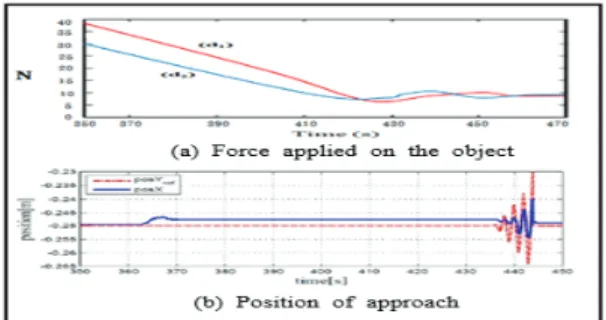
Examples of these experimental set-ups shown in Fig. 6, the results are shown in Fig. 7 - Fig. 8. In Fig. 7, the three fingers first approach a fixed object until each of them is at a desired distance from it, then the contacts are applied. Fig. 8 shows an experiment involving force control of gasping the object. In Fig. 8, phase 1, 2 are the preparing phase to gasp the object. Phase 3,

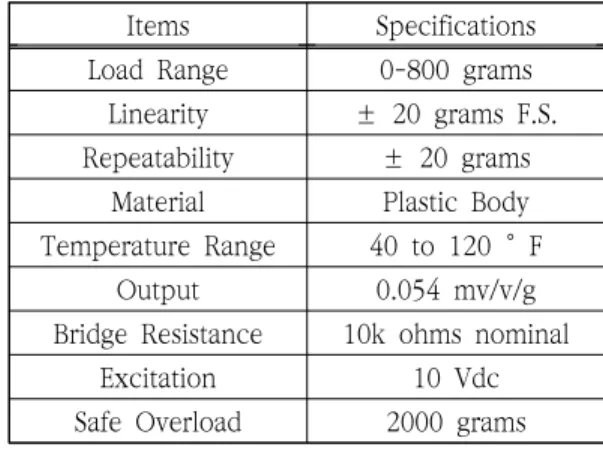
Items Specifications

Load Range 0-800 grams

Linearity ± 20 grams F.S.

Repeatability ± 20 grams

Material Plastic Body

Temperature Range 40 to 120 °F

Output 0.054 mv/v/g

Bridge Resistance 10k ohms nominal

Excitation 10 Vdc

Safe Overload 2000 grams Table 2. Shows the Specifications of F/T Sensor

Fig. 6 Experiments set-up

(6)

4 shows the application force is controlled, in this case, the reference force is changed during hand system force to show the effectiveness of the force control. At the end, the phase 5 shows the object is released and the force is null.

A number of laboratory experiments have been performed both on single finger modules and sensorial/actuation subsystems in order to test the efficiency of each finger structure and of the control system. The validation has also included verification of the procedures for the object approach, based on the use of both the distance and the position sensor information, and the use of the force/torque sensors.

Fig. 7 The experimental results of object grasping

Fig. 8 The experiment results of finger’s performance test

Concerning the approach and contact phases, it must be observed that the possibility of independently moving the fingers has noticeably increased the capability of grasping moving objects. As a matter of fact, the object may be tracked with a coordinated movement of both the arm and the fingers.

Once the motion is tracked, the grasp may be firmly applied without loosing contact.

5. CONCLUSION

We proposed a new technique to design and control of a three-fingered with 8 degrees of freedom robotic hand finger for real application in manufacturing process.

It presents a very large workspace with respect to its grasping range, and is capable of operation both on small and on large parts; its sensory equipment seems to be sufficiently flexible and more than precise for the expected tasks. The reliability was illustrated by the performance test of the hand fingers in particular with respect to the force control and to the possibility of applying simple manipulation procedures on the grasping and moving diverse shape objects.

The future research will be implement the

improvement of flexibility and intelligence in

control of grasping and handling for smart

factory.

(7)

References

[1] M. Ishikawa et al. “A CMOS vision chip with SIMD processing element array for 1ms image processing,” Dig. Tech. Papers of IEEE Int.

Solid-State Circuits Conf., pages 206– 207, 1999.

[2] Biagiotti, C. Melchiorri, G. Vassura,

“Experimental activity on grasping objects in free floating conditions,” ASTRA’’2000, ESTEC, Noordwijk, NL, 5-7 dic. 2000.

[3] Sang-Yeong Jo, Min-Seong Kim, Gi-Hoon Do, Sung-Hyun Han, Eun-Tae Ha, Hyun-Seok Sim and Cahng-Sik Im, “A Study on Real Time Working Path Control of Vertical Articulated Robot for Forging Process Automation in High Temperature Environments,” The Korean Society of Industry Convergence, Vol. 20, No. 1, Mar.

2017, pp. 34-48.

[4] C. Melchiorri, “Slip Detection and Control Using Tactile and Force Sensors,” IEEE Trans.

on Mechatronics, special Issue on Advanced Sensors for Robotics, Vol. 5, No. 3, Sept. 2000, pp. 235-243.

[5] G. Vassura, C. Melchiorri, “Three Finger Grasping for Intra Vehicular Space Experiments,”

WAC’’2000, Maui, Hawaii, June 11-16 2000.

[6] Min-Seong Kim, Min-Hyeok Choi, Ho-Yeong Bae, O-Deuk Im, Jeong-Suk Gang and Sung-Hyun Han, “A Study on Optimal Working Path Control of Seven Axes Vertical Type Robot with Translation Joint for Triming Working Automation in Forming Process” The Korean Society of Industry Convergence, Vol.

21, No. 2, Mar. 2018, pp. 53-62.

[7] T. Oomichi et al., “Development of working multifinger hand manipulator,” Proc. IEEE Int.

Workshop on Intelligent Robots and Systems, 873–-880,1990.

[8] C. Melchiorri, G. Vassura, “Design of a Three-Finger Gripper for Intra-Vehicular Robotic Manipulation,” 1st IFAC Workshop on Space

Robotics, SPRO98, Montreal, CA, Oct. 19-22, 1998.

[9] R.A. Grupen et al., “A survey of general-purpose manipulation,” Int. J. Robot. Res., 8(1): 38–-62, 1989.

[10] Sung-Hyun Han, Man-Hyung Lee, R.R.

Mohler, “Real-Time Implementation of a Robust Adaptive Controller for a Robotic Manipulator Based on Digital Signal Processors,” IEEE Transactions on systems, Man, And Cybernetics-Part A : Systems and Humans Vol. 29, No. 2, March 1999.

(Manuscript received May 17, 2018; revised June 28,

2018; accepted July 9, 2018.)

수치

Fig.  1  The  structure  of  hand  finger
Fig.  3  The  flowchart  of  robot  hand  control  based  on  F/T  sensor
Fig.  4  Hand  system  and  its  fingers  in  configurations.
Fig.  6  Experiments  set-up
+2

참조

관련 문서

근래에 연구되는 격자형 모델은 각 경계범위에서 각기 다른 변수의 영향을 정확 하게 산출하지 못하고 있으나 , 수용모델링을 병행하는 경우 높은 정확도를 추정할

A stress component is positive when it acts in the positive direction of the coordinate axes, and on a plane whose outer normal points in one of the positive coordinate

The torque analysis was performed acting on the joint of robot by modeling the kinematics and dynamics of the robot.. Load torque of the joint

Just as we achieved good control with a joint-based controller that was based on a linearizing and decoupling model of the arm, we can do the same for the Cartesian case.

출처 : IAEA 발표 자료(Comprehensive inspection exercise at bulk handling facilities, “U-235 Enrichment measurements by gamma-ray spectroscopy”) 13.  Uranium

The feed is commonly a solution in a solvent like ethanol or t-butanol, and the nonsolvent is water..

In order to derive a new fuzzy controller, a fixed design-parameter fuzzy PID controller was surveyed in view of deriving a control law based on the

The biomedicalisation of smoking cessation: a mixed methods study of lay perspectives on nicotine addiction.. Norway's tobacco