• 검색 결과가 없습니다.

STAR FORMATION HISTORY AND DUST PRODUCTION: NGC147 AND NGC185

N/A
N/A
Protected

Academic year: 2021

Share "STAR FORMATION HISTORY AND DUST PRODUCTION: NGC147 AND NGC185"

Copied!
3
0
0

로드 중.... (전체 텍스트 보기)

전체 글

(1)

Publications of the Korean Astronomical Society pISSN: 1225-1534

30: 169 ∼ 171, 2015 September eISSN: 2287-6936

2015. The Korean Astronomical Society. All rights reserved. c http://dx.doi.org/10.5303/PKAS.2015.30.2.169

STAR FORMATION HISTORY AND DUST PRODUCTION: NGC 147 AND NGC 185 Roya Hamedani Golshan

1,3

, Atefeh Javadi

1

, Jacco Th. van Loon

2

, and Habib G. Khosroshahi

1

1

School of Astronomy, Institute for Research in Fundamental Sciences (IPM), P.O. Box 19395-5531, Tehran, Iran

2

Astrophysics Group, Lennard-Jones Laboratories, Keele University, ST5 5BG, UK

3

Department of Physics, Isfahan University of Technology, I sfahan 84156-83111, Iran E-mail: [email protected]

(Received November 30, 2014; Reviced May 31, 2015; Aaccepted June 30, 2015)

ABSTRACT

NGC 147 and NGC 185, paired satellites of the Andromeda galaxy, possess the same order of mass and analogous structures, but they show different star formation and different amounts of interstellar gas and dust. Therefore, we present the first reconstruction of the star formation history of NGC 147 and NGC 185. Asymptotic Giant Branch stars are highly evolved stars that are brightest in K-band. This maximum K-band magnitude is related to the birth mass of stars. As a result, we have found a 9.9 Gyr old single star formation epoch for NGC 185 followed by relatively continuous star formation. NGC 147, however, has passed through two star formation episodes; one is as old as ∼6 Gyr and the other is as recent as ∼850 Myr. Asymptotic Giant Branch stars are also important dust factories; by fitting Spectral Energy Distributions to observed near and mid infrared data for each star, we were able to measure the dust production rates of individual stars; on order of 10 −5 M yr −1 . Hence, we estimate the total mass entering the interstellar medium to be 1.06 × 10 −4 M yr −1 and 2.89 × 10 −4 M yr −1 for NGC 147 and NGC 185.

Key words: galaxies: NGC 147, NGC 185 – galaxies: star formation– stars: AGB stars, LPV stars

1. INTRODUCTION

Asymptotic Giant Branch (AGB) stars are evolved stars with low to intermediate masses (0.8–8 solar masses).

Since cool AGB stars emit most of their flux in near- infrared wavelengths the K-band is a good measure of the bolometric flux. On the other hand, the most evolved, dust-enshrouded AGB stars can only be de- tected at infrared wavelengths. Therefore, the K-band is an appropriate wavelength for observing Long Period Variable stars (LPVs).

NGC 147 and NGC 185, Andromeda’s paired satellite galaxies, which have the same order of mass and analo- gous structures but different evolutionary tracks, offer a unique opportunity to consider star formation histories and evolution. Furthermore, NGC 147 and NGC 185 are categorized as dwarf spheroidal galaxies, and therefore are appropriate candidates to increase our insight about the evolution of dwarf spheroidal galaxies.

This paper aims to construct the birth mass function of Long Period Variable stars and derive star formation histories in the inner 6.4 0 × 6.4 0 region of NGC 147 and NGC 185 in section 3. In section 4, we will state the amount of mass shed into Interstellar Medium (ISM).

http://pkas.kas.org

2. DATA AND METHODOLOGY

NGC 147 and NGC 185 were observed on 38 nights be- tween October 2003 and February 2006 in the Gunn-i- band with the 2.56 m Nordic Optical Telescope (NOT).

Single-epoch K-band photometry for the target galaxies was obtained during two consecutive nights in Septem- ber 2004. Finally, LPVs were detected by image sub- traction method. Photometric data has been published in Lorenz et al. (2011) and we have made use of them.

A galaxy’s Star Formation History (SFH) is the de- scription of the amount of gas which has been converted to stars over a period of time, and can be described by the Star Formation Rate (SFR), ξ, as a function of time.

Therefore, the mass of stars, dM , created during a time interval, dt, is:

dM (t) = ξ(t)dt. (1)

Javadi et al. (2011) give the following form for ξ:

ξ(t) = dn 0 (t) δt

R max

min f IM F (m)mdm R m(t+dt)

m(t) f IM F (m)dm

(2)

where f IM F is the initial mass function. We have re-

vised the theoretical models provided for stellar evolu-

tion by Padova group (Marigo et al. 2008) to construct

the mass-luminosity relation for NGC 147 and NGC 185

related metallicities (Javadi et al. 2011). The theo-

retical models of the Padova group can also help us to

169

(2)

170 GOLSHAN ET AL.

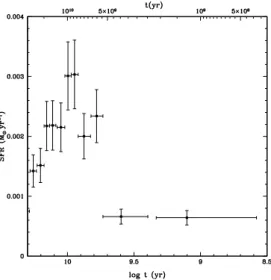
Figure 1. The Star Formation History of NGC 147 derived from near-IR Long Period Variable Stars

Figure 2. The Star Formation History of NGC 185 derived from near-IR Long Period Variable Stars

determine mass-age relations and mass-pulsation dura- tion.

As we mentioned above, AGB stars experience copi- ous mass loss. The “Dusty” code is an appropriate tool to use to determine the total amount of mass that each star loses during the late stages of evolution. Further- more, we have used WISE mid-IR photometric data.

3. STAR FORMATION HISTORY

The SFR as a function of elapsed time is depicted in Fig. 1 and Fig. 2 for NGC 147 and NGC 185, respec- tively. NGC 185 went through a 9.9 Gyr old star forma- tion epoch that produced 79.02% of the total mass of stars. It was followed by a relatively continuous SFR of 6.5 × 10 −4 M yr −1 . However, we found two star for- mation epochs in NGC 147; one ∼6 Gyr ago at the rate

Figure 3. Dots: Photometric data in the near and mid-IR from Lorenz et al. (2011) and WISE. Curves: The best SEDs of dusty models matched to photometric data; M-type star(solid curve), C-type star(dotted curve)

of ∼2.1 × 10 −3 M yr −1 and another one only 850 Myr ago at the rate of 1.5 × 10 −3 M yr −1 . During these two epochs 76.96% and 7.6% of total mass of stars were formed.

4. DUST PRODUCTION

We have modeled the dust of AGB stars by combining near and mid-IR photometry data and the fitted SED of the Dusty code (Fig. 3). The optical depth, lumi- nosity and mass loss of the sample star were then de- termined; the mass loss is 1.423 × 10 −6 M yr −1 . We have repeated this process for a sample of 91 carbon stars in NGC 147 (Sohn et al. 2006) and 73 carbon star in NGC 185 (Kang et al. 2005). We achieve the com- plete mass loss rate as follows; 1.06 × 10 −4 M yr −1 for NGC 147 and 2.89 × 10 −4 M yr −1 for NGC 185.

5. DISCUSSION

The total mass of stars created in NGC 185 is 3.8 × 10 8 M . Davidg (2005) proposed a value of 2 × 10 8 M . In NGC 147 total mass of stars is 1.7 × 10 8 M .

Modeling the dust of carbon stars gives an estimate of the total mass enters the ISM. For NGC 147 and NGC 185, this amount is 1.06 × 10 −4 M yr −1 and 2.89

× 10 −4 M yr −1 , respectively. Welch et al. (1996) pre- dicted a 1.8 × 10 −4 M yr −1 mass loss rate for NGC 185.

Gallagher et al. (1981) derive a mass return rate of 1–2

× 10 −3 M yr −1 for NGC 185.

REFERENCES

Ivezic, Z. & Elitzur, M., 1996, Self-similarity and Scaling Behavior of IR Emission from Radiatively Heated Dust:

I. Theory, MNRAS, 000, 1-14

Javadi, A., & van Loon, J. Th., et al., 2011, The UK Infrared

Telescope M 33 Monitoring project. II. The Star Forma-

(3)

STAR FORMATION HISTORY AND DUST PRODUCTION: NGC 147 AND NGC 185 171 tion History in the Central Square Kiloparsec, MNRAS,

414, 3394

Javadi, A., & van Loon, J. Th., et al., 2013, The UK In- frared Telescope M 33 Monitoring Project. III. Feedback from Dusty Stellar Winds in the Central Square Kilopar- sec, MNRAS, 432, 2824

Marigo, P., & Girardi, L., et al., 2008, Evolution of

Asymptotic Giant Branch Stars II. Optical to Far-infrared

Isochrones with Improved TP-AGB Models, A&A, 482,

883

수치

Figure 3. Dots: Photometric data in the near and mid-IR from Lorenz et al. (2011) and WISE

참조

관련 문서

“With the MySQL Query Analyzer, we were able to identify and analyze problematic SQL code, and triple our database performance. More importantly, we were able to accomplish

GDP impact of COVID-19 spread, public health response, and economic policies. Virus spread and public

Micro- and nano-sized pores were formed on the surface of the alloy using PEO and anodization methods, and the pore shape change according to the Zr

5.. Monthly Energy Statistics presents current data on production, consumption, imports, exports, stocks and prices of principal energy commodities in Korea.and

In this paper, defect of nuclear energy pipe and composite material were, measured using dual-beam shearography and infrared thermography, quantitatively

For each of several tests, elastic, plastic, and total strain data points are plotted versus life, and fitted lines are also

To obtain data for the optimal growth conditions for crops in this intelligent plant growing system, sensors were used to measure and control the

But, in this case, it cause damage the near by houses, factories, railroads due to the soil disturbance due to soft ground improvement and also cause