OPEN ACCESS Journal of Korean Tunnelling and Underground Space Association 20(6)1061-1071(2018)
https://doi.org/10.9711/KTAJ.2018.20.6.1061
eISSN: 2287-4747 pISSN: 2233-8292
Received September 19, 2018 Revised October 18, 2018 Accepted October 25, 2018
This is an Open Access article distributed under the terms of the Creative Commons Attribution Non-Commercial License (http://creativecommons.org/
licenses/by-nc/4.0/) which permits unrestricted non- commercial use, distribution, and reproduction in any medium, provided the original work is properly cited.
Copyright ⓒ2018, Korean Tunnelling and Underground Space Association
가상해저터널의 지진 시 응답 특성
장동인
1ㆍ곽창원
2ㆍ박인준
3*ㆍ김창용
41
학생회원, 한서대학교 토목공학과 박사과정
2
정회원, 한국지역난방공사 과장
3
정회원, 한서대학교 토목공학과 교수
4
정회원, 한국건설기술연구원 선임연구원
Seismic response characteristics of the
hypothetical subsea tunnel in the fault zone with various material properties
Dong In Jang
1ㆍChang-Won Kwak
2ㆍInn-Joon Park
3*ㆍChang-Yong Kim
41
Ph.D. Student, Dept. of Civil Engineering, Hanseo University
2
Manager, Associate Korea District Heating Corp
3
Professor, Dept. of Civil Engineering, Hanseo University
4
Senior Research Fellow, Korea Institute of Construction and Building Technology
*Corresponding Author : Inn-Joon Park, [email protected]
Abstract
A subsea tunnel, being a super-sized underground structure must ensure safety at the
time of earthquake, as well as at ordinary times. At the time of earthquake, in particular,
of a subsea tunnel, a variety of response behaviors are induced owing to relative
rigidity to the surrounding ground, or difference of displacement, so that the behavior
characteristics can be hardly anticipated. The investigation aims to understand the
behavior characteristics switched by earthquake of an imaginary subsea tunnel which
passes through a fault zone having different physical properties from those of the
surrounding ground. In order to achieve the aim, dynamic response behaviors of a
subsea tunnel which passes through a fault zone were observed by means of indoor
experiments. For the sake of improved earthquake resistance, a shape of subsea tunnel
to which flexible segments have been applied was considered. Afterward, it is
believed that a D/B can be established through 3-dimensional earthquake resistance
interpretation of various grounds, on the basis of verified results from the experiments
and interpretations under various conditions. The present investigation performed 1 g
shaking table test in order to verify the result of 3-dimensional earthquake resistance
interpretation. A model considering the similitude (1:100) of a scale-down model test
was manufactured, and tests for three (3) Cases were carried out. Incident seismic
wave was introduced by artificial seismic wave having both long-period and
short-period earthquake properties in the horizontal direction which is rectangular to
the processing direction of the tunnel, so that a fault zone was modeled. For numerical
analysis, elastic modulus of the fault zone was assumed 1/5 value of the modulus of individual grounds surround the tunnel, in order to simulate a fault zone. Resultantly, reduced acceleration was confirmed with increase of physical properties of the fault zone, and the result from the shaking table test showed the same tendency as the result from 3-dimensional interpretation.
Keywords: Flexible segment, Subsea tunnel, Shaking table test, Fault zone, Artificial seismic
초 록
초대형 지하구조물인 해저터널은 평상시는 물론 지진 시에도 안정성을 확보하여야 한다. 특히 해저터널의 지진 시 주위 지반과의 상대적인 강성, 변위 차이에 의하여 다양한 지진 응답거동이 유발되므로 그 거동 특성을 예측하기가 쉽지 않다.
본 연구의 목적은 주위 지반과 물성이 다른 단층대를 통과하는 가상해저터널의 지진 시 동적 거동특성 파악이며, 이를 위 하여 3차원 내진해석의 결과를 토대로 실내시험을 통해 단층대를 통과하는 해저터널의 동적 응답거동을 파악하였다. 이 때, 해저터널은 내진성능 향상을 위하여 가동세그먼트(Flexible Segment)가 적용된 형태를 고려하였다. 추후, 다양한 조건에서의 해석 및 시험을 통하여 검증된 결과를 획득하고 이를 바탕으로 다양한 지반의 3차원 내진해석을 통한 D/B 구축이 가능할 것으로 판단된다. 본 연구에서는 3차원 내진해석의 결과를 검증하기 위하여 1 g 진동대 시험(1 g Shaking table test)을 수행하였다. 축소 모형시험의 상사율(1:100)을 고려하여 아크릴로 모형을 제작하고 3가지 Case의 시험을 수행하였다. 입력 지진파는 장, 단주기 지진특성을 모두 가진 인공지진파를 터널 진행방향과 직교하는 수평방향으로 가 진 하였으며 단층대를 모델링하였다. 수치해석시 단층대를 모사하기 위하여 단층대의 탄성계수는 터널 주위 각 해당지 반의 탄성계수의 1/5에 해당하는 값으로 가정하여 적용하였다. 그 결과 단층대의 물성이 증가함에 따라 가속도 감소를 확인할 수 있었으며 진동대 시험결과도 3차원해석결과와 동일한 경향을 나타냄을 확인하였다.
주요어: 가동세그먼트, 해저터널, 진동대실험, 단층대, 인공지진
1. 서 론
빠른 산업화와 이에 따른 도시화로 인해 교통량 및 물류량이 대폭 증가하고 있다. 이로 인해 효율적인 공간 활
용을 위해 다양한 지하 구조물의 건설이 증가하는 추세이며, 그 중 세계적으로 건설 및 설계가 증가하고 있는 것
이 해저터널이다. 노르웨이, 중국, 영국, 터키 등 해저터널을 이용한 다양한 사회기반 시설, 교통난 해소, 관광 활
성화 및 대형선박의 원활한 운항 등을 통하여 상당한 경제적인 효과를 보여주고 있다. 또한 지속적으로 해저터널
프로젝트 및 건설이 증가하고 있다(Kim et al., 2017). 해저터널은 지중에 위치하는 지하구조물의 특성상 지진 시
지반 운동의 크기와 관성력이 작고 일산 감쇠가 커서 상부 구조물에 비해 유리하나 최근 발생한 지진의 규모와 빈
도가 증가하면서 지중구조물 중 특히 해저터널의 내진설계 및 관련 면진 시스템의 개발에 관심이 증대하고 있는
추세이다. 따라서 해저터널의 지진 시 응답 특성에 대한 보다 정밀한 접근이 필요하다. 이런 연구의 필요성을 충
족하기 위하여 지진 시 터널 단면형상, 설치심도, 라이닝의 강도 및 주변지반의 물성을 고려한 동적원심모형 시험
및 연구 결과가 다수 발표되고 있다(Cilingir and Madabhushi, 2011a; Cilingir and Madabhushi, 2011b). 최근에
는 지진 시 가속도수준에 따른 도심터널의 동적거동을 동적원심모형 시험 및 동적 내진해석을 통해서 규명하고
자 하는 연구들이 활발하게 진행되어 왔다(Baziar et al., 2014; Chen and Shen, 2014; Yang et al., 2013). 특히 국 내에서도 고수압을 받는 해저터널의 내진안정성을 확보하기 위하여 가동세그먼트(Flexible Segment)가 설치된 가상해저터널의 지진 시 동적거동 특성 규명을 위한 연구가 진행되면서 최근에 그 결과물들이 발표되고 있다 (Kwak and Park, 2015; Kwak et al., 2016).
본 연구에서는 기존 연구와 달리 물성이 다른 단층대를 통과하는 가상해저터널의 지진 시 동적거동을 3차원 내 진해석 및 1 g 진동대 시험을 이용하여 파악하고자 한다. 1 g 진동대시험을 통해 3차원 내진해석 결과를 검증하며, 향후 다양한 물성의 동해석 및 시험을 통하여 D/B를 구축하는 것이 본 연구의 또 다른 중요한 목표이다.
2. 3차원 동적 내진해석
다양한 가상 해저터널의 지반물성을 고려한 3차원 내진해석을 진행하였다. 모델링 시 가동세그먼트의 위치는 기 수행된 연구결과(Jang et al., 2017)를 통하여 최적 위치를 고려하여 적용하였다. 이 때, 가동세그먼트와 인접하여 다 양한 물성을 가진 단층대를 통과할 경우를 가정하여 각각 수치해석을 수행하였다. 본 연구에서 사용된 지진파는 장, 단주기 특성을 모두 가진 인공지진파를 적용하였고 최대가속도는 붕괴방지 내진 1등급에 해당하는 0.154 g이다.
2.1 해석조건
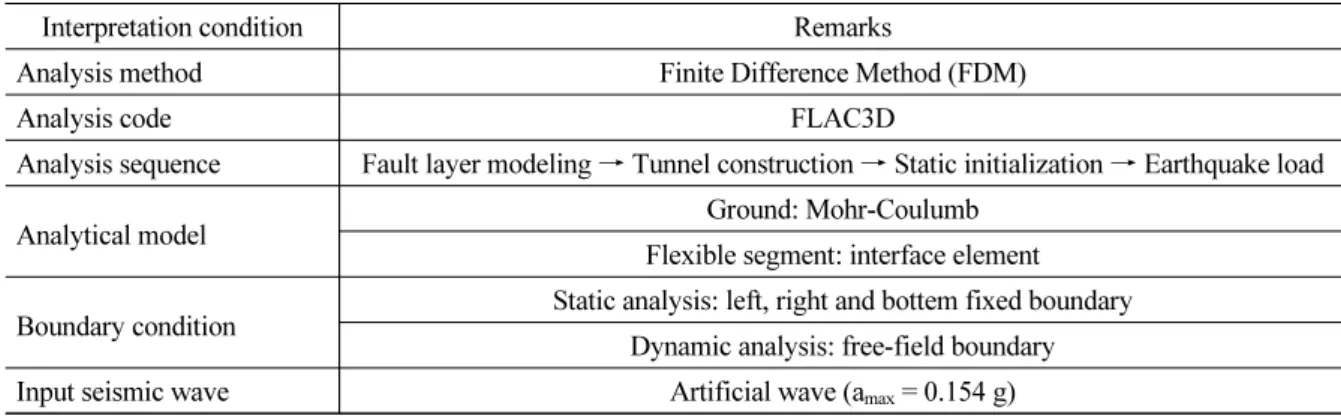
본 해석은 수직구를 가진 해저터널의 가동세그먼트를 고려하여 해석을 수행하였다. 가동세그먼트와 근접하게 단층대를 모사하였고 인공지진파 시간이력을 재하 하여 3차원 동적 내진해석을 수행하였다. 내진해석 조건은 다 음 Table 1과 같고, 해석 모델링 결과는 Fig. 1(a)해석 결과의 모니터링 위치는 Fig. 1(b)와 같다. Fig. 2(a)와 같이 터널 진행방향과 사선으로 교차하는 형태의 단층대를 모델링하였고 단층대 물성에 따라 해석 Case는 총 3가지로 나누어 해석을 수행하였다. 해석 Case별로 지반 물성치를 조정하였으며, 단층대의 물성은 각 해당지반 탄성계수 의 1/5로 가정하여 해석하였다. 각 Case별 지반 및 단층대의 탄성계수 값은 다음 Table 2와 같다. 본 연구에서 적용 된 인공지진파는 장, 단주기 특성을 모두 가지고 있으며 붕괴방지 내진1등급에 해당하는 최대가속도 0.154 g이며 가속도 시간이력과 설계응답 스펙트럼은 Fig. 3과 같다. Table 3에서는 해석에 적용된 전체 물성을 나타내었다.
Table 1. Numerical analysis conditions
Interpretation condition Remarks
Analysis method Finite Difference Method (FDM)
Analysis code FLAC3D
Analysis sequence Fault layer modeling → Tunnel construction → Static initialization → Earthquake load
Analytical model Ground: Mohr-Coulumb
Flexible segment: interface element Boundary condition Static analysis: left, right and bottem fixed boundary
Dynamic analysis: free-field boundary
Input seismic wave Artificial wave (a
max= 0.154 g)
(a) 3D modeling (b) Monitoring point Fig. 1. 3D modeling and monitoring point
Table. 2 Numerical analysis condition for young’s modulus
Cases Case-1 Case-2 Case-3
Young’s modulus, rock (Mpa) 800 2,000 10,000
Shattered zone (Mpa) 160 400 2,000
Fault zone
(a) Interface modeling (b) Underground stress
(vertical stress) (c) Boundary condition (free-field) set Fig. 2. 3D modeling of fault zone
(a) Time history for artificial acceleration (b) Standard design spectral acceleration
Fig. 3. Input seismic wave
Table 3. Ground properties Case Ground
rating Division
Unit weight (kN/m
3)
Shear wave velocity
(m/sec)
Poisson ratio
Cohesion (kN/m
2)
Friction angle (degree)
Case-1 1 (S6) Unconsolidated layer (SL) 18.5 350.0 0.3 0.0 30.0
Case-2,3 2 (S6) Soft layer/shattered zone (FLT) 21.4 350.0 0.3 50.0 21.0 Case-3 3 (S1)
Bedrock
Ⅰ 26.8 2000.0 0.2 6000.0 45.0
Case-2 5 (S2) Ⅲ 24.7 1400.0 0.2 700.0 38.0
Case-1 7 (S2) Ⅴ 21.4 750.0 0.3 50.0 21.0
2.2 내진해석 결과
3 차원 동적 내진해석 결과 다음과 같이 각 Case별 가속도 응답 특성을 산정하였다.
해석결과 물성 증가에 따라 세그먼트에 발생하는 최대 응답가속도 Fig. 4를 통해 확인할 수 있었다. Point-1에 서 Case-1 대비 Case-3에서 최대 51.1% 감소를 보였으며, Point-2에서 Case-1대비 Case-3에서 최대 32.8% 감소 를 보였다. 변위 응답 특성은 Fig. 5와 같다.
(a) Case-1 (b) Case-2
(c) Case-3
Fig. 4. Acceleration results
(a) Case-1 (b) Case-2
(c) Case-3 Fig. 5. Displacement result
변위 응답 특성도 가속도와 같이 물성 증가에 따라 변위가 감소하나 그 절대폭은 작은 것을 Fig. 5와 같이 확인 하였다. Point-1에서 Case-1 대비 Case-3에서 최대 3.2% 감소하였으며, Point-2에서 Case-1 대비 Case-3에서 최 대 3.0% 감소를 보였다.
암반 물성 증가에 따른 가속도 및 변위 감소를 확인하였으며, 가속도 감소 경향이 변위 감소 경향보다 현저히 큰 것으로 관찰되었다.
3. 1 g 진동대 시험
3 차원 내진해석 결과의 검증을 위하여 1 g 진동대 시험을 수행하였다. 실내 시험의 여건상 3차원 내진해석 시 지반조건을 완벽하게 재현하기에는 한계가 있으나 상사율과 상대밀도를 고려하여 최대한 해석 조건과 유사한 조 건을 구현하여 진동대 시험을 수행하였다.
연구에서는 기 수행된 해저터널 내진성능 향상을 위한 가동세그먼트 효용성 연구(Jang et al., 2017)를 바탕으
로 가동세그먼트의 최적 위치를 고려한 모델을 적용하였다. 아크릴로 제작된 터널 모형에 수직구에서 0.5d이격
된 자리에 가동세그먼트를 설치하였으며, 시험 대상은 가상해저터널 분기부(수직구)이다. 상사비(Iai, 1989)는
1:100 을 적용하였다. 총 3가지의 Case의 시험을 진행하였으며 각 Case별로 지반의 물성을 조정하였으며, 단층대
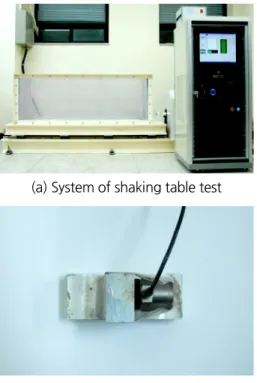
에는 해당지반 탄성계수의 1/4을 적용하였다. 시험에서 사용된 입력지진 최대가속도 0.154 g의 장단주기 성격을 모두 지닌 인공지진파를 적용하였으며 3차원 내진해석에 적용한 것과 동일한 인공지진파를 적용하였다. 시험에 서 사용한 진동대 시험기 및 센서를 Fig. 6에 도시하였다.
(a) System of shaking table test (b) Control program of shaking table
(c) Accelerometer (d) Data logger
Fig. 6. System of shaking table test and sensors
3.1 시험방법
1 g 진동대 시험기의 재하판 위에 토조를 설치하였다. 실험적 변수를 차단하기 위해 토조 안의 좌우 측면은 두
께가 얇은 스티로폼을 설치하여 반사되는 지진동의 감쇠를 도모하였다. 토조의 크기는 너비 150 cm, 폭 50 cm 높
이 60 cm이고 상사비 1:100에 맞추어 모형을 제작 사용하였다. 3차원 내진해석의 지반 강도를 실내시험으로 완
벽히 모사하기에는 한계가 있으므로 실리카 모래를 강사 하여 상대밀도를 조정하는 방법으로 지반을 조성하였
다. 단층대 모사를 위하여 상대적으로 실리카 모래에 비해 상대밀도가 작은 주문진 표준사를 이용하여 단층대를
형성하였다. Table 4는 본 시험에서 적용된 상대 밀도 조건을 정리한 것이다. 3차원 내진해석과 비교하기 위해 최
대한 유사한 물성의 지반을 구축하였다. 다음 Fig. 7은 모형의 계측 위치 및 단면을 간략하게 표기한 것이며 3차원
내진해석시 측점과 같은 위치에서 가속도를 측정하였다. Fig. 8은 시험방법 및 순서를 나타낸 것이다.
Table 4. Cases of shaking table test
Cases Case-1 Case-2 Case-3
Relative density (D
r) (ground) 60% 70% 80%
Relative density (D
r) (shattered zone) 12% 14% 16%
acceleromete
Fault zone
Fig. 7. Measurement location
accelerometer
(a) Foundation ground (b) Install accelerometer
(c) Finished section
Fig. 8. 1 g shaking table test procedures
3.2 시험 결과
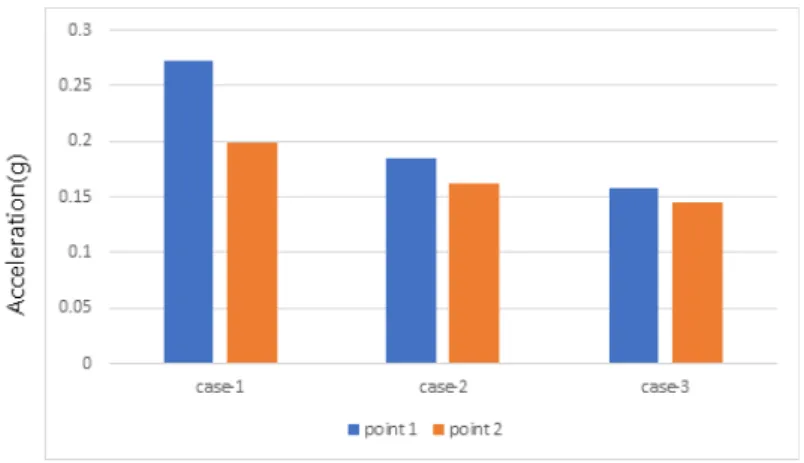
다양한 조건의 1 g 진동대 시험 결과는 다음과 같다. 계측결과 Case-1의 Point-1, 2에서 0.281 g, 0.199 g 및 Case-2 의 Point-1, 2에서 0.185 g, 0.162 g가 측정되었고 Case-3의 Point-1, 2에서 0.158 g, 0.145 g가 측정되었다.
Point-1 에서의 계측결과 지반 강성이 증가할수록 가속도 값이 감소하는 경향을 확인할 수 있었다. Case-3과 Case-1 을 비교한 결과 최대가속도는 최대 43.8% 감소하는 현상을 보였다. Point-2에서도 Point-1과 마찬가지로 지반 강성이 증가할수록 가속도 값이 감소하였고 Case-3과 Case-1을 비교한 결과 최대가속도는 최대 27.1% 감 소하는 결과를 확인하였다. Fig. 9는 Case별 각 Point에서의 계측값을 그래프로 비교한 것이다.
Fig. 9. 1 g shaking table test result
3.3 3차원 내진해석 결과와 1 g 진동대 시험의 결과 비교 분석