• 검색 결과가 없습니다.

Non-Textual Elements as Opportunities to Learn: An Analysis of Korean and U.S. Mathematics Textbooks

N/A
N/A
Protected

Academic year: 2021

Share "Non-Textual Elements as Opportunities to Learn: An Analysis of Korean and U.S. Mathematics Textbooks"

Copied!
13
0
0

로드 중.... (전체 텍스트 보기)

전체 글

(1)

대한수학교육학회지 <학교수학> 제 12 권 제 4 호 Journal of Korea Society of Educational Studies in Mathematics School Mathematics Vol.12, No.4, 605-617, Dec.2010

Non-Textual Elements as Opportunities to Learn:

An Analysis of Korean and U.S. Mathematics Textbooks 1)

Kim, Rae Young

*

I. Introduction

Many educational studies have viewed teaching and learning as cultural practices (e.g., Alexander, 2000;

Fernandez & Yoshida, 2004; Ma, 1999; Stigler &

Hiebert, 1999). It is not surprising that textbooks as a crucial medium in teaching and learning are largely embedded in various socio-historical contexts where shared understandings, principles, and meanings are constituted. Recently, researchers in many international comparative studies have argued that the curriculum is one of the key contributing factors to cross-national similarities and differences in students’ mathematics achievement (e.g., Mayer, Sims, & Tajika, 1995;

Schmidt et al., 2001; Stigler, 1990; Stigler, Lee, Lucker, including TIMSS studies (e.g., Li, 2000; Mayer et al.,

& Stevenson, 1982). Many comparative studies

1995; Schmidt et al., 2001; Valverde, Bianchi, Wolfe, Schmidt, & Houang, 2002) have, thus, investigated mathematics textbooks across countries to know "what is to be taught and how" (Alexander, 2001, p. 549).

They have, however, primarily focused on textual elements such as content coverage, types of problems, topics of problems, and textbook structure. They have generally failed to capture the analytic significance of understanding the characteristics and roles of non-textual elements in mathematics textbooks: What do they offer for teaching and learning mathematics, and how are they similar/different cross-nationally?

Non-textual elements in this study denote all elements that are not solely either verbal or symbolic repre- sentations in textbooks including pictorial represen- tations such as photos and illustrations as well as mathematical representations such as graphs and mathematical figures.

* Ewha Womans University ([email protected])

1) This study was supported by the Ewha Womans University Research Grant.

This study explores the characteristics and roles of non-textual elements in secondary mathematics

textbooks in the United States and South Korea, using a conceptual framework that I have

developed: variety, contextuality, and connectivity. Analyzing five U.S. standards-based textbooks

and 13 Korean textbooks, this study shows that although non-textual elements in mathematics

textbooks are free of literal language, they exhibit different emphases and reflect assumptions

about what is important in learning mathematics and how it can be taught and learned in a

particular societal context (Mishra, 1999; Zazkis & Gadowsky, 2001). While there are similar

patterns in the use of different types of non-textual elements in textbooks from both countries,

different opportunities are provided for students to learn mathematics between the two countries.

(2)

Existing research on representations have empha- sized the importance of visual representations in mathematics teaching and learning (Abrams, 2001;

Arcavi, 2003; Brenner et al., 1997; Duval, 2006;

Herman, 2007; Pape & Tchoshanov, 2001). It is widely believed that representations play important roles in creation of one’s concept image, communication with others, and mathematical reasoning as "tools for thinking" (Cuoco, 2001). Most studies have mainly focused on its cognitive and psychological effects on students’ mathematical learning, and thus only on mathematical representations such as graphs and symbols. However, little effort has been made to specify in any systemic way the characteristics and role of non-textual elements in mathematics textbooks. Noti- ceably, non-textual elements except mathematical representations in mathematics textbooks have not yet been explored. Although there are many studies which investigate the impact of visual representations in textbooks on student learning and comprehension, such research has been done in mainly science and reading areas (e.g., Carney & Levin, 2002; Levin & Mayer, 1993; Peeck, 1993). Unlike typical visual repre- sentations in reading and science, mathematical visual representations are used not only as informative agents but also as integral "tools for thinking" (Cuoco, 2001) with which students manipulate and experiment in their minds and hands. It thus calls attention to the development of a conceptual framework to understand non-textual elements in mathematics textbooks.

In this study, I investigate the characteristics and roles of non-textual elements in mathematics textbooks from South Korea and the United States according to a conceptual framework that I have developed (Kim, 2009a, 2009b). Since non-textual elements in textbooks are easily recognized and apprehended without any

linguistic knowledge, the interpretation of non-textual elements may be more influenced by preconceptions, knowledge, and experiences generated in a particular societal context because "people bring their cultural histories into the classroom and interpret and reconstruct the various messages" (Bishop, 1992, p. 185). From this perspective, although some regard mathematics as an objective global language that has been taught across time and place as a core subject (Kamens, Meyer,

& Benavot, 1996), it would be important to investigate how non-textual elements in mathematics textbooks are constructed and used in different societal contexts.

In particular, there are big gaps between Asian and American students’ representational competence (Bre- nner, Herman, Ho, & Zimmer, 1999). This calls attention to the need to investigate which opportunities to learn by non-textual elements in mathematics textbooks are provided in different societal contexts such as South Korea and the United States where substantial differences are observed in their student achievement (Schmidt et al., 2001). As a mediator between planned and enacted curriculum, textbooks are "components of opportunities to learn school subjects and have their own characteristic impact on instruction" (Valverde et al., 2002, p. 10). It is, thus, important to scrutinize the characteristics of the pedagogical uses of non-textual elements in mathe- matics textbooks in different societal contexts in order to understand "the nature of the provided educational opportunities" (Valverde et al., 2002, p. 12).

II. Theoretical Framework

An appropriate framework to analyze cultural aspect

of representations in textbooks has rarely been develo-

(3)

ped. In order to scrutinize the characteristics and role of non-textual elements in Korean and U.S. secondary mathematics textbooks, this study employs a com- parative research design according to the conceptual framework that I have developed (Kim, 2009a, 2009b).

This study uses some of the components in the framework for textbook analysis: variety, connectivity, and contextuality that would offer information about the usages and characteristics of non-textual elements in textbooks within/across societal contexts.

Variety , in this study, means the diversity of types of non-textual elements for explaining a certain concept or problem. This is closely related to Dienes’ multiple embodiment principle that “by varying the contexts, situations and frames in which isomorphic structures occur, the learner is presented opportunities via which structural (conceptual) mathematical similarities can be abstracted” (Sriraman & English, 2005, p258).

Presmeg (1997) claims that the "one-case concreteness"

of drawings and images is the source of many difficulties in visualization-based mathematical reasoning. Some typical representations may be sources of students’

conceptual errors (Cordier & Cordier, 1991). It is thus important to demonstrate various representations to explain a concept. On the other hand, different types of non-textual elements can influence students’

understanding of a concept and their problem solving.

Although the same problem is given in textbooks, the non-textual elements for the problem can provide different image and information. For example, in order to give a problem to get the degree of an angle, one textbook uses an abstract mathematical figure to ask the degree of the angle between the two rays and another book uses a clock picture to ask the angle between two hands of the clock. The types of non-textual elements that are used in textbooks demonstrate the

ways of presenting the concept as well as the roles of non-textual elements.

Contextuality is related to the context(s) where an element lies in. Freudenthal’s (1991) realistic mathe- matics which advocates that a real-world situation or authentic context should serve as the starting point for learning mathematics. NCTM standards (2000) emphasize the importance of students’ mathematical experiences in a context because "using mathematics in applied situations leads to deeper understanding"

(p. 93). Wiggins (1993) asserts the compartmen- talization of knowledge and the decontextualization of knowing are false because competency requires both context and reasoning. It is consistent with the results from Ferratti and Okolo’s research (1996) that students’

thinking skills and attitudes are enhanced when they collaborate in the solution of contextual problems. I think it is not only a matter of texts and problems.

Contextual non-textual elements may influence students’ understanding and learning with connections between mathematics and real life. Such experiences in the textbooks may give students an opportunity to think about mathematics in contexts and deepen their understanding (National Council of Teachers of Mathematics, 2000).

There are two different approaches to establish relations between mathematics and real contexts.

Whereas traditional approaches in mathematics edu-

cation take abstract mathematical facts and concepts

and apply them to the real contexts, Realistic Mathe-

matics Education (RME) attempts to establish relations

in the opposite way: from realistic contextual problems

to abstract mathematical concepts (Meyer, 2001). Thus,

in this study, I examine how non-textual elements are

established in two aspects: mathematical contextuality

and instrumental contextuality. Mathematical contex-

(4)

tuality in this study denotes how are presentation serves as a context that illustrates a concept in an abstract mathematical way. Instrumental contextuality indicates how are presentation is factual in real contexts to explain a concept. In this study, mathematical abstract figures and graphs are regarded as mathematical contextual elements, and photos and illustrations that are intended to provide real-life contextual information are counted as instrumental contextual elements.

Connectivity refers to how non-textual elements are closely related to textual elements. Braden (1983) coins the terms "visual-verbal symbiosis" and "visual-verbal discontinuity" for describing the relationship between visual and verbal elements. Visual-verbal symbiosis means well connectedness and supportiveness to each other between visual and verbal elements, while visual-verbal discontinuity indicates disconnection between visual and verbal representations. Many studies have found that a symbiotic connection between verbal and visual literacy helps improve student achievement when the two are united (Braden, 1983; Dwyer, 1988;

Herbel-Eisenmann, 2002). Since visual representations can serve as concrete models to show what they cannot see in texts and symbols (e.g., patterns and concrete images) and as tools to solve problems (Arcavi, 2003), it is very important to maintain a close connection between verbal and visual representations to support students’ learning. Levin and Mayer (1993) also claim that all kinds of text-connected pictorial representations improve students’ understanding from texts whereas disconnected pictorial representations do not. They argue that decorative pictures or illustrations cannot help students understand the content. However, from a textbook analysis in a previous study, I noticed that some decorative non-textual elements provide contextual or behavioral information. Although they

have some connections with texts and may influence students’ understanding of the content, their impact on students’ learning remains unanswered. Thus, this study focuses only on mathematical connectivity between texts and non-textual elements. How contex- tual informative non-textual elements affect students’

understanding will be investigated as instrumental contextuality.

III. Data and Methods

1. Sample

Based on the conceptual framework described above, five U.S. standards-based textbooks and 13 Korean secondary mathematics textbooks (written based on the 7th revised national curriculum) that are currently used in each country and available for this study are analyzed. Standards-based textbooks have many different features from conventional textbooks because they challenge traditional beliefs on both what important mathematics is and what is the most effective way to teach and learn mathematics (Senk & Thompson, 2003). Similarly, the Korean textbooks have been developed by the government as a reform movement with focus on mathematics with relation to real context and experience, mathematical reasoning and problem solving, and student-centered instruction (Korean Ministry of Education, 1999). It is worthy to see how both textbooks which have been developed with similar policy intentions are constituted in different countries in terms of using non-textual elements.

Then, I have found that some mathematical

contents/topics in geometry are commonly taught in

both textbooks at the similar grade levels. In this study,

(5)

according to the conceptual framework, I counted the number of non-textual elements that explain the concept of angles and parallel lines per page in the textbooks.

Since the concept of angles and parallel lines are one of the fundamental ideas in geometry, it is a good topic to see how the textbooks introduce these concepts and their applications using non-textual elements.

2. Data Analysis

Variety, contextuality, and connectivity are mea- sured by coding corresponding characteristics of non-textual elements. In terms of variety, I calculated the average numbers of non-textual elements per page by category to find general patterns among the use of non-textual elements. Then, I compared proportions of each type of angles in order to see opportunities to learn provided by the textbooks through non-textual elements. For contextuality, I compared the average numbers of non-textual elements between U.S. and Korean textbooks in terms of mathematical contex- tuality and instrumental contextuality. For connectivity, I compared the number of non-textual elements with and without mathematical connection. The details of the analysis will be provided in the next section. I did not include non-textual elements used in review section at the end of each chapter.

IV. Results

The findings from this study suggest that non-textual elements in the textbooks provide different oppor- tunities to learn mathematics.

1. Variety

General patterns in the use of non-textual elements are similar between South Korea and the United States:

mathematical figures are dominantly used in the textbooks than other types of non-textual elements (see Table IV-1). Nonetheless, while the proportion of mathematical figures in Korean textbooks is over 73%, the proportion in U.S. textbooks is only around 47%.

This shows that Korean textbooks have less variety of non-textual elements than the counterpart.

U.S. Korea

Photos 0.57(20.21%) 0.64(13.76%) Illustrations 0.86(30.50%) 0.55(11.83%) Mathematical

Figures 1.32(46.81%) 3.41(73.33%) Graphs 0.07(2.48%) 0.05(1.08%) Total 2.82(100.00%) 4.65(100.00%) Note: n = the number of textbooks included for analysis.

Percentages are in the parenthesis.

<Table IV-1> Average numbers and percentages of different types of non-textual elements, per page

In terms of variety, both textbooks provide different opportunities to learn the concept of angles and parallel lines. Although both textbooks use more mathematical figures than other types of non-textual elements, they have different emphases and opportunities to learn the concept of angles in the textbooks in terms of types of angles and shapes (For example, see Table IV-2).

Whereas the U.S. textbooks predominantly show acute angles rather than other types of angles, the Korean textbooks show a variety of types of angles relatively in balance. In particular, the U.S. textbooks do not show any straight angle even in the introduction of types of angles.

2. Contextuality

In terms of the average number of pictorial represen-

tations including photos and illustrations for instru-

(6)

U.S. Korea

Acute angles 73% 42%

Right angles 6% 29%

Obtuse angles 21% 22%

Straight angles 0% 7%

Note: n = the number of textbooks included for analysis.

Percentages are rounded to the nearest whole number.

<Table IV-2> Percentage of each type of angles used in the textbooks, per page

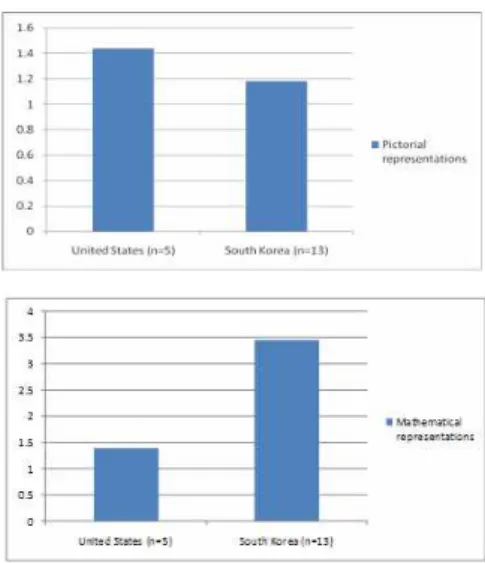
mental contextuality, and that of mathematical repre- sentations including mathematical figures and graphs for mathematical contextuality (see Figure IV-1), it appears that the U.S. textbooks use many photos and illustrations which have a lot of realistic contexts and images whereas the Korean textbooks use more abstract mathematical representations which have fewer realistic contexts. As shown in Table IV-1, even though the average number of non-textual elements per page is less in the U.S. textbooks than in the Korean textbooks, it is noticeable that the U.S. textbooks include more pictorial representations than the Korean text- books. This implies that the U.S. textbooks are likely to provide more opportunities to understand mathe- matics within contexts whereas the Korean textbooks give students to have more opportunities to learn mathematics in abstract mathematical ways.

3. Connectivity

Even among the pictorial representations, there are differences between South Korean and U.S. textbooks in terms of mathematical connectivity of non-textual elements. Since this study investigates mathematics textbooks which are designed to help students learn mathematical concepts, even photos and illustrations could have some connections with related mathematical concepts. Thus, I divide each type of pictorial repre- sentations into two subcategories: photos with mathe

[Figure IV-1] The average number of pictorial representations and mathematical

representations, per page

matical connection, and photos without mathematical connection; and illustrations with mathematical connec tion, and illustrations without mathematical connection.

Figure IV-2 shows illus- trative examples of each type of non-textual element. For example, even though both (1) a and (1) b in Figure IV-2 are photos, they may have different roles. When the scissors are shown in textbooks, students can use them as a tool to think about angles around them. However, the picture of the woman in Figure IV-2, (1) b have no such mathematical connections so that students may not know what kinds of mathematical ideas could be drawn from the picture.

1) Pictorial representations

a. Photos with mathematical connection

(7)

b. Photos without mathematical connection

c. Illustrations with mathematical connection

d. Illustrations without mathematical connection

2) Mathematical representations a. Graphs

b. Mathematical figures (other than graphs)

[Figure IV-2] Examples of each type of non-textual elements

The average numbers of photos and illustrations used in the textbooks are similar across the textbooks.

The average numbers of photos and illustrations used in the U.S. standards-based textbooks and Korean textbooks are 1.44 and 1.18, respectively. However, it is important to note that there are some differences among the textbooks (see Figures IV-3 and IV-4). The proportion of non-textual elements with mathematical connection in U.S. textbooks is pretty lower than the counterpart. Both photos and illustrations used in U.S.

textbooks have less mathematical connections. In other words, most photos and illustrations in Korean textbooks have mathematical connections while U.S.

textbooks use more decorative non-textual elements that do not have any mathematical connection than photos and illustrations with mathematical connection.

Although decorative non-textual elements have been

gradually used in mathematics textbooks to attract

students’ attention (Woodward, 1993), it could be

inefficient if there are more decorative non-textual

elements than those with mathematical connections

in textbooks. Although some decorative non-textual

elements are used to supplement to related problems

or concepts by showing objects or contexts, this cannot

be useful for student learning because non-textual

elements can be effective in student learning only when

clues or instructions are explicitly given (Peeck, 1993).

(8)

[Figure IV-3] Photos with connection vs. photos without connection

[Figure IV-4] Illustrations with connection vs.

illustrations without connection

V. Discussion and Conclusion

Exploring the characteristics and roles of non-textual elements in secondary mathematics textbooks in the United States and South Korea, I argue that we need to reconsider non-textual elements in mathematics textbooks as opportunities to learn which influence students’ mathematical learning. Even though non- textual elements are free from literal language, they also provide different opportunities to learn mathe- matics by conveying ideas of what is mathematics and how mathematics can be taught, which have been shaped in different national contexts. The results of

the study show that even a single mathematical concept can be described and expressed in various ways through non-textual elements. Such variety may provide students with different experiences to conceptualize the mathematical concept. For example, if students primarily see only acute angles from textbooks, they may feel difficulty in considering other types of angles.

Instrumental contextual non-textual elements may motivate students to think about the related mathematical problems within the real contexts whereas mathematical contextual non-textual elements may show how to represent a concept precisely in abstract mathematical ways. In addition, I have found that it is important to have connectivity of non-textual elements to help students’ learning because ill-connec- ted non-textual elements may impact on students’

misconception (Mishra, 1999). Such different charac- teristics of non-textual elements in mathematics textbooks in different countries may provide different opportunities to learn which may influence students’

learning of mathematics as well as their beliefs about what mathematics is, is for, and is about.

Further, this implies that their different assumptions about which roles non-textual elements play in mathematics textbooks in different societal contexts:

non-textual elements providing contextual information and motivation versus those providing abstract and clear mathematical concepts as "tools for thinking."

The results of this study support the arguments that

there may be "visual culture" which is how people

recognize representations and see the world through

representations in the context (Latour, 1990). In other

words, the difference of the roles of non-textual

elements in mathematics textbooks may reflect their

socio-cultural values on what mathematics is and how

mathematics is taught (Presmeg, 2007; Seah & Bishop,

(9)

2000). Thus, non-textual elements can be considered as important lens to see socio-cultural aspect of mathematical teaching and learning.

Recently, in order to intrigue students’ interests to mathematics textbooks, many textbooks in both countries have included more non-textual elements than ever before. However, the findings from this study pose a question if attractiveness of non-textual elements can be trade off their mathematical rigor and connection.

Improper representations may impede students’

mathematical understanding. More representations may not always ensure students’ better understanding of mathematics. The results suggest that we need to recognize important roles of non-textual elements in mathematical teaching and learning. Further discussion and policy debates on how to use non-textual elements in appropriate ways in textbooks should be followed.

Publishers and authors of textbooks also need to consider the potential effects of non-textual elements on students’ learning and be careful to use them in a productive way. In addition, further systematic analyses remain to be done with regard to how non-textual elements in mathematics textbooks are actually used in classrooms.

References

Abrams, J. P. (2001). Teaching mathematical modeling and the skills of representation. In A. A. Cuoco & F. R. Curcio (Eds.), The roles of representation in school mathematics (pp.269- 282). Reston, VA: NCTM.

Alexander, R. J. (2000). Culture and pedagogy:

International comparisons in primary edu- cation . Malden, MA: Blackwell.

Alexander, R. J. (2001). Border crossing: Towards a comparative pedagogy. Comparative Edu- cation, 37 (4), 507-523.

Arcavi, A. (2003). The role of visual repre- sentations in the learning of mathematics. Edu- cational Studies in Mathematics, 52 , 215-241.

Bishop, A. J. (1992). Cultural issues in the intended, implemented and attained mathematics curri- culum. In G. C. Leder (Ed.), Assessment and learning of mathematics (pp.169-189). Haw- thom, Victoria: Australian Council for Edu- cational Research.

Braden, R. A. (1983). Visualizing the verbal and verbalizing the visual. In R. A. Braden & A.

D. Walker (Eds.), Seeing ourselves: Visuali- zation in a social context . Blacksburg, VA:

International Visual Literacy Association.

Brenner, M. E., Herman, S., Ho, H.-Z., & Zimmer, J. M. (1999). Cross-national comparison of representational competence. Journal for Re- search in Mathematics Education, 30 (5), 541-557.

Brenner, M. E., Mayer, R., E., Moseley, B., Brar, T., Duran, R., Reed, B. S., et al. (1997). Learning by understanding: The role of multiple repre- sentations in learning algebra. American Edu- cational Research Journal, 34 (4), 663-689.

Carney, R. N., & Levin, J. R. (2002). Pictorial illustrations still improve students' learning from text. Educational Psychology Review, 14 (1), 5-26.

Cordier, F., & Cordier, J. (1991). L'application du

theoreme de Thales: Un exemple du role des

representations typiques comme biais cogni-

tifs. Recherches en Didactique des Mathe-

matiques, 11 (1), 45-64.

(10)

Cuoco, A. A. (2001). The roles of representation in school mathematics . Reston, VA: NCTM.

Duval, R. (2006). A cognitive analysis of problems of comprehension in a learning of math.

Educational Studies in Mathematics, 61 (1-2), 103-131.

Dwyer, F. M. (1988). Examining the symbiotic relationship between verbal and visual literacy in terms of facilitating student achievement.

Reading Psychology, 9 , 365-380.

Fernandez, C., & Yoshida, M. (2004). Lesson study: A Japanese approach to improving mathematics teaching and learning . Mahwah, NJ: Lawrence Erlbaum.

Ferratti, R. P., & Okolo, C. M. (1996). Authe- nticity in learning: Multimedia design projects in the social studies for students with disa- bilities. Journal of Learning Disability, 29 (5), 450-460.

Freudenthal, H. (1991). Revisiting mathematics education: China lectures . Dordrecht, NL:

Kluwer Academic.

Herbel-Eisenmann, B. A. (2002). Using student contributions and multiple representations to develop mathematical language. Mathematics Teaching in the Middle School, 8 (2), 100-105.

Herman, M. (2007). What students choose to do and have to say about use of multiple repre- sentations in college algebra. Journal of Com- puters in Mathematics and Science Teaching, 26 (1), 27-54.

Kamens, D. H., Meyer, J. W., & Benavot, A. (1996).

Worldwide patterns in academic secondary education curricula. Comparative Education Review, 40 (2), 116-138.

Kim, R. Y. (2009a). Mathematics teachers'

pedagogical understanding of textbook embed- ded non-textual elements in South Korea and the United States [in Korean with an English abstract]. Journal of Korean Teacher Edu- cation, 26 (3), 199-217.

Kim, R. Y. (2009b). Pedagogical uses of non- textual elements in mathematics textbooks:

South Korean and United States cases . Presented at the annual meeting of the American Educational Research Association, San Diego, CA.

Korean Ministry of Education. (1999). Jungha- kkyo gyoyuk kwajeong haeseol: Suhak, kwahak, kisul, gajeong [7th national curricu- lum for middle schools: Mathematics, science, engineering, and home management] . Seoul:

Korean Ministry of Education.

Latour, B. (1990). Drawing things together. In M. Lynch & S. Woolgar (Eds.), Representation in scientific practice (pp.19-68). Cambridge, MA: MIT Press.

Levin, J. R., & Mayer, R. E. (1993). Under- standing illustrations in text. In B. K. Britton, A. Woodward & M. R. Binkley (Eds.), Learning from textbooks: Theory and practice (pp.95-111). Hillsdale, NJ: Lawrence Erlbaum.

Li, Y. (2000). A comparison of problems that follow selected content presentations in American and Chinese mathematics textbooks. Journal for Research in Mathematics Education, 31 (2), 234-241.

Ma, L. (1999). Knowing and teaching elementary

mathematics: Teachers' understand- ing of

fundamental mathematics in China and the

United States . Mahwah, NJ: Lawrence Erlba-

um.

(11)

Mayer, R., E., Sims, V., & Tajika, H. (1995). A comparison of how textbooks teach mathe- matical problem solving in Japan and the United States. American Educational Research Jour- nal, 32 (2), 443-460.

Meyer, M. R. (2001). Representation in realistic mathematics education. In A. A. Cuoco & F.

R. Curcio (Eds.), The roles of representation in school mathematics (pp.238-250). Reston, VA: NCTM.

Mishra, P. (1999). The role of abstraction in scientific illustration: Implications for peda- gogy. Journal of Visual Literacy, 19 (2), 139-158.

National Council of Teachers of Mathematics.

(2000). Principles and standards for school mathematics . Reston, VA: NCTM.

Pape, S. J., & Tchoshanov, M. A. (2001). The role of representation(s) in developing mathe- matical understanding. Theory into Practice, 40 (2), 118-127.

Peeck, J. (1993). Increasing picture effects in learning from illustrated text. Learning and Instruction, 3 , 227-238.

Presmeg, N. C. (1997). Generalization using imagery in mathematics. In L. D. English (Ed.), Mathematical reasoning: Analogies, meta- phors, and image s. Mahwah, NJ: Lawrence Erlbaum.

Presmeg, N. C. (2007). The role of culture in teaching and learning mathematics. In F. K.

Lester (Ed.), Second handbook of research on mathematics teaching and learning (pp.435- 458): Information Age.

Schmidt, W. H., McKnight, C. C., Houang, R. T., Wang, H., Wiley, D. E., Cogan, L. S., et al.

(2001). Why schools matter: A cross-national comparison of curriculum and learning . San Francisco, CA: Jossey-Bass.

Seah, W. T., & Bishop, A. J. (2000). Values in mathematics textbooks: A view through two Australasian regions . Paper presented at the 81st annual meeting of the American Edu- cational Research Association, New Orleans, LA.

Senk, S. L., & Thompson, D. R. (2003). School mathematics curricula: Recommendations and issues. In S. L. Senk & D. R. Thompson (Eds.), Standards-based school mathematics curri- cula: What are they? What do students learn?

(pp.3-27). Mahwah, NJ: Lawrence Erlbaum.

Sriraman, B., & English, L. D. (2005). On the teaching and learning of Dienes’ principles.

International Reviews in Mathematics Edu- cation (ZDM), 37 (3), 258-262.

Stigler, J. W. (1990). Mathematical knowledge of Japanese, Chinese, and American elemen- tary school children . Reston, VA: NCTM.

Stigler, J. W., & Hiebert, J. (1999). The teaching gap: Best ideas from the world's teachers for improving education in the classroom . New York, NY: Free Press.

Stigler, J. W., Lee, S.-y., Lucker, G. W., &

Stevenson, H. W. (1982). Curriculum and achi- evement in mathematics: A study of elemen- tary school children in Japan, Taiwan, and the United States. Journal of Educational Psy- chology, 74 (3), 315-322.

Valverde, G. A., Bianchi, L. J., Wolfe, R. G.,

Schmidt, W. H., & Houang, R. T. (2002). Accor-

ding to the book: Using TIMSS to investigate

the translation of policy into practice through

(12)

the world of textbooks . Dordrecht, NL: Kluwer Academic.

Wiggins, G. (1993). Assessment: Authenticity, context, and validity. Phi Delta Kappan, 75 (3), 200-214.

Woodward, A. (1993). Do illustrations serve an instructional purpose in U.S. textbooks? In B.

K. Britton, A. Woodward & M. Binkley (Eds.),

Learning from textbooks: Theory and practice (pp.115-134). Hillsdale, NJ: Lawrence Erlbaum.

Zazkis, R., & Gadowsky, K. (2001). Attending to transparent features of opaque representations of natural numbers. In A. A. Cuoco & F. R.

Curcio (Eds.), The roles of representation in school mathematics (pp.44-52). Reston, VA:

NCTM.

(13)

학습기회로서의 비문자적 표상 분석:

한미 중등 수학교과서 사례 연구

김 래 영 (이화여자대학교)

본 연구는 한국과 미국의 중등 수학 교과서에 사용된 비문자적 표상의 특성과 역할을 다양성, 상황성, 연결성이라는 분석틀을 활용하여 탐구하 였다. 비문자적 표상이란, 문자들로만 혹은 상징들 로만 표현되지 않는, 교과서에 포함된 시각적 표상 들로, 사진이나 그림과 같은 회화적 표상과 그래프 혹은 수학적 도형과 같은 수학적 표상들을 포함하 고 있다.

수학 교수 학습에서의 시각적 표상의 중요성에 도 불구하고, 기존 연구는 교과서에서 사용되는 비문자적 표상의 특성과 역할의 교육적 의미를 간과해 왔다. 본 연구에서 현재 사용되고 있는 수학교과서 18종(미국 5종, 한국 13종)을 분석한 결과, 비문자적 표상은 각각의 사회 문화적 상황에 서 어떤 수학에 중점을 두고 어떻게 가르칠 것인가

* key words : Non-textual elements(비문자적 표상), Variety(다양성), Contextuality(상황성), Connectivity(연결성)

논문접수 : 2010. 11. 3

논문수정 : 2010. 12. 2

심사완료 : 2010. 12. 10

하는 데 대한 인식을 반영하고 있었다. 예를 들면,

미국 교과서는 회화적 표상과 상황성을 지닌 비문

자적 표상이 주류를 이루어 수학의 활용에 초점을

두었던데 반해, 한국 교과서는 수학적 연결성이

강하고 추상적인 비문자적 표상이 주류를 이루어

수학적 표현과 엄밀성에 중점을 두었다. 이러한

비문자적 표상의 특성의 차이는 수학학습의 목적

과 방법론에 따른 각 사회문화적 차이를 반영할

뿐만 아니라 이에 따른 다른 "학습기회 (opportu-

nities to learn)"를 제공함으로써 학생들의 수학 학

습에 대한 인식에도 영향을 줄 수 있는 가능성을

보여준다. 따라서 본 연구는 학습기회로서 비문자

적 표상을 재인식하여야 하며 더 나아가 이에 대한

지속적인 연구와 교육과정 개발에의 반영이 필요

함을 시사하고 있다.

수치

Figure IV-2 shows illus- trative examples of each type of non-textual element. For example, even though both (1) a and (1) b in Figure IV-2 are photos, they may have different roles

참조

관련 문서

Third, looking at the sub-factors in terms of textbooks and software by priority, they were in the order of development of textbooks and learning tools

Also, If you're a recognized system of various textbooks on science education and to promote the creative approach will need to review the recognition system

Metalloids(준금속) : the elements that are difficult to classify exclusively as metals or nonmetals and have properties between those of elements in the two

• Gantt charts illustrate the start and finish dates of the terminal elements and summary elements of a project.. • Terminal elements and summary elements comprise the work

The purpose is to analyze the content elements of character education presented in middle school social studies textbooks of the 2015 Revised Special

이는 제재가 학습 단원의 하위 요소로 인식되지 않기 때문에 다양한 학습 목표를 실현 하는 그에 맞는 적절하고 다양한 형식과 내용의 제재가 선정될 수 없었다

In this study, we developed a non-toxic titanium alloy with low elastic modulus in order to improve biocompatibility, and the surface characteristics of

And We tried to look out the mathematics-appraisal-guide that was reported in Korea Institute of Curriculum &amp; Evaluation(KICE) to show the education-goal