231
Developing the Mathematics Teaching Efficacy Beliefs Instrument Korean Version for Secondary Prospective Mathematics Teachers
★
Dohyoung Ryang(Univsersity of North Carolina at Greensboro)
Ⅰ. Introduction
Teacher efficacy is an important construct with great implications to teacher education. Teacher efficacy is defined as a teacher’s “judgment about his or her capabilities to bring about desired outcomes of student engagement and learning, even among those students who may be difficult or unmotivated”
(Tschannen-Moran & Woolfolk Hoy, 2001, p.783).
Research has established the importance of this construct for the past three decades. For example, teacher efficacy has influence to a teacher’s effectiveness in actual instructions in his or her classroom (Bandura, 1986, 1997); teachers of high level of efficacy are more likely to use student-centered teaching strategies, while low efficacious teachers tend to use teacher-directed strategies (Czerniak, 1990).
Also, teacher efficacy has positive effects on teacher effort and persistence in the face of difficulties (Soodak & Podell, 1993), openness to new teaching methods and teacher behavior (Ghaith & Yaghi, 1997), student academic achievement (Moore & Esselman, 1992; Ross, 1992), and student motivation (Midgley,
* Received March 22, 2013; revised April 26; accepted May 12, 2013
* ZDM Classification : B59
* 2000 Mathematics Subject Classification : 97C70
* Key words : culture, efficacy, mathematics, reliability, secondary prospective teachers, validity
* The paper was partially presented at the 12th International Congress of Mathematics Conference in July 2012, Seoul, Korea
Feldlaufer, & Eccles, 1989).
Central to the researchers is how to measure accurately teacher efficacy. Bandura (1997) indicated that self-efficacy depends on the context and/or situation relative to the action or task to be performed. Thus, self-efficacy is most suitably measured within the context specific behaviors (Henson, 2001; Pajares, 1996). However, Tschannen-Moran, Hoy and Hoy (1998) suggested that the development of measures should not be so specific that they lose their predictive power and only address very particular skills or context. With this understanding about the level of specification, teaching efficacy is situation-specific and subject specific (Tschannen-Moran et al., 1998). Also, it has been argued that once the teaching efficacy of teachers, they would be difficult to change (Hoy & Spero, 2005), and teaching efficacy is being more open to change during the early phases of learning to teach (Hoy, 2004). In this sense, it is meaningful to study prospective teachers’ teaching efficacy beliefs in a subject matter.
Teaching efficacy may vary according to the situation and context that teachers have experienced.
The contexts of elementary and secondary teacher education programs are theoretically different in that elementary teacher education program trains all-subject general educators while secondary program cultivates one-subject specialists. Also, the two programs are practically different in number of methods and content courses, level of content courses, quantity of field experience, belongings in the college,
and so on. So, it is a possibility that teaching efficacy of secondary prospective teachers is different from that of elementary prospective teachers.
Culture is another factor to teacher efficacy. Lin, Gorrell, and Taylor (2002) found that teacher efficacy was very much subject to cultural influences;
prospective teachers in Taiwan and the United States have conceptually different expectation of teaching. On the top of these findings, we hypothesize that East Asian educational tradition and philosophy (Confucian values are common in this region) are very different from Western culture. Despite the importance of mathematics teaching efficacy, the findings on this construct in the United States and similar Western cultures are not directly applicable to other culture like Korea, which is believed as one of the most strongly influenced countries by Confucius philosophy.
Globalizing the findings to a non-Western Culture (cf. Korea) for non-elementary (cf. secondary) prospective teachers is a way of generalizing the knowledge of mathematics teaching efficacy. As we hypothesized, teaching efficacy would be different between elementary and secondary teachers as well as culture to culture. The first quantitative study should require to develop a measure in that culture. For better comparison in cross-cultural studies, it is desired to use the same instrument to measure teaching efficacy, and thus validating an existing measure in a different culture using a different language is of utmost importance.
This study is an empirical study to explore the process of validating the MTEBI (originally written in English) for secondary mathematics prospective teachers in Korea. Special emphasis is put on the translation process, and then statistical treatment follows. If this study is successful, then researchers can perform studies on mathematics teaching efficacy in Korea.
Ⅱ. Related Literature
1. Development of the MTEBI
Bandura’s (1986, 1997) self-efficacy theory has provided a useful framework for examining the construct of teacher efficacy. According to Bandura, a person’s efficacy beliefs can be better explained by a two-dimensional model where self-efficacy and outcome expectancy are intertwined in some way. The self-efficacy or personal efficacy is a person’s confidence that he or she can perform the action successfully; the outcome expectancy is a person’s belief that the action will have a desirable result.
These two efficacy perceptions play key roles for intervening variables between stimuli and responses (situational-interaction). Since self-efficacy perceptions are cues from social behaviors, personal cognitive interpretations, and environmental influences that intertwine interactively, these perceptions determine resultant action consequences. The theory thus says that individuals are motivated to execute an action by these two perceptions.
Adapting Bandura’s definition of self-efficacy, Enochs, Smith, and Huinker (2000) developed the Mathematics Teaching Efficacy Beliefs Instrument (MTEBI) on a sample of 324 elementary prospective teachers in the United States. They established factorial validity of this instrument using confirmatory factor analysis. The final MTEBI consists of the two subscales, the Personal Mathematics Teaching Efficacy (PMTE) and the Mathematics Teaching Outcome Expectancy (MTOE). The names of these two subscales indicate that the MTEBI was conceptually framed in Bandura’s self-efficacy model. The PMTE has 13 items and the MTOE has 8 items. The subscale Cronbach alphas were .88 for the PMTE and .77 for the MTOE. The comparative fit index of the MTEBI was .919.
Assuming that an instrument developed in a culture
is appropriate for another is in danger. Translation from a source language to a target language should always consider cultural and linguistic differences to achieve equivalence between two different languages (Mpofu & Ortiz, 2009). Brislin’s (1970) back translation strategy is well-known to cross-cultural researchers. According to this strategy, a bilingual person translates the instrument from the source language into the target language (forward translation). Then another bilingual person translates the documents from the target language back to the source language (backward translation). To ensure the equivalency of the translated documents, the back translation is done by blinding the second translator to the original document. Both versions (the original and the back-translated documents) are then compared for accuracy.
The validity of a scale cannot be extended to culturally different populations without empirical verification (Alkhateeb, 2004). Ryang (2007) attempted validating the MTEBI on a sample of 165 Korean prospective teachers. The purpose was to develop kind of a universal measure for both elementary and secondary prospective teachers. After deleting five items, the two subscales had reasonable reliabilities, but the instrument was still problematic to factorial validity. The result gave a lesson that teaching efficacy should be measured separately in terms of the level of the teacher preparations like elementary or secondary.
2. Research Using the MTEBI
The MTEBI has been used in numerous studies on mathematics teaching efficacy of elementary prospective teachers in the United States. First of all, Swars (2005) stressed the significance of mathematics teaching efficacy as a predictor of mathematics instructional strategies, and discussed that highly efficacious teachers are more effective mathematics
teachers than teachers with a lower sense of efficacy.
Researchers also have revealed characteristics of elementary prospective teachers’ mathematics teaching efficacy and how this relates to various interventions of teacher preparation. For example, Utley, Bryant, and Moseley (2005) examined 51 prospective teachers who completed three administrations of the MTEBI during their final 9 months of coursework, which included 15 hours of mathematics methods, 3-week education methods seminar, and a 12-week field experience. The result of the study indicated that the students’ personal mathematics teaching efficacy and mathematics teaching efficacy increased, as the prospective teachers progressed in their mathematics methods courses.
In addition, research indicates that mathematics teaching efficacy is correlated to other psychological constructs such as attitudes toward mathematics and mathematics anxiety. For example, Evans (2011) measured mathematics efficacy beliefs (PMTE and MTOE) and attitudes towards mathematics (ATM) of 42 new teachers in New York City at the beginning and end of the semester. The result showed that PMTE and ATM are positively correlated in pre-test ( = .690, < .01) and post-test ( = .491, < .01).
No significance was found between ATM and MTOE.
Similarly, Gresham (2008) used the MTEBI and the Mathematics Anxiety Rating Scale (MARS) on 156 elementary prospective teachers and found that mathematics teaching efficacy is negatively related to mathematics anxiety ( = -.475, < .05). Swars, Daane, and Giesen (2006) also tested the relationship between mathematics anxiety and mathematics teacher efficacy using the MTEBI and the MARS on 28 elementary prospective teachers who just completed methods course. A finding was a significant and moderately negative relationship between mathematics anxiety and mathematics teacher efficacy ( = -.440,
< .05). They concluded that the prospective
teachers with the lowest degrees of mathematics anxiety had the highest levels of mathematics teacher efficacy.
Swars, Smith, Smith, and Hart (2009) investigated the impact of a teacher preparation program on 24 prospective teachers’ mathematics pedagogical and teaching efficacy beliefs, mathematics anxiety, and specialized content knowledge for teaching mathematics. The study indicated that the programmatic features experienced by the prospective teachers, including a developmental two-course mathematics methods sequence and coordinated developmental field placements, provided a context supporting changes in their mathematics teaching efficacy beliefs and mathematics knowledge;
mathematics anxiety among prospective teachers was reduced.
Cakiroglu (2008) conducted an international study comparing the teaching efficacy beliefs of elementary prospective teachers in the United States and Turkey.
The data were collected by means of the MTEBI and its Turkish translation; the sample sizes were 141 and 104 respectively. Results indicated that Turkish prospective teachers tend to have a stronger belief that teaching can influence student learning when compared with prospective teachers in the United States; similar difference was not found for personal mathematics teaching efficacy.
Most recently, Brown (2012), using the MTEBI, measured mathematics teaching efficacy on a sample of 144 non-traditional elementary education majors in a state university in Florida, and its relations to prospective teachers’ characteristics. The result was that prospective teachers’ ages, lower division mathematics history, and mathematics methods course performance, had a significant relationship with their mathematics teaching efficacy but the variable of high-stakes mathematics failures did not.
Ⅲ. Methods
1. Participants
Six hundred fifty eight undergraduate students enrolled at mathematics teacher education programs in South Korea participated in this study. The age ranged from 19 to 46, the average age was 21.7 (SD
= 2.72) years old; nine (1.1%) students did not reported their ages; the participants were mostly less than or equal to 24 years old (90.6%). Among them, there were 386 (58.7%) male, and 269 (40.9%) female students; three (.5%) did not report the gender. By the class level, there were 151 (23%) freshmen, 138 (21%) sophomores, 178 (27.1%) juniors, and 190 (28.9%) seniors; one did not report the class level.
2. Procedures
Data was collected from 10 different universities.
Participants were asked to complete a survey package which consisted of three parts. In the first part, the participants were to read the directions, purpose of study, significance of participating in the study, researcher’s contact information, and consent form.
After that, they would voluntarily give agreement to complete the survey. The second part was the demographic section asking the participant to provide his or her age, gender, and class level. The third part was the MTEBI Korean version with modification to the context of secondary teacher education program.
The participants would choose one of five options from Strongly Disagree to Strongly Agree to rate their feeling in each item. The survey was administered for 20 minutes.
3. Translation and Modification
Two Korean-speaking bilingual doctoral students studying in the United States participated in the translation process (neither student was an education major). Then, four Korean mathematics teacher
education professors, who are fluent in reading English, thoroughly reviewed the translated instrument to evaluate the instruments’ content and semantic equivalencies. This process was described in detail in Ryang, Thompson, and Craig’s (2011) article. Here, the translation process was briefly introduced:
Step 1: The first translator forward translated the original MTEBI into the target language (English Version 1 to Korean Version 1).
Step 2: Second translator back translated Korean Version 1 to English (Version 2) without prior knowledge of the original MTEBI.
Step 3: English Version 2 was compared with the English Version 1 by both translators.
After discussion, minor revisions made on Korean Version 1 and thus Korean Version 2 was produced.
Step 4: Four Korean mathematics teacher education professors thoroughly reviewed Korean Version 2 with the original MTEBI (English Version 1) to suggest revising the instrument (Korean Version 3).
Step 5: Korean Version 3 was translated into English by the author and reviewed by two American education professors (English Version 3). They agreed to use Korean Version 3 in this research.
4. Instrumentation
This study used the translated MTEBI to measures the degree in which Korean prospective teachers feeling about effectiveness in teaching mathematics.
The translated MTEBI consisted of 21 items within the two constructs; 13 items in the PMTE and eight items in the MTOE. The PMTE scale represents a prospective teacher’s personal beliefs about the teacher’s ability to teach mathematics effectively; the MTOE scale describes a prospective teacher’s expectancy that effective mathematics teaching will
result in a positive outcome in student’s mathematical learning. A PMTE item is stated in the first person and written in the future tense while an MTOE item is stated in the third person and written in the present tense.
The Korean translated 21 items of the MTEBI was pilot tested prior to this study. The result indicated that Items 5 and 7 weakened reliability and validity of the translated MTEBI. In this study, two alternatives for these items were added into the instrument. For convenience on statistical analysis, a PMTE item was marked with the letter P, and an MTOE item with the letter O (e.g., P5, O7). The two alternative items were marked by P5A and O7A. Thus, the instrument used in this study included the 23 items (14 P-items and nine O-items). The instrument uses 5-point rating scale from 1 (Strongly Disagree) to 5 (Strongly Agree). Eight negatively worded items (P3, P5, P6, P8, P15, P17, P19, P21) were reversely coded (1 = 5, 2 = 4, 4 = 2, 5 = 1). Thus, the PMTE score ranges from 14 to 70 and the MTOE score from 9 to 45.
5. Data Analysis
The missing data were found in some items (P3, O4, P5, P6, O7, O9, O10, P11, O12, O13, P17, P18, P21, P5A, O7A), but only 32 responses were not answered out of 658 × 23 = 15134 so the missing rate was 0.2%. These missing cases were pairwise deleted in the statistical analysis. Using the IBM SPSS 21 program, normality analysis, reliability analysis, and principal component analysis were conducted on the data set obtained from the coding process. Normality is tested by numeriacal methods as well as alternative criterion. The scale reliability could be determined by the item-total correlations (Pearson
r
-coefficient) and internal consistency (Cronbach -coefficient) after deleting an item for the scale. For the construct validity of the instrument, factor structure was explored via principal component analysis.[Table 1] Descriptive Statistics and Normality Tests
Item Mean S. D. Skewness Kurtosis Kolmogorov-Smirnova Shapiro-Wilka
O1 3.51 .767 -.335 -.027 .280 .848
P2 4.33 .626 -.461 -.274 .288 .761
P3 3.98 .907 -.839 .520 .270 .839
O4 4.03 .672 -.672 1.609 .326 .779
P5 4.07 .802 -1.038 1.796 .300 .797
P6 3.67 .827 -.460 .215 .280 .861
O7 2.82 .867 .057 -.359 .220 .886
P8 4.07 .754 -.909 1.747 .301 .797
O9 3.84 .755 -.795 1.416 .331 .809
O10 4.02 .729 -.641 .775 .308 .808
P11 3.59 .806 -.116 -.190 .240 .866
O12 3.78 .736 -.729 1.226 .336 .808
O13 3.46 .822 -.364 -.036 .263 .864
O14 4.04 .748 -.816 1.322 .308 .801
P15 3.46 .868 -.414 -.042 .260 .873
P16 3.79 .778 -.464 .323 .296 .845
P17 3.95 .879 -.917 .941 .300 .827
P18 3.60 .901 -.286 -.284 .235 .885
P19 3.95 .793 -1.108 2.077 .346 .777
P20 3.86 .796 -.378 .147 .262 .851
P21 3.66 .829 -.532 .165 .299 .852
P5A 3.83 .681 -.387 .342 .332 .805
O7A 3.88 .660 -.635 1.456 .352 .778
Note. Skewness statistic in each item has standard error .095; kurtosis statistics in each item has standard error .190. aKolmogorov-Smirnov and Shapiro-Wilk’s normality statistics are all significant ( = .000) with
= 658.
Ⅳ. Results and Discussion
1. Normality Analysis
Normality is a basic assumption of parametric statistical analysis. Since an item variable has five numerical responses from 1 through 5, an ideal normal distribution will have the median and the mean same
at 3. However, the participants were all prospective teachers who would want to become good teachers.
They thus possibly answered on the survey with more positive sense; that is, all item variables would have mean slightly greater than 3 (slightly negatively skewed). Table 1 shows some descriptive statistics such as mean, standard deviation, skewness, and
[Table 2] Reliability Analysis
Subscale Full Scale
ITC AID ITC AID
MTEBI .843
PMTE .830
P2 .491 .819 .496 .834
P3 .385 .825 .334 .840
P5 .113 .841 .130 .847
P6 .376 .825 .341 .839
P8 .585 .812 .519 .832
P11 .445 .821 .439 .835
P15 .401 .824 .367 .838
P16 .565 .813 .524 .832
P17 .631 .808 .556 .830
P18 .424 .823 .436 .835
P19 .540 .815 .502 .833
P20 .463 .820 .454 .834
P21 .519 .816 .460 .834
P5A .560 .815 .546 .832
MTOE .742
O1 .392 .723 .329 .839
O4 .374 .726 .391 .837
O7 .304 .742 .101 .849
O9 .455 .713 .383 .837
O10 .434 .717 .428 .836
O12 .510 .704 .429 .836
O13 .485 .707 .310 .840
O14 .333 .733 .357 .838
O7A .512 .706 .464 .835
kurtosis. Note that Item O7 is the only item whose mean is less than 3 and so positively skewed. The item was flagged for further investigation.
Table 1 also shows the results of two numerical test of normality in the last two columns. All of Shapiro-Wilk and Kolmogorov-Smirnov statistics were significant ( = .000), indicating that the items are not normally distributed. However, “if a sample is large, though it is near to a normal distribution, a statistical software program reports that it is significant to reject the null hypothesis of the sample normality, so a test of normality is not much useful”
(Bae, 2006, p. 191, In Korean). Instead, an alternative criterion resulted from Monte Carlo simulations is encouraged to use to social and behavioral scientists:
Normality is not violated if |skewness| < 3.0 and
|kurtosis| < 8.0 (Bae, 2006). As seen in Table 1, all items’ skewness and kurtosis stay in the suggested interval. However, Items P5 and P19 had relatively larger absolute values of skewness and kurtosis.
These two items were flagged for further investigation.
2. Reliability Analysis
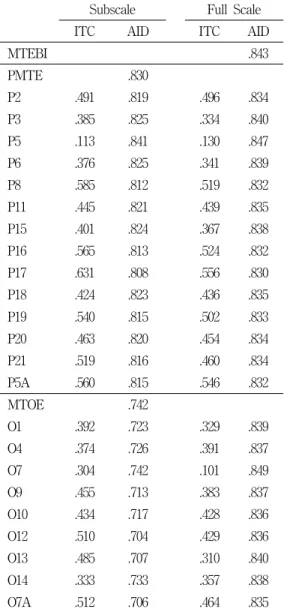
Reliability analysis is a process to find a weak item reducing the reliability of the scale to which the item belongs. To find a weak item, item-total correlations (ITC) and Cronbach’s alpha after deleting an item (AID) were calculated (see Table 2). Alpha after deleting an item from the scale was compared to the alpha of the scale that the item belongs to.
Alphas for the PMTE, the MTOE, and the whole scale were, .830, .742, and .843, respectively. If AID is higher than the subscale and/or the whole scale, then the item does not contribute to the scale being reliable. In addition, an item with ITC less than .30 is regarded as not contributing to the scale being reliable (Field, 2005).
The calculation indicated that Items P5 and O7 were weak items. Item P5 had very low ITC ( = .113) to the PMTE; the AID ( = .841) for the PMTE was higher than the PMTE scale reliability (
= .830). Also, to the whole scale, the item had very low ITC ( = .130); the AID ( = .847) was higher
[Fig. 2] Component Plot in Rotated Space [Fig. 1] Scree Plot of the 21 Items than the whole scale reliability ( = .843). Item O7
acted as in the border line for the MTOE scale. The item had minimally acceptable ITC ( = .304) to the MTOE; the AID in the subscale was as same as the MTOE scale instrument ( = .743). To the whole scale, Item O7 had very low ITC ( = .101); deleting the item increased reliability from = .843 to = .849. These results strongly suggested removing these two items from the instrument.
3. Factor Analysis
Factor analysis is used to detect a structural relationship between variables, and thus provides evidence for the construct validity of the instrument (Hill & Lewicki, 2007). The MTEBI was confirmed to have the two-factor structure, the PMTE and the MTOE (Enoch, Smith, & Huinker, 2000). The Korean translation also be assumed to have the same structure. This study explored the two-factor structure using principal component analysis.
First, sampling adequacy and multivariate normality assumptions were tested. The KMO sampling adequacy index was .883 and Bartlett’s sphericity test was significant ( = 3568.468, = 253, = 0.000) on the 23 item instrument. When extracting a factor solution, promax rotation method was selected because the personal efficacy and the outcome expectancy are intertwining with each other in some way in Bandura’s theory. The 23 item instrument had a three-factor solution, but after deleting the weak items (P5 and O7) in reliability analysis, the 21 item instrument had a simple fit to a two-factor solution.
In the scree plot (see Figure 1), the first two eigenvalues are dominantly higher than the others which are gradually decreasing around or below eigenvalue 1.
To determine if the two factors are the PMTE and the MTOE, a two-factor solution with promax rotation was extracted on the 21 items. Visually, in
the component plot (see Figure 2), the P-items were clustered around the intersection of the Component 2 line zero and the Component 1 line 0.6; the O-items were clustered around the intersection of the Component 2 line .6 and the Component 1 line zero.
[Table 3] Pattern Matrix: Promax Rotation
Item Component
1 2
P17 .779
P8 .731
P21 .695
P16 .669
P19 .643
P5A .579
P11 .523
P15 .520
P20 .515
P3 .505
P6 .456
P2 .445
P18 .436
O13 .716
O12 .683
O7A .669
O9 .633
O1 .571
O10 .534
O4 .491
O14 .421
[Table 3] Pattern Matrix: Promax Rotation
Item Component
1 2
P17 .779
P8 .731
P21 .695
P16 .669
P19 .643
P5A .579
P11 .523
P15 .520
P20 .515
P3 .505
P6 .456
P2 .445
P18 .436
O13 .716
O12 .683
O7A .669
O9 .633
O1 .571
O10 .534
O4 .491
O14 .421
The pattern matrix (see Table 3) gives a numerical description. All 13 P-items loaded to Component 1 and all 8 O-items loaded to Component 2. The factor loading range of the P-initial items was from .775 down to .449, and that of the O-items was from .711 down to .411. Further, 10 out of 13 P-items and seven out of eight O-items had factor loadings greater than .5, so these two factors are strong (Osborne & Costello, 2005). Component 1 accounted for 26.53% with eigenvalue 5.57 of the total variance, and Component 2 explained 9.68% with eigenvalue 2.06 of the total variance; the two factors together explained 36.21% of the total variance. Therefore, it was concluded that the Component 1 must be the PMTE and the component 2 must be the MTOE.
4. Discussion
This study explored validating the MTEBI, originally written in English, for Korean secondary prospective teachers. Language translation is critical in a cross-cultural study. Despite the sincere effort in translation and review process, continued effort needs to make the items be better sense of wordings to the examinees. For example, the Korean translation of Item 6 (I will not be very effective in monitoring students’ mathematics learning activities in the classroom) seemed to have no problem in its statistical stance. Nonetheless, a better wording can be suggested. Both two Korean statements below have the same meaning of Item 6. The first one was used in the instrument; the second looks simpler and smoothly worded to Koreans.
나는 교실에서 학생들의 수학 학습 활동을 관찰할 때 그리 효과적이지 못할 것이다.
나는 효과적으로 학생들의 수학 학습 활동을 관찰 하지 못할 것 같다.
Throughout the review process, Items 3, 5, and 18 were significantly changed. A brief discussion is put here; for detail, see Ryang, Thompson, and Craig’s (2011) description. Item 18 are discussed first, and then Item 3 and 5 are discussed in the next paragraphs with other issues. Item 18 was pointed out as one of the most problematic items by the reviewers. See the original and then the revised form of this item listed at the end of this paragraph. The original form seems to focus on a teacher’s choice rather than confidence to a teacher’s ability so the item is regarded as inappropriate for measuring efficacy belief. Also, the original form deals with evaluation by only one person, principal. It was
suggested that teaching evaluation in different perspectives of many people would connect better sense of teaching efficacy. With these ideas, Item 18 was revised.
Given a choice, I will not invite the principal to evaluate my mathematics teaching.
I will agree to open my class to others to observe my mathematics teaching.
Note that the MTEBI, framed in Bandura’s theory, consists of the PMTE and the MTOE. An MTOE item uses a word ‘teacher’ without a specific subject, indicating an all-subjects generalist. In Korea, secondary teachers are always mentioned with their subject specialties, for example, ‘mathematics teacher.’
Thus, an item in the MTOE scale in this study used a term mathematics teacher rather than just a teacher.
Also, the PMTE scale possibly includes an item working specifically for elementary teachers only. Item 3 is such an item; see the original form and then the revised form at the end of this paragraph. In the original form, a teacher is assumed to teach multiple subjects. Comparing my mathematics teaching with other subject teaching cannot work for secondary teachers, who teach only a specific subject. Thus, the item was revised by wording of comparing my mathematics teaching with other’s mathematics teaching.
Even if I try very hard, I will not teach mathematics as well as I will most subjects.
Even if I try very hard, I will not teach mathematics as well as other math teachers will.
Item 5 (I know how to teach mathematics concepts effectively) in the original MTEBI looks simple and nicely worded. However, the Korean mathematics teacher educators detected that this item violated the
tense rule: A PMTE item is written in future tense.
They questioned if ‘alda’ (which is a Korean word equivalent to ‘know’ in English) can show the future tense in the Korean language. Their understanding of the original sentence is that a prospective teacher,
I
in the item, will teach effectively in the future because he or she already knows how to do it. Thus, to avoid the tense violation but to keep the same meaning, a revised form P5 (Since I alreadyknow
how to teach mathematics concepts effectively, Iwon’t
need to learn more about it in the future) was suggested. However, the wording of P5 still looked awkward. Rather than using two tenses in two clauses, using future tense in auxiliary verb can be a better way to correct the tense disagreement. Thus, the alternative P5A (see Appendix) was added and examined in this study.Item O7 (If students are underachieving in mathematics, it is most likely due to a teacher’s ineffective mathematics teaching) is identical to the original wording in the MTEBI. However, O7 was the only item of negative skewness (see Table 1). This item also is the only item that includes double negations (underachieving, ineffective), which might lead to unclear decision making of the prospective teachers. To avoid this potential miscommunication, the contrapositive form, O7A (see Appendix), was added in the instrument and examined.
The result of statistical analysis showed that Items P5 and O7 performed poorly both in each subscale as well as the whole instrument. In contrast, their alternatives were statistically stronger behaved.
Comparing these items with their alternatives would show how the item and the scale would improve both the reliability and validity of the instrument (see Table 4).
An item’s communality measures the percent of variance of the item in a given variable explained by all the factors jointly. Item P5A had higher level of
communality (
h
2 = .435) while Item P5 had very low communality (h
2 = .026), close to zero, indicating that Item P5 is unreliable and little contributes to the instrument. The alternative P5A also showed good values in other parameters of factor loading, ITC, and AID, Similarly, Item O7A had better measures in all parameters than Item O7. After deleting Items P5 and O7, the final Korean version MTEBI has 13 items in the PMTE and 8 items in the MTOE, as same as the original MTEBI does. The scale reliabilities were =.839 for PMTE and = .742 for MTOE.
[Table 4] Comparing the Weak Items and Their Alternatives
P5 P5A O7 O7A
Communality .026 .435 .327 .438 Factor loading .003 .599 .603 .615 ITCto the subscale .113 .560 .304 .512 ITC to the whole scale .130 .546 .101 .464 AID in the subscale .841a .815 .742b .706 AID in the whole scale .847c .832 .849c .835 Note. aThis value is greater than the PMTE reliability
= .830. bThe value is as same as the MTOE reliability = .742 upto the three decimal places. cThe values are greater than the MTEBI reliability = .843.
Ⅴ. Conclusion and Implications
The orignal MTEBI has been used in research studies, and produced useful information on elementary prospective teachers’ personal efficacy and outcome expectancy in teaching mathematics. However, a validated scale for secondary mathematics teachers is not yet reported; we have little known about secondary teachers’ mathematics teaching efficacy.
This study established the reliability the and factorial validity of the MTEBI Korean modification for
secondary prospective mathematics teachers. It is expected that this instrument contributes to produce plenty of knew knowledge on secondary mathematics prospective teachers’ personal efficacy and outcome expectancy in teaching mathematics.
As Swars (2005) discussed, mathematics teaching efficacy is a strong predictor to a mathe- matics teacher’s instructional effectiveness. It is no doubt that mathematics teacher education programs have great accountability of increasing prospective teachers' level of mathematics teaching efficacy as well as mathematical knowledge. Thus, there is a research need to determine how personal efficacy and outcome expectancy influence teaching practice and student achievement. This information will be important to both mathematics teachers and mathematics teacher educators as reformers.
As a potential implication, the instrument developed will be a starter to pioneer mathematics teaching efficacy covering East Asia, globally hot spot of mathematics education. East Asia, including countries and territories like China, Hong Kong, Japan, Korea, Singapore, and Taiwan, is a culture block bound by Confucius philosophy in education; these countries and territories are world class in international mathematics completions. This study provided English version as well as Korean version of the instrument (see Appendix). It is a possibility that the instrument English version would work well without further modification for those countries and territories after translation to the language. Performing international studies using the same instrument will provide benefits in detecting similarities and differences between the countries. Consequently, the findings will help understand mathematics teaching efficacy more systematically and with more integration.
Though the new instrument looks fine at this point, the validation of a scale is not a once conclusive result but continues to be an ongoing process. The
use of the modified MTEBI will continually require assessing reliability and cross-validity in terms of context specification and cultural variety. Additional assessment is needed to confirm the factorial validity.
As more research studies are conducted in different cultures, specific attention should be made to the functionality of the instrument to predict mathematics teaching effectiveness in the culture.
References
Alkhateeb, H. M. (2004). Internal consistency reliability and validity of the Arabic translation of the mathematics teaching efficacy beliefs instrument.
Psychological Reports, 94
, 833-838.Bae, B. (2006). LISREL structural equation model:
Understanding, practice, and programming. Seoul:
Cheongram. (In Korean).
Bandura, A. (1986). Social foundations of thought and action: A social cognitive theory. Englewood Cliffs, NJ: Prentice Hall.
Bandura, A. (1997). Self-efficacy: The exercise of control. New York: W. H. Freeman.
Brislin, R. W. (1970). Back-translation for cross- cultural research.
Journal of Cross-Cultural Psychology, 1
, 185-216.Brown, A. B. (2012). Non-Traditional Prospective Teachers and Their Mathematics Efficacy Beliefs,
School Science and Mathematics, 112
(3), 191-198.Cakiroglu, E (2008). The teaching efficacy beliefs of pre-service teachers in the USA and Turkey,
Journal of Education for Teaching, 34
(1), 33-44.Czerniak, C. M. (1990). A study of self-efficacy, anxiety, and science knowledge in pre-service elementary teachers. Paper presented at the annual meeting of the National Association of Research in Science Teaching, Atlanta, GA, April 8-11.
Enochs, L., Smith, P. L., & Huinker, D. (2000).
Establishing factorial validity of the mathematics
teaching efficacy beliefs instrument.
School Science and Mathematics, 100
(4), 194-202.Evans, B. R. (2011). Content knowledge, attitudes, and self-efficacy in the mathematics New York City Teaching Fellows (NYCTF) program.
School Science and Mathematics, 111
(5), 225-235.Field, A. (2005). Discovering statistics using SPSS (2nd ed.). London: Sage.
Ghaith, G., & Yaghi, H. (1997). Relationships among experience, teacher efficacy, and attitudes toward the implementation of instructional innovation.
Teaching and Teacher Education 13
, 451-458.Gresham, G. (2008). Mathematics anxiety and mathematics teacher efficacy in elementary prospective teachers.
Teaching Education, 19
(3), 171-184.Henson, R. K. (2001, January). Teacher self-efficacy:
Substantive implications and measurement dilemmas. Paper presented at annual meeting of the Educational Research Exchange, Texas A & M University, College Station, Texas.
Hill, T., & Lewicki, P. (2007). Statistics methods and applications. Tulsa, OK: Statsoft.
Hoy, A. W. (2004). The educational psychology of teacher efficacy.
Educational Psychology Review, 16
, 153-176.Hoy, A. W., & Spero, R. B. (2005). Changes in teacher efficacy during the early years of teaching:
A comparison of four measures.
Teaching and Teacher Education, 21
(4), 343-356.Lin, H., Gorrell, J., & Taylor, J. (2002). Influence of culture and education on U. S. and Taiwan prospective teachers’ efficacy beliefs.
Journal of Educational Research 96
, 37-46.Midgley, C., Feldlaufer, H., & Eccles, J. (1989).
Change in teacher efficacy and student self- and task-related beliefs in mathematics during the transition to junior high school.
Journal of
educational Psychology, 81
, 247-258.Moore, W., & Esselman, M. (1992). Teacher efficacy, power, school climate and achievement: A desegregating district’s experience. Paper presented at the annual meeting of the American Educational Research Association, San Francisco.
Mpofu, E., & Ortiz, S. (2009). Equitable assessment practices in diverse contexts, In E. Grigorenko (Ed.), Multicultural psychoeducational assessment (pp. 41-76). New York: Springer Publishing Company.
Osborne, J. W., & Costello, A. B. (2005). Best practices in exploratory factor analysis: Four recommendations for getting the most from your analysis.
Practical Assessment Research &
Evaluation, 10
(7), 1-9.Pajares, F. (1996). Self-efficacy beliefs in academic settings.
Review of Educational Research, 66
, 543-578.Ross, J. A. (1992). Teacher efficacy and the effect of coaching on student achievement.
Canadian Journal of Education, 17
(1), 51-65.Ryang, D. (2007). Reliability and validity of a Korean-translated Mathematics Teaching Efficacy Beliefs Instrument.
Journal of Korea Society of Mathematical Education Series A: The Mathematical Education, 46
(3), 263-272. (In Korean).Ryang, D, Thompson, A., & Craig, S. (2011). Korean mathematics teacher educators’ response on the Mathematics Teaching Efficacy Beliefs Instrument.
Research in Mathematical Education, 15
(4), 315–336.
Soodak, L., & Podell, D. (1993). Teacher efficacy and student problems as factors in special education referral.
Journal of Special Education 27
, 66-81.Swars, S. L. (2005). Examining perceptions of mathematics teaching effectiveness among elementary prospective teachers with differing levels of mathematics teacher efficacy.
Journal of
Instructional Psychology, 32
(2), 139-147.Swars, S. L., Daane, C. J., & Giesen, J. (2006).
Mathematics Anxiety and Mathematics Teacher Efficacy: What is the Relationship in Elementary Prospective Teachers?
School Science and Mathematics, 106
(7), 306-315.Swars, S. L., Smith, S. Z., Smith, M. E., & Hart, L.
C. (2009). A longitudinal study of effects of a developmental teacher preparation program on elementary prospective teachers’ mathematics beliefs.
Journal of Mathematics Teacher Education, 12
, 47-66.Tschannen-Moran, M., Woolfolk Hoy, A., & Hoy, W.
K. (1998). Teacher efficacy: Its meaning and measure.
Review of Educational Research, 68
, 202-248.Tschannen-Moran, M., & Woolfolk Hoy, A. (2001).
Teacher efficacy: Capturing an elusive construct.
Teaching and Teacher Education, 17
(7), 783-805.Utley, J., Bryant, R., & Moseley, C. (2005).
Relationship between science and mathematics teaching efficacy of prospective elementary teachers.
School Science and Mathematics, 105
(2), 82-87.Appendix. MTEBI Korean Version Items Item English
Korean
P17 I wonder if I have the necessary skills to teach mathematics in the future.
나는 수학교사가 된 뒤에 수학을 가르치는데 필요한 기술을 가지고 있을지 잘 모르겠다.
P8 I will not be able to teach mathematics effectively.
나는 효율적으로 수학을 가르칠 것 같지 않다.
P21 I do not know what to do to turn students on to mathematics in the future.
나는 수학 교사가 되었을 때, 학생들이 수학에 관심을 갖게 하기 위해 무엇을 해야 할 지 잘 모를 것 같다.
P16 I will be able to answer a student's mathematics question.
나는 수학 수업 시간에 학생들의 질문에 대답을 잘 할 수 있을 것이다.
P19 When a student has difficulty understanding mathematics concepts, I usually will not be able to help the student.
학생이 수학 개념을 잘 이해하지 못하는 경우, 나는 그 학생에게 도움을 주지 못할 것 같다.
P5A I will teach mathematics in such a way that the students easily understand the concept.
나는 학생들이 쉽게 이해할 수 있게 수학을 가르칠 수 있을 것이다.
P11 Since I understand mathematics concepts well, I will teach elementary mathematics effectively in the future.
나는 수학 개념을 잘 이해하고 있기 때문에, 장래에 수학을 잘 가르칠 수 있을 것이다.
P15 I find it difficult to use manipulatives to explain to students why mathematics works.
나는 교사가 된 뒤에도 교구를 사용하여 수학을 설명하는 것이 어려울 것 같다.
P20 When teaching mathematics, I will like to answer students' questions.
나는 수학 수업 시간에 학생들이 질문에 대답하기를 좋아할 것이다.
P3* Even if I try very hard, I will not teach mathematics as well as other math teachers will.
내가 아무리 애를 써도 다른 수학 교사가 가르치는 것보다는 못 할 것이다.
P6 I will not be very effective in monitoring students' mathematics learning activities in the classroom.
나는 교실에서 학생들의 수학 학습 활동을 관찰할 때 그리 효과적이지 못할 것이다.
P2 I will continually find better ways to teach mathematics.
나는 수학을 가르치는 더 좋은 방법을 찾으려고 언제나 노력할 것이다.
P18* I will willingly agree to open my class to others to observe my mathematics teaching.
나는 수학 수업을 다른 사람들이 평가하도록 공개하는 것에 대하여 동의할 것이다.
O13 Students' achievement in mathematics is directly related to their teacher's effectiveness in mathematics teaching.
수학 교사가 얼마나 효과적으로 수학을 가르쳤느냐는 학생들의 수학성취도와 직접적으로 관계가 있다.
O12 The mathematics teacher is generally responsible for students' mathematics achievement.
수학 교사는 일반적으로 학생의 수학 성취도에 책임이 있다.
O7A If a mathematics teacher teaches effectively, then students show improvement on mathematics assessments.
수학 교사가 수학을 효과적으로 가르치면, 학생들은 수학 평가에서 좋은 성적을 거둔다.
O9 The inadequacy of a students' mathematical performance can be overcome by a mathematics teacher's good teaching.
수학 교사가 수학을 잘 가르치면 학생들의 나쁜 수학 공부 습관을 고칠 수 있다.
O1 When a student does better than usual in mathematics, it is because the mathematics teacher exerted extra effort.
학생이 평소보다 수학을 더 잘 할 때, 이는 수학 교사가 추가 노력을 기울인 결과다.
O10 When a mathematics teacher gives extra attention to a low-achieving student, the student shows progress in mathematics learning.
수학 교사가 수학 성취 수준이 낮은 학생에게 좀 더 관심을 기울이면, 그 학생은 수학 실력이 나아진다.
O4 When students' mathematics grades improve, it is often due to their mathematics teacher having found a more effective teaching approach.
학생들의 수학 성적이 향상되는 것은, 때로는 수학 교사가 더 효과적인 수학 교수 방법을 찾아낸 덕분이다.
O14 When a mathematics teacher's performance is good in a class, the students shows more interest in mathematics at school.
수학 교사가 수학을 가르치는 능력이 뛰어나면, 수학에 대한 학생들의 흥미가 높아진다.
Note. Items are listed in descending order of factor loading as shown in Table 3.
*Items were adjusted or changed in the review process.
중등 예비 수학 교사를 대상으로 하는 MTEBI 한글판 개발
량량도형★
Dept. Math. & Stat., University of North Carolina at Greensboro, U.S.A. 27402 E-mail : [email protected]
MTEBI는 미국에서 초등 예비 교사들의 수학 교수 효능감을 측정하는데 자주 이용되는 척도이다. 이 연구의 목 적은 MTEBI를 한국의 중등 예비 교사들에게 사용하는 것이 적합한지를 탐색하는 것이었다. 이를 위하여, 미국에 있는 대학원에 다니며 영어와 국어 둘 다 말할 수 있는 박사 학생 두 명이 MTEBI를 브리슬린의 이론대로 국문으 로 번역하였고, 그 뒤에 한국에 있는 다수의 수학 교사 교육자들이 번역된 척도를 면밀하게 검토하였다. 한글판 척 도를 먼저 작은 표본에서 초벌 실험하였는데, 두 개 문항이 도구의 신뢰도와 타당도를 현저하게 떨어뜨렸다. 본 연 구에서는 이 두 개의 유용하지 못한 문항을 대신할 두 개 문항을 더한 23개 문항으로 구성된 척도에 대하여 정규 성, 신뢰도, 요인 타당도 등을 658명의 표본에서 검사하였다. 초벌 연구에서 발견된 두 개의 유효하지 않는 문항은 본 연구에서도 역시 그와 같아서, 그 두 문항은 척도에서 제거되었다. 최종적으로 얻어진 21 문항 척도는 한국의 예비 수학 교사들의 수학 교수 효능감을 측정하는데 적합한 척도이다. 앞으로, MTEBI 한글판을 이용하여 한국에 서 교사 효능감에 대한 연구가 활발하게 일어나기를 기대한다.
* 접수일(2013년 03월 22일), 수정일(2013년 04월 26일), 게 재확정일(2013년 05월 12일)
* ZDM분류 : B59
* MSC2000분류 : 97C70
* 주제어 : 문화, 수학, 신뢰도, 중등 예비 교사, 타당도, 효능감