• 검색 결과가 없습니다.

Isolation and Identification of Alkali-tolerant Bacteria from Near-Shore Soils in Dokdo Island

N/A
N/A
Protected

Academic year: 2021

Share "Isolation and Identification of Alkali-tolerant Bacteria from Near-Shore Soils in Dokdo Island"

Copied!
11
0
0

로드 중.... (전체 텍스트 보기)

전체 글

(1)

Isolation and Identification of Alkali-tolerant Bacteria from Near-Shore Soils in Dokdo Island

Teddy Namirimu

1

, Jinnam Kim

1,2

, and Young-Gun Zo

1,2

*

1

Department of Biology, Kyungsung University, Busan 48434, Republic of Korea

2

Environmental Science and Technology Research Institute, Kyungsung University, Busan 48434, Republic of Korea

Received: July 28, 2018 / Revised: September 18, 2018 / Accepted: September 20, 2018

Introduction

Soil pH greatly affects availability of many plant nutrients in soil [1]. Plants growing on a high pH soil can be deficient in zinc (Zn), copper (Cu), manganese (Mn), and iron (Fe) and develop chlorosis symptoms [1, 2]. In addition, high pH condition can make metal ions and phosphorus precipitate, affecting normal physiologi- cal functions of roots in a way leading to destruction of root cell structure [3]. Thus, plants in alkaline soil must cope with nutrient deficiency and struggle to maintain

intracellular ion balance in roots.

Soil pH depends on mineral composition of its parent material and weathering reactions undergone on the material [4]. Alkaline condition in a soil is also some- times associated with salinity since many saline envi- ronments have alkaline or extremely alkaline pH values [5]. Highly alkaline soils tend to be high in sodium chlo- ride and bicarbonate. High amount of salt ions in or around plant cells are toxic to plant tissues and cause retardation of plant growth [6]. Therefore, plants suffer- ing stresses from salinity also tend to be exposed to stresses by high pH [7].

Soil pH is also regarded as one of the most important determinants for composition and diversity of soil micro- bial community [8]. While high levels of bacterial diver- Saline or alkaline condition in soil inhibits growth of most crop plants and limits crop yields in many parts of the world. Augmenting an alkaline soil with alkali-tolerant bacteria capable of promoting plant growth can be a promising approach in expanding fertile agricultural land. Near-shore environments of Dokdo Island, a remote island located in the middle of the East Sea, appear to have patches of seawater-influenced haloalkaline soil that is unsupportive for growth of conventional plants. To exploit metabolic capacities of alkali-tolerant bacteria for promoting plant growth in saline or alkaline soils, we isolated of alkali-tolerant bacteria from near-shore soil samples in Dokdo and investigated properties of the isolates. Alkali-tolerant bacteria were selectively cultivated by inoculating suspended and diluted soil samples on a plate medium adjusted to pH 10. Fifty colonies were identified based on their GTG

5

-PCR genomic fingerprints and 16S rRNA gene sequences. Most isolates were affiliated to alkali-tolerant and/or halotolerant genera or species of the phyla Firmicutes (68%), Proteobacteria (30%) and Actinobacteria (2%). Unlike the typical soil bacte- rial flora in the island, alkali-tolerant isolates belonged to only certain taxa of terrestrial origin under the three phyla, which have traits of plant growth promoting activities including detoxification, phytohor- mone production, disease/pest control, nitrogen-fixation, phosphate solubilization or siderophore produc- tion. However, Firmicutes of marine origin generally dominated the alkali-tolerant community. Results of this study suggest that haloalkaline environments like Dokdo shore soils are important sources for plant growth promoting bacteria that can be employed in bio-augmentation of vegetation-poor alkaline soils.

Keywords: Dokdo, haloalkaline soil, alkali-tolerant bacteria, plant growth promoting bacteria

*Corresponding author

Tel: +82-51-663-4643, Fax: +82-51-627-4645 E-mail: [email protected]

© 2019, The Korean Society for Microbiology and Biotechnology

(2)

sities are found in neutral soils, those of alkaline [9] and acidic soils [8, 10] are significantly lower. Soil pH will affect chemical form, concentration and availability of substrates [11], and consumption of maintenance energy supporting survival of a cell. Therefore, alkaline soil pH influences growth and activity of bacterial cells differen- tially depending on their metabolic characteristics. The lower diversity indicates that alkaline soil is unfavorable for most bacteria. Microbial community structure is often known to be correlated with soil pH level [8].

Studies show that there are mutualistic relationships between plant diversity and soil microorganisms [12].

High plant diversity seems to positively correlate with microbial diversity and activity [13]. The relationship is often visualized as a mutualism. Plants exude organic compounds that support microbial activity near the roots, which, in turn, provides various beneficial services to the plant. However, the mutualism is weakened in high-pH soil because very few microorganisms can toler- ant high pH condition. The loss of microbe-plant interac- tions will consequently affect plant growth in such soils.

Plant growth promoting bacteria (PGPB) which can tolerate alkaline soils may play a role in enhancing resistance of plants to saline and/or alkaline soil envi- ronment. Some PGPB may exert a direct stimulation on plant growth by providing fixed nitrogen, phytohor- mones, siderophore-bound iron, or soluble phosphate [14]. Considering that plants are under nutritional and physiological stresses in alkaline soils, an interaction between plant and beneficial microorganisms can exert a greater influence on plant growth. Therefore, studying the unexplored diversity of bacterial community in alka- line soil environments will help us identify PGPB spe- cies capable of cycling nutrients.

Dokdo is a small remote island located in the middle of the East Sea. The parental rocks of Dokdo are of volcanic origins and alkaline. Major volcanic rocks constituting Dokdo are trachyte and trachyandesite which were pro- duced from alkaline basaltic magma [15]. Because of the location and size of Dokdo, oceanic climatic features including frequent turbulent flows in the East Sea strongly influence its soil chemistry. Together with strong salty winds, exposure of bedrocks, steep inclina- tions and lack of organic nutrients discourage plant growth in the island. In addition, saline and/or alkaline conditions in some patches of soils near shore might

impose various stresses on vegetation growth. Neverthe- less, there are some patches of near-shore soils with some vegetation. Thus, we hypothesize that Dokdo soils near shore can be a good place to find PGPBs that can either facilitate growth or protect plants from harms of haloalkaline soils.

While much of PGPB screenings were carried out under farm-field conditions [16, 17], studies on identifi- cation of PGPB in other soil environments remain rela- tively limited. Particularly, study on PGPB from haloalkaline soil is extremely rare. Moreover, microbial diversity, microbial processes and key microbes involved in biogeochemical cycles of haloalkaline soils near shores of Dokdo Island have never been characterized. In this study, we explored diversity of the alkali-tolerant bacte- rial community in the haloalkaline soil, by isolating and identifying alkali-tolerant bacteria in soils from Dokdo Island. Community structure of alkali-tolerant bacteria was interpreted for potential of the isolates as PGPB appropriate for alkali-stress mitigation.

Materials and Methods

Sampling site and sampling

The total area of Dokdo is 187,453 m

2

, and it is com- posed of volcanic rocks. The climate of Dokdo is highly influenced by ocean currents with the annual mean of atmosphere temperature at 12 ℃, and the averages for winter and summer are 1 ℃ and 23℃, respectively. Thus, Dokdo experiences snow, rain, and thick sea fog which make the area relatively warm and very moist [18].

Although the soil depth reaches to 60 cm in some areas of Dokdo, the soil layer in most areas is very thin with a depth of 20 −30 cm, due to erosion from strong winds and rainfall. Dokdo is also exposed to strong salty sea winds and thick sea fog, so the soils of Dokdo are low in organic materials and soil pH differs dramatically among loca- tion and seasons, ranging from 3.36 to 8.02 [19].

The sampling site for this study (37.239199°N,

131.868115°E) was located in the Dongdo dock area. The

soil samples were collected from a spot at the topmost

part of tidal zone and 5-m distant to well-developed veg-

etation. The surface soil (0 −10 cm depth) samples were

taken using sterilized spatulas at the site and trans-

ported to the laboratory in an ice-cold container contain-

ing 25% glycerol. Samples were stored at -50 ℃ until

(3)

further use.

Soil pH was measured in laboratory. Five grams of soil samples were added into 25 ml distilled water, and the mixtures were incubated at room temperature for 1 h.

Measurements were taken using a pH meter (FP20, Mettler-Toledo, USA) in triplicates.

Bacterial isolation

The soil samples were homogenized before performing 10-fold serial dilutions. Initially, 0.5 g of the soil samples were homogenized in 1 ml of 0.85% (w/v) saline solution, and the homogenate was serially diluted. One hundred microliters of diluted samples were spread on triplicate Trypticase Soy Agar (TSA) plates (pH 10), and the plates were incubated at 37 ℃ for 24 h. Fifty colonies were ran- domly isolated and streaked on the alkaline TSA plates until pure isolates were obtained. Purified colonies were inoculated into Trypticase Soy Broth medium (pH 10) for 24 h before their genomic DNA were extracted.

Identification of isolates

(GTG)5 rep-PCR analysis. Genomic DNA was extracted using BioFact DNA Extraction Kit (BioFact, Korea) according to manufacturer’s instructions and stored at -20 ℃ until further use for PCR. Amplifications reac- tions were carried out in a total of 20 µl PCR mixture containing 1× EX Taq Buffer (Takara, Japan), 0.2 mM deoxy ribonucleotide phosphates (dNTPs), 0.8 µM (GTG)

5

primer (5’-GTGGTGGTGGTGGTG-3’), sterile distilled water, DNA template and 0.8 U EX Taq DNA polymerase. Using the Peltier PTC-200 thermal cycler (MJ Research, USA), the amplification began with pre- denaturation at 95 ℃ (5 min), followed by 35 cycles of denaturation, annealing and extension at 95 ℃ (45 sec), 55 ℃ (1 min) and 68℃ (10 min), respectively. The final elongation was carried out at 65 ℃ for 20 min. The amplified PCR product, was electrophoresed in 0.8%

(w/v) agarose gel in 0.5× Tris-Borate-EDTA (TBE) buffer at 100 V for 50 min. Using the Gel Compar II software (Applied Maths, Belgium), genomic fingerprints of all isolates were classified into clusters made by unweighted pair group method using arithmetic average (UPGMA) algorithm applied on distances measured as Pearson correlation coefficients among density chromatograms.

Thirty isolates representing each unique group were

selected for further analysis.

16S rRNA gene PCR. Isolates were identified using their 16S rRNA gene sequences. Two universal primers, namely the 27F primer (5’-AGA GTT TGA TCM TGG CTC AG-3’) and the 1492R primer (5’-CGG TTA CCT TGT TAC GAC TT-3’), were used. The 50 µl reaction mixture consisted of 1× Dr. Taq Buffer, 0.2 mM dNTPs, 0.5 µM of each primer, sterile distilled water, DNA tem- plate and 3 U Dr. Taq DNA polymerase (Dr. Protein, Korea). Using the Peltier PTC-200 thermal cycler, ther- mal cycling was carried out as follows: pre-denaturation at 95 ℃ (5 min), followed by 30 cycles of denaturation, annealing and extension at 95 ℃ (30 sec), 55℃ (30 min) and 72 ℃ (1 min), respectively. The final elongation was done at 72 ℃ for 5 min, and the reaction products were stored at 4 ℃ for further use. The PCR product were purified using MinElute PCR purification kit (Qiagen, Germany) and sent to Macrogen (Korea) for DNA sequencing service by Big Dye termination method. The 16S rRNA gene sequences of isolates were deposited in GenBank under the accession numbers MH819694- MH819723.

Phylogenetic analysis. Two sequence reads, one with forward primer and the other with reverse primer, were generated from each isolate, and they were assembled into a single molecule of 16S rRNA gene using the

> 200 bp overlap between the two reads. The assembled sequences had length > 1,300 bp. For identification of the bacterial taxon that a sequence is affiliated with, maximum likelihood method employing Hasegawa- Kishino-Yano base substitution model was used with aid of MEGA software version 6 (https://www.megasoft- ware.net). Reference sequences were selected as RDP- deposited type sequences of taxa identified to have a close similarity (> 80% pairwise sequence identity) with a 16S rRNA gene sequence of an isolate by SeqMatch software in Ribosomal Database Project (http://rdp.cme.

msu.edu). Multiple sequences were aligned by ClustalW

algorithm implemented in MEGA. Validity of a phyloge-

netic cluster in a maximum likelihood tree was tested by

bootstrapping 2,000 pseudo-datasets. In species identifi-

cation, bootstrap support > 70 was used as the criterion

for formation of a valid phylogenic cluster.

(4)

Results

Dokdo soil samples were dark brown soils with a mod- erate fine granular structure, and the granules were fri- able and non-sticky. Particles larger than sand were also observed, and those were presumed to have originated from the trachyandesite bedrocks. The mean pH of sam- ples was 7.8, indicating that the sample soils were slightly alkaline rather than being strongly alkaline.

Trachyte and trachyandesite are well known as natu- rally alkaline components. In addition, salt supplied to the soil by sea fog and sea water can be considered as causes for a high pH. The sampling location was selected because sea salt was expected to accumulate at the site by evaporation of seawater which occasionally reach the location by unusually high tide or strong wind.

Therefore, the slightly alkaline pH was lower than an expected level. Regarding the fact that there was 2- day rainfall before the sampling (> 25 mm; http://

www.weather.go.kr), the lower-than-expected pH value could be due to wash out of salts from the soil. The dilu- tion and loss of salts by rain water might have affected the abundance of bacteria but not the diversity of bacte- ria in the soil because those physical effects are not taxon-selective.

Diversity of alkali-tolerant bacteria in the near-shore soils was examined by analyzing the PCR-amplified 16S rRNA gene sequences generated from genomic DNA extracts. A total of 50 bacterial colonies on alkaline TSA plates were randomly isolated. A dendrogram based on electrophoretic band patterns was generated by UPGMA cluster analysis of Pearson’s correlation coefficients among digitized GTG

5

-PCR fingerprints of isolates (Fig.

1). Similar band patterns were classified as a unique group. Among the 50-screened bacteria isolates, 30 rep- resentative isolates of each unique group were further identified to species levels by their 16S rRNA gene sequences. Near full length sequences of 16S rRNA genes fell into 3 phyla or 11 genera. The three phyla, Fir- micutes, Actinobacteria and Proteobacteria, are typically for alkali-tolerant or halotolerant bacteria. Firmicutes, the most abundant phylum, composed the core of the microbial community of the near-shore soils from Dokdo (Fig. 2A).

At genus level, the alkali-tolerant community showed diverse dominance values among 11 genera of the three

phyla. Among total isolates, Enterobacter sp. (26%) most

dominated the soil community, followed by Exiguobacte-

Fig. 1. Comparison of electrophoretic types from (GTG)

5

-PCR.

(5)

rium spp. (22%), Planomicrobium spp. (14%), Marinilac- tibacillus spp. (10%), Solibacillus spp. (8%), Bacillus spp. (6%), and Pantoea spp. (4%). Lysinibacillus sp., Microbacteria sp., Paenibacillus sp. and Saccharibacil- lus sp. were rare species (Fig. 2B). The predominant spe- cies were interpreted to be more adapted to the conditions of the sampled location at the time of sam- pling while the rare species might gain dominance in some other times due to temporal fluctuations of envi- ronmental conditions of Dokdo Island.

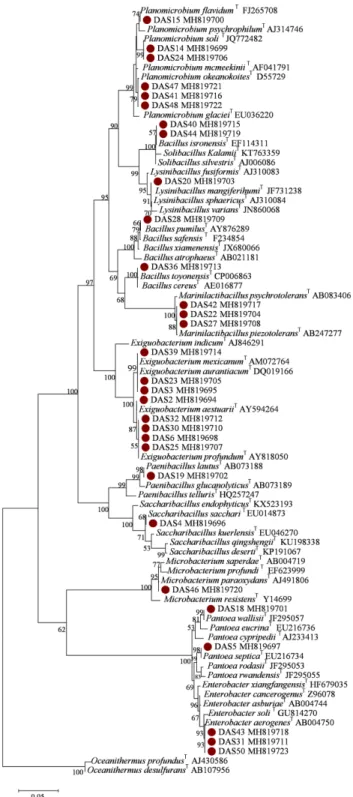
For species level identification, every isolate was sub- jected to phylogenetic cluster analysis by building maxi- mum likelihood trees and testing branches of a tree by bootstrap test. As shown in the consolidated tree (Fig. 3), 16S rRNA gene sequences of all isolates, named DAS1- 50, robustly clustered with one or more type strain sequences of known species. When there were more than one type strain sequence highly similar (≥ 99%) to that of an isolate, the type strain sequences themselves were completely or nearly identical to each other (≥ 99%), indicating that difference in 16S rRNA sequence does

not provide enough resolution to discern those species inferred by the similar type sequences. We interpreted the different species showing completely or nearly iden- Fig. 2. Community structure of alkali-tolerant bacteria in

Dokdo Island. (A) Composition by phyla, (B) Composition by genera.

Fig. 3. Maximum likelihood tree of 16S rRNA gene sequences;

Values under branches are bootstrap support, and GenBank

accession numbers were shown next to taxa names.

(6)

tical 16S rRNA sequences as a species complex rather than a single species. When the maximum likelihood tree was built for each isolate (data not shown), sequence from a DAS strain could be clustered with the single closest sequence among all type strain sequences of known species in the affiliated genus. Therefore, all DAS strains could be identified into a species.

The 11 Exiguobacterium isolates were identified into four species (Ex. profundum, Ex. mexicanum, Ex. auran- tiacum, and Ex. aestuarii) with 94 −99% sequence simi- larities to the respective type strains of the species.

Seven Planomicrobium isolates were found to be Pla.

okeanokoites, Pla. soli and Pla. flavidum, with similarities of 96 −97%, 99% and 95% to respective type strain sequences. In the genus Marinilactibaciluus, all five isolates showed 95 −96% sequence similarities to the type sequence of M. piezotolerans. The three Bacillus isolates showed 100% and 99% similarities to the type sequences of B. cereus and B. pumilus, respectively. In genus Solibacillus, the four isolates shared 97% similar- ities to the type sequence from Bacillus isronensis (a misnomer, now called as Solibacillus isronensis comb.

nov.). Two isolates were identified as Paenibacillus lautus with 95% sequence similarities. Saccharibacillus sac- chari and Lysinibacillus mangiferihumi were the least abundant species among Firmicutes as each species was represented by only one isolate. DAS4 and DAS20 isolates were identified as S. sacchari and L. mangiferi- humi with sequences similarities of 97% and 94% to the respective type sequences. Phylum Proteobacteria was represented by two genera Enterobacter and Pantoea.

All 13 Enterobacter isolates were identified into En.

aerogenes with 95 −100% sequence similarities while two Pantoea isolates were classified as Pan. wallisii and Pan. septica with sequence similarities of 98% and 93%, respectively for their type sequences. Actinobacteria were the most rare phylum among the isolates as the taxon was detected by presence of a single isolate affiliated to Microbacterium paraoxydans, with 99% sequence similarity.

Discussion

Characteristics of bacterial community

The sampling location was just above the tidal zone and had haloalkaline influence from seawater via wind,

sea fog and subsurface routes. The spots only occasion- ally have a sparse level of vegetation, and exposures to sunlight and air temperature fluctuating through the summer high (mean 23 ℃) and the winter low (mean 1℃) make the location an extreme habitat for development of bacterial flora. Soil pH at the location is also expected to fluctuate by influence of such events as seawater inva- sion, evaporation and rainfall. Consequently, it is not surprising that the predominant taxa are almost limited to Firmicutes that are able to remain viable in harsh conditions and develop without competition from other bacteria [20]. In this study, the Firmicutes were repre- sented by the eight genera, namely Exiguobacterium, Planomicrobium, Marinilactibacillus, Bacillus, Soli- bacillus, Lysinibacillus, Paenibacillus and Sacchariba- cillus. The genera are known to have alkali-tolerant strains or species in haloalkaline habitats, particularly in marine mud, seafood, hydrothermal vents, tidal sedi- ments, and soils [21 −23].

Enterobacter species are widely distributed in nature and have been isolated from humans, animals, clinical samples, plants and environments. En. aerogenes is a halotolerant hydrogen-producing bacterium [24] and was characterized with its ability to produce phytase, a phosphatase enzyme catalyzing hydrolysis of organic phosphorus into inorganic phosphorus to make phospho- rus readily available for plants [25]. Frequent presence of En. aerogenes in the oligotrophic haloalkaline soils on Dokdo can be explained as its tolerance to high pH and low nutrient conditions.

Among the dominant genera assigned to Firmicutes, the Exiguobacterium genus was notable since it is known for adaptation to certain harsh conditions. Most species in the genus are known to be alkali-tolerant [21, 23]. Exiguobacterium strains have been reported to pro- duce enzymes such as alkaline protease, alkali-tolerant esterase and dehydrogenase [26 −28]. Ex. profundum, which is a moderately thermophilic, lactic acid-produc- ing bacterium, was the most abundant species among the DAS isolates. Ex. profundum can grow in presence of elevated NaCl up to 11%, and its pH range for growth is between 5.5 and 9.5 with the optimum at 7.0 [23]. There- fore, marine origin, halo-tolerance and alkali-tolerance of the species explain the predominance of this species among all isolates.

In addition, a group of Firmicutes isolates belonged to

(7)

genus Marinilactibacillus (Fig. 3). It harbors halophilic and alkaliphilic lactic acid bacteria and Marinilacti- bacillus species are known for their strong fermentation activity [22]. Features making the genus known as an extremophile include adaptations to unusual pressure, salinity, temperature and pH. The genus harbors only two described species, and both are from the ocean (Fig.

3). The DAS isolates were closely related to Ma. piezotol- erans that is a species highly tolerant to hydrostatic pressure and haloalkaline condition and first found from deep sea floor sediment [29]. Therefore, the recovery of this species in a near- shore soil is noteworthy.

Due to the harsh environment of Dokdo, the predomi- nance of spore-forming Bacillus species in the soil sample was expected in this study. However, a low abundance was observed in the genus. The Bacillus isolates showed close relatedness to the known alkali-tolerant species B.

cereus and B. pumilus, which were previously isolated from the rhizosphere of the wild grass Elymus tsukush- iensis on Dokdo Island [30]. The relatively low abun- dance and diversity within the otherwise extremely diverse Bacillus genera indicates that alkaline condi- tions are rather selective for a few highly adapted spe- cies even among Bacillus spp.

Comparison to known bacterial communities in Dokdo While the flora and fauna of Dokdo have been fre- quently studied, its microbial flora has been under research only recently. According to metagenomics anal- yses of Dokdo soils by Kim et al. [31], three phyla (Pro- teobacteria, Actinobacteria, and Acidobacteria) among the 36 phyla identified in Dokdo soils accounted for approximately 74.64% of the total community with aver- age relative abundances of 34.3%, 23.9%, and 16.1%, respectively. In a culture dependent study, Gamma-Pro- teobacteria (53.8%) and Firmicutes (30.8%) dominated the halotolerant isolates from rhizosphere soil of coastal plants in Dokdo Island [32]. Unlike the previous study, the order of dominance in this study was different as Firmicutes (68%) dominated Proteobacteria (30%) and Actinobacteria (2%).

Compared with the two previous studies in which Pro- teobacteria was the most dominant phylum in both cul- tured and culture-independent methods, results of this study is unique in that the most predominant phylum was Firmicutes while Proteobacteria was the second.

Difference in sampling location, culture medium (saline or alkaline media) and identification methods (partial or full-length sequence of 16S rRNA) are likely source of the difference. Because the two previous studies are also different in terms of culture medium and identification methods [33], difference in sampling location or selective pressure from alkaline culture condition is a more plau- sible cause for predominance of Firmicutes among DAS isolates. Therefore, alkali-tolerant bacteria in haloalka- line habitat could be mostly represented as Firmicutes strains.

At species level, the Firmicutes community analyzed in this study was different from those of the previous studies in that most Firmicutes had marine origins. Pla.

flavidum, Pla. okeanokoites, Pae. lautus, M. piezotolerans, Ex. profundum, Ex. mexicanum, Ex. aurantiacum, and Ex. aestuarii comprised most Firmicutes in this study (Fig. 3), and they were known by being isolated from marine samples. Bacillus spp. isolated in this study were also found in the previous culture study on rhizo- sphere of a wild grass in Dokdo [30], implying their ter- restrial origin. Therefore, it could be concluded that the alkali-tolerant community in near-shore soil of Dokdo is a mixture of marine and terrestrial bacteria while the majority of which being marine origin. Interestingly, two strains of Solibacillus isronensis, which was described only once from upper atmosphere of India, was isolated in near-shore soil on Dokdo.

Comparison to bacterial communities in other haloalka- line environments

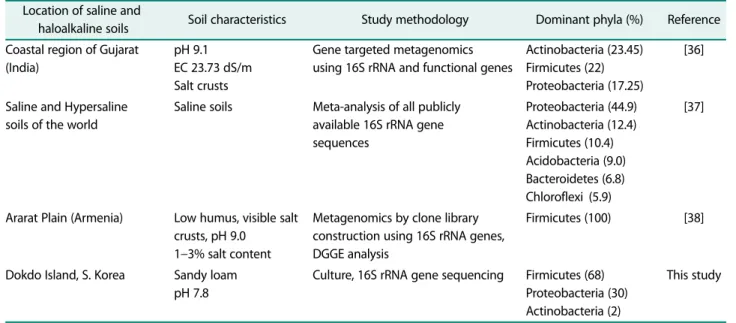
In this study, the three phyla, Firmicutes, Proteobac- teria and Actinobacteria, were the most abundant. Even in cases of haloalkaline freshwater, there are reports on dominance of Firmicutes and Proteobacteria, like the case of Lake Elmenteita, Kenya [34, 35]. Results of indi- vidual studies on haloalkaline soils by culture-independent methods or meta-analysis on most known communities of saline soils also showed the three phyla as the major phyla (Table 1) [36 −38]. However, their relative abun- dance varied from study to study. Firmicutes was most abundant only in some cases. The fact that the meta- analysis on most known saline soil communities showed dominance of Proteobacteria contrasted to the domi- nance of Firmicutes in haloalkaline soils (Table 1).

Therefore, it was suggested that predominance of Fir-

(8)

micutes in saline soils is a unique feature exerted by alkaline condition.

In some studies, abundance of Actinobacteria was comparable to that of Firmicutes (Table 1), whereas Act- inobacteria was found to be a rare phylum, represented by only one species, Microbacterium paraoxydans. This difference could be from negative-selection by culture medium, variance in cultivability, or difference in local environment such as soil chemistry and climate. Because there were reports on predominance of Actinobacteria in haloalkaline coastal soil in culture-independent analysis (Table 1), alkaline pH cannot be regarded as the cause for rarity of the phylum.

Alkali-tolerant bacteria of Dokdo as PGPB

Ability of a microorganism to tolerate saline and alka- line conditions in soil can be useful for plant cultivation on infertile soils if combined with traits of PGPB. Thus, we explored the potential of DAS isolates for such traits.

As listed in Table 2, there are several kinds of plant growth promoting traits carried by bacterial taxa identi- fied from alkali-tolerant isolates of this study. While Achromobacter, Arthrobacter, Azotobacter, Azospiril- lum, Burkholderia, Klebsiella, Pseudomonas, Serratia and Streptomyces are taxa well known to include PGPB, those listed in Table 2 are also well established as PGPB taxa [30, 39 −43]. Traits directly related to growth of plant in haloalkaline soils are related to detoxification or

supply of minerals, such as fixing nitrogen and trapping or mobilizing iron [44] and phosphorous [30], whereas PGPB traits like antibiotics production [45], disease/pest control and phytohormone production contribute to plant growth by interacting with other organisms rather than with soil.

Bacillus spp. are major contributors to the soil miner- alization process and various biogeochemical cycles and known as important components for functioning of haloalkaline soil ecosystem [5]. In this study, B. cereus and B. pumilus, which were previously isolated from the rhizosphere of the wild grass Elymus tsukushiensis on Dokdo Island [30], was isolated in near-shore soil. The Table 1. Bacterial communities from saline or haloalkaline soils.

Location of saline and

haloalkaline soils Soil characteristics Study methodology Dominant phyla (%) Reference Coastal region of Gujarat

(India)

pH 9.1 EC 23.73 dS/m Salt crusts

Gene targeted metagenomics using 16S rRNA and functional genes

Actinobacteria (23.45) Firmicutes (22) Proteobacteria (17.25)

[36]

Saline and Hypersaline soils of the world

Saline soils Meta-analysis of all publicly available 16S rRNA gene sequences

Proteobacteria (44.9) Actinobacteria (12.4) Firmicutes (10.4) Acidobacteria (9.0) Bacteroidetes (6.8) Chloroflexi (5.9)

[37]

Ararat Plain (Armenia) Low humus, visible salt crusts, pH 9.0

1 −3% salt content

Metagenomics by clone library construction using 16S rRNA genes, DGGE analysis

Firmicutes (100) [38]

Dokdo Island, S. Korea Sandy loam pH 7.8

Culture, 16S rRNA gene sequencing Firmicutes (68) Proteobacteria (30) Actinobacteria (2)

This study

Table 2. Plant growth promoting bacteria (PGPB) affiliated to alkali-tolerant isolates from Dokdo Island.

Plant growth promoting trait PGPB Taxa Reference Phosphate solubilization Bacillus spp.

Paenibacillus spp.

Enterobacter spp.

[39]

[40]

[41]

N

2

-fixation Enterobacter spp. [42]

Formation of siderophore Bacillus spp.

Paenibacillus spp.

Enterobacter spp.

[39]

[40]

[41]

Production of phytohormones Bacillus spp.

Paenibacillus spp.

Enterobacter spp.

[30, 39]

[40]

[41]

Disease/pathogen/insect control Bacillus pumilus [30, 43]

(9)

two bacilli have been reported as PGPB. In the case of B.

cereus LCR12 [46], both growth promotion and heavy metal detoxification activities were found. B. pumilus is a well-established biological control agent for crops; B.

pumilus increases defense against blue mold in tobacco [43] and suppresses gray leaf spot disease in pepper [30].

While numerous strains in Paenibacillus have been identified as PGPB with various features, Saccharibacil- lus spp. are known for survival in desert or heavy metal contaminated soil. In this study, single strains of Paeni- bacillus lautus and Saccharibacillus sacchari were iso- lated, casting potentials of the strains in helping survival of plants in harsh soil condition.

While many species and strains of Lysinibacillus were reported as PGPB with toxin resistance and other activi- ties, isolating L. mangiferihumi, which has been reported only once from rhizosphere of a mango tree in China for protecting the plant by production of nemati- cidal volatile compounds [47], in this study is significant in acquiring potential PGPB from Dokdo soil. As Firmic- utes, two DAS isolates of Planomicrobium were identi- fied as Pla. soli (Fig. 3). The species was recently described only once for its first encountering in a desert of Inner Mongolia, China [48]. Together with finding of the atmospheric bacterium Solibacillus isronensis and dryness-adapted Saccharibacillus, finding of Pla. soli implies harshness of soil condition in Dokdo. Their met- abolic activities for survival might also contribute to plant growth in Dokdo.

Firmicute isolates other than mentioned above were reported as marine origin. Into our knowledge, their PGPB potential have never been tested as most PGPB studies were carried out for agricultural soil. As with their relative Firmicutes, we hypothesize that those marine-origin isolates might have uncharted PGPB characteristics in certain conditions because they are most abundant in haloalkaline soil in this study.

Phytohormones production by bacteria is one of the most important factors of plant growth promotion.

According to Son et al. [30], 55% of bacterial isolates iso- lated from Dokdo rhizosphere soils were able to produce indole-3-acetic acid (IAA), a typical plant growth hor- mone. Halotolerant Enterobacter spp. were reported to promote plant growth under salt stress in different plants [49]. In this study, En. aerogenes strains were iso- lated, and the species is known to produce IAA and

metal resistance [50]. Together with Enterobacter, the Gammaproteobacteria genus Pantoea is also reported to be associated with various types of plant growth promot- ing. In this study, Pan. wallisii and Pan. septica were identified as member of the genus. The two species are relatively novel and have been described only a few times as an etiologic agent for eucalyptus tree and human, respectively. Detecting the two species in a haloalkaline soil environment is an interesting finding, prompting investigation on their role the soil environ- ment. As the only member of Actinobacteria, Mi. para- oxydans was isolated in this study. The species was usually reported as opportunistic pathogen of human and fish, but it is also reported as an arsenic- and lead- tolerant bacterium in contaminated soil. In the latter case, a strain of the species was associated with growth promotion of eucalyptus tree on a contaminated lead mine soil [51]. Therefore, all Actinobacteria and Proteo- bacteria strains isolated in this study have affiliation to PGPB taxa.

In summary, most taxa of isolates though to have ter- restrial origin showed affiliation to PGPB with one or more than one plant growth-promoting characteristics.

Despite the harsh environment of Dokdo, these results encourage us to presume that multi-functional interac- tions between alkali-tolerant PGPB can promote plant growth in stressed haloalkaline environments. While these results will be important for further researches, the potential of PGPB traits among the isolates com- bined with their capacity to tolerate alkaline pH and saline conditions warrants their biotechnological appli- cation.

This study is the first culture-dependent report on the

alkali-tolerant microbial diversity in near-shore soils of

Dokdo Island. Despite its saline and alkaline soil condi-

tion, in addition to the harsh oceanic climatic conditions,

a considerably rich microbial community spread among

three phyla exists. The soil community from Dokdo was

similar to other haloalkaline soils in some aspects. The

microbial diversity was relatively lower than neutral

soils, and the alkaline-saline soils were predominated by

three specific groups of bacteria, namely Firmicutes,

Actinobacteria and Proteobacteria. Compared to other

alkaline/haloalkaline soils, however, Dokdo community

was unique in that it has a higher abundance of Firmic-

utes of marine origin than other phyla.

(10)

In this study, alkaline-tolerant strains (Bacillus spp., Enterobacter spp., Microbacterium spp., Paenibacillus spp., and Pantoea spp.) affiliated to taxa displaying important PGPB characteristics (phytohormone produc- tion, disease control, nitrogen-fixation and phosphate- solubilization and/or siderophore-production) were iso- lated. Some of the taxa could exhibit more than two or three PGPB traits, which may promote plant growth directly, indirectly or synergistically. Bio-augmentation of soils by isolates capable of solubilizing phosphate, pro- ducing siderophores and fixing nitrogen will promote plant growth and significantly increase productivity of crops in alkaline soil.

Conflict of Interest

The authors have no financial conflicts of interest to declare.

References

1. Bolan N, Brennan R. 2011. Bioavailability of N, P, K, Ca, Mg, S, Si, and Micronutrients, pp. 11-80. In Huang PM, Li Y, Sumner ME (eds.), Handbook of Soil Sciences: Resource Management and Envi- ronmental Impacts, 2nd Ed. CRC Press, Boca Raton, FL.

2. Thomas MD. 1955. Effect of ecological factors on photosynthesis.

Annu. Rev. Plant Physiol. 6: 135-156.

3. Li C, Fang B, Yang C, Shi D, Wang D. 2009. Effects of various salt- alkaline mixed stresses on the state of mineral elements in nutri- ent solutions and growth of alkali resistant halophyte Chloris vir- gata. J. Plant Nutr. 32: 1137-1147.

4. Gökbulak F, Őzcan M. 2008. Hydro-physical properties of soils developed from different parent materials. Geoderma 145: 376- 380.

5. Marquez M, Sánchez-Porro C, Ventosa A. 2011. Halophilic and Haloalkaliphilic, Aerobic Endospore-forming Bacteria in Soil, pp.

309-339. In Logan NA, De Vos P (eds.), Endospore-Forming Soil Bacteria, 1st Ed. Springer-Verlag Berlin Heidelberg.

6. Hasegawa PM, Bressan RA, Zhu J-K, Bohnert HJ. 2000. Plant cellu- lar and molecular responses to high salinity. Annu. Rev. Plant Physiol. Plant Mol. Biol. 51: 463-499.

7. Yang CW, Xu HH, Wang LL, Liu J, Shi DC, Wang DL. 2009. Compar- ative effects of salt-stress and alkali-stress on the growth, photo- synthesis, solute accumulation, and ion balance of barley plants.

Photosynthetica 47: 79-86.

8. Fierer N, Jackson RB. 2006. The diversity and biogeography of soil bacterial communities. Proc. Natl. Acad. Sci. USA 103: 626-631.

9. Roesch LF, Fulthorpe RR, Riva A, Casella G, Hadwin AK, Kent AD, et al. 2007. Pyrosequencing enumerates and contrasts soil micro- bial diversity. ISME J. 1: 283-290.

10. Rousk J, Baath E, Brookes PC, Lauber CL, Lozupone C, Caporaso

JG, et al. 2010. Soil bacterial and fungal communities across a pH gradient in an arable soil. ISME J. 4: 1340-1351.

11. J. Kemmitt S, Wright D, Goulding K, Jones D. 2006. pH regulation of carbon and nitrogen dynamics in two agricultural soils. Soil Biol. Biochem. 38: 898-911.

12. Van der Heijden MG, Bardgett RD, Van Straalen NM. 2008. The unseen majority: soil microbes as drivers of plant diversity and productivity in terrestrial ecosystems. Ecol. Lett. 11: 296-310.

13. Eisenhauer N, Bessler H, Engels C, Gleixner G, Habekost M, Milcu A, et al. 2010. Plant diversity effects on soil microorganisms sup- port the singular hypothesis. Ecology 91: 485-496.

14. Ryu CM, Farag MA, Hu CH, Reddy MS, Wei HX, Pare PW, et al.

2003. Bacterial volatiles promote growth in Arabidopsis. Proc.

Natl. Acad. Sci. USA 100: 4927-4932.

15. Sohn YK. 1995. Geology of Tok Island, Korea: eruptive and depo- sitional processes of a shoaling to emergent island volcano. Bull.

Volcanol. 56: 660-674.

16. Joshi P, Bhatt A. 2011. Diversity and function of plant growth pro- moting rhizobacteria associated with wheat rhizosphere in North Himalayan region. Int. J. Environ. Sci. 1: 1135.

17. Farina R, Beneduzi A, Ambrosini A, de Campos SB, Lisboa BB, Wendisch V, et al. 2012. Diversity of plant growth-promoting rhi- zobacteria communities associated with the stages of canola growth. Appl. Soil Ecol. 55: 44-52.

18. Chang KI, Kim YB, Suk MS, Byun SK. 2002. Hydrography around Dokdo. Ocean Polar Res. 24: 369-389.

19. Lee GS, Choo YS. 2009. Physical and chemical characteristics of Dokdo Soil. J. Ecol. Environ. 32: 295-304.

20. Enache M, Popescu G, Itoh T, Kamekura M. 2012. Halophilic Microorganisms from Man-made and Natural Hypersaline Envi- ronments: Physiology, Ecology, and Biotechnological Potential, pp. 201-226. In Stan-Lotter H, Fendrihan S (eds.), Adaption of Microbial Life to Environmental Extremes: Novel Research Results and Application, 2nd Ed. Springer, Cham, Vienna.

21. Collins MD, Lund BM, Farrow JAE, Schleifer KH. 1983. Chemotaxo- nomic study of an alkalophilic bacterium, Exiguobacterium aurantiacum gen. nov., sp. nov. J. Gen. Microbiol. 129: 2037-2042.

22. Ishikawa M, Nakajima K, Yanagi M, Yamamoto Y, Yamasato K, Toffin L, et al. 2003. Marinilactibacillus psychrotolerans gen. nov., sp. nov., a halophilic and alkaliphilic marine lactic acid bacterium isolated from marine organisms in temperate and subtropical areas of Japan. Int. J. Syst. Evol. Microbiol. 53: 711-720.

23. Crapart S, Fardeau ML, Cayol JL, Thomas P, Sery C, Ollivier B, et al.

2007. Exiguobacterium profundum sp. nov., a moderately thermo- philic, lactic acid-producing bacterium isolated from a deep-sea hydrothermal vent. Int. J. Syst. Evol. Microbiol. 57: 287-292.

24. Yokoi H, Aratake T, Hirose J, Hayashi S, Takasaki Y. 2001. Simulta- neous production of hydrogen and bioflocculant by Enterobacter sp. BY-29. World J. Microbiol. Biotechnol. 17: 609-613.

25. Muslim SN, Mohammed Ali AN, Al-Kadmy IMS, Khazaal SS, Ibra-

him SA, Al-Saryi NA, et al. 2018. Screening, nutritional optimiza-

tion and purification for phytase produced by Enterobacter

aerogenes and its role in enhancement of hydrocarbons degra-

(11)

dation and biofilm inhibition. Microb. Pathog. 115: 159-167.

26. Wada M, Yoshizumi A, Furukawa Y, Kawabata H, Ueda M, Takagi H, et al. 2004. Cloning and overexpression of the Exiguobacterium sp. F42 gene encoding a new short chain dehydrogenase, which catalyzes the stereoselective reduction of ethyl 3-oxo-3-(2-thie- nyl)propanoate to ethyl (S)-3-hydroxy-3-(2-thienyl)propanoate.

Biosci. Biotechnol. Biochem. 68: 1481-1488.

27. Hwang BY, Kim JH, Kim J, Kim BG. 2005. Screening of Exiguobac- terium acetylicum from soil samples showing enantioselective and alkalotolerant esterase activity. Biotechnol. Bioprocess Eng.

10: 367.

28. Kasana RC, Yadav SK. 2007. Isolation of a psychrotrophic Exiguo- bacterium sp. SKPB5 (MTCC 7803) and characterization of its alka- line protease. Curr. Microbiol. 54: 224-229.

29. Toffin L, Zink K, Kato C, Pignet P, Bidault A, Bienvenu N, et al. 2005.

Marinilactibacillus piezotolerans sp. nov., a novel marine lactic acid bacterium isolated from deep sub-seafloor sediment of the Nankai Trough. Int. J. Syst. Evol. Microbiol. 55: 345-351.

30. Son JS, Sumayo M, Hwang YJ, Kim BS, Ghim SY. 2014. Screening of plant growth-promoting rhizobacteria as elicitor of systemic resistance against gray leaf spot disease in pepper. Appl. Soil Ecol.

73: 1-8.

31. Kim YE, Yoon H, Kim M, Nam YJ, Kim H, Seo Y, et al. 2014. Metage- nomic analysis of bacterial communities on Dokdo Island. J. Gen.

Appl. Microbiol. 60: 65-74.

32. You YH, Park JM, Lee MC, Kim JG. 2015. Characterization and phy- logenetic analysis of halophilic bacteria isolated from rhizo- sphere soils of coastal plants in Dokdo Islands. Korean J.

Microbiol. 51: 86-95.

33. Vaz-Moreira I, Egas C, Nunes OC, Manaia CM. 2011. Culture- dependent and culture-independent diversity surveys target dif- ferent bacteria: a case study in a freshwater sample. Antonie van Leeuwenhoek. 100: 245-257.

34. Mwirichia R, Muigai AW, Tindall B, Boga HI, Stackebrandt E, Mwir- ichia R, et al. 2010. Isolation and characterisation of bacteria from the haloalkaline Lake Elmenteita, Kenya. Extremophiles 14: 339- 348.

35. Mwirichia R, Cousin S, Muigai AW, Boga HI, Stackebrandt E. 2011.

Bacterial diversity in the haloalkaline Lake Elmenteita, Kenya.

Curr. Microbiol. 62: 209-221.

36. Keshri J, Mishra A, Jha B. 2013. Microbial population index and community structure in saline-alkaline soil using gene targeted metagenomics. Microbiol Res. 168: 165-173.

37. Ma B, Gong J. 2013. A meta-analysis of the publicly available bac- terial and archaeal sequence diversity in saline soils. World J.

Microbiol. Biotechnol. 29: 2325-2334.

38. Panosyan H, Hakobyan A, Birkeland NK, Trchounian A. 2018.

Bacilli community of saline–alkaline soils from the Ararat Plain (Armenia) assessed by molecular and culture-based methods.

Syst. Appl. Microbiol. 41: 232-240.

39. Ahmad F, Ahmad I, Khan MS. 2008. Screening of free-living rhizo- spheric bacteria for their multiple plant growth promoting activ- ities. Microbiol. Res. 163: 173-181.

40. Phi QT, Park YM, Seul KJ, Ryu CM, Park SH, Kim JG, et al. 2010.

Assessment of root-associated paenibacillus polymyxa groups on growth promotion and induced systemic resistance in pep- per. J. Microbiol. Biotechnol. 20: 1605-1613.

41. Pramanik K, Mitra S, Sarkar A, Maiti TK. 2018. Alleviation of phyto- toxic effects of cadmium on rice seedlings by cadmium resistant PGPR strain Enterobacter aerogenes MCC 3092. J. Hazard. Mater.

351: 317-329.

42. Sarkar A, Ghosh PK, Pramanik K, Mitra S, Soren T, Pandey S, et al.

2018. A halotolerant Enterobacter sp. displaying ACC deaminase activity promotes rice seedling growth under salt stress. Res.

Microbiol. 169: 20-32.

43. Zhang S, Reddy M, Kloepper JW. 2002. Development of assays for assessing induced systemic resistance by plant growth-promot- ing rhizobacteria against blue mold of tobacco. Biol. Control. 23:

79-86.

44. Valencia-Cantero E, Hernández-Calderón E, Velázquez-Becerra C, López-Meza JE, Alfaro-Cuevas R, López-Bucio J. 2007. Role of dis- similatory fermentative iron-reducing bacteria in Fe uptake by common bean (Phaseolus vulgaris L.) plants grown in alkaline soil. Plant Soil. 291: 263-273.

45. Compant S, Duffy B, Nowak J, Clement C, Barka EA. 2005. Use of plant growth-promoting bacteria for biocontrol of plant dis- eases: principles, mechanisms of action, and future prospects.

Appl. Environ. Microbiol. 71: 4951-4959.

46. Egidi E, Wood JL, Mathews E, Fox E, Liu W, Franks AE. 2016. Draft genome sequence of Bacillus cereus LCR12, a plant growth-pro- moting rhizobacterium isolated from a heavy metal-contami- nated environment. Genome Announc. 4: e01041-16.

47. Yang LL, Huang Y, Liu J, Ma L, Mo MH, Li WJ, et al. 2012. Lysiniba- cillus mangiferahumi sp. nov., a new bacterium producing nem- aticidal volatiles. Antonie van Leeuwenhoek. 102: 53-59.

48. Luo X, Zhang J, Li D, Xin Y, Xin D, Fan L. 2014. Planomicrobium soli sp. nov., isolated from soil. Int. J. Syst. Evol. Microbiol. 64: 2700- 2705.

49. Upadhyay SK, Singh JS, Singh DP. 2011. Exopolysaccharide-pro- ducing plant growth-promoting rhizobacteria under salinity condition. Pedosphere 21: 214-222.

50. Kumar KV, Srivastava S, Singh N, Behl HM. 2009. Role of metal resistant plant growth promoting bacteria in ameliorating fly ash to the growth of Brassica juncea. J. Hazard. Mater. 170: 51-57.

51. Waranusantigul P, Lee H, Kruatrachue M, Pokethitiyook P, Auesu-

karee C. 2011. Isolation and characterization of lead-tolerant

Ochrobactrum intermedium and its role in enhancing lead accu-

mulation by Eucalyptus camaldulensis. Chemosphere 85: 584-590.

수치

Fig. 3. Maximum likelihood tree of 16S rRNA gene sequences;
Table 2. Plant growth promoting bacteria (PGPB) affiliated to alkali-tolerant isolates from Dokdo Island.

참조

관련 문서

Distribution of Cd in stream sediments, paddy soils, rice stalks and grains from the Kubong

Changes in the composition and structure of Mediterranean rokey-shore communities following a gradient of nutrient enrichment: Descriptive study and test

Changes of lactic acid bacteria numbers and photodiode during fermentation mode and storage mode in S kimchi · · ·40..

Days to emergence and heading, duration of growth, leaf traits and stem diameter of sweet sorghum as affected by soils. Soil type Days

Concentration of soil residual endosulfan-sulfate with days after treatment of endosulfan in different soils

Probiotic properties of lactic acid bacteria isolated from mukeunji, a long-term ripened kimchi. Journal of Food

The obligate methanotrophic bacteria Methylococcus, Methylomonas, Methylosinus and related bacteria. Schleifer

In this thesis, a delay tolerant distance-based broadcasting protocol is proposed, which can change latency according to circumstance of network topology..