− 782 − DOI:10.5720/kjcn.2011.16.6.782
국내 한국인 및 중국인 대학생의 라이프스타일별 커피 만족도 선행요인 분석
정혜경·김혜영1)·이해영2)†
연세대학교 의과대학 강남세브란스병원 영양팀,
1)가톨릭대학교 교육대학원,
2)상지대학교 식품영양학과
The Antecedents of Coffee Satisfaction by Lifestyle Segments for Korean and Chinese University Students in Korea
Hye-Kyung Chung, Hye-Young Kim
1), Hae-Young Lee
2)†Department of Nutrition Services, Gangnam Severance Hospital, Yonsei University College of Medicine, Seoul, Korea
1)
Graduate School of Education, The Catholic University of Korea, Bucheon, Korea
2)
Department of Food and Nutrition, Sangji University, Wonju, Korea
Abstract
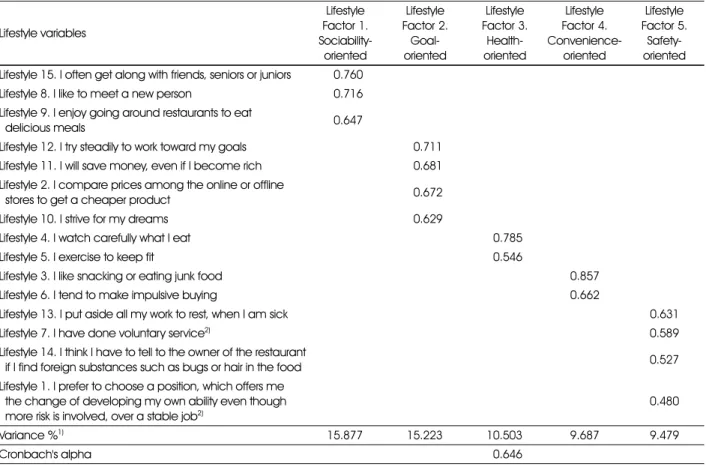
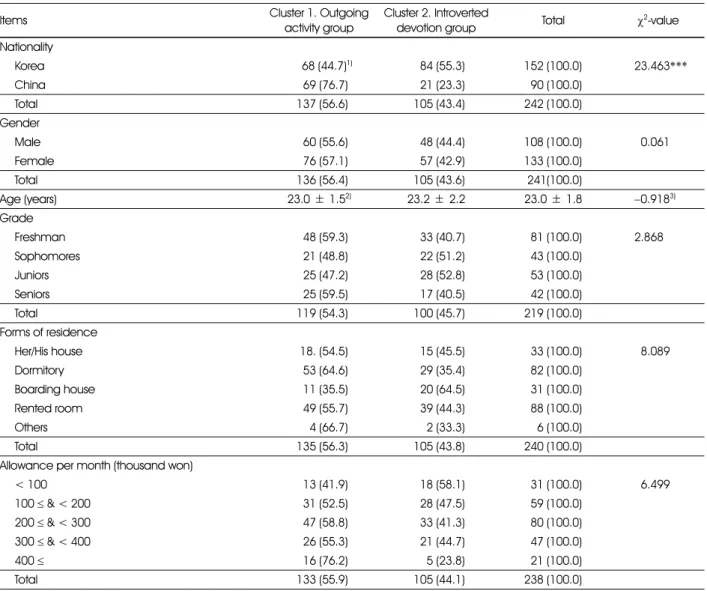
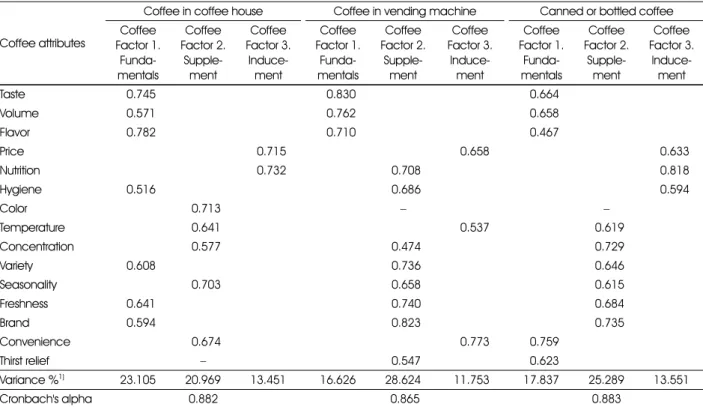
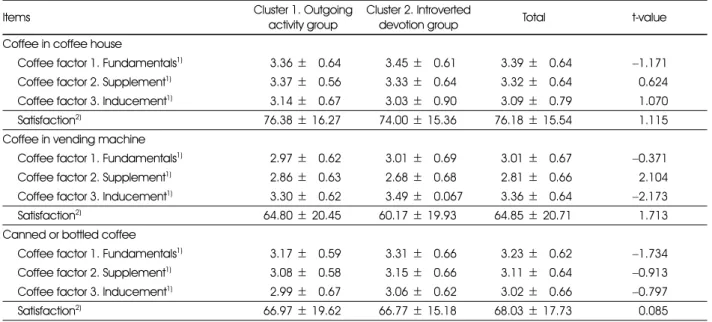
The purposes of this study were to classify university students by their lifestyle and to investigate the relationships between lifestyle and coffee satisfaction. The survey had been undertaken for 360 Korean and Chinese university students in Daejeon from November to December 2009. A total of 242 usable questionnaires were received with 67.2% response rate. The statistical analysis was performed by the SPSS 18.0 package program. Lifestyles of subjects, based on AIO (Activities, Interests, Opinions) method and factor analysis, were segmented into 2 groups of “outgoing activity” (n = 137) and “introverted devotion” (n = 105). “Outgoing activity” group exhibited highly health-oriented (p < 0.001) and convenience-oriented (p < 0.001) characteristics, but “introverted devotion” group showed highly goal- oriented (p < 0.01) and safety-oriented (p < 0.01) features. Comparing to “introverted devotion” group, “outgoing activity” group showed higher intake of coffee (p < 0.01) and more expense for beverage (p < 0.01). Three factors were extracted from 15 coffee quality attributes by factor analysis; “fundamentals”, “supplement” and “inducement”.
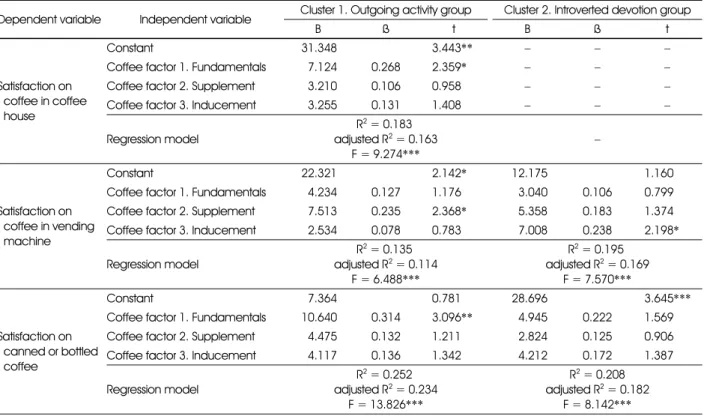
These factors were positively correlated with coffee satisfaction according to lifestyle groups (p < 0.01). For “outgoing activity” group, ‘fundamentals’ was independent factor for satisfaction on coffee in coffee house (β = 0.268, p < 0.05) and canned or bottled coffee (β = 0.314, p < 0.01), and “supplement” was independent factor for satisfaction on coffee in vending machine ( β = 0.235, p < 0.05). For “introverted devotion” group, “inducement” was independent factor for satisfaction on coffee in vending machine (β = 0.238, p < 0.001). These results provide an understanding for lifestyles of coffee consumers and give an insight into differentiated marketing plans for coffee industry. (Korean J Community Nutr 16(6) : 782~793, 2011)
KEY WORDS : coffee·lifestyle·satisfaction·university students
—————————————————————————
서 론
—————————————————————————
라이프스타일이란 사회 전체 또는 일부 구성원들이 공통 적으로 지니는 독특한 생활양식으로(Lazer 1963), 간단하
게 말하면 사람이 어떻게 사느냐로 정의내릴 수 있으며 (Kucukemiroglu 1997), 일반적으로 사람들이 살아가면 서 돈과 시간을 소비하는 생활방식(Anderson & Golden 1984)을 말한다. 라이프스타일은 초기 사회학 또는 심리학 에서 계층간의 차이를 나타내고 사회를 세분화하는 개념으 로 쓰이다가 최근에는 마케팅과 광고 계획에 유용한 개념이 되고 있다(Wells & Tigert 1977; Kaynak & Kara 1996). 소비자들의 라이프스타일을 세분화하여 그 특성을 이해하는 것은 변화하는 소비자들의 욕구를 지속적으로 파 악하고 이에 따라 소비자 중심의 맞춤형 서비스를 제공할 수 있다는 측면에서 효과적인 마케팅 계획을 가능하게 한다
접수일: 2011년 10월 18일 접수수정일: 2011년 11월 22일 수정 채택일: 2011년 12월 21일 채택
*This research was supported by Sangji University Research Fund, 2010.
†Corresponding author: Hae-Young Lee, Department of Food and Nutrition, Sangji University, 660 Woosan-dong, Wonju 220-702, Korea Tel: (033) 730-0492, Fax: (033) 738-7740
E-mail: [email protected]