Update of Sepsis: Recent Evidences about Early Goal Directed Therapy
Woo Hyun Cho, M.D.
Department of Internal Medicine, Pusan National University Yangsan Hospital, Pusan National University School of Medicine, Yangsan, Korea
Severe sepsis and septic shock is a life-threatening disease. It is combined with multi-organ failure. In the past decade, early goal directed therapy has been proposed as an effective treatment strategy for better outcome. Recent epidemiologic studies showed that the outcome of sepsis has been improved with the introduction of early goal directed therapy. However, it is unclear which elements of early goal directed therapy contributed to the better outcome. Recent prospective and randomized trials suggested that some elements of early goal directed therapy did not have any effect on the outcome benefit. In this paper, recent articles about early goal directed therapy will be reviewed and the effectiveness of individual elements of early goal directed therapy will be discussed.
Keywords: Sepsis; Shock, Septic; Therapeutics
elements and targets
3-5. In order to solve this controversy, well designed, large scaled, randomized trial has been published.
Recently, ProCESS study
5and ARISE study
4reported no mor- tality benefit with EGDT-based therapies. However, there are recent evidences supporting the benefit of EGDT
6-9. In this review, therefore, debates on EGDT and recent evidences re- garding sepsis treatments will be discussed.
Diagnostic Criteria of Sepsis
Sepsis is defined as a systemic inflammatory response syn- drome caused by bacterial infection
10. According to severity of sepsis, it is classified into sepsis, severe sepsis and septic shock. Severe sepsis is defined as the state which is combined with sepsis induced organ failure or tissue hypoperfusion.
Septic shock is defined as sepsis-induced hypotension persist- ing despite adequate fluid administration.
Epidemiologic Evidences about EGDT
Since the 1970s, the incidence of sepsis has been increasing every year in the United States. Hospitalization due to sepsis has been increased by 7.9% annually since 2000 and sepsis has become the most common causes of hospitalization in the sixth
1. This increase in incidence is thought to be related Copyright © 2015
The Korean Academy of Tuberculosis and Respiratory Diseases.
All rights reserved.
Introduction
During the past 30 years, the incidence of sepsis has been increased and the related mortality rate amounts to 50 per- cent in the most severe cases
1,2. In 2001, Rivers et al.
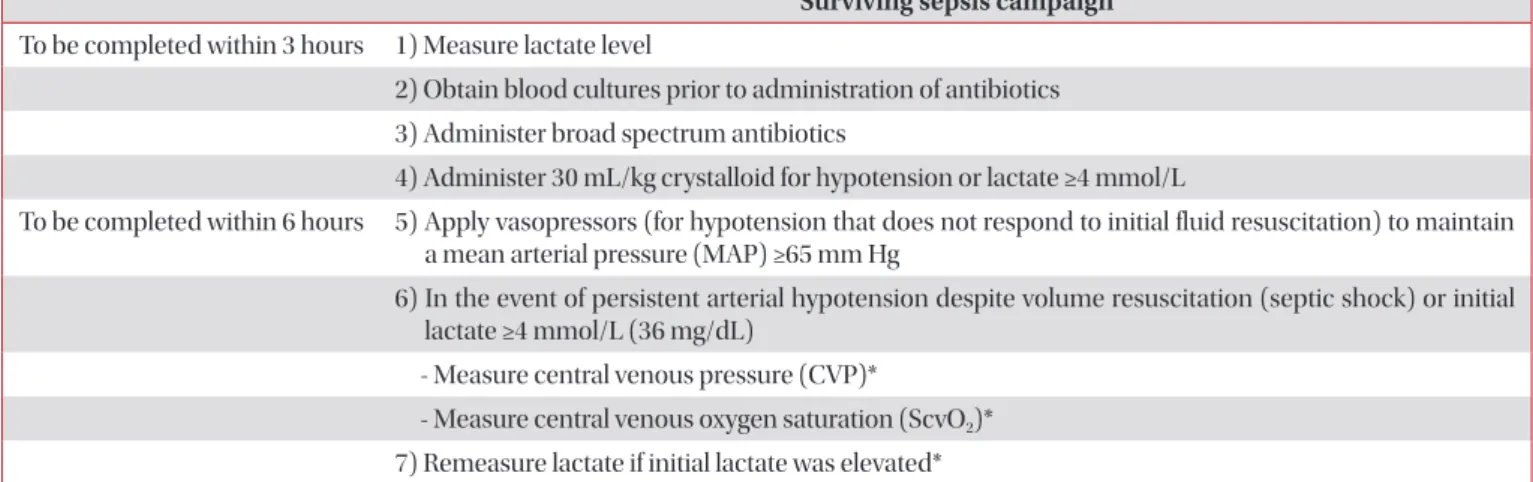
3suggest- ed early goal directed therapy (EGDT) improved the survival of severe sepsis and septic shock. EGDT refers to a treatment bundle including early intensive fluid administration using physiologic targets to guide resuscitation within first six hours in severe sepsis and septic shock. Thereafter, EGDT has widely accepted in clinical practice; however, there is conflicting evi- dences regarding the effectiveness of individual resuscitation
Address for correspondence: Woo Hyun Cho, M.D.
Department of Internal Medicine, Pusan National University Yangsan Hospital, Pusan National University School of Medicine, 20 Geumo-ro, Yangsan 626-787, Korea
Phone: 82-55-360-1414, Fax: 82-55-360-1757 E-mail: [email protected] Received: Jan. 24, 2015
Revised: Feb. 17, 2015 Accepted: Feb. 23, 2015
cc