抗生物質 懸满液中에서 Erythrosine 의 吸收에 관한 硏究
白于技 • 宋泳俊 .金 正 優* • 金 鍾 甲*
鍾根堂 中央硏究所 • 中 央 *學 校 藥學:大學* (Received August 30,1979)
Woo Hyun Paik, Yung Joon Song, Jung Woo Kim*, and Johng Kap Kim*
Research Laboratory, Chong Kun D ang Corporation、Seoul 150’ and College o f Pharmacy, Chung-ang University*,Seoul 151, Korea
Studies on the Adsorption of Erythrosine in the Suspension of Antibiotics
A b stra ct—T he adsorption of erythrosine in the aliphatic alcohols by antibiotics such as am picillin anhydrous, ampicillin trihydrate, amoxicillin trihydrate, cephalexin monohydrate was studied. The adsor
ption isotherms were all described with Freudlich equation. From the various experimerts, it was found that the adsorption of erythrosine by antibiotics in the aliphatic alcohols was affected by the solubility of adsorbents. The adsoption in the mixture of aliphatic alcohols and water is related with the dielectric cons
tant of mixed solvents. According to increase in the pH values of aqueous solution, the adsorption of erythrosine for antibiotics is decreased, but increased in the mixture of aliphatic alcohols and water. The adsorption of erythrosine in the suspension of antibiotics showed a correlation with the temperature. Col
loidal silica which is used as stabilizer had a favorable effect on the adsorption of erythrosine in the suspension of antibiotics.
多量의 不溶性 物質에 可溶性 物質이 溶解되어 있을 境遇,前者에 後者가 吸着되어 그 結果- 는物理的인 變化가豫想되며이에對한硏究가 많이 進行되고 있다. Evicim 과 Barr1)는 alkaloid 水溶液에서 여러가지 clay 에 따른 吸着을,Zografi 와 Mattocks2) 는 starch 에 erythrosine 의 吸 着을, N o gam i et al. 3)^ barbiturates, sulfonamides, phenathiazines 의 carbon black 에 對^!즈 吸着과 吸收의 關係를,Umeyama4) 는 carbon black 에 對한 phenol 誘導體의 吸着 mechanism에 關하여,Kim 衫 d. 5)는 talc, kaolin 等에 依한 berberine HC1 의 吸着에 關한 것을, Nambu et al.6)은 colloidal silica 에 依한 sulfonylurea 의 吸着을,Seller et al.7)은 active carbon 에 依
한 barbiturates 의 吸着에 關하여 硏究 報告한 바 있다. 그러나 難溶性 藥品에 依한 色素의 吸
着에 關하여서는 別다른 報告가 없으며,또한 ampicillin, amoxicillin, cephalexin 둥 抗生物質 의 syrup 製劑에 coloring agent 를使用하는 境遇 color 의 發現差異가 pH, coloring agents 의
種類 또는 時間에 따른 吸着정도에 따라 color 의 發想狀態가 다르게 되어 均一한 color 를 維持
하지 못하게되어 여러가지 色狀이 나타나게 된다. 이에 難溶性 物質로서 抗生物質中 많이 使用 되고 있는 ampicillin anhydrous, ampicillin trihydrate, amoxicillin trihydrate, cephalexin monohydrate 에 erythrosine(FD&C Red No. 3) 의 吸着에 미치는 다음과 같은 要因들에 對하여 相互 檢討하였다. (1) aliphatic alcohols solvent 에 서 erythrosine 의 抗生物質에 대 한 吸 着 (2)
alip hatic alcohols-water m ixture 에서 dielectric constant 에 따른 吸着 變化狀態 (3) aqueous solution 과 ethanol-water m ixture 에서 p H 에 依한 影響 (4) 溫度에 따른 吸着變化 (5) 安定
劑로서 使用되는 colloidal silica 를 添加했을 때 일어나는 吸着狀態變化를 硏究檢討하였다.
* 驗
試料,吸着媒一ampicillin anhydrous, am picillin trihydrate, am oxicillin trihydrate 및 ce- phale x in monohydrate 는 粒子의 크기를 一定하게 하기 爲하여 모든 粒子를 1 0 0〜2 0 0mesli 로 하여 使用하였다 (종근당 製品).
吸着質一erythrosine(FD -C R ed No. 3)
方法一吸着試驗5) :erythrosine 의 濃度가 5,10,15, 20 및 25 fig/m l 인 溶液 50mZ 에 吸着媒 ᅳ 定量을 加한 後 一定溫度(2 5 ± 1 0)에서 2 時間 振湯한다. 振湯한 溶液을 爐過하여 爐液의 濃度를 求하여 原濃度와의 差異로 吸着量을 求하였다.
Erythrosine 의 定量8> : 吸收極ᄎ波長 526nm 에 서 吸光度를 測定하여 erythrosine 의 量을 求 하였다.
吸着 平衡 到達時間의 測定5〉: erythrosine 溶液 (2 0/zg/mZ) 에 antibiotics —定量 (1. 0g) 을 加하 고 一定溫度( 2 5 ± 1 ° )에서 0 .5 ,1 . 0 , 2 . 0 , 3 . 0 및 4 .0時間 振湯後, 滤過하여 爐液의 吸光度를 測定 하여 平衡到達時間을 求하였다. 그 結果는 Table I 과 같다.
溶解度 測定ᅳ半合成 p e n ic illin 系 抗生物質이 水溶液中에 서 不安定하므로 거 의 e q uilibrium 狀 態에 到達한 時間을 終點으로 해서, H iguchi-Lach 實驗方法« 에 따라 다음과 같이 任意의 solvent 50mi 에 測定하고자 하는 antibiotics 2 . 0g 을 加하고 一定溫度( 2 5 ± ° )에 서 4 時間 振湯後 爐過하여 溶解度를 求하였다.
Table I —Time required for reaching equilibrium
Drugs Time required
Ampicillin anhydrous 1. 5 hrs
Ampicillin trihydrate 2.0 ”
Amoxicillin trihydrate 2.0 "
Cephalexin monohydrate 2.0 ”
結果 및考察
A liphatic alcohols 溶液에서 antibiotics 에對한 erythrosine 의 吸着ᅳ前記한方法으로 ampi
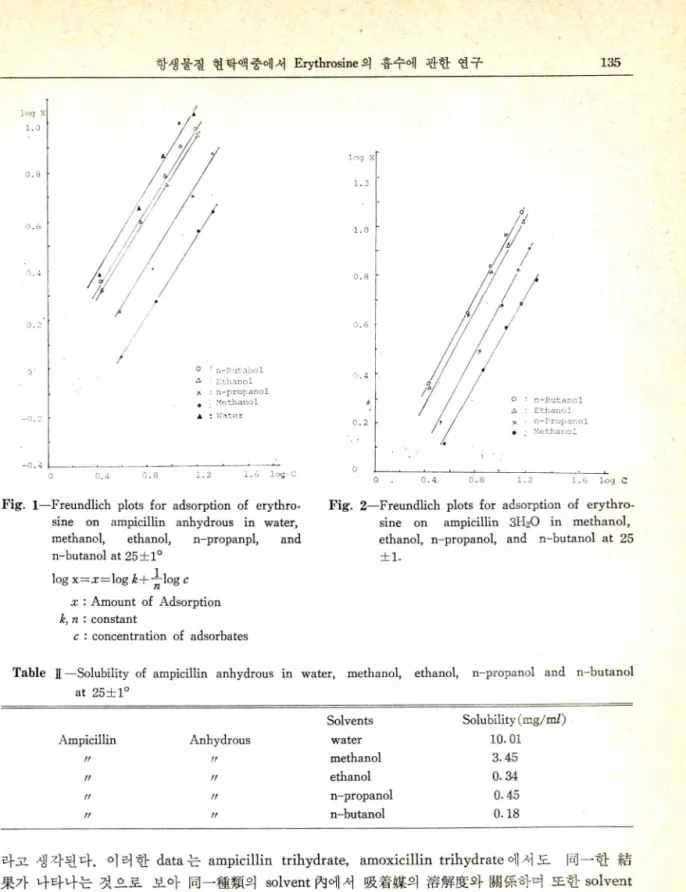
cillin anhydrous 에 erythrosine 의 吸着量을 求하여 Freundlich equation 에 따라 plot 하면 Fig.
1에서와 같이 ampicillin anhydrous 에 erythrosine 의 吸着量은 water〉n-butanol〉ethanol〉n- propanol〉 methanol 順으로 吸着이 되며 이는 Table 표의 aliphatic alcohols 中에서 ampicillin anhydrous 의 溶解度와는逆으로나타난다. Fig. 1 과 Table 표를 比較해 보면 erythrosine 의 吸 着은 吸着媒의 溶解度가 크면 클수록 吸着媒의 表面積은 減少하여 結果的으로 吸着能이 低下되
며 水溶液에 있어 erythrosine의 吸着量이 溶解度가 크면서도 n-butan이에서보다 더큰 것은
erythrosine 과 ampicillin anhydrous 와의 親和力이 n-butanol 에서보다 水溶液에서 크기 때문이
l o g
lo g - C
Fig. 1—Freundlich plots for adsorption of erythro
sine on ampicillin anhydrous in water, methanol, ethanol, n-propanpl, and n-butanol at 25 士 1°
log x = j:=log log c x : Amount of Adsorption k, n : constant
c : concentration of adsorbates
/V
l o g
Fig. 2—Freundlich plots for adsorption of erythro
sine on ampicillin 3H2O in methanol, ethanol, n-propanol, and n-butanol at 25
±1.
Table J —Solubility of ampicillin anhydrous in water, methanol, ethanol, n-propanol and n-butanol at 25+1°
Solvents Solubility (mg/m/)
Ampicillin Anhydrous water 10. 01
// rr methanol 3.45
// tt ethanol 0.34
// tr n-propanol 0.45
// rr n-butanol 0.18
라고 생각된다. 이러한 data는 ampicillin trihydrate, a m o x ic illin trihydrate 에서도 同一한 結 果가 나타나는 것으로 보아 同一種類의 solvent 內에서 吸着媒의 溶解度와 關係하며 또한 solvent 의 物性에 크게 左右된다 (Fig. 2).
Aliphatic alcohol-water mixture 中에서 antibiotics 에 對한 erythrosine 의 吸着 相互關 係一10,20,40 및 60% ethanol-water mixture 에서 a m p ic illin trihydrate 에 있어 erythrosine 의
1 . G l o g C
3ᅳFreundlich plots for adsorption of eryth- rosine on ampicillin 3H2O in the mixture of ethanol and water at 25 士 I 0.
Fig. 5——Freundlich plots for adsorption of eryth- rosine on cephalexin in the mixture of ethanol and water at 25 士 I 0.
0 ᄋ. 4
Fig. 4ᅳFreundlich rosine on
of ethanol and water at
log 1
plots for adsorption of eryth- amoxicillin in the mixture
25 士 10C.
Fig. n——Freundlich plots for adsorption of ery- throsine on ampicillin 3H2ᄋ in the mix
ture of n-propanol and water at 25士 1°C.
Ethai
,0 ,0 ,0 ,0
1246
•og X
E t h a i 0 ,O'
O'
Fig. 7一Freundlich plots for adsorption of eryth- Fig. 8—Freundlich plots for adsorption of eryth
rosine on amoxicillin in the mixture of rosine on cephalexin in the mixture of n-propanol and water at 25 士 1°. n-propanol and water at 25 士 1°.
Table ffl —Solubility of ampicillin trihydrate in 19, 20,40,60 and 80% ethanol-water mixture at 25 士 l 0 Ethanol-water mixture D C .10) Solubility (mg/m/)
Ampicillin trhydrate 10% ethanol soln 73.11 4. 75
// rr 20 // // 67.69 4.96
// ft 40 // rf 56.84 6.15
// // 60 n n 46. 00 5.59
rt tt 80 n tt 35.15 3.02
Dielectric constant (D. C .) is calculated by formula equation
吸着은 Fig. 3 에서처럼 ethanol 比率이 클수록 吸着이 잘된다. 또한 10,20.40 및 60% ethanol- water m ixture 에서 am picillin trihydrate 의溶解度와 solvent 의 dielectric constant 를 求하면 T able HI 과 같고 F ig . 3과 Table Dl 을比較하면 ethanol-water m ixture 에서 a m p ic illin trih y d rate 에 erythrosine 의 吸着은溶解度와는 相關關係를 크게 갖지 않으나 dielectric constant 와는 密接 한 關係를 갖고 있다. ethanol-water m ixture 에서 dielectric constant 가 크면 클수록 吸着量이
커지며 이는 n-propanol-water m ix tu r e에서도 同一한 結果를 나타낸다. 이러한 結果로 보0h
aliphatic alcohols-water m ixture 에서 吸着은 dielectric constant 가 클수록 吸着이 잘 일어닌T 다 (Fig. 3〜 8).
n - p r o p a n o l
l e g 1 .6
i . 4
1 .2
lo g X
1 .0 ,
0 .8
1 . 0
0 .6
:
0 . 8 / / ' --- : PH 4 . 0 i f /
/ i .• / / • PH 4 .0
* , --- •• pH 5 . ᄋ
•' / / --- : pH 5 .0
0 . 6 0 . 1
... • pH 6.0
0 .2 V, :/
/
... '• pH 6 .0-1 .0 - 0 . 6 - 0 .2 0 . 2 0 . 6 l o g C 0 .4 0 .8 1 .2 i . 6 lo g C
Fig. 9ᅳ Freundlichplots for adsorption of eryth- Fig. 1(1ᅳFreundlich plots for adsorption of eryth
rosine on ampicillin 2H2O in the aqueous rosine on ampicillin 3H2O in the water- solution at pH 4.0, 5.0 ant 6.0. ethanol mixture (80:20) at pH 4.0,5.0
and 6. 0.
Aqueous solution과 ethanol-water mixture 에서 吸着에 미치는 pH 의 影響ᅳ水溶液에서 pH 變化에 따른 吸着變化는 F ig . 9과 같으며 2 0% ethanol-water m ixture 에서 p H 變化에 따른 吸
Table If —Solubility of ampicillin trihydrate in aqueous solution and ethanol-water mixture at various pH (25± l°).
Solvents pH Solubility (mg/ml)
Water 4.0 5. 97
5.0 6.02
6.0 6.44
Ethanol-water 4.0 4.72
(20:80) 5.0 5.26
6.0 4.93
着變化는 F ig . 10과 같고 吸着과 溶解度와의 關係를 알기 위하여 p H 4 .0 , 5 .0 , 및 6 .0에서의 水溶液과 ethanol-water m ixture 에서 各各의 溶解度를 求하면 Table 17 와 같으며 Fig. 9 , 10을
T able 하와 比較하면 水溶液에서는溶解度와 吸着이 比例的인 關係가있는듯하다. ethanol-water
:m ixure 에서는 그 反對로 된다. 즉,水溶液에서는吸着이 p H 4 . 0 > 5 . 0 > 6 . 0順이나 ethanol water
m ixture 에서는反對로 p H 6 . 0 > 5 .0 > 4 . 이頃으로 吸着된다. 이러한結果는 am p ic illin anhydrous am o x icillin trihydrate 에서도 同一했으며,이 러한 結果는吸着이 溶解度뿐만아니라 solvent 와 吸着質, 吸着媒의 物性에 크게 左右되며 역시 p H 도 吸着에 커다란 影響을 준다.
吸着에 미치는 溫度의 影響ᅳ溫度가 吸着에 미치는 影響을 알기 위하여 15ᄋ,20ᄋ,25° 및 30ᄋ
에서 吸着量을 求하여 F reundlich equation에 따라 plot 하면 F ig . 11처럼 吸着量은 溫度가 增加
하면 減少하며,溫度가 減少하면 吸着量은增加한다. 이는 a m p ic illin trihy drate 의 溶解度는 溫 度가 上昇하면 增加하므로 結果的으로 表面積이 減少하여 吸着能이 減少할 뿐 아니라 吸着이 일어나는 境遇 吸着熱 發散을 隨伴하므로 溫度가 上昇하면 當然히 吸着量은 減少하게 된다.
Colloidal silica 가 吸着에 미치는 影響ᅳ安定劑로서 使用되는 aerosil 200(h y d ro p h ilic )이 an
tibiotics 에 混合되어 있을 境遇,吸着에 어떠한 變化를 주는가를 알기 위해서 a m p ic illin tr ih y drate (1. 0g), a m p ic illin trihydrate (1. Og) + aerosil (150m g), 및 aerosil (150nig) 에 대한 各各의 吸着量을 求하여 F reundlich equation 에 따라 p lot 하면 F ig . 12처럼 a m p ic illin trihy drate 에 aerosil 이 混合되어 있는 境遇 erythrosine 의 吸着量은 a m p ic illin trihydrate, aerosil 各各의 單 獨 吸着量보다 크다. 이는 aerosil 單獨으로는 erythrosine 을 吸着하지 못하나 a m p icillin tri
hydrate 와共存하는 境遇, aerosil 이 ampicillin trihydrate 를 吸着하여 aerosil 表面에 ampicillin.
의 皮膜을 形成함으로서 全體的으로 a m p ic illin表面積은 增加되어 吸着量은 增加된다고 생각 된다.
Fig. 11—The effect pf temperature in the adsor
ption of erythrosine on ampicillin 3H2O in the water-ethanol mixture (80:20).
Fig. 12—The effect of colloidal silica in the adsorp tion of erythrosine on ampicillin 3H2O in the water ethanol mixture
(80:20) at 25士1.
結 論
難溶性 抗生物質인 am picillin anhydrous, am picillin trihydrate, am o x icillin trihydrate 와 ce ph ale x in m onohydrate 에 erythrosine 의 吸着은 F reundlich equation (lo g log 초+ ^*log 자에 따라 吸着되며 , aliphatic alcohol 中에서 抗生物質에 對한 erythrosine 의 吸着量은 solvent 中에 서 吸着媒인 抗生物質의 溶解度와 關係되고 aliphatic alcoh이과 水溶液과의 混液中에서 抗生 物質에 erythrosine 의 吸着은 混合溶媒의 dielectric constant 와 關係된다.
抗生物質에 對한 erythrosine 의 吸着에 있어서 p H 의 影響은 水溶液의 境遇에서는 p H 값이 적 을수록,alip hatic alcohols-water m ixture 에서 는 p H 값이 클수록 吸着이 잘되고,吸着에 미치는
溫度의 影響은 溫度가 增加함에 따라 吸着量은 減少하며 溫度가 낮아지면 吸着量은 增加한다.
이는 solvent 中에서 溫度에 따른 溶解度와 吸着熱에 起因한다. 抗生物質에 安定劑로서 많이 使
用되는 colloidal silica 가 混合되어 있는 境遇 吸着量은 各各의 單獨 吸着量보다 吸着量이 增加
된 다.
1 2 3 4 5 6
•7 8 9 10
文 獻
N. Evicim, and M. Barr, J. Am. Pharm. Assoc.,44, 570 (1955).
G. Zografi, and Mattocks, J. Pharm. Sci., 52,1103(1963).
H. Nogami et al.’ Chem. Pharm. Bull., 17, 176(1969).
H. Umeyama, Chem. Pharm. B ull., 18, 1714(1970).
Kim et al.,, J. Pharm. Soc. Korea. 15, 1 (1971).
N, Nambu et al.,Chem. Pharm. Bull., 22, 1405(1974).
E.M . Seller et al., J. Pharm. Sci., 66,1640(1977).
第二版 食品添加物公定書 注解 p. 438(1968).
T. Higuchi, and L. Lich, J. Am. Pharm. Assoc., Sci. Ed., 43, 529(1954).
S. Tanaka et al.,Chem. Pharm. Bull., 24, 2825(1976).