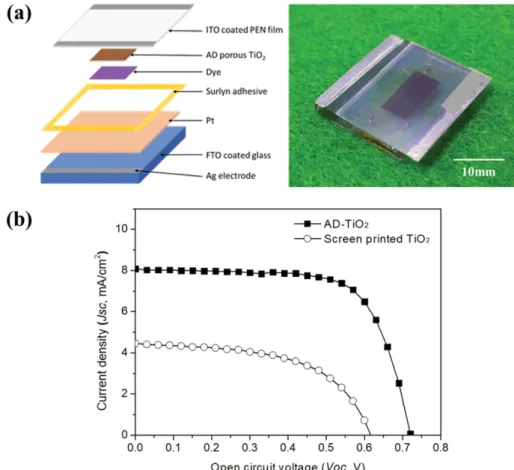
Abstract The depletion of fossil fuels and the increase in environmental awareness have led to greater interest in renewable energy. In particular, solar cells have attracted attention because they can convert an infinite amount of solar energy into electricity. Dye-sensitize solar cells (DSSCs) are low cost third generation solar cells that can be manufactured using environmentally friendly materials. However, DSSC photoelectrodes are generally produced by screen printing, which requires high temperature heat treatment, and low temperature processes that can be used to produce flexible DSSCs are limited. To overcome these temperature limitations, this study fabricated photoelectrodes using room-temperature aerosol deposition. The resulting DSSCs had an energy conversion efficiency of 4.07 %. This shows that it is possible to produce DSSCs and flexible devices using room-temperature processes.
Key words Dye-sensitized solar cell, Aerosol deposition, Photoelectrode, TiO
2, Room temperature process
1. Introduction
The energy conversion efficiency of dye-sensitized solar cells (DSSCs) is comparable to that of amorphous- silicon solar cells. Furthermore, their simple structure and low manufacturing costs mean that they are more likely to be commercialized than other third-generation or hybrid designs. DSSCs consist of four main compo- nents: dyes with selective light absorption bands to effectively absorb visible light which comprises 44 % of the energy from the sun; photoelectrodes to transport excited electrons from the dyes; oxidated/reduced liquid electrolytes; and a transparent conductive oxide (TCO) counter electrode to allow the transmission of visible light.
TiO
2is the most widely used photoelectrode because it is inexpensive, has a wide bandgap (3.2 eV), and good stability. The n-type photoelectrodes used in DSSCs are usually produced by screen printing with paste and ink [1-4]. Photoelectrodes manufactured using this method are heat treated at approximately 500
oC to burn-off the binder and to develop particle-to particle connections.
However, this process is costly and limits the choice of substrate materials.
In an attempt to overcome this problem, Gutierrez-
Tauste et al. [5] and Jiang et al. [6] conducted numer- ous studies on low temperature processes using ultra- violet (UV)-irradiation and nanowires. However, they only achieved energy conversion efficiencies of less than 2 %.
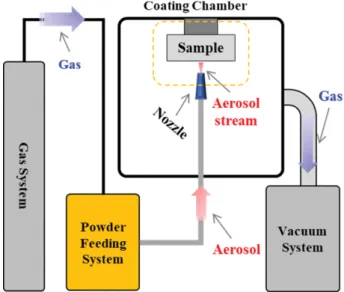
This study aims to present an improved method for manufacturing photoelectrodes using a new coating tech- nique. Here, photoelectrodes are produced using aerosol deposition on polyethylene naphthalate (PEN) films coated with transparent indium tin oxide (ITO) elec- trodes at room temperature. A DSSC fabricated using the new photoelectrode will then be compared to a tra- ditional design.
2. Experiments 2.1. Materials
TiO
2powders, with particles 200 and 15 nm in diame- ter, were used to produce the photoelectrodes (NanoPac, Korea). Anatase phase TiO
2was used as it is a well- known nanocrystalline particle that is stable at room tem- perature. Figure 1 shows a field electron scanning elec- tron microscopy (FE-SEM) image of the TiO
2particles.
A PEN film (surface resistance: 15 /□) coated with a 100 nm thick layer of ITO was used as the substrate and N719 (Solaronix, Switzerland), a ruthenium com-
†
Corresponding author
†