자가 학습 행동 분석 기반의 시니어 응급관리시스템
이덕희*ㆍ이영식*ㆍ김종견**ㆍ최철재***
Senior Emergency Management System Using Self-Learning Information Analysis
Duk-Hee Lee
*ㆍYoung-Sik Lee
*ㆍChong-Kyen Kim**ㆍChul-Jae Choi
***요 약
시니어인구의 지속적 증가로 4차 산업혁명 응용기술이 보건복지 분야에 도입이 필요한 시점이다. 또한, 청년 층 일손부족으로 노노케어 중심의 시니어 응급관리시스템이 구축되어 응급상황발생 시 시니어 동료가 응급구호 시설에 직접 통보하는 복지전달체계의 전략화가 필요하다. 본 논문에서는 시니어의 응급상황예측을 위해 스마트 앱을 통한 시니어 자가 학습으로 개별적 활동·비활동 정보를 수집분석하며, 시니어 동료가 스마트 폰 앱 메뉴를 통해 음성 및 이미지 등록정보로 응급상황을 예측하는 시니어 응급관리시스템을 설계한다.
ABSTRACT
With the continuous increase of the senior population, it is necessary to introduce the 4th industrial revolution applied technology into the health and welfare field. In addition, a senior emergency management system centered on Nono Care is established due to the shortage of young people, which requires strategization of a welfare delivery system in which senior colleagues notify emergency relief facilities directly in case of an emergency. In this paper, senior emergency management system is designed to collect and analyze individual activities and inactivity information through senior self-learning through smartphone app and to predict emergency situations with voice and image registration information through smartphone app menu.
키워드
App Solution, Senior Care, Self-learning, Emergency System 앱 솔루션, 시니어 돌봄, 자가 학습, 응급 시스템
* (주)이앤지테크 ([email protected])
* 경동대학교 소프트웨어학과([email protected])
** 경동대학교 호텔경영학과([email protected])
*** 교신저자 : 경동대학교 소프트웨어학과 ㆍ접 수 일 : 2021. 09. 05
ㆍ수정완료일 : 2021. 09. 26 ㆍ게재확정일 : 2021. 10. 17
ㆍReceived : Sep. 05, 2021, Revised : Sep. 26, 2021, Accepted : Oct. 17, 2021 ㆍCorresponding Author : Chul-Jae Choi
Dept. of Software, Kyungdong University Email : [email protected]
I. Introduction
As we enter advanced countries, the senior population is steadily increasing due to the development of living environment and medical technology. Of the total population of 51,635,000 in
2018, the number of seniors aged 65 and over accounted for 7,281,000, or 14.3%, and in 2050, it is expected to reach 17,991, or 37.4%.
As the number of senior citizens increases, the
government is also pushing to revitalize the Nono
http://dx.doi.org/10.13067/JKIECS.2021.16.5.1011
Care business where senior citizens can take care of each other along with medical aspects, which is being implemented with big data and artificial intelligence technologies of the fourth industrial revolution. The trend is to implement it with artificial intelligence technology.
In the proposed paper, as a Nono Care system that takes care of each other according to the annual increase of the senior population, it departs from the existing method of connecting to emergency relief facilities in case of an emergency, and analyzes the daily life of seniors through group activities among senior colleagues to provide inactive information when an emergency occurs, a senior fellow member visits the site to check the emergency and contact emergency relief facilities. If it is not an emergency, it has the effect of improving the unnecessary unconditional dispatch by quickly releasing the emergency situation.
Chapter 2 defines environmental analysis and domestic and foreign solutions for elderly living alone in Korea through related research, and Chapter 3 designs senior care solutions. Finally, Chapter 4 defines the commercialization method according to the implementation through conclusions.
II. Related Research
2.1 Analysis of Elderly Living Alone
Table 1. Population estimates for 2018∼50
year
division 2018 2020 2025 2030 2050
total population 51,635 51,435 51,972 52,160 48,121 Number of senior
citizens aged 65 and over (%)
7,381 (14.3)
8,084 (14.3)
10,331 (19.9)
12,691 (24.3)
17,991 (37.4) Ratio of aged
75+ 6.2 6.7 8.1 10.0 23.0
(Unit: thousand people, %)
According to the data of the National Statistical Office, based on the total population of 51,635,000 in 2018, the number of senior citizens aged 65 and over is 7,381 thousand, which is 14.3%. 10,331 thousand people, accounting for 19.9%, and by 2050, 17,991 thousand people are expected to reach 37.4% [1]. In addition, the size of the elderly living alone, the target group of beneficiaries of the Nono Care project, is expected to increase rapidly from 1.4 million in 2018 to 3 million in 2035.
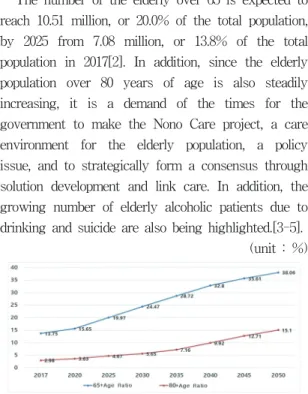
The number of the elderly over 65 is expected to reach 10.51 million, or 20.0% of the total population, by 2025 from 7.08 million, or 13.8% of the total population in 2017[2]. In addition, since the elderly population over 80 years of age is also steadily increasing, it is a demand of the times for the government to make the Nono Care project, a care environment for the elderly population, a policy issue, and to strategically form a consensus through solution development and link care. In addition, the growing number of elderly alcoholic patients due to drinking and suicide are also being highlighted.[3-5].
(unit : %)
Fig. 1 Percentage of senior from 2017 to 1950 According to the 2017 survey on Nono Care as a senior care service worker, the elderly in need of care had fewer outcomes than the elderly with high self-reliance in daily life, but at a time when the elderly population aged 70 and over and 80 years old increased, the number of caregivers is expected to increase annually[6].
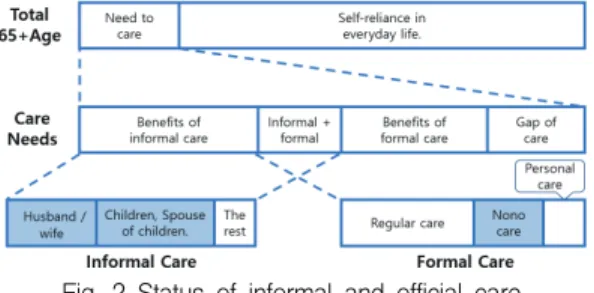
In addition, it is possible to predict situations in
which unofficial care is lower than that of
beneficiaries through formal care, considering the
government's budget, etc. among senior citizens who
need care[7]. Therefore, the design of the proposed solution requires the dissemination of risk-cognition solutions that are suitable for individuals after analyzing individual life patterns.
Fig. 2 Status of informal and official care 2.2 Domestic development status
Table 2. Domestic IoT service status
Service Service Status
SKT
In collaboration with Seoul National University Hospital, health status analysis and personalized health care programs are provided through activity measuring devices (worn waist/wrist)
Aram solution co.
Send various measurement data to the server using infrared sensor and IMU sensor technology. Used as a teaching tool for the treatment of intellectually disabled and elderly with dementia
Utarex co.
Patient's medical accident equipment by requesting RFID-based tags on the wristM2m net.
co.
The function of calling the guardian urgently in case of an emergency, checking the location and travel route using GSP/Wifi, phone call text, and informing children of entering and leaving the safe zone.
Hyodol co.
Based on senior and interaction, Hyodol, a companion doll was developed, and functions such as voice message, dementia prevention program, and safety verification were provided.
Due to the increase in the elderly population, each company is providing elderly care products[2].
Currently, hardware products are being released based on IoT functions rather than software. The Hyodori doll applies an interaction function that interacts with the elderly, allowing simple conversations according to the manual, and also includes continuous conversation requests and emergency relief facilities if there is no response for a certain period of time.
Other solutions are based on IoT, but they have
the ability to prepare for emergencies with the activity information of the elderly collected by collecting health data through sensors and providing it to a smartphone or control system.
In a state where artificial intelligence technology that can recognize emergency situations by itself is still lacking, technology for predicting dangerous situations based on input information for a static environment in the system aspect has been developed. In comparison, the proposed system is efficient in utilizing the analysis information through the activity and inactivity collected information of seniors. This is a method that measures individual daily information by a certain time unit and provides an emergency notification menu if it is different from the existing activity information.
In particular, according to the 2015 survey data of 720 seniors residing in Gangwon-do, 19.4% of the senior population used smartphones, among which 57.9% of the SNS community apps were used, and 49.3% of them took photos and videos.
Therefore, it is judged that the proposed solution, Nono Care solution, will be easily applied[3].
2.3 Overseas Development Status
Table 3 Status of IoT Services in Overseas
Service Service Status
Watch type Vital sign recorder
A system in which sensors attached to a clock automatically check health and transmit data wirelessly to a smartphone or computer.
Emergency call machine using RFID
A pager that allows elderly people to contact their guardians when they fall or are in an emergency, seeking help and simply pressing a button.
Silver phone
Silver phones too for the elderly can read newspapers and Internet articles while listening to music like regular smartphones.Telemedicine service
Taiwan's Chunghua Biologicla Technology Corp.
and HISC, a welfare service center in the United States, have entered into a strategic partnership to provide telemedicine services so that the elderly can receive medical services from the comfort of their own homes.
JUST 5
companies – CP09 MIA phone
After Voxtel launched the so-called 'grandmother's phone' in 2009, Samsung (C3060R), JUST 5, teXet, and Fly, as well as Russian telecom operator Megafon, launched the product on a large scale.
As shown in Table 3, trends and examples of overseas technology development are developing IoT-based aged care solutions using IT technologies and products such as RFID, wireless LAN, mobile devices, and cloud computing.
However, considering the elderly who cannot handle electronic products well, products that re-manufacture existing products for the convenience of the elderly are gaining popularity. In addition, telemedicine services and various medical devices that combine information and communication technology(ICT) and life technology(BT) are being commercialized and serviced for the elderly population.
Ⅲ. Self-learning behavior analysis
3.1 Senior Emergency Management Scenario
Fig. 3 Service provision
This is the design implementation stage of the proposed senior emergency management system. The emergency management system based on senior self-learning and behavioral analysis of daily life is a solution for families, senior colleagues, and multi-party life managers to share activity information of the elderly living alone with smartphone applications in a privacy environment.
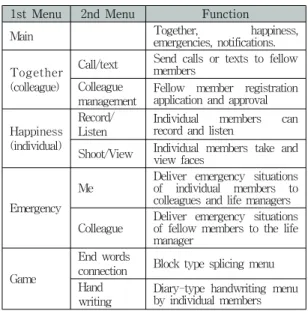
Table 4 is the senior emergency system menu.
When an abnormal situation is predicted with the collected daily activity information, the information is delivered to the life manager and senior colleagues through a solution.
Table 4. Senior emergency system menu
1st Menu 2nd Menu Function
Main Together, happiness,
emergencies, notifications.
Together (colleague)
Call/text Send calls or texts to fellow members
Colleague management
Fellow member registration application and approval Happiness
(individual)
Record/
Listen
Individual members can record and listen
Shoot/View Individual members take and view faces
Emergency
Me Deliver emergency situations of individual members to colleagues and life managers Colleague Deliver emergency situations
of fellow members to the life manager
Game
End words
connection Block type splicing menu Hand
writing
Diary-type handwriting menu by individual members
Unconditional emergency dispatch can be resolved by having the closest colleague visit the emergency situation and contact the emergency relief facility.
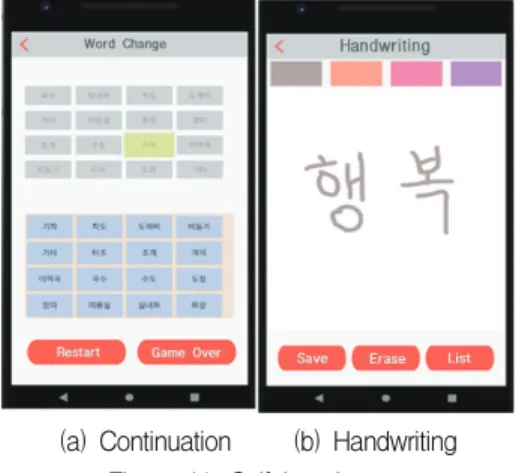
In addition, the provision of game menus including the collection of senior behavioral information motivates the brain activity to prevent dementia and depression in seniors. Word chain enhances concentration by randomly placing text boxes in block format to select words sequentially, and provides handwriting menus for daily life moods so that handwriting diaries can be written and stored directly.
In addition, during senior self-study, smartphone
photography and photo editing can be achieved by
sharing information with senior colleagues through
SNS, and the mood at that time can be left as data
on the app, linking it to data so that life managers
can continuously monitor and predict emergency
situations.
3.2 Senior emergency management system 1) Development Environment
The senior emergency management system was developed based on the e-Government framework so that it can be operated by local governments and care operating organizations, and consists of the environment shown in Table 5.
Table 5. System Configuration
Division Specification
H/W
Develop server
Desktop PC Geometry M’gmt Server
Integrated Build Server
S/W
Develop Framework E-Government 3.8
UI Bootstrap
Application JAVA(jdk-8u73 )
Database Maria DB 10.4
WAS Tomcat 8
OS Ubuntu 16.04
2) System block diagram
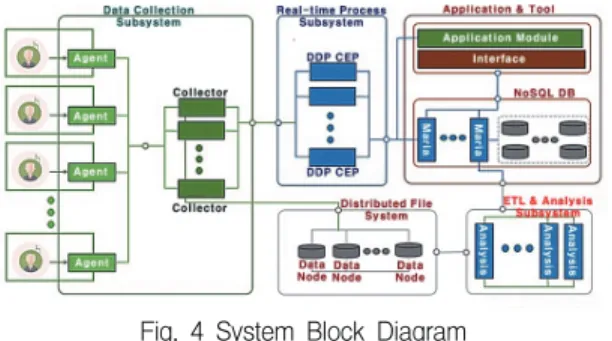
Figure 4 shows the process data processing structure of the process of collecting activity information of senior individual members and performing information of life managers from each member and storing them in the physical DB through distributed CEP.
Fig. 4 System Block Diagram
The data collection subsystem collects activity information for each senior individual member, sends it to the Real-time Process Subsystem, and stores it in the physical DB through Application &
Tool. through the ETL & Analysis Subsystem.
3) Program main module
Based on the purpose of collecting activity information of senior members, the proposed paper has a structure in which individual members by happiness, emergency, and game menu are linked together as the main module of identifier, as shown in Figure 5.
protected void onCreate(Bundle savedInstanceState) { super.onCreate(savedInstanceState);
getWindow().setFlags(WindowManager.LayoutParams.FLAG_F ULLSCREEN,
WindowManager.LayoutParams.FLAG_FULLSCREEN);
setContentView(R.layout.activity_main);
toolbar = findViewById(R.id.toolbar);
setSupportActionBar(toolbar);
DrawerLayout drawer = findViewById(R.id.drawer_layout);
ActionBarDrawerToggle toggle = new ActionBarDrawerToggle(
this, drawer, toolbar, R.string.navigation_drawer_open, R.string.navigation_drawer_close);
drawer.addDrawerListener(toggle);
toggle.syncState();
loadSharedData();
FirebaseInstanceId.getInstance().getInstanceId().addOnSuccessLis tener(this, new
OnSuccessListener<InstanceIdResult>() {
@Override
public void onSuccess(InstanceIdResult result) { String newToken = result.getToken();
Log.d(TAG, "Firebase Reg id : " + newToken);}
});
setStartService();// service start PowerManager pm = (PowerManager) getSystemService(Context.POWER_SERVICE);
mWakeLock =
pm.newWakeLock(PowerManager.PARTIAL_WAKE_LOCK, getClass().getName());
mWakeLock.acquire(); }
Fig. 5 Main module
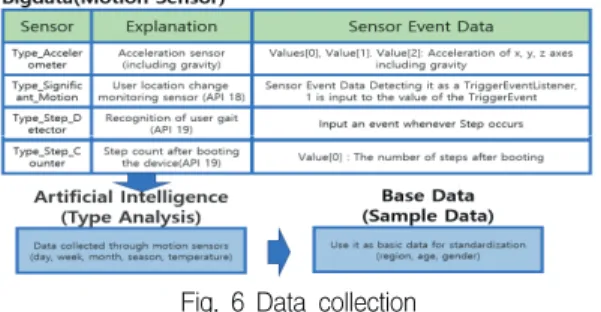
3.3 Senior behavioral data collection design It collects activity information and location information from the motion sensor provided by the smartphone. Activity and inactivity information is collected through Type_Accelerometer and Type_step_Detector, and user location information is collected through Type_Significant_Motion.[8-10]
The information collected in this way is defined as
location information, and if activity information
below the standard is shown by patterning it into
daily information with the control menu, it is
predicted as an emergency.
Fig. 6 Data collection
3.4 Senior Activity Information Analysis App This section provides design-oriented research on senior behavior analysis care system. Figure 7 shows the design results by dividing the senior app for collecting activity information and the life manager app for monitoring the collected data.
(a)senior app (b)Life manager app Fig. 7 Service menu
(a)Add to friends (b)Friend Approval Fig. 8 Together (Colleagues) Menu
Figure 8 shows the process of adding and approving a senior member as a colleague in order to share an emergency situation and call or voice message. In particular, it is registered in the form of an image so that colleagues can be easily identified in the Add Friends menu.
Figure 9 shows the happiness (individual) menu, which captures the current mood of the senior through self-learning by recording/listening and shooting/viewing. It is a menu of fun elements through seniors taking and analyzing photos themselves. A life manager can prevent dangerous situations in advance by monitoring whether he is depressed or in a normal state through voice keywords and photo-taking images.
(a)Record/Listen> (b)Shoot/View>
Fig. 9 Happiness (Personal) Menu
(a) emergency request (b) Location infor menu
Figure 10. Emergency menu
Figure 10 shows a menu in which, if the senior himself/herself recognizes a dangerous state and requests through the emergency menu, nearby fellow members will quickly visit directly through the location information and contact the emergency relief facility according to the confirmation result.
Figure 11 is a self-learning game menu that expresses the feelings of seniors by providing a continuation menu for seniors' dementia and depression prevention and a handwriting menu to leave the current psychology in writing. Provides a function to recognize the psychology of the senior.
(a) Continuation (b) Handwriting Figure 11. Self-learning menu
Fig. 12 Control System Menu 3.5 Life manager monitoring design
As a system to control senior activity information, the activities and inactivity information of senior care members is graphically visualized from the daily and current status, and the location
information is collected time-to-time to predict trends in the event of danger and thus provides protection from emergencies.
IV. Conclusion and Suggestions The number of senior members is continuously increasing due to the aging population and changes in the perception of caring for careers. In preparation for such changes in the social environment, the application of core technologies of the 4th industrial revolution is required. There is a need for a solution in terms of senior population policy and welfare, and policies should be developed so that many seniors can receive various benefits through the proposed senior emergency management system.
In the proposed thesis, the daily information of senior members is collected through the smartphone sensor, separated into activity and inactivity information, and daily patterns are compared and analyzed to prepare for emergency situations. By installing the app, it is possible to improve the wasteful emergency call response due to an error in the recognition of an emergency situation as a post-visit measure by establishing a Nono Care between seniors. In addition, it is possible to grasp the mental health status of seniors through self-learning. Game menu learning information with fun elements to prevent depression and dementia provides daily life status information to life managers.
Based on data collection information by senior
members in the future, the goal is to improve the
system through technology development and
application that can reduce cognitive errors in
emergencies by applying self-learning-based
artificial intelligence algorithms.
References
[1] J. Yoo, “A Survey on the Status of Nono Care,”
Report, 2018.
[2] E. Kang, “Labour Force Participation and Social Participation among Older Adults in Korea,”
Report, 2018.
[3] S. Kim, “A Study on the Job Experience of the Life-care Managers for Elders Living Alone,”
Master's Thesis, Dankook University, 2019.
[4] K. Jin, “The Effect of Alcohol Usage on Suicidal Ideation for the Elderly Living Alone,” Master's Thesis, Myongji University, 2016.
[5] K. Jin, “The Effect of Alcohol Usage on Suicidal Ideation for the Elderly Living Alone : Staying Single as a Moderator,” Master's Thesis, Myongji University, 2016.
[6] Y. Kim, “Effects of Smartphone Usage on Life Satisfaction of Older Adults in Rural Area,”
Master's Thesis, Hallym University, 2019.
[7] C. Cho, “The Effect of Basic Service for Elderly Care on Living Satisfaction for the Elderly living alone,“ Master's Thesis, Korea National Transportation University, 2019.
[8] Y. Baek, H. Lee, and J. Oh, “A Study on the Near Field IoT Medical Receipt System Based on Uncontact,”
J. of the Korea Institute of Electronic Communication Sciences, vol. 15, no. 4, 2020, pp. 785-790.
[9] O. Kim and Y. Goh, “Data Collection System to Water Depth in Reservoir Using Accurate Location Information,” J. of the Korea Institute of Electronic Communication Sciences, vol. 15, no.
2, 2020, pp. 327-334.
[10] Y. Kong, H. Kim, Y. Yi, and S. Kang,
“Development of Incident Detection Algorithm using GPS Data,” J. of the Korea Institute of Electronic Communication Sciences, vol. 16, no. 4, 2021, pp. 771-782.
저자 소개
이덕희(Duk-Hee Lee)
2010년 한국방송통신대학교 컴퓨터 과학과 졸업(이학사)
2021년 강원대학교 산업대학원 컴 퓨터정보통신공학과(석사수료) 2015년∼현재 (주)이앤지테크 연구소장
※ 관심분야: 시니어웹케어, CMS
이영식(Young-Sik Lee)
1986년 한국항공대학교 통신정보공 학과 졸업(공학사)
1996년 경희대학교 산업정보대학원 정보통신학과 졸업(공학석사) 2004년 관동대학교 전자통신공학과 졸업(공학박사) 1985년∼1992 삼성전자 통신종합연구소
1992년∼1995 경복대학 전자계산과 전임강사 1997년∼현재 경동대학교 소프트웨어학과 교수
※ 관심분야 : 전자통신공학, 사이버범죄론
김종견(Chong-Kyen Kim)
1990년 미국캘리포니아 Asusa퍼스 픽대학교 대학원 졸업(석사) 2000년 동국대학교 대학원 영어영 문학과(박사)
2000년∼현재 경동대학교 호텔경영학과 교수
※ 관심분야 : 호텔정보시스템, 농촌복지정책
최철재(Chul-Jae Choi)