188
and Safety
Available online at http://www.foodhygiene.or.kr
http://dx.doi.org/10.13103/JFHS.2013.28.2.188
식품 중 사용금지 원료인 Aphanizomenon flos-aquae 검출법 개발 및 응용
박용춘*·신승정1·이호연·김용상·김미라·이상재·이화정
식품의약품안전처 식품의약품안전평가원 식품위해평가부 신종유해물질팀, 1식품의약품안전처 건강기능식품기준과
Development and Application of Detection Method for
Aphanizomenon flos-aquae not Usable as a Food Materials in Korea
Yong-Chjun Park*, Seung-Jung Shin1, Ho-Yeon Lee, Yong-Sang Kim, Mi-Ra Kim, Sang-Jae Lee, and Hwa-Jung Lee
New Hazardous Substance Team, Food Safety Evaluation Department, National Institute of Food and Drug Safety Evaluation, Ministry of Food and Drug Safety
1Health/Functional Food Standardization Division, Ministry of Food and Drug Safety Osongsaengmyeong2-ro, Osong-eup, Cheongwon-gun, Chungcheongbuk-do 363-700, Korea
(Received April 5, 2013/Revised May 9, 2013/Accepted June 4, 2013)
ABSTRACT - Anatoxin-a, saxitoxin and neosaxitoxin are produced by Aphanizomenon flos-aquae that is a sort of the cyanobacteria phylum. Therefore, it is not permitted for food materials in Korea. Traditionally, the classification of cyanobacteria has been based on morphological characters such as trichome width, cell size, division planes, shape, and the presence of character such as gas vacuole. But, some diagnostic features, such as gas vacuole or akinetes, can show variation with different environmental or growth conditions and even be lost during cultivation. Therefore, we developed detection method for functional foods containing Aph. flos-aquae by PCR. To design the primer, 16S rRNA region of Aph. flos-aquae, Spirulina laxissima, and Spirulina spp. registered in the GeneBank (www.ncbi.nlm.nih.gov) have been used and for comparative analysis, BioEdit ver. 7.0.9.0. was used. As a result, we was design AFA-F1/AFA- R1 (363 bp) primer for the differentiation Aph. flos-aquae from chlorella, spirulina, green tea, and spinach. Also, it could be distinguished chlorella and spirulina products those are made to contain 1% Aph. flos-aquae.
Key words: Aphanizomenon flos-aquae, 16S rRNA, PCR
서 론
시아노박테리아(Cyanobacteria 문)에 속하는 조류는 전 세계적으로 수 천년 동안 식품원료 및 가벼운 질병을 치 료하기 위하여 사용되어졌다1.2). 극동지역의 해안가 지방 에서는 기원전 6,000년 전부터 식품원료로 해초 등의 대 형조류(macroalgae)를 사용하였으며, 서기 900년부터 의약 품으로써 사용하였다는 근거가 있다3). 대부분의 미세조류 생산업체는 아시아태평양 지역에 밀집되어있고 매년 약 500톤의 생산능력을 보유하고 있으며 생산되는 미세조류
는 Aphanizomenon flos-aquae, 클로렐라, 스피루리나, 두날 리엘라 등이 주종을 이룬다4). 스피루리나의 경우 지난 30 년간 사람 또는 동물의 식품공급원 및 식품 중 색깔을 내 기 위하여 상업적으로 생산되고 있으며5,6), 아프리카, 캘리 포니아, 하와이, 태국, 중국, 타이완, 인디아에서는 설비시 설을 갖춘 야외 연못에서 배양하고 있다7). 그리고 1995년 기준 전 세계적으로 약 2,000톤이 생산되고 있다5). 설비 시설을 갖춘 야외연못에서 생산하는 스피루리나와 다르게 Aph. flos-aquae는 주로 야외의 대형호수에서 수확하며 1980 년대 초부터 미국 오레곤 주의 클래머스 호(Upper Klamath Lake)에서 가장 큰 규모로 수확되며 식품 및 건강식품보 충제로 판매되고 있으며 건조 중량으로 약 1,000톤 이상 이 생산되고 있는 것으로 보고되고 있다8). 기능성식품의 측면에서 Aph. flos-aquae의 지질 중 약 50%(전체 건조량 의 5-9%)는 불포화지방산으로 구성되어 있으며 동물실험 결과 식이보충제 뿐 아니라 혈액의 콜레스테롤 수치를 저
*Correspondence to: Yong-Chjun Park, New Hazardous Substance Team, Food Safety Evaluation Department, National Institute of Food & Drug Safety Evaluation, Ministry of Food and Drug Safety, 187 Osongsaengmyeong2-ro, Osong-eup, Cheongwon-gun, Chungcheongbuk-do 363-700, Korea
Tel: 82-43-719-4454, Fax: 82-43-719-4450 E-mail : [email protected]
감화하는 효과가 있다고 보고하고 있다9). 그러나 클래머 스 호는 독성물질을 생산하는 시아노박테리아의 일종인 Microcystis aeruginosa가 항상 생존하고 있어 수확 중에 오염 가능성이 높다10). Carmichael 등8)에 따르면 클래머스 호에서 수확한 Aph. flos-aquae의 80% 이상에서 마이크로 시스틴 독소가 검출되었다고 보고하였다. 또한 Rapala 등11), Ferreira 등12)및 Mahmood 등13)에 의하면 Aph. flos-aquae 는 anatoxin-a, saxitoxin, neosaxitoxin 등의 독소를 생산할 수 있음을 보고하였다. 스피루리나의 경우 독소를 생산한 다는 보고는 없으며14), 클로렐라 제품의 경우 Aph. flos- aquae에 오염된 제품이 종종 유통되기도 한다10).
Aph. flos-aquae는 남조류강(Cyanophyceae Class) 연쇄체 목(Nostocales Order) 염주말과(Nostocaceae Family)에 속 하는 남조류의 일종이며 담수에서 자생하며 녹조현상을 일으키는 주요 미세조류의 일종이다15,16). Yamamoto17)에 따 르면 비교적 높은 위도지역에서 녹조 발생 시 최초로 발견 된다는 보고가 증가하고 있다고 밝혔다. 국내의 경우 낙동 강에서 시아노박테리아에 의하여 여름과 초가을에 녹조현 상이 발생하며18)주요 원인균 중 Aph. flos-aquae, Microcystis, Anabaena 등은 담수 환경에 나쁜 영향을 나타내는 것으 로 알려져 있다19). 형태학적 특징으로는 수십에서 수백 µm 의 사상체로 구성되어 있으며 사상체는 대부분 영양세포 로 구성되어 있고 중간에 간헐적으로 이형세포(heterocyst) 가 나타나기도 하며 기온이 낮아지는 등의 생장환경의 변 화가 발생하면 무성포자를 형성하여 생존한다20). 그리고 환경조건 중 수온과 pH에 의하여 영향을 많이 받으며 수 온 15.1oC 이상 또는 pH9 이상에서는 매우 증식속도가 높 은 것으로 측정되었으나 일조량에 대하여는 크게 영향을 나타내지 않는다20). 시아노박테리아의 분류는 사상체의 넓 이, 세포크기, 분열형태, 배열형태, 색소, 가스주머니의 존 재 등 형태학적 특징에 기본을 두고 있다21,22). 그러나 Komarek 등은22) 배양조건에 따른 환경변화로 인하여 50%
이상은 동정결과에 차이가 있을 수 도 있다고 보고하였다.
즉, 가스주머니 등은 생장조건 또는 서로 다른 환경에 따 라 다양성을 보여주며 심지어 배양 중 소실되기도 한다23). 이러한 형태학적 분류체계의 한계를 극복하기 위하여 최
근에는 유전자염기 구성 비율, 유전자염기서열 결정 등에 대한 분자생물학적 접근이 시도되고 있다24).
상기에서 기술하였듯이 Aph. flos-aquae는 식품원료로 활 용가치가 있지만 독소를 생성하기 때문에 소비자의 건강 을 위하여 현재 국내에서는 식품원료로 사용할 수 없도록 규정하고 있다. 따라서 시중에 유통 중인 건강기능식품 중 클로렐라 또는 스피루리나 제품에 Aph. flos-aquae가 혼합 되어 있는지를 확인하기 위하여 형태학적 분석법은 적용 에 어려움이 있어 종 특이 프라이머를 이용한 PCR 법을 개발하였다. 본 연구에서 개발한 방법은 소비자 및 선의 의 식품제조·유통업체를 보호하는 등 식품안전관리에 활 용할 수 있을 것으로 기대된다.
재료 및 방법
시약 및 검체 구입
유전자증폭(Polymerase Chain Reaction, PCR)을 위한 프 라이머 및 Taq DNA polymerase는 바이오니아(Bioneer, Korea)에 의뢰하여 합성 또는 구매하였다. PCR 장비는 C1000 TouchTM Thermal Cycler (Bio-RAD Laboratories, Inc. USA)을 사용하였으며, 유전자 추출은 DNeasy Plant mini 키트(Qiagen GmbH, Hilden, Germany)를 사용하였다.
표준시료인 Aph. flos-aquae, 클로렐라, 스피루리나는 식 품의약품안전처 (건강기능식품기준과)로부터 분양 받았으 며, 대조군으로 사용된 녹차, 시금치, 클로렐라 제품 2종, 스피루리나 제품 2종은 일반 마트에서 직접 구입하였다.
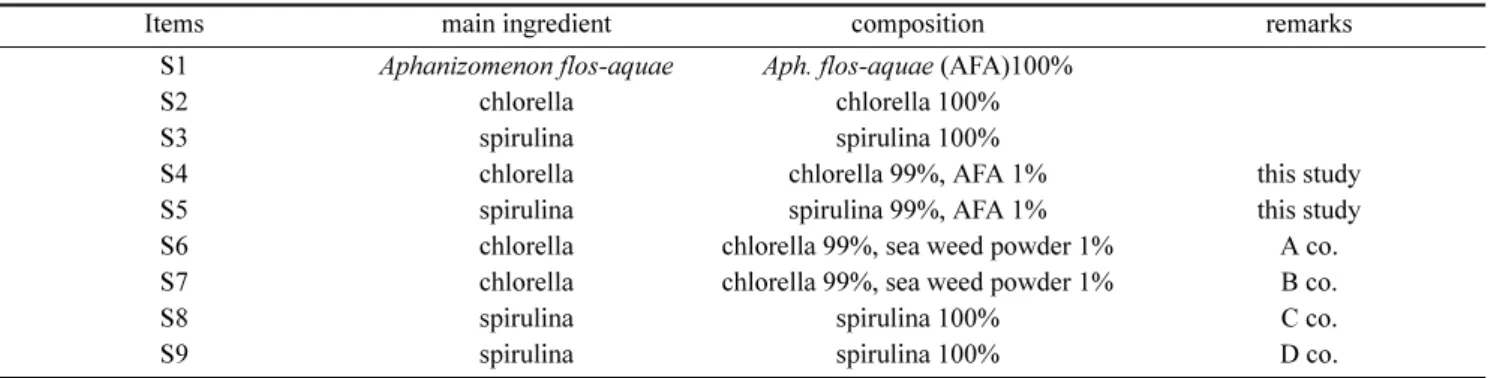
그리고 표준시료를 이용하여 클로렐라 및 스피루리나에 Aph. flos-aquae가 각각 10% 함유하도록 실험실에서 제조 하였으며, 사용된 제품에 대하여는 Table 1에 명기하였다.
유전자 추출
DNeasy Plant mini 키트를 사용하여 유전자를 추출하였 다. 추출방법은 제조사에서 제공하는 추출법에 의거하여 추출하였으며, 단 최종 용출단계에서는 AE 완충용액 대신 멸균증류수를 사용하여 DNeasy Mini spin column으로부 터 용출하였다
Table 1. List of blue green algae related product used in this study
Items main ingredient composition remarks
S1 Aphanizomenon flos-aquae Aph. flos-aquae (AFA)100%
S2 chlorella chlorella 100%
S3 spirulina spirulina 100%
S4 chlorella chlorella 99%, AFA 1% this study
S5 spirulina spirulina 99%, AFA 1% this study
S6 chlorella chlorella 99%, sea weed powder 1% A co.
S7 chlorella chlorella 99%, sea weed powder 1% B co.
S8 spirulina spirulina 100% C co.
S9 spirulina spirulina 100% D co.
종 특이 프라이머 설계
미국 국립보건원에서 운영하는 유전자은행(www.ncbi.
nlm.nih.gov)에 등록되어있는 Aph. flos-aquae (Accession No. FJ424569 및 EU157995), 스피루리나(Accession No.
DQ393278 및 HQ008228)의 16S rRNA부위에 대한 염기 서열을 대상으로 하였으며 비교 및 분석에는 소프트웨어
인 BioEdit ver. 7.0.9.0 프로그램을 사용하였다.
Polymerase Chain Reaction (PCR) 반응액 조성 및 반 응조건
PCR을 위한 반응액의 조성은 주형 DNA 50 ng, dNTPs 200µM, MgCl2 2.0 mM, 프라이머 각 0.5 µM이 되게 혼
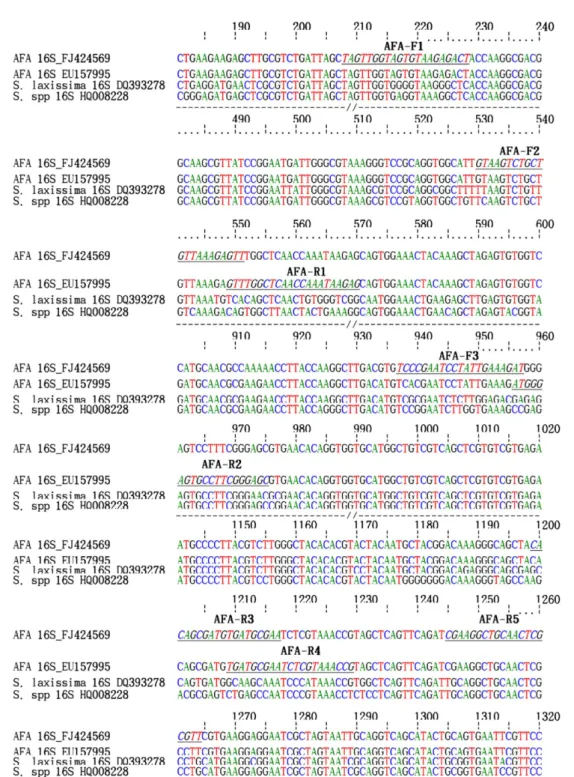
Fig. 1. Nucleotide sequence alignment and primer information designed from 16S rRNA gene of Aphanizomenon flos-aquae (Accession No.
FJ424569 and EU157995), Spirulina laxissima (Accession No. DQ393278) and Spirulina spp. (Accession No. HQ008228) for detection of Aphanizomenon flos-aquae. The underline and italic sequence indicate designed primer site. For more detailed contents of primer see the Table 2.
합하였으며 최종 용량은 20 µl로 하였다. Aph. flos-aquae 판별을 위한 PCR 반응조건은 95oC에서 5분 예비가열 후, 95oC 30초 변성, 60oC 15초 재결합, 72oC 30초 중합반응 등의 과정을 35회 반복하고 마지막에 72oC에서 3분간 처 리하였다.
결과확인
최종산물의 확인은 반응액 2 µl를 취하여 2% 아가로즈 젤로 100 V, 30분간 전기영동하고 EtBr로 염색(1 µg/ml) 한 후 UV투영기를 이용하여 확인하였다.
결과 및 고찰
종 특이 프라이머 설계
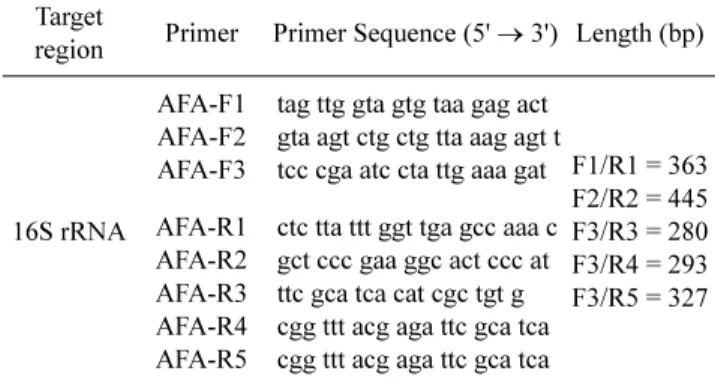
Aph. flos-aquae의 검출을 위한 종 특이 프라이머를 설 계하기 위하여 유전자은행(www.ncbi.nlm.nih.gov)에 등록 되어있는 Ahp. flos-aquae (Accession No. FJ424569 및 EU157995), Spirulina laxissima (Accession No. DQ393278) 및 Spirulina spp. (Accession No. HQ008228)의 16S rRNA 염기서열을 이용하였다. Aph. flos-aquae의 경우 등록된 염 기서열의 오류 범위를 줄이기 위하여 2 종을, 스피루리나 의 경우 Spirulina laxissima 및 Spirulina spp.를 선정하였 다. 그리고 클로렐라의 경우 활용할 수 있는 16S rRNA 염기서열이 없어 이론적 비교·분석 어려워 가능한 여러 종류의 프라이머를 설계하여 실험을 통한 최적의 프라이 머를 선정하였다. Aph. flos-aquae에 대한 특이 프라이머 를 설계하기 위하여 정방향 3종(AFA-F1, AFA-F2 및 AFA- F3)과 역방향 5종(AFA-R1, AFA-R2, AFA-R3, AFA-R4 및 AFA-R5)을 설계하였다. 그리고 가공식품에 대하여 적용이 가능하도록 하기 위하여 PCR 산물의 크기는 가급적으로 300 bp 이내가 되도록 조합을 구성하여 총 5종류(AFA-F1/
AFA-R1, AFA-F2/AFA-R2, AFA-F3/AFA-R3, AFA-F3/AFA- R4, AFA-F3/AFA-R5)의 조합이 이루어지도록 하였으며(Fig.
1), 설계된 프라이머에 대한 정보는 Table 2에 기술하였다.
Aph. flos-aquae 판별 프라이머 선정
Carmichael 등13)에 따르면 클래머스 호에서 수확한 Aph.
flos-aquae의 80% 이상에서 마이크로시스틴 독소가 검출 되었다고 보고하고 있으며, 클로렐라, 스피루리나의 생산 단가가 높아 일부 생산업체에서는 Aph. flos-aquae를 혼합 하여 제품을 생산하여도 현재의 분석법으로는 혼합여부를 확인할 수 없다. 그리고 Aph. flos-aquae, 클로렐라, 스피 루리나는 고유의 형태학적 특징이 있으나 배양조건 등 환 경변화에 의하여 형태학적 분류에 오류가 있을 수 있어22) 유전자분석법을 시도하였다. 유전자분석법에는 염기서열 결정 등의 방법이 있으나 분석시간, 분석기술, 분석비용 등을 고려하여 신속·정확하고 분석방법이 간편한 종 특 이 프라이머를 이용하였다. 또한 대조군으로는 녹차 및 시 금치를 추가하여 수행하였다. 설계된 총 5종류(AFA-F1/
AFA-R1, AFA-F2/AFA-R2, AFA-F3/AFA-R3, AFA-F3/AFA- R4, AFA-F3/AFA-R5)의 프라이머를 이용하여 PCR을 수행 한 결과 AFA에서는 PCR 산물이 뚜렷이 생성되고 클로렐 라, 스피루리나, 녹차 및 시금치에서는 특이적 밴드가 형 성되지 않는 AFA-F1/AFA-R1 (363 bp)을 최종 선정하였다 (Fig. 2)
유통제품에 대한 적용성 검토
국내의 「건강기능식품에 관한 법률」제19조에 의거한
Table 2. Species-specific primer designed for detection of Apha- nizomenon flos-aquae
Target
region Primer Primer Sequence (5'→ 3') Length (bp)
16S rRNA
AFA-F1 AFA-F2 AFA-F3
tag ttg gta gtg taa gag act gta agt ctg ctg tta aag agt t
tcc cga atc cta ttg aaa gat F1/R1 = 363 F2/R2 = 445 F3/R3 = 280 F3/R4 = 293 F3/R5 = 327 AFA-R1
AFA-R2 AFA-R3 AFA-R4 AFA-R5
ctc tta ttt ggt tga gcc aaa c gct ccc gaa ggc act ccc at ttc gca tca cat cgc tgt g cgg ttt acg aga ttc gca tca cgg ttt acg aga ttc gca tca
Fig. 2. PCR results from various blue green algae and plant by PCR using AFA-F1/AFA-R1 primer designed for detection of Aph- anizomenon flos-aquae. Lane S; 100 bp ladder, 1; Aphanizomenon flos-aquae 2; Chlorella spp. 3; Spirulina spp. 4; Camellia taliensis, 5; Spinacia oleracea, 6; no template control.
Fig. 3. PCR results from blue green algae-related product by PCR using Aphanizomenon flos-aquae-specific primer (APA-F1/APA- R1). Lane S; 100 bp ladder, 1; Aphanizomenon flos-aquae, 2; chlo- rella product containing Aphanizomenon flos-aquae 1%, 3; spir- ulina product containing Aphanizomenon flos-aquae 1%, 4;
chlorella product (S6), 5; chlorella product (S7), 6; spirulina prod- uct (S8), 7; spirulina product (S9), 8; no template control. For more detailed information of samples see the Table 1.
건강기능식품 공전 제3. 개별기준 및 규격 2. 기능성원료 에 따르면25)클로렐라 및 스피루리나는 제조방법을 “인공 적으로 배양하고 건조하여 제조하여야 함” 그리고 기능성 분 (또는 지표성분)의 함량은 “총 엽록소를 각각 10 mg/g, 5 mg/g 이상 함유하고 있어야 함”으로 명기하고 있다. 또 한 일반적으로 자연호수에서 채취하며8) 독성물질을 생산 하는 특징11,12,13)이 있는 Aph. flos-aquae에 대하여 식품의 약품안전처에서는 식품원료로 사용으로 할 수 없도록 규 정하고 있다26). 따라서 국내에 유통 중인 건강기능식품에 대하여 식용불가 원료인 Aph. flos-aquae 함유여부를 조사 하였다. 대상 시료로는 클로렐라 및 스피루리나 제품 각 2건을 구입하였으며, 분양받은 Aph. flos-aquae, 클로렐라, 스피루리나를 이용하여 Aph. flos-aquae가 1% 함유되도록 실험실 조건에서 제조하였다. 본 연구에서 설계한 AFA- F1/AFA-R1 프라이머를 이용한 PCR 분석 결과 유통 중인 제품에서는 Aph. flos-aquae가 검출되지 않았으며 Aph. flos- aquae가 1% 함유되도록 제조된 시료에서는 모두 PCR 산 물을 확인하였다(Fig. 3). 따라서 본 연구에서 확립된 시 험 방법은 의도적으로 혼합하거나 비의도적으로 혼입된 가공식품에 대하여 Aph. flos-aquae의 확인이 가능하여 소 비자의 건강 및 건전한 제조·유통업체를 보호할 수 있는 식품안전관리에 활용이 가능할 것으로 기대된다.
감사의 말
이 논문은 2013년도 식품의약품안전처 자체연구개발과 제(13161소비자102) 연구비로 수행된 결과의 일부로서 이 에 감사의 글을 전합니다.
요 약
Aphanizomenon flos-aquae는 시아노박테리아 일종이며 anatoxin-a, saxitoxin, neosaxitoxin 등의 독소를 생산할 수 있어 국내에서는 식품원료로 사용이 금지되어있다. 전통 적으로 시아노박테리아는 사상체 넓이, 세포 크기, 분열방 법, 세포형태, 가스주머니의 존재유무 등의 형태학적 특징 에 의한 분류가 가능하다. 그러나 가스주머니 혹은 무성 포자와 같은 특징은 주변 환경 또는 생장조건에 따라 차 이가 있으며 경우에 따라 소실되기도 한다. 따라서 PCR 에 의한 Aph. flos-aquae를 함유하는 기능식품을 검출할 수 있는 분석법을 개발하였다. 프라이머를 설계하기 위하 여 유전자은행(www.ncbi.nlm.nih.gov)에 등록되어있는 Aph.
flos-aquae, 스피루리나의 16S rRNA 염기서열을 이용하였 으며, 비교 및 분석에는 BioEdit ver. 7.0.9.0 프로그램을 사용하였다. 최종적으로 클로렐라, 스피루리나, 녹차, 시금 치로부터 Aph. flos-aquae를 검출할 수 있는 AFA-F1/AFA- R1 (363 bp) 프라이머를 최종 선정하였다. 그리고 상기 프
라이머는 Aph. flos-aquae가 각각 1% 함유 되도록 제조된 클로렐라, 스피루리나 제품에서 모두 혼입여부의 확인이 가능함을 확인하였다.
참고문헌
1. Hoppe HA, Levring T, Tanaka Y. Marine algae in pharmaceu- tical science. Walter de gruyter Publs, New York. USA. pp.
25-119 (1979).
2. Richmond A. Handbook of microalgal mass culture. CRC Press, Boca Raton, Florida, USA. pp. 528 (1990).
3. Cannell RJP. Algal biotechnology. Appl. Biochem. Biotech.
26, 85-105 (1990).
4. Lee YK. Commercial production of microalgae in the asia- pacific rim. J. Appl. Phycol. 9, 403-411 (1997).
5. Belay A, Kato T, Ota Y. Spirulina(Arthrospira): potential application as an animal feed supplement. J. Appl. Phycol. 8, 303-311 (1996).
6. Ciferri O, Tiboni O. The biochemistry and industrial poten- tial of Spirulina. Ann. Rev. Microbiol. 39, 503-526 (1985).
7. Li DM, Qi YZ. Spirulina industry in china: present status and future prospects. J. Appl. Phycol. 9, 25-28 (1997).
8. Carmichael WW, Drapeau C, Anderson DM. Harvesting of Aphanizomenon flos-aquae Ralfs ex Born. & Flah. var. flos- aquae (Cyanobacteria) from Klamath Lake for human dietary use. J. Appl. Phycol. 12, 585-595 (2000).
9. Kushak RI, Drapeau C, Van Cott EM, Winter H. Favorable effects of blue-green algae Aphanizomenon flos-aquae on rat plasma lipids. J. Amer. Nutrac. Asso. 2, 59-65 (2000).
10. Heussner AH, Mazija L, Fastner J, Dietrich DR. Toxin con- tent and cytotoxicity of algal dietary supplements. Tox. Appl.
Pharm. 265, 263-271 (2012).
11. Rapala J, Sivonen K, Luukkainen R, Niemela S. Anatoxin-a concentration in Anabaena and Aphanizomenon under differ- ent environmental conditions and comparison of growth by toxin and non-toxic Anabaena-strains. J. Appl. Phycol. 5, 581- 591 (1993).
12. Ferreira F. Franco Soler J, Fidalgo M, Fernandez-Vila P. PSP toxin from Aphanizomenon flos-aquae(cyanobacteria) col- lected in the Crestuma-Lever reservoir(Douro river, northern Portugal). Toxicon. 39, 757-761 (2001).
13. Mahmood NA, Carmichael WW. Paralytic shellfish poisons producted by the freshwater cyanobacterium Aphanizome- non flos-aquae NH-5. Toxicon. 24, 175-186 (1986).
14. Yang Y, Park Y, Cassada D, Snow D, Roger D, Lee J. In vitro and in vivo safety assessment of edible blue-green algae, Nos- toc commune var sphaeroides Kutzing and Spirulina planten- sis. Food Chem. Toxicol. 49, 1560-1564 (2011).
15. Environmental Newspaper. The Value of Variable Algae.
Available from: http://www.hkbs.co.kr. Accessed Mar. 18, 2012.
16. Wikipedia. Aphanizomenon flos-aquae. Available from: http:/
/en.wikipedia.org. Accessed Mar. 20, 2013.
17. Yamamoto Y. Environmental factors that determine the occurrence and seasonal dynamics of Aphanizomenon flos-
aquae. J. Limnol. 68, 122-132 (2009).
18. Ha K. Phytoplankton community dynamics and Microcystis bloom development in a hypertrophic river (Nakdong river, Korea). Ph. D. dissertation. Pusan National Univ. pp. 140 (1999).
19. Falconer IR. Algae toxin in seafood and drinking water. Aca- demic Press, San Diego, USA. pp. 176-186 (1993).
20. Yamamoto Y, Nakahara H. Kife cycle of cyanobacterium Aphanizomenon flos-aquae. Taiwania. 54, 113-117 (2009).
21. Komarek J, Anagnostidis K. Modern approach to the classi- fication system of Cyanophytes 2 Chrococcales. Algol Stud.
43, 157-226 (1986).
22. Komarek J, Anagnostidis K. Modern approach to the classi- fication system of Cyanophytes 4 Nostocales. Algol Stud. 56, 247-345 (1989).
23. Rudi K, Skulberg OM, Larsen F, Jakobsen KS. Strain charac- terization and classification of oxyphotobacteria in clone cul- tures on the basis of 16S rRNA sequence from the variable region V6, V7, and V8. Appl. Environ. Microbiol. 63, 2593- 2599 (1997).
24. Kaneko T, Nakamura Y, Wolk CP, Kuritz T, Sasamoto S, Watanabe A, Lriguchi A, Ishikama K, Kawashima K. Com- plete genome sequence of the filamentous nitrogen-fixing cyanobacterium Anabaena sp. strain PCC7120. DNA Res. 8, 205-213 (2001).
25. Korea Food and Drug Administration. Health Functional Food Code. Chungcheongbuk-do, Korea. pp. 55-56 (2012) 26. Korea Food and Drug Administration. Raw Materials for Food.
Available from: http://fse.foodnara.go.kr. Accessed Mar. 20, 2013.