• 검색 결과가 없습니다.

Eff ects of type 2 diabetes mellitus on expression of macrophage colony-stimulating factor and bone diff erentiation factors in human chronic periodontitis

N/A
N/A
Protected

Academic year: 2021

Share "Eff ects of type 2 diabetes mellitus on expression of macrophage colony-stimulating factor and bone diff erentiation factors in human chronic periodontitis"

Copied!
9
0
0

로드 중.... (전체 텍스트 보기)

전체 글

(1)

Introduction

Periodontitis is a inflammatory disease characterized by periodontal pocket formation and alveolar bone resor- ption, followed by tooth loss. Porphyromonas gingivalis and Actinobacillus actinomycetemcomitans are major perio- dontopathic bacteria involved in various forms of periodontitis,

but the presence or absence from periodontitis lesions of these specific bacteria cannot simply determine the type or severity of periodontitis (Nagasawa et al., 2007) As any other chronic inflammatory disease, periodontitis results from a disarrangement of host factors, mainly cytokines and the initiating agent (Bickel et al., 2001). Modulation of the cytokines is not only controlled by the host but also by infecting bacteria and their products. Th e cytokine network takes control cytokines and local factors implicated in osteoclast activity include PGE

2

, interleukin [IL]-1, IL-6 and tumor necrosis factor (TNF)-α (Liu et al., 2003). These cytokines are involved in destruction of both periodontal connective tissue and alveolar bone resorption through the activation of macrophage colony-

Eff ects of type 2 diabetes mellitus on expression of macrophage colony-stimulating factor and bone diff erentiation factors

in human chronic periodontitis

Won-Suk Yang, Jae-Mok Lee*

Department of Periodontology, School of Dentistry, Kyungpook National University, Daegu, Korea

ABSTRACT

Purpose: The purpose of this study was to compare and quantify the expression of macrophage colony-stimulationg factor (M-CSF), receptor activator of nuclear factor kappa-B (RANK) and osteoprotegerin (OPG) that the related to bone resorption in the gingival tissues of patients with type 2 diabetes mellitus (DM) and healthy adults with chronic periodontitis.

Materials and Methods: Depending on the patient's systemic condition and clinical criteria of gingiva, each gingival sample was divided into three groups. Group 1 (n=12) is clinically healthy gingiva obtained from systemically healthy 12 patients. Group 2 (n=12) is infl amed gingiva from patients with chronic periodontitis. Group 3 (n=12) is infl amed gingiva from patients with chronic periodontitis associated with type 2 DM. Tissue samples were prepared and analyzed by Western blotting. The relative quantifi cations of M-CSF, RANK and OPG were performed with a densitometer.

Results: The expression levels of M-CSF signifi cantly increased in group 3 as compared to group 1 (p<0.05). The expression levels of RANK were signifi cantly increased in group 3 as compared to group 1 and 2. And In the group 2, the levels of RANK were signifi cantly increased as compared to group 1 (p<0.05). The expression levels of OPG were signifi cantly increased in the group 3 as compared to group 1 and 2 (p<0.05).

Conclusion: In conclusion, It can be assumed that M-CSF, RANK and OPG may be involved in the progression of periodontal inflammation associated to type 2 DM. This study demonstrated that the expression levels of RANK and OPG might be infl ammatory markers in periodontal infl amed tissue.

Key Words: Diabetes mellitus, Macrophage colony-stimulating factor, Osteoprotegerin, Periodontal disease, RANK

Received Mar 23, 2012; Revised version received Jul 11, 2012 Accepted Aug 6, 2012

Corresponding author: Jae-Mok Lee

Department of Periodontology, School of Dentistry, Kyungpook National University, Dalgubeol-daero, Jung-gu, Daegu 700-412, Korea

Tel: 82-53-600-7522, Fax: 82-53-427-3263

E-mail: [email protected]

(2)

stimulationg factor (M-CSF) or receptor activator of nuclear factor kappa-B ligand (RANKL) (Page, 1991).

M-CSF, initially described as a growth factor of the mononu- clear phagocytic lineage, also participates in immunological and infl ammatory reactions, bone metabolism and pregnancy (Fixe

& Praloran, 1998). M-CSF is essential for osteoclastogenesis (Liu et al., 2003; Crotti et al., 2003), which also acts as a growth factor that plays a role in the proliferation and diff erentiation of mononuclear phagocytes (Suda et al., 1999). Th e requirement for M-CSF in differentiation of osteoclasts is well supported by in vivo and in vitro evidence (Suda et al., 1992). It is reported that M-CSF is produced by osteoblasts/bone marrow stromal cells during bone metabolism process and stimulates the differentiation of osteoclast from osteoclast precursor by cooperating with RANKL, thereby increasing bone resorption (Lacey et al., 1998; Yasuda et al., 1998a; Yasuda et al., 1998b;

McCauley & Nohutcu, 2002; Th eoleyre et al., 2004; Katagiri &

Takahashi, 2000; Cochran, 2008). M-CSF is a secreted factor, but the cell surface form of RANKL requires a juxtacrine (cell to cell) interaction (McCauley & Nohutcu, 2002).

Receptor activator of nuclear factor kappa-B (RANK) as a member of TNF-receptor superfamily is a type I transmem- brane receptor with four cystein-rich pseudorepeats and a total of 616 amino acid (Baek & Lee, 2007). Expression of functional RANK has been detected mainly in infl ammation by osteoclast and dendritic cell (Katagiri & Takahashi, 2002). Its signaling cascade involves stimulation of the c-jun, NF-kB, and serine/

threonine kinase PKB/Akt pathways (Wada et al., 2006).

Osteoprotegerin (OPG), a secreted glycoprotein, is a decoy receptor for RANKL (Yasuda et al., 1998). OPG transgenic mice showed severe osteoporosis, suggesting that OPG is crucial for in vivo suppression of osteoclastogenesis. Osteoclast diff erentiation is regulated by RANKL and OPG expression in the local milieu (Simonet et al., 1997).

Chae et al. (2009) have shown expression patterns of RANKL, OPG and M-CSF in bone metabolism. Not only osteoblast but also, other residual cells, including periodontal ligament fibroblast and gingival fibroblasts, participate in the regulation of RANKL and OPG in periodontal tissue (Hormdee et al., 2005; Mizuno et al., 2005; Nagasawa et al., 2007). Recent studies have demonstrated that human dental mesenchymal and epithelial cells express RANKL and OPG, and that these cytokines are regulated by the very same factors that also

modulated RANKL and OPG expression in osteoblastic lineage cells (Sakata et al., 1999; Rani & MacDougall, 2000).

Diabetes mellitus (DM) is one of the main contributing factors for periodontal disease and a limiting factor for periodontal treatment including implant therapy. Periodontitis, which is the most common oral infection in humans, has been considered a complication of diabetes (Pontes et al., 2007).

Emrich et al. have provided evidence that the type 1 and 2 diabetes increase the risk and severity of periodontitis (Emrich et al., 1991; Grossi et al., 1994; Hugoson et al., 1989). Severe periodontitis has been associated with an increase risk of poor glycemic control and, in turn untreated advaced periodontal disease can deteriorate the metabolic control of diabetes (Salvi et al., 1997; Yalda et al., 1994). Th e interrelationships between periodontitis and diabetes provide an example of systemic disease predisposing to oral infection, and once that infection is established, the oral infection exacerbates systemic disease (Iacopino, 2001). But the etiologic factors of the relationship between two diseases are not known yet.

In infl ammatory response with bone resorption, the role and interactions of M-CSF, RANK, and OPG are not clear. And their relative contribution in the pathogenesis of periodontitis and alveolar bone resorption is not entirely established yet.

Moreover, none of the in vivo studies simultaneously analyzed each M-CSF, RANK, and OPG and their interrelationship for the diabetic and nondiabetic patients with chronic periodontitis. The purpose of this study was to compare and quantify the expressions of M-CSF, RANK, and OPG in gingival tissues of patients with chronic periodontitis accompanied with infl ammatory reaction related to alveolar bone resorption with or without type 2 DM.

Materials and Methods

Study population and tissue sampling

Th e study population was consisted of 12 patients with type

2 DM and chronic periodontitis, 12 patients with chronic

periodontitis, and 12 healthy individuals. Marginal gingival

tissue samples were obtained in the department of periodontics,

Kyungpook National University Hospital, South Korea by

internal bevel incision at the time of periodontal surgery

(including surgical crown lengthening) or tooth extraction and

all of the participants signed the Institutional Review Board-

(3)

approved consent form before the surgery (No. 74005-418).

According to the patient's systemic condition (age, sex, blood glucose level, obesity and smoking), clinical criteria of gingiva (sulcus bleeding index value and probing depths) and radiographic evidences of bone resorption, each gingival sample was divided into three groups. Group 1 (normal, n=12) is clinically healthy gingiva without bleeding, evidence of bone resorption or periodontal pockets, obtained from systemically healthy 12 patients.

Group 2 (chronic periodontitis, n=12) is inflamed gingiva from patients with chronic periodontitis. The diagnosis of chronic periodontitis was established on the basis of clinical and radiographic criteria (bone resorption) according to the classifi cation system for periodontal disease and condition. All patients of group 2 were systemically healthy and had more than one periodontal pockets ≥5 mm and at least one pocket with ≥5 mm loss of attachment. All gingival samples were obtained from the teeth with probing depth ≥5 mm, swelling of the marginal gingiva, and bleeding corresponding to gingival sulcus bleeding index 3 according to Mühlemann and Son (Mühlemann & Son, 1971).

Group 3 (chronic periodontitis with type 2 DM, n=12) is inflamed gingiva from patients with chronic periodontitis associated with type 2 DM. Patients in group 3 were diagnosed type 2 DM since 6 months and showed blood glucose level in postprandial 2 hours of 200 mg/dL and above. Patients in group 2 and group 3 have similar periodontal condition, but patients in group 2 were systemically healthy and patients in group 3 had type 2 DM.

Gingival samples were obtained by similar way described above.

Following surgery, excised tissue specimens were immediately placed on liquid nitrogen and subsequently frozen at -70

o

C.

Protein isolation and Western blotting

For Western blotting, as previously described technique by Parkand Joo (Park & Lee, 2007; Joo & Lee, 2007). Frozen tissues were homogenized in RIPA lysis buffer (10 mM EDTA, 0.15 M NaCl) with 1 : 30 diluted protease inhibitor cocktail (Roche, Mannheim, Germany) (Cho et al., 2000).

The lysates were sonicated three times for 10 seconds and centrifuged at 12,000 g for 20 minutes. Protein concentrations of supernatant were routinely determined by a Braford protein

assay (Quick Start; Bio-Rad, Hercules, CA, USA) using bovine serum albumin as a standard.

Lysates were boiled in SDS samples buffer (1 M Tris-HCl (pH 6.8), 40% glycerol, 8% sodium dodecyl sulfate (SDS), 2% mercapto-ethanol, 0.002% Bromophenol blue). Prepared samples were separated by 15% SDS-polyacrylamide gels and transferred to a polyvinylidene difl uride membrane.

Th e membranes were subsequently blocked in tris-buff ered saline (TBS) containing 5% powdered milk and 1% BSA for 1 hour, and then incubated with polyclonal anti-M-CSF antibody, anti-RANK antibody and anti-OPG antibody (Santa Cruz Biotechnology Inc., Santa Cruz, CA, USA) for 1.5 hours at room temperature.

The membranes were washed (5 times for 5 minutes with Tween 20) and incubated with a horseradish peroxidase- conjugated goat anti-rabbit secondary antibody for anti-M- CSF antibody, anti-RANK antibody and anti-OPG antibody (diluted 1 : 2,000 in TBS) for 1 hour at room temperature.

After additional washing (5 times for 5 minutes with Tween 20) the Western blot procedure was completed with an ECL Plus development kit (Amersham Pharmacia Biotech, Buckinghamshire, UK).

The relative quantification analysis of M-CSF, RANK and OPG expression was performed using a densitometer (Image Gauge ver. 3.46, Koshin Graphic Systems; Fuji Photo Film Co., Tokyo, Japan). After normalization to β-actin (Abcam, Cambridge, UK) in each sample, levels of M-CSF, RANK and OPG were expressed as a ratio of M-CSF, RANK and OPG/

β-actin and the differences of density between 3 groups were determined.

Statistical analysis of the Western blot results

All data were presented as means±standard deviation and results were statistically analyzed. The M-CSF, RANK and OPG levels were compared using one-way ANOVA followed by Tukey test. p-value <0.05 was considered to statistically signifi cant.

Results

Marginal gingival tissue from chronic periodontitis group,

chronic periodontitis with type 2 DM group and normal

healthy group showed the expression of M-CSF, RANK and

(4)

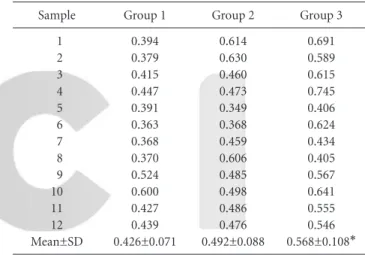
OPG in all samples. To compare M-CSF expression levels in human gingiva with chronic periodontitis with or without type 2 DM, M-CSF specific antibodies were used to detect the cytokine in the tissues (Figs. 1, 2). Representative Western blot data were presented in Fig. 1. The expression levels of β -actin were also measured by anti-β-actin specifi c Western blot analysis. In order to quantify the level of M-CSF expression in the groups, the expression levels of M-CSF in each sample were measured by a densitometer. Th e comparison of M-CSF expression levels were also studied by detecting about 18.5 kDa molecular weight of M-CSF band and measuring their density and areas in all three groups (Fig. 1). Th e levels of normalized

M-CSF expression are given in Table 1 and summarized as a graph in Fig. 2.

Mean value of M-CSF expression (ratio of M-CSF/β-actin) was 0.426±0.071 for group 1, 0.492±0.088 for group 2, 0.568

±0.108 for group 3. There was significant difference between group 1 and group 3 (p<0.05), but there was no statistically significance (p>0.05) between group 1 and group 2 and bet- ween group 2 and group 3.

Th e comparison of RANK expression levels was also studied by Western blot analysis using RANK specifi c antibody which detected RANK in all three groups (Fig. 3). Th e levels of RANK expression were also quantified with β-actin normalization

Fig. 1. M-CSF western analysis showing 4 representative samples in each group. Macrophage colony-stimulationg factor (M-CSF) levels were quantified on the basis of β-actin levels. M-CSF correspond- ing to molecular weight 18.5 kDa was shown to be expressed in all samples including healthy gingiva, and the expression levels of M- CSF were increased in order of group 1, group 2 and group 3. Group 1:

healthy gingiva from systemically healthy person, group 2: infl amed gingiva from patient with chronic periodontitis, group 3: infl amed gingiva from patient with chronic periodontitis and type 2 DM.

Fig. 2. Graphics showing the average amounts (ratio of M-CSF/

β-actin) and standard deviation of M-CSF level in groups 1, 2 and 3. In the group 3, the levels of M-CSF were signifi cantly increased as compared to group 1 (*p<0.05). M-CSF: macrophage colony-stimu- lationg factor, group 1: healthy gingiva from systemically healthy per- son, group 2: infl amed gingiva from patient with chronic periodonti- tis, group 3: infl amed gingiva from patient with chronic periodontitis and type 2 DM.

Table 1. Normalized M-CSF Expressions by M-CSF/β-actin

Sample Group 1 Group 2 Group 3

1 2 3 4 5 6 7 8 9 10 11 12 Mean±SD

0.394 0.379 0.415 0.447 0.391 0.363 0.368 0.370 0.524 0.600 0.427 0.439 0.426±0.071

0.614 0.630 0.460 0.473 0.349 0.368 0.459 0.606 0.485 0.498 0.486 0.476 0.492±0.088

0.691 0.589 0.615 0.745 0.406 0.624 0.434 0.405 0.567 0.641 0.555 0.546 0.568±0.108*

*Significant difference between group 1 and group 3 (p<0.05).

M-CSF: macrophage colony-stimulationg factor, SD: standard de- viation, group 1: healthy gingiva from systemically healthy person, group 2: infl amed gingiva from patient with chronic periodontitis, group 3: infl amed gingiva from patient with chronic periodontitis and type 2 DM.

Fig. 3. RANK Western analysis showing 4 representative samples in each group. RANK levels were quantifi ed on the basis of β-actin lev- els. RANK corresponding to molecular weight 90 kDa was shown to be expressed in all samples including healthy gingiva, and the expres- sion levels of RANK were increased in order of group 1, group 2 and group 3. RANK: receptor activator of nuclear factor kappa-B, group 1:

healthy gingiva from systemically healthy person, group 2: infl amed

gingiva from patient with chronic periodontitis, group 3: infl amed

gingiva from patient with chronic periodontitis and type 2 DM.

(5)

(Fig. 4) and normalized levels of individual gingival RANK expression are given in Table 2. Mean value of RANK expression (ratio of RANK/β-actin) was 0.507±0.095 for group

1, 0.660±0.185 for group 2 and 0.812±0.154 for group 3. Th ere were significant differences between group 1 and group 2 (p<0.05), between group 2 and group 3 (p<0.05) and between group 1 and group 3 (p<0.05).

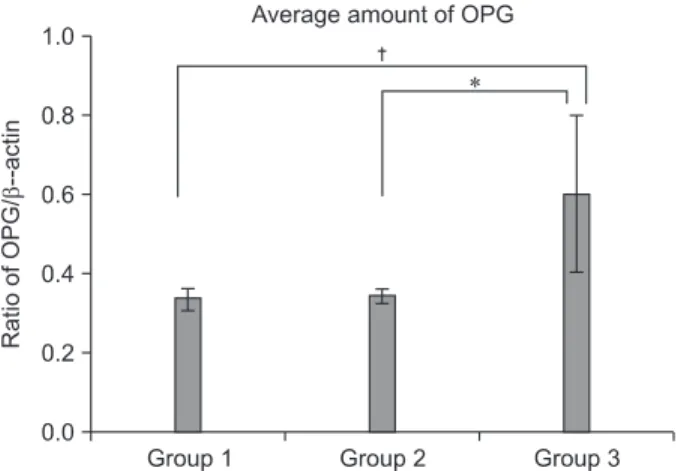
In this study, molecular weight of OPG was identified as 28 kDa size in Western blot analysis (Fig. 5). Th e normalized quantifi cation data are presented in Table 3 and summarized as a graph in Fig. 6. Mean value of OPG expression (ratio of OPG/

β-actin) was 0.340±0.024 for group 1, 0.345±0.019 for group 2 and 0.606±0.198 for group 3. Th ere were signifi cant diff erences between group 1 and group 3 and between group 2 and group 3 (p<0.05). But there was no statistically signifi cance between Fig. 4. Graphics showing the average amounts (ratio of RANK/

β-actin) and standard deviation of RANK level in groups 1, 2 and 3. In the group 3, the levels of RANK were significantly increased as compared to group 1 and 2 (*

,‡

p<0.05). And In the group 2, the levels of RANK were signifi cantly increased as compared to group 1 (

p<0.05). RANK: receptor activator of nuclear factor kappa-B, group 1: healthy gingiva from systemically healthy person, group 2:

infl amed gingiva from patient with chronic periodontitis, group 3:

infl amed gingiva from patient with chronic periodontitis and type 2 DM.

Table 2. Normalized RANK Expressions by RANK/β-actin

Sample Group 1 Group 2 Group 3

1 2 3 4 5 6 7 8 9 10 11 12 Mean±SD

0.530 0.460 0.549 0.574 0.483 0.564 0.483 0.438 0.714 0.544 0.361 0.381 0.507±0.095

0.650 0.478 0.544 0.709 0.561 0.503 0.500 0.565 0.568 1.006 0.897 0.993 0.660±0.185*

0.747 0.767 0.673 0.720 0.781 0.549 0.653 0.966 0.999 0.919 0.980 0.992 0.812±0.154

†,‡

RANK: receptor activator of nuclear factor kappa-B, SD: standard deviation, group 1: healthy gingiva from systemically healthy person, group 2: infl amed gingiva from patient with chronic periodontitis, group 3: infl amed gingiva from patient with chronic periodontitis and type 2 DM. *Signifi cant difference between group 1 and group 2 (p<0.05),

between group 1 and group 3 (p<0.05),

between group 2 and group 3 (p<0.05).

Fig. 5. Osteoprotegerin (OPG) Western analysis showing 4 represen- tative samples in each group. OPG levels were quantifi ed on the basis of β-actin levels. OPG corresponding to molecular weight 60 kDa was shown to be expressed in all samples including healthy gingiva, and the expression levels of OPG were increased in order of group 1, group 2, and group 3. Group 1: healthy gingiva from systemically healthy person, group 2: infl amed gingiva from patient with chronic periodontitis, group 3: infl amed gingiva from patient with chronic periodontitis and type 2 DM.

Table 3. Normalized OPG Expressions by OPG/β-actin

Sample Group 1 Group 2 Group 3

1 2 3 4 5 6 7 8 9 10 11 12 Mean±SD

0.336 0.316 0.320 0.369 0.367 0.327 0.351 0.314 0.380 0.334 0.308 0.355 0.340±0.024

0.336 0.324 0.339 0.361 0.345 0.364 0.360 0.383 0.342 0.321 0.323 0.345 0.345±0.019

0.653 0.737 0.873 0.888 0.524 0.609 0.707 0.780 0.366 0.364 0.387 0.379 0.606±0.198*

,†

OPG: osteoprotegerin, SD: standard deviation, group 1: healthy

gingiva from systemically healthy person group 2: infl amed gingiva

from patient with chronic periodontitis, group 3: infl amed gingiva

from patient with chronic periodontitis and type 2 DM. *Signifi cant

difference between group 1 and group 3 (p<0.05),

between group

2 and group 3 (p<0.05).

(6)

group 1 and group 2 (p>0.05).

Discussion

Periodontitis is a complex, multifactorial process aff ected by bacterial plaque-components and host defense mechanisms (Hugoson et al., 1989). Destruction of periodontal connective tissue deserves particular attention because it results from the activation of various inflammatory mediators included in the pathologic process.

Th e M-CSF, also designated CSF-1, was originally discovered in serum, urine and other biological fl uids as a factor that can stimulate the formation of macrophage colonies from bone marrow hematopoietic progenitor cells. M-CSF is a growth factor that plays a role in the proliferation and diff erentiation of mononuclear phagocytes (Tanaka et al., 1993). Th is growth factor is also essential for osteoclastogenesis because it facilitates the diff erentiation of osteoclast precursors (Tanaka et al., 1993:

Yamazaki et al., 2001).

Kawano et al. (2004) using human granulosa cells reported that both IL-1 and TNF-α could increase the secretion of M-CSF. Tanaka et al. (1993) showed that the signal from M-CSF is one of the crucial factors required for the diff erentiation of osteoclast progenitors.

In present study, the quantitative analysis of M-CSF level

show ed that M-CSF expression was rather increased in infl amed gingiva associated to type 2 DM compared to healthy gingiva and inflamed gingiva of systemically healthy patient.

And the diff erence was statistically signifi cant (p<0.05).

This result indicate that M-CSF is an important mediator of the inflammatory response and can regulate the release of proinflammatory cytokines from macrophage. It is thought M-CSF is the factor that is concerned with increasing of inflammation and bone resorption in inflammatory tissue formation with type 2 DM.

The ligand for this receptor, RANK (also designated TNF- related activation-induced cytokine [TRANCE] or osteoclast differentiation factor [ODF]), is a type II transmembrane protein expressed primarily in lymphoid tissues and T cells lines. RANKL appears to be an important regulator of T cells and osteoclasts.

RANK-L (ligand to receptor activator of NFκB), also known as osteoprotegerin ligand (OPG-L); TRANCE; ODF; and TNF superfamily (TNFSF) 11 and its cell surface receptor RANK (TNFRSF11A) are key regulators of bone remodeling and essential for the development and activation of osteoclasts (Th eill et al., 2002).

Recently, RANK and RANKL have been found in dental tissues and cells in human deciduous teeth43), and RANKL also has been associated with alveolar bone tissue destruction during periodontal infection in an animal model study (Teng et al., 2000).

Genetic and functional experiments by different groups indicate that the balance between RANKL-RANK signaling and the levels of biologically active OPG regulate development and activation of osteoclasts and bone metabolism (Th eill et al., 2002).

Crotti et al. (2003) reported that RANK mRNA were detected in mononuclear cell aggregates in the periodontitis tissue using in situ hybridization. It was suggested that the presence of cells expressing RANK mRNA is strong evidence that there are cells that may form mature osteoclast in the periodontitis tissue.

This study also demonstrated that the total amount of cytokine RANK in the periodontally diseased sites and pe- riodontally diseased sites associated with type 2 DM was significantly higher than those of the healthy sites. Therefore, it is thought that a possible pathogenesis of periodontal bone resorption is as follows.

Fig. 6. Graphics showing the average amounts (ratio of OPG/

β-actin) and standard deviation of OPG level in groups 1, 2 and 3. In the group 3, the levels of OPG were signifi cantly increased as com- pared to group 1 and 2 (*

,†

p<0.05). OPG: osteoprotegerin, group 1:

healthy gingiva from systemically healthy person, group 2: infl amed

gingiva from patient with chronic periodontitis, group 3: infl amed

gingiva from patient with chronic periodontitis and type 2 DM.

(7)

Periodontitis is triggered by the host immune response to a constellation of periodontal biofi lm-associated infectious agents.

Inflammatory cells (mainly lymphocytes and macrophage) infiltrated into gingival tissue product proinflammatory cytokines (e.g., IL-1, TNF-α). The cytokines are known to induce periodontal bone resorption indirectly by stimulation of RANKL production by osteoblastic lineage cells. Moreover, activated T cells can produce and express RANKL directly.

It is thought that these RANKL stimulate osteoclastogenesis via RANK on preosteocalst and contribute to progression of infla mmation including bone resorption (Baek & Lee, 2007).

And it is assumed that RANK was increased in infl ammatory tissue with DM by M-CSF etc.

The cytokine OPG, also designated osteoclastogenesis inhibitory factor, is known to inhibit osteoclast formation.

OPG is thought to inhibit osteoclastogenesis by disrupting the cell-to-cell signaling between osteoblastic stromal cells and osteoclast progenitors. OPG also binds to ODF, also known as TRANCE/RANKL, membrane-bound protein belonging to the TNF ligand family.

Yaturu et al. (2008) reported that OPG levels were elevated in subjects with diabetes compared to control subjects and OPG levels are significantly correlated with insulin resistance and may reflect the proinflammatory state in type 2 diabetes.

Nabipour et al. (2009) reported that circulating OPG levels are significantly associated with diabetes, independent of cardiovascular risk factors in postmenopausal women.

But Costa et al. (2010) reported that salivary MMP-8 and OPG concentrations were elevated regardless of periodontal infl ammation in patients with diabetes, therefore periodontitis and diabetes are conditions that may interfere with protein expression and should be considered when using saliva for diagnoses.

In present study, the quantitative analysis of OPG level showed that OPG expression was significantly increased in infl amed gingiva with type 2 DM compared to healthy gingiva or inflamed gingiva without DM. And there was statistically significant difference (p<0.05). It is thought that OPG was increased by relative compensatory tissue reaction concerned with inflammatory mediators and bone resorption in infl ammatory tissue with type 2 DM.

Yasuda et al. (1998) reported that OPG plays an important role in bone remodelling and may useful for the treatment of

osteoporosis associated with increased osteoclast functions.

Therefore further studies are warranted to determine the pathophysiologic origin of elevated OPG in type 2 DM insulin resistance and may refl ect the proinfl ammatory state in type 2 diabetes.

In conclusion, this study demonstrated that expression levels of M-CSF, RANK, OPG in human gingival inflammed tissue from chronic periodontitis with type 2 DM showed significant increased level compared to healthy gingiva from non-periodontitis pateint or periodontitis patient without type 2 DM. It is thought that M-CSF could eff ect expressions of RANK and OPG during the bone metabolism with type 2 DM. And it is also thought that these results could be used as a indicator materials on diagnosis and treatment procedure of inflammatory diseases. These studies seems to be able to contribute to the development of disease diagnosis methods and treatment modality.

Acknowledgments

This study was supported by MEDIM foundation (2011) for development of implant surface and Kyungpook National University Research Fund, 2012

References

Baek YR, Lee JM: Th e expression of rank and RANKL in gingival tissue of human chronic periodontitis. J Korean Acad Periodontol 37:849-857, 2007.

Bickel M, Axtelius B, Solioz C, Attström R: Cytokine gene expression in chronic periodontitis. J Clin Periodontol 28:

840-847, 2001.

Chae YM, Heo SH, Kim JY, Lee JM, Ryoo HM, Cho JY: Upregu- lation of smpd3 via BMP2 stimulation and Runx2. BMB Rep 42:86-90, 2009.

Cho JY, Xing S, Liu X, Buckwalter TL, Hwa L, Sferra TJ, Chiu IM, Jhiang SM: Expression and activity of human Na+/I- symporter in human glioma cells by adenovirus-mediated gene delivery. Gene Th er 7:740-749, 2000.

Costa PP, Trevisan GL, Macedo GO, Palioto DB, Souza SL, Grisi MF, Novaes AB Jr, Taba M Jr: Salivary interleukin-6, matrix metalloproteinase-8, and osteoprotegerin in patients with periodontitis and diabetes. J Periodontol 81:384-391, 2010.

Crotti T, Smith MD, Hirsch R, Soukoulis S, Weedon H, Capone M,

Ahern MJ, Haynes D: Receptor activator NF kappaB ligand

(RANKL) and osteoprotegerin (OPG) protein expression in

periodontitis. J Periodontal Res 38:380-387, 2003.

(8)

Emrich LJ, Shlossman M, Genco RJ: Periodontal disease in non- insulin-dependent diabetes mellitus. J Periodontol 62:123-131, 1991.

Fixe P, Praloran V. M-CSF: haematopoietic growth factor or infl ammatory cytokine? Cytokine 10:32-37, 1998.

Grossi SG, Zambon JJ, Ho AW, Koch G, Dunford RG, Machtei EE, Norderyd OM, Genco RJ: Assessment of risk for periodontal disease. I. Risk indicators for attachment loss. J Periodontol 65:260-267, 1994.

Hormdee D, Nagasawa T, Kiji M, Yashiro R, Kobayashi H, Koshy G, Noguchi K, Nitta H, Ishikawa I: Protein kinase-A-dependent osteoprotegerin production on interleukin-1 stimulation in human gingival fibroblasts is distinct from periodontal ligament fi broblasts. Clin Exp Immunol 142:490-497, 2005.

Hugoson A, Th orstensson H, Falk H, Kuylenstierna J: Periodontal conditions in insulin-dependent diabetics. J Clin Periodontol 16:215-223, 1989.

Iacopino AM: Periodontitis and diabetes interrelationships: role of infl ammation. Ann Periodontol 6:125-137, 2001.

Joo SD, Lee JM. The comparison of inflammatory mediator expression in gingival tissues from human chronic perio- dontitis patients with or without type 2 diabetes mellitus. J Korean Aca Periodontol 37(2 Suppl):353-368, 2007

Katagiri T, Takahashi N: Regulatory mechanisms of osteoblast and osteoclast diff erentiation. Oral Dis 8:147-159, 2002.

Kawano Y, Fukuda J, Itoh H, Takai N, Nasu K, Miyakawa I: The eff ect of infl ammatory cytokines on secretion of macrophage colony-stimulating factor and monocyte chemoattractant protein-1 in human granulosa cells. Am J Reprod Immunol 52:124-128, 2004.

Lacey DL, Timms E, Tan HL, Kelley MJ, Dunstan CR, Burgess T, Elliott R, Colombero A, Elliott G, Scully S, Hsu H, Sullivan J, Hawkins N, Davy E, Capparelli C, Eli A, Qian YX, Kaufman S, Sarosi I, Shalhoub V, Senaldi G, Guo J, Delaney J, Boyle WJ:

Osteoprotegerin ligand is a cytokine that regulates osteoclast diff erentiation and activation. Cell 93:165-176, 1998.

Liu D, Xu JK, Figliomeni L, Huang L, Pavlos NJ, Rogers M, Tan A, Price P, Zheng MH: Expression of RANKL and OPG mRNA in periodontal disease: possible involvement in bone destruction. Int J Mol Med 11:17-21, 2003.

McCauley LK, Nohutcu RM: Mediators of periodontal osseous destruction and remodeling: principles and implications for diagnosis and therapy. J Periodontol 73:1377-1391, 2002.

Mizuno N, Shiba H, Mouri Y, Xu W, Kudoh S, Kawaguchi H, Kurihara H: Characterization of epithelial cells derived from periodontal ligament by gene expression patterns of bone- related and enamel proteins. Cell Biol Int 29:111-117, 2005.

Mühlemann HR, Son S: Gingival sulcus bleeding--a leading symptom in initial gingivitis. Helv Odontol Acta 15:107-113, 1971.

Nabipour I, Kalantarhormozi M, Larijani B, Assadi M, Sanjdideh Z:

Osteoprotegerin in relation to type 2 diabetes mellitus and the metabolic syndrome in postmenopausal women. Metabolism

59:742-747, 2010.

Nagasawa T, Kiji M, Yashiro R, Hormdee D, Lu H, Kunze M, Suda T, Koshy G, Kobayashi H, Oda S, Nitta H, Ishikawa I: Roles of receptor activator of nuclear factor-kappaB ligand (RANKL) and osteoprotegerin in periodontal health and disease.

Periodontol 2000 43:65-84, 2007.

Page RC: Th e role of infl ammatory mediators in the pathogenesis of periodontal disease. J Periodontal Res 26(3 Pt 2):230-242, 1991.

Park JW, Lee JM: The comparison of IL-6, elastase and α 1-PI expressions in human chronic periodontitis with type 2 diabetes mellitus. J Korean Aca Periodontol 37(2 Suppl):325-338, 2007.

Pontes Andersen CC, Flyvbjerg A, Buschard K, Holmstrup P:

Relationship between periodontitis and diabetes: lessons from rodent studies. J Periodontol 78:1264-1275, 2007.

Rani CS, MacDougall M: Dental cells express factors that regulate bone resorption. Mol Cell Biol Res Commun 3:145-152, 2000.

Sakata M, Shiba H, Komatsuzawa H, Fujita T, Ohta K, Sugai M, Suginaka H, Kurihara H: Expression of osteoprotegerin (osteoclastogenesis inhibitory factor) in cultures of human dental mesenchymal cells and epithelial cells. J Bone Miner Res 14:1486-1492, 1999.

Salvi GE, Yalda B, Collins JG, Jones BH, Smith FW, Arnold RR, Off enbacher S: Infl ammatory mediator response as a potential risk marker for periodontal diseases in insulin-dependent diabetes mellitus patients. J Periodontol 68:127-135, 1997.

Simonet WS, Lacey DL, Dunstan CR, Kelley M, Chang MS, Lüthy R, Nguyen HQ, Wooden S, Bennett L, Boone T, Shimamoto G, DeRose M, Elliott R, Colombero A, Tan HL, Trail G, Sullivan J, Davy E, Bucay N, Renshaw-Gegg L, Hughes TM, Hill D, Pattison W, Campbell P, Sander S, Van G, Tarpley J, Derby P, Lee R, Boyle WJ: Osteoprotegerin: a novel secreted protein involved in the regulation of bone density. Cell 89:309-319, 1997.

Suda T, Takahashi N, Martin TJ: Modulation of osteoclast diffe- rentiation. Endocr Rev 13:66-80, 1992.

Suda T, Takahashi N, Udagawa N, Jimi E, Gillespie MT, Martin TJ:

Modulation of osteoclast diff erentiation and function by the new members of the tumor necrosis factor receptor and ligand families. Endocr Rev 20:345-357, 1999.

Tanaka S, Takahashi N, Udagawa N, Tamura T, Akatsu T, Stanley ER, Kurokawa T, Suda T: Macrophage colony- stimulating factor is indispensable for both proliferation and diff erentiation of osteoclast progenitors. J Clin Invest 91:257- 263, 1993.

Teng YT, Nguyen H, Gao X, Kong YY, Gorczynski RM, Singh B, Ellen RP, Penninger JM: Functional human T-cell immunity and osteoprotegerin ligand control alveolar bone destruction in periodontal infection. J Clin Invest 106:R59-R67, 2000.

Th eill LE, Boyle WJ, Penninger JM: RANK-L and RANK: T cells,

bone loss, and mammalian evolution. Annu Rev Immunol

20:795-823, 2002.

(9)

Wada T, Nakashima T, Hiroshi N, Penninger JM: RANKL-RANK signaling in osteoclastogenesis and bone disease. Trends Mol Med 12:17-25, 2006.

Yalda B, Offenbacher S, Collins JG: Diabetes as a modifier of periodontal disease expression. Periodontol 2000 6:37-49, 1994.

Yamazaki H, Kunisada T, Yamane T, Hayashi SI: Presence of osteoclast precursors in colonies cloned in the presence of hematopoietic colony-stimulating factors. Exp Hematol 29:68- 76, 2001.

Yasuda H, Shima N, Nakagawa N, Yamaguchi K, Kinosaki M, Mochizuki S, Tomoyasu A, Yano K, Goto M, Murakami A, Tsuda E, Morinaga T, Higashio K, Udagawa N, Takahashi N, Suda T: Osteoclast differentiation factor is a ligand for

osteoprotegerin/osteoclastogenesis-inhibitory factor and is identical to TRANCE/RANKL. Proc Natl Acad Sci U S A 95:3597-3602, 1998a.

Yasuda H, Shima N, Nakagawa N, Mochizuki SI, Yano K, Fujise N, Sato Y, Goto M, Yamaguchi K, Kuriyama M, Kanno T, Murakami A, Tsuda E, Morinaga T, Higashio K:

Identity of osteoclastogenesis inhibitory factor (OCIF) and osteoprotegerin (OPG): a mechanism by which OPG/OCIF inhibits osteoclastogenesis in vitro. Endocrinology 139:1329- 1337, 1998b.

Yaturu S, Rains J, Jain SK: Relationship of elevated osteoprotegerin

with insulin resistance, CRP, and TNF-alpha levels in men

with type 2 diabetes. Cytokine 44:168-171, 2008.

수치

Fig. 2. Graphics showing the average amounts (ratio of M-CSF/
Table 3. Normalized OPG Expressions by OPG/β-actin
Fig. 6. Graphics showing the average amounts (ratio of OPG/

참조

관련 문서