한국동력기계공학회지 제19권 제5호 pp. 38-44 2015년 10월 ISSN 1226-7813(Print) ISSN 2384-1354(Online)
Journal of the Korean Society for Power System Engineering http://dx.doi.org/10.9726/kspse.2015.19.5.038 Vol. 19, No. 5, pp. 38-44, October 2015
자동차용 냉연강판 SPCC와 냉연고장력강판 SPCF590의 유/무기 하이브리드 용액에 의한 내식특성
Corrosion Resistance by Organic/Inorganic Hybrid Solution for Cold Rolled Steel of SPCC and SPFC590 for
Automobile
이소영*․이광호**․정희록***․남기우****†
So-Young Lee*, Kwang-Ho Lee**, Hee-Rok Jeong*** and Ki-Woo Nam****†
(Received 03 July 2015, Revision received 06 August 2015, Accepted 17 August 2015)
Abstract:The cold-rolled steel sheet for automobile is liable to corrosion, and will be painting in a variety of ways for the anticorrosive. This paper was coated on cold rolled steel (SPCC and SPFC590) for automobiles using five kinds of organic/inorganic hybrid solution. This was evaluated corrosion resistance and so on by the salt spray. Corrosion area was less according to increasing of curing time in 2 types of steel plate with 5 types of the coating solution. No.1 solution was showed the best corrosion resistance regardless of the kinds of the steel sheet. It is judged that the melamin hardner had the role of bridge between SiO
2polysilicate and urethan resin. Other properties were excellent in all solution.
Key Words:Cold Rolled Steel Sheet for Automobile, Corrosion Resistance, Coating, Salt Spray Test, Organic/Inorganic Hybrid solution
****†
남기우(
교신저자) :
부경대학교 재료공학과E-mail : [email protected], Tel : 051-629-6358
*
이소영:
부경대학교 대학원 재료공학과**
이광호:
부경대학교 대학원 학연협동기계공학***
정희록: ㈜
프리폴****
†
Ki-Woo Nam(corresponding author) : Department of Materials Science and Engineering, Pukyong National University.E-mail : [email protected], Tel : 051-629-6358
* So-Young Lee : Department of Materials Science and Engineering, Graduate School, Pukyong National University.
** Kwang-Ho Lee : UR Interdisciplinary Program of Mechanical Engineering, Graduate School, Pukyong National University.
*** Hee-Rok Jeong : Prepoll Co., Ltd.
1. 서 론
최근 자동차는 승차자의 안전성 강화에 의하 여 고속에서 높은 충돌 성능을 요구하고 있다.
특히 센터 필라는 경량화 및 측면 충돌로 인한 승객의 안전성을 확보하기 위하여 상부에 고강 도 재료를 적용하여, 하부보다 충돌 강성을 더욱 높게 유지해야 한다. 그러나 자동차는 안전성도 중요하지만, 외관의 심미성도 좋아야 한다. 자동
차 센터 필라에 적용하는 냉연 강판은 부식에 취 약하기 때문에, 내식성을 위하여 다양한 방법으 로 도색을 실시하고 있다.
내식성 향상을 위한 크로메이트 처리액에 포
함된 6가 크롬은 인체 위험성 때문에 오늘날 사
용이 금지 되었다. China RoHS는 전자전기제품
에 6대 유해물질(Pb, Hg, Cd, Cr
+6, PBB, PBDE)의
사용을 제한하고 있고, 유럽에서도 폐전기 전자기
기에 관련된 규정인 EU RoHS는 제품에 포함되는
사용제한 및 금지물질이 규정되어 시행되고 있다.
최근 전 세계적으로 이러한 규제에 대응하기 위하여 Cr 등 유해 물질의 사용을 제한하고 있으 므로, 환경 친화형 코팅 용액의 개발이 활발하다.
즉, Cr
+3크로메이트,
1∼4)Cr-free,
5,6)무기 또는 유 기계 피막처리
7∼12)등의 친환경 방청 기술에 관 한 연구가 활발하게 진행되었다.
13)저자 등은 아 연도금강판 및 냉간압연강판에 유/무기 하이브리 드 용액을 코팅하여, 내식성 등 제 특성을 연구
하였다.
14∼20)본 연구는 5종류의 유/무기 하이브리드 용액을 자동차용 냉연 강판 SPCC와 냉연 고장력강판 SPFC590에 코팅하여, 염수 분무에 의한 내식성, 부착성, 내비등수성, 문지름 특성 및 내굴곡성을 평가하였다.
2. 재료 및 실험 방법
사용한 재료는 자동차에 널리 사용되는 두께 1 mm의 냉연 강판 SPCC와 냉연 고장력강판 SPFC590이다. 재료의 기계적 성질 및 화학적 성 분을 Table 1과 2에 나타내었다. 염수분무 시험 편의 크기는 KS D 9502 규정의 150 × 70 mm보 다 약간 큰 160 × 90 mm로 만들었으며, Fig. 1에 나타내었다. 이것은 염수 분무 시험을 할 때 가 장자리 부분에서 부식이 시작되는 것을 방지하 기 위하여 테이핑 처리하기 위한 것이다. 시험편 은 제조 시에 부식 방지를 위하여 뿌려놓은 기름 을 제거하기 위하여 이소프로판올에서 5분간 초 음파 세척하였다.
Speci.
(MPa) (MPa) (%) HRB SPCC 167.7 306.0 47 41 SPFC590 512.9 640.4 25 89 Table 1 Mechanical properties
Speci. C Si Mn P S
SPCC 0.023 0.003 0.1 0.015 0.005 SPFC590 0.083 0.185 1.86 0.02 0.005 Table 2 Chemical compositions (wt.%)
Fig. 1 Dimensions of specimen for salt spray test
코팅은 습도막 두께 6.86 ㎛인 바코터 3호를 사용하였다. 코팅의 경화조건은 No.1∼No.3 용액 은 463 K에서 1, 2, 3분으로 하였고, No.4∼No.5 용액은 463 K에서 5, 7, 9분으로 하였다. 이때 경 화된 코팅층의 두께는 습도막의 두께에 코팅 용 액의 고형분을 곱하면, 0.47∼1.12 ㎛ 정도이다.
코팅 용액은 우레탄 수지, SiO
2폴리실리케이 트 및 멜라민(경화제)을 증류수와 에타놀에 합성 하여 (주)프리폴에서 제조한 것으로 Table 3에 나 타내었다.
Materials No.1 No.2 No.3 No.4 No.5 Distilled water 48.0 56.0 47.0 41.0 37.0 EtOH 21.0 24.0 20.0 18.0 16.0 SiO
2polysilicate 7.0 4.0 13.0 12.0 10.0 Urethane resin 21.0 16.0 13.0 23.0 32.0 Melamine 3.0 0.0 7.0 6.0 5.0 Table 3 Composition of coating solution (wt.%)
염수분무시험
21)은 사용 강판의 내식성을 조사
하기 위하여 염수분무시험기(ATS-SST900)를 사
용하였다. 용액 및 경화 시간에 따른 내식성을
비교하기 위하여, 190℃에서 1~9분간 경화한 시
험편을 각각 5개씩 사용하였다. 시험편은 챔버
내의 45° 기울어진 거치대에 설치하고, 분무실내
의 온도는 35±2℃로 유지하면서 중성 염수를 분
무하여 시험을 실시하였다. 시험편은 1시간 간
자동차용 냉연강판 SPCC와 냉연고장력강판 SPCF590의 유/무기 하이브리드 용액에 의한 내식특성
1 2 3 1 2 3 Hardening time (min.) Hardening time (min.) (a) (b)
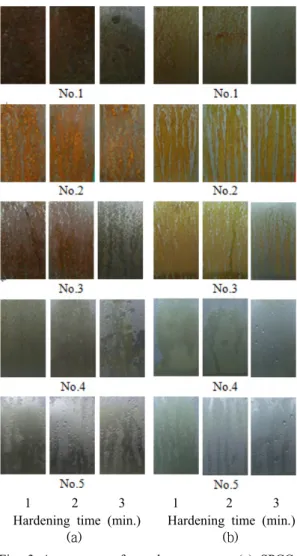
Fig. 3 Appearance after salt spray test. (a) SPCC, (b) SPFC590
Ultrasonic Cleaning (Isopropanol, 5 minute)
↓
Solution Coating (Bar coater, No.3)
↓
Hardening treatment (1, 2, 3, 5, 7, 9 minute at 190 ℃)
↓
Water cooling
↓
Taping of specimen edge
↓
Salt spray test (7 hours) Fig. 2 Flaw chart of salt spray test
격으로 관찰하였으며, 7시간 동안 실시하였다.
시험편의 내식성 평가는 촬영한 사진으로 초기 부식의 발생시간과 부식의 넓이로 판단하였다.
Fig. 2는 염수분무 시험의 흐름도이다.
부착성
22,23), 내비등수성과 문지르기 특성, 내굴
곡성 및 긁힘 저항성은 No.1∼No.5 용액을 코팅 하고, 3분 경화한 것을 평가하였다. 부착성은 Fig. 1과 같이 10 × 10 mm 면적에 1 mm 간격으 로 크로스 컷을 한 후, 3M 테이프로 붙여서 떼 어내었을 때, 코팅 층의 박리 여부로 평가하였다.
내비등수성과 문지르기 특성은 코팅 시험편을 끓는 물에 1시간 동안 침적한 후 건져내어 표면 을 관찰하고, 젖은 상태에서 손가락으로 30회 문 질러 표면의 색변화를 관찰하였다. 굴곡성은 180°굽혀서, 코팅 표면의 균열 및 박리 등의 발 생 유무를 관찰하였다.
3. 결과 및 고찰
3.1 염수분무에 의한 내식성
SPCC 및 SPFC590 시험편을 사용하여, 7시간 염수 분무 시험 후의 외관을 각각 Fig. 3에 나타 내었다. Fig. 3에서 (a)는 No.1 용액, (b)는 No.2 용액, (c)는 No. 3 용액, (d)는 No. 4 용액, (e)는 No. 5 용액을 코팅하여 실시한 것이다. 시험편 종류와 용액에 관계없이 부식은 경화 시간이 증 가할수록 적게 나타나는 것을 확인할 수 있었다.
Fig. 4(a)와 (b)는 대표적으로 No.1 용액을 코팅
한 SPCC와 SPFC590 시험편의 염수분무 시간과
부식 면적률과의 관계를 나타낸다. (a) SPCC에서
경화 시간 1분은 염수 분무 3시간까지 10% 이하
이지만, 그 이후는 급격한 증가를 나타내었다. 2
분은 완만하게 증가하다가 염수 분무 6시간에서
급격하게 증가하였다. 그러나 3분은 염수분무 7
시간까지 부식 면적률 10% 이하의 아주 우수한
내식특성을 나타내었다. (b) SPFC590에서 경화
시간 1분은 염수분무 7시간까지 완만하게 증가
하고, 경화 시간 2분은 염수분무 4시간까지 거의
부식이 나타나지 않았으나, 그 이후 약간 발생하
0 1 2 3 4 5 6 7 0
20 40 60 80 100 SPCC
Corrosion area rate, %
Salt spray time, h
1 min 2 min 3 min
(a)
0 1 2 3 4 5 6 7
0 20 40 60 80 100
SPFC590
Salt spray time, h
Corrosion area rate, %
1 min 2 min 3 min
(b)
Fig. 4 Relationship between salt spray time and corrosion area rate. (a) SPCC, (b) SPFC590
Speci. Ht(min)
Solution 1 2 3 5 7 9
SPCC
No.1 93.7 76.1 7.7 - - - No.2 85.8 91.5 82.9 - - - No.3 96.2 94.4 66.9 16.9 - - No.4 - - - 68.5 65.9 22.2 No.5 - - - 18.0 6.0 4.0
SPFC 590
No.1 21.0 18.7 1.5 - - - No.2 80.9 79.5 84.2 - - - No.3 96.5 93.7 48.9 13.8 - - No.4 - - - 29.0 22.5 3.1 No.5 - - - 10.3 2.2 1.7 Table 4 Corrosion area rate (%) in 7 hours of salt
spray time
0 1 2 3 4 5 6 7 8 9 10
0 20 40 60 80
100 SPCC
No.1 solution No.2 solution No.3 solution No.4 solution No.5 solution
Corrosion area rate in 7 hours, %
Hardening time, min
(a)
0 1 2 3 4 5 6 7 8 9 10
0 20 40 60 80 100
SPFC590 No.1 solution No.2 solution No.3 solution No.4 solution No.5 solution
Corrosion area rate in 7 hours, %
Hardening time, min
(b)
Fig. 5 Relationship between corrosion area rate in 7 hours of salt spray time and hardening time. (a) SPCC, (b) SPFC590
였다. 경화 시간 1분과 2분은 염수분무 7시간에 서 약 20% 전후의 부식률을 나타내었다. 경화 시간 3분은 염수분무 7시간에서 부식 면적률 1.5%로 매우 우수한 내식특성을 나타내었다.
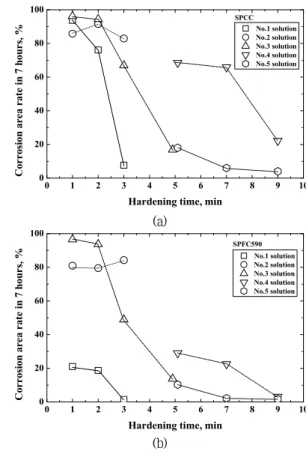
Table 4는 염수 분무 시간 7시간에서 부식 면 적률을 나타낸 것이다.
Fig. 5는 Table 4를 그래프로 나타낸 것이다.
이 그림에서 (a)는 SPCC, (b) SPFC590의 결과이
다. (a)에서 No.1 용액은 경화 시간의 증가에 따
라서 부 식 면적률이 현저하게 감소하였으며, 경
화 시간 3 분에서 약 7.7%의 부식 면적률을 나타
내었다. No.2 용액은 경화 시간 1분, 2분 및 3분
에서 부식 면적률이 비슷하였다. No.3 용액은 경
화 시간 1분과 2분에서 약 95%로 비슷하였으나,
경화 시간 3분에서 부식 면적률이 급격하게 하락
자동차용 냉연강판 SPCC와 냉연고장력강판 SPCF590의 유/무기 하이브리드 용액에 의한 내식특성
하고, 5분에서 약 17%를 나타내었다. No.4 용액 은 경화 시간이 증가하였으나 내식성이 나쁘게 나타났다. No.5 용액은 경화 시간의 증가와 함께 내식성이 매우 좋게 나타났다. (b)에서 No.1 용액 의 경화 시간 1분, 2분 및 3분에서 우수한 내식 성을 나타내었다. 특히 경화시간 3분은 약 1.5%
의 부식 면적률을 나타내었다. No.2 용액은 경화 시간 1분, 2분 및 3분에서 부식 면적률 약 80%로 비슷하였다. No.3 용액은 경화 시간 3분에서 부 식 면적률이 급격하게 하락하고, 5분에서 약 14%를 나타내었다. No.4 용액은 경화 시간의 증 가와 함께 내식성이 증가하였다. No.5 용액은 경 화 시간의 증가와 함께 내식성이 매우 좋게 나타 났다.
이와 같이 (a), (b)에서 No.1 용액의 내식성이 우수한 것은 SiO
2폴리실리케이트 및 우레탄 수 지의 합성에 멜라민 경화제가 가교 역할을 하였 다고 판단된다.
3.2 코팅층의 특성
부착성, 내비등수성과 문지르기 특성 및 내굴 곡성은 No.1∼No.5 용액을 SPCC와 SPFC590 모 재 시험편에 코팅하여, 190 ℃에서 3분 경화 처 리하여 평가하였다.
부착성 평가의 결과를 Fig. 6에 나타내었다.
No.1∼No.5 용액은 두 종류의 강판에서 박리가 전혀 발생하지 않아, 부착성이 매우 양호하였다.
굴곡성의 대표적인 결과는 No.1용액에 대하여 Fig. 7에 나타내었다. (a)는 SPCC이고, (b)는 SPFC590이다. 두 종류 강판의 굽힘 시험에서 코 팅층의 균열 또는 박리가 전혀 발생하지 않았다.
또한 나머지 용액에서도 균열이나 박리가 발생 하지 않아, 우수한 특성을 나타내었다.
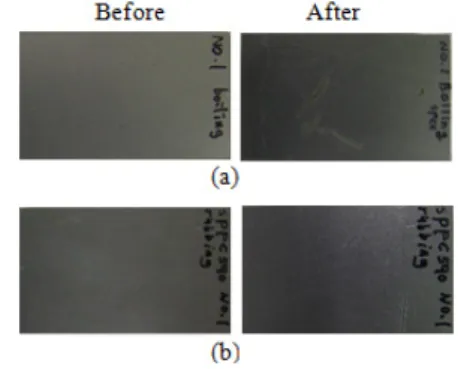
내비등수성의 대표적인 결과는 No.1 용액에 대하여 Fig. 8에 나타내었다. (a)는 SPCC이고, (b) 는 SPFC590이다. 두 종류 강판의 비등수 시험에 서 코팅층의 박리 또는 부풀음이 전혀 발생하지 않았고, 문지름에서도 변화가 없었다. 나머지 용 액의 내비등수성 및 문지름 특성은 두 종류의 강 판에대하여 매우 양호하였다.
Fig. 6 Results of adhesion test. (a) SPCC, (b) SPFC590
Fig. 7 Results of bending resistance test with coating of No. 1 solution. (a) SPCC, (b) SPFC590
Fig. 8 Results of boiling water resistance test and rubbing test with coating of No. 1 solution. (a) SPCC, (b) SPFC590
5. 결 론
내식성 향상을 위하여 크로메이트 처리액에
포함된 6가 크롬은 인체 유해성 때문에, 전 세계
적으로 사용이 금지되었다. 본 연구는 이것을 대
체할 고내식 코팅액을 제조하여, 두 종류의 자동
차용 냉연 강판의 내식성 등 제 특성을 평가하였
다. 그 결과는 다음과 같다.
(1) 두 종류의 냉연 강판에 코팅한 No.1 코팅액 은 190 ℃의 3분 경화에서 부식 면적률이 각 각 7.7%와 1.5%를 나타내어 가장 양호하였다.
(2) 부착성, 내비등수성과 문지르기 특성 및 내 굴곡성은 2종류의 냉연 강판에 코팅한 5종류 의 코팅액에서 우수한 특성을 나타내었다.
(3) 코팅액의 우수한 내식성은 SiO2 폴리실리케 이트 및 우레탄 수지에 멜라민 경화제가 가교 역할을 하였다고 판단된다.
References
1. S. W. Kim and C. T. Lee, 2006,
“Environment-friendly Trivalent Chromate Treatment for Zn Electroplating”, J. Korean Industrial and Engineering Chemistry, Vol. 17, No. 5, pp. 433-442.
2. C. T. Lee, 2007, “Enlargement of Anti-corrosion of Zinc Plating by the Trivalent Chromium Sulfate Conversion Coating”, J.
Korean Industrial and Engineering Chemistry, Vol. 18, No. 3, pp. 296-302.
3. M. Kim, J. J. Lee, D. Y. Kim, S. U. Park and S. C. Kwon, 2004, “The Trend of Study of Echo-Friendly Hard Trivalent Chromium Deposition”, J. the Korean Institute of Surface Engineering, Vol. 37, No. 3, pp. 179-184.
4. F. Deflorian, S. Rossi, L. Fedrizzi and P. L.
Bonora, 2005, “EIS study of organic coating on zinc surface pretreated with environmentally friendly products”, Progress in Organic Coatings, Vol. 52, No. 4, pp. 271-279.
5. E. N. Michael and P. B. Gordon, 2004,
“Mg-rich coatings: A new paradigm for Cr-free corrosion protection of Al aerospace alloys”, J.
Coatings Technology and Research, Vol. 1, No.
2, pp 69-80.
6. G. B. Rudolph, G. Hong, M. Suhakar and W.
Fariaty, 2003, “Active corrosion protection and corrosion sensing in chromate-free organic coatings”, Progress in Organic Coatings, Vol.
47, Vo. 3–4, pp. 174-182.
7. R. Zandi-zanda, A. Ershad-langroudia. and A.
Rahimia, 2005, “Silica based organic–inorganic hybrid nanocomposite coatings for corrosion protection”, Progress in Organic Coatings, Vol.
53, No. 4, pp. 286-291.
8. T. P. Chou, C. Chandrasekaran, S. J. Limmer, S. Seraji, Y. Wu, M. J. Forbess, C. Nguyen and G. Z. Cao, 2001, “Organic–inorganic hybrid coatings for corrosion protection”, J.
Non-Crystalline Solids, Vol. 290, Vo. 2–3, pp.
153-162.
9. H. J. Kim, 1993, “Development of Anti-Finger Printed EGI Steel Sheet with High Corrosion Resistance”, J. the Korean Institute of Surface Engineering, Vol. 26, No. 6, pp. 307-315.
10. J. B. Bajat,, V. B. Miskovic-Stankovic, N.
Bibic and D. M. Drazic, 2007, “The influence of zinc surface pretreatment on the adhesion of epoxy coating electrodeposited on hot-dip galvanized steel”, Progress in Organic Coating, Vol. 58, No. 4, pp. 323-330.
11. J. H. Steven, C. Lowe, T. M. James and F.
W. John, 2005, “Migration and segregation phenomena of a silicone additive in a multilayer organic coating”, Progress in Organic Coatings, Vol. 54, No. 2, pp. 104-112.
12. M. L. Zheludkevich, S. I. Miranda and M. G.
S. Ferreira, 2005, “Sol-gel coatings for corrosion protection of metals”, J. Materials Chemistry, Vol. 15, pp. 5099-5111.
13. N. W. Cho, S. H. Kim and K. T. Kim, 2000,
“Silica Coating on Ai-Si Alloy by the Sol-Gel Method”, RIST Research Paper, Vol.14, No. 3, pp. 358-363.
14. K. W. Nam, D. W. Kim, N. S. Kim and K.
Y. Seong, 2014, “Characteristic of Corrosion Resistance under Different Heat Treatment Conditions of Coated Zinc Coating Steel with Cr-Free Solution”, Lecture Notes in Electrical Engineering, Vol. 282, pp. 635-643.
15. K. W. Nam, J. R. Kim and C. M. Choi, 2013,
“Corrosion resistance characteristics of cold
자동차용 냉연강판 SPCC와 냉연고장력강판 SPCF590의 유/무기 하이브리드 용액에 의한 내식특성