• 검색 결과가 없습니다.

A Case of Late Stent Thrombosis Following Platelet Transfusion in a Patient With Aplastic Anemia

N/A
N/A
Protected

Academic year: 2022

Share "A Case of Late Stent Thrombosis Following Platelet Transfusion in a Patient With Aplastic Anemia"

Copied!
4
0
0

로드 중.... (전체 텍스트 보기)

전체 글

(1)

54 Copyright © 2012 The Korean Society of Cardiology Korean Circulation Journal

Introduction

Aplastic anemia is a form of anemia in which the bone marrow fails to produce adequate numbers of peripheral blood elements.

The incidences of atherosclerosis and myocardial infarction in pa- tients with congenital coagulation disorders and chronic thrombo- cytopenia are very low. However in cases requiring invasive proce- dures (e.g., dental procedure and endoscopic procedure), patients at times need platelet transfusion. In this paper, a case of late stent thrombosis was reported within 4 hours after transfusion of plate- lets for anticipated bleeding in an aplastic anemia patient.

Case

A 52-year-old man who had been diagnosed with aplastic anemia

Case Report

http://dx.doi.org/10.4070/kcj.2012.42.1.54 Print ISSN 1738-5520 • On-line ISSN 1738-5555
A Case of Late Stent Thrombosis Following Platelet Transfusion in a Patient With Aplastic Anemia

Hyun-Sung Shin, MD and Tae Soo Kang, MD

Division of Cardiovascular Medicine, Department of Internal Medicine, Dankook University College of Medicine, Cheonan, Korea

Aplastic anemia is a condition in which the bone marrow fails to produce adequate numbers of peripheral blood elements. The incidences of atherosclerosis and myocardial infarction in patients with congenital coagulation disorders and chronic thrombocytopenia are very low. In this paper, a case of late stent thrombosis within a drug-eluting stent occurring after platelet transfusion in a patient with aplastic anemia is presented. The authors’ observations emphasize the risks of platelet transfusion and the authors’ support withholding such a treatment unless vitally indicated, in patients with coronary artery stent implantation and even in those on dual antiplatelet therapy. (Korean Circ J 2012;42:54-57)

KEY WORDS: Stent; Thrombosis; Platelet transfusion; Aplastic, anemia.

Received: July 19, 2011

Revision Received: October 10, 2011 Accepted: October 30, 2011

Correspondence: Tae Soo Kang, MD, Division of Cardiovascular Medicine, Department of Internal Medicine, Dankook University College of Medi- cine,16-5 Anseo-dong, Cheonan 330-715, Korea

Tel: 82-41-550-7690, Fax: 82-41-556-0524 E-mail: [email protected]

• The authors have no financial conflicts of interest.

This is an Open Access article distributed under the terms of the Creative Commons Attribution Non-Commercial License (http://creativecommons.

org/licenses/by-nc/3.0) which permits unrestricted non-commercial use, distribution, and reproduction in any medium, provided the original work is properly cited.

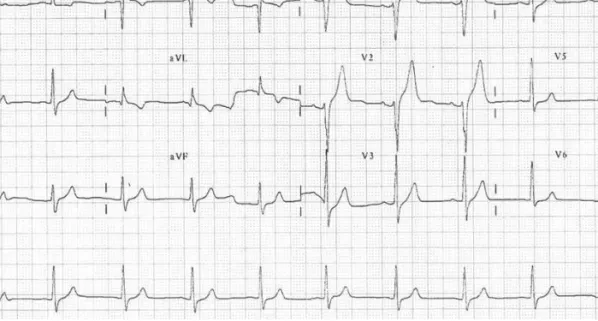
and stable angina visited the emergency room of the authors’ hos- pital with a complaint of chest pain. The chest pain had developed 1 hour before the patient’s arrival at the hospital. The initial electro- cardiogram showed a hyperacute tall T wave in the precordial leads (Fig. 1). In the initial laboratory findings, the cardiac markers were in the normal range, but thrombocytopenia was noted (initial white blood cell count: 3350, hemoglobin: 12.5 g/dL, platelet: 45000/μL).

The patient’s vital signs were stable. His past history revealed that he had been admitted to a hospital a year ago for acute coronary syn- drome and percutaneous coronary intervention (PCI) of the left an- terior descending artery (LAD), for which a Cypher Select stent (3.5×

28 mm, Johnson & Johnson-Cordis, Miami, FL, USA) procedure was performed (Fig. 2). He had been taking 100 mg of aspirin, 75 mg of clopidogrel and 100 mg of oxymetholone (anabolic steroids) for ap- lastic anemia daily since the last one year. However, he had stopped taking aspirin and clopidogrel for 3 days before presenting himself at the hospital since he was scheduled to be treated for a decayed tooth. He also visited the hematology clinic routinely. His laboratory findings showed that he had severe thrombocytopenia (platelet count: 12000/μL). His hematologist recommended platelet trans- fusion for anticipated bleeding. Therefore, transfusion of 6 pints of platelet concentrates was performed on the same day of the pati- ent’s visit to the hospital. Four hours later, he developed chest pain.

The emergent coronary angiography demonstrated total occlu-

sion of the mid-LAD. Balloon angioplasty was done with a 3.0×15

mm non-complaint coronary balloon. Thrombolysis in myocardial

infarction 3 distal flow was obtained. Thus, no additional stent was

(2)

55 Hyun-Sung Shin, et al.

http://dx.doi.org/10.4070/kcj.2012.42.1.54 www.e-kcj.org

needed (Fig. 3).

A dose of 7,000 units of unfractionated heparin was injected during the CAG with another loading dose of 300 mg of clopidogrel.

After the PCI, the chest pain subsided. On the second day, blood started oozing from the puncture site, hence a manual compression dressing was applied for 1 hour, after which there was no more com- plications. The follow-up platelet count was 12000/μL. On the 12th day, the patient’s dental caries was treated with tooth extraction without bleeding complications, and the patient was discharged.

He was prescribed triple antiplatelet therapy with aspirin, clopido- grel, and cilostazol. He was also asked to continue oxymetholone (anabolic steroids) therapy for aplastic anemia.

Discussion

Aplastic anemia is a form of anemia in which the bone marrow

fails to produce adequate numbers of peripheral blood elements. The incidences of atherosclerosis and myocardial infarction in patients with congenital coagulation disorders and chronic thrombocyto- penia are very low.

There are a few reports of cases of aplastic anemia associated with myocardial infarction during treatment with anabolic steroids.

1)

Steroids have been commonly used to treat aplastic anemia, are a possible risk factor for coronary thrombosis, because steroids have an accelerating effect on metabolic changes and can induce a hy- percoagulable state, each of which may promote atherosclerosis.

Therefore, steroids may have helped to precipitate the clinical events in the patient.

2)

Andrade et al.

3)

reported a case of acute stent throm- bosis in a patient with giant cell arteritis, but there is no case report of long-term oral steroid therapy associated with very late stent th- rombosis.

Even if other risk factors for stent thrombosis (e.g., incomplete Fig. 1. Initial electrocardiogram showed hyperacute tall T wave in the precordial leads.

Fig. 2. One year before this event, coronary angiography revealed a diffuse, eccentric luminal narrowing up to 90% (A) and percutaneous coronary inter- vention with Cypher Select 3.5×28 (Johnson & Johnson-Cordis, Miami, FL, USA) was performed due to acute coronary syndrome (arrows) (B).

A   B  

(3)

56 Late Stent Thrombosis in a Patient With Aplastic Anemia

http://dx.doi.org/10.4070/kcj.2012.42.1.54 www.e-kcj.org

REFERENCES

1. Toyama M, Watanabe S, Kobayashi T, et al. Two cases of acute myocardial infarction associated with aplastic anemia during treatment with anabolic steroids. Jpn Heart J 1994;35:369-73.

2. Fisher M, Appleby M, Rittoo D, Cotter L. Myocardial infarction with extensive intracoronary thrombus induced by anabolic ste- roids. Br J Clin Pract 1996;50:222-3.

3. Andrade J, Al Ali A, Saw J, Wong GC. Acute stent thrombosis in a patient with giant cell arteritis. Can J Cardiol 2008;24:e25-6.

4. Sabovic M, Zorman SK. Plasminogen activator inhibitor-1, which is released from blood product transfusions, might be associated with (sub)acute thrombosis after coronary dilatation and stent- ing: a case report. Heart Vessels 2003;18:47-9.

5. Juhan-Vague I, Alessi MC. Plasminogen activator inhibitor 1 and atherothrombosis. Thromb Haemost 1993;70:138-43.

6. Urano T, Sakakibara K, Rydzewski A, Urano S, Takada Y, Takada A.

Relationship between euglobulin clot lysis time and the plasma levels of tissue plasminogen activator and plasminogen activa- tor inhibitor 1. Thromb Haemost 1990;63:82-6.

7. Cornet AD, Klein LJ, Groeneveld AB. Coronary stent occlusion af- ter platelet transfusion: a case series. J Invasive Cardiol 2007;19:

E297-9.

8. Méndez TC, Díaz O, Enríquez L, Baz JA, Fernández F, Goicolea J.

Severe thrombocytopenia refractory to platelet transfusions, secondary to abciximab readministration, in a patient previously diagnosed with idiopathic thrombocytopenic purpura: a possible etiopathogenic link. Rev Esp Cardiol 2004;57:789-91.

9. Emerson GG, Herndon CN, Sreih AG. Thrombotic complications after intravenous immunoglobulin therapy in two patients. Phar- stent expansion or clopidogrel resistance), according to time sequ-

ence, could not be completely excluded, platelet concentrate trans- fusion might have played an important role in coronary stent th- rombosis in this study. Sabovic and Simona

4)

suggested that a sub- stantial number of platelets and whole blood transfusions might be risk factors for coronary thrombosis. That is, plasminogen activator inhibitor-II, a strong prothrombotic factor, which accumulates in stored blood products in a time-dependent manner, could extensi- vely increase in the plasma after transfusions. This prediction, which may be clinically relevant, must be further clarified.

5)6)

Unfortunately, this marker or other coagulation factors have not been examined.

There are few reports of stent thrombosis associated with blood component transfusion. Cornet et al.

7)

reported three case studies of coronary stent occlusion after platelet transfusion. Actually, since peri- or intra-procedural massive bleeding was noted in all three cases, platelet transfusion was done inevitably. In our case, one could argue that platelet transfusion was not necessary in a patient who was scheduled for a minor dental procedure.

The use of intravenous immunoglobulin (IVIG) concomitant with platelet transfusion is indicated in patients with life-threatening se- vere thrombocytopenia or hemorrhage, or when therapeutic pro- cedures with some risk of bleeding are performed.

8)

IVIG should be administered only after careful consideration of the risks and ben- efits, and should be reserved for patients at risk of severe hemorr- hage, and the use of a bare-metal stent over a drug-eluting stent should always be considered as the first option.

9-11)

In conclusion, the authors’ observations emphasize the risks of platelet transfusion and support withholding such a treatment un- less vitally indicated, in patients with coronary artery stent implant- ation and even in those on dual antiplatelet therapy.

Fig. 3. Coronary angiography of the left coronary artery. Total occlusion of the mid left anterior descending artery in the portion of the previously inserted stent (A) was noted (arrows). After balloon angioplasty with 3.0×15 mm non-complaint coronary balloon, thrombolysis in myocardial infarction 3 distal flow was obtained (B).

A   B  

(4)

57 Hyun-Sung Shin, et al.

http://dx.doi.org/10.4070/kcj.2012.42.1.54 www.e-kcj.org

macotherapy 2002;22:1638-41.

10. Paolini R, Fabris F, Cella G. Acute myocardial infarction during treatment with intravenous immunoglobulin for idiopathic throm- bocytopenic purpura (ITP). Am J Hematol 2000;65:177-8.

11. Anderson D, Ali K, Blanchette V, et al. Guidelines on the use of

intravenous immune globulin for hematologic conditions. Trans-

fus Med Rev 2007;21(2 Suppl 1):S9-56.

수치

Fig. 2. One year before this event, coronary angiography revealed a diffuse, eccentric luminal narrowing up to 90% (A) and percutaneous coronary inter- inter-vention with Cypher Select 3.5×28 (Johnson & Johnson-Cordis, Miami, FL, USA) was performed due
Fig. 3. Coronary angiography of the left coronary artery. Total occlusion of the mid left anterior descending artery in the portion of the previously inserted  stent (A) was noted (arrows)

참조

관련 문서