632 https://e-kcj.org
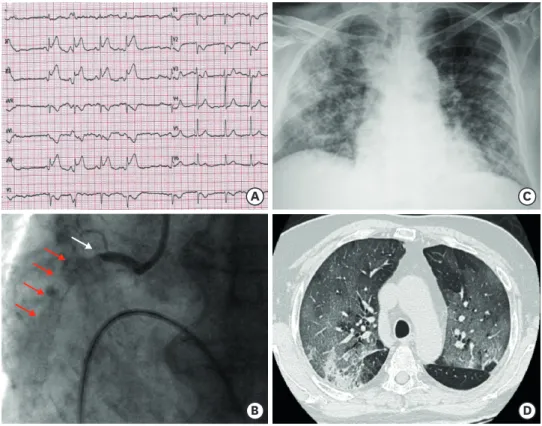
A 79-year-old man presented at our hospital with acute myocardial infarction after he had been successfully treated with percutaneous coronary intervention 2 years earlier, and discharged on dual antiplatelet therapy (clopidogrel 75 mg/day for 12 months and aspirin 100 mg/day indefinitely). The patient had remained asymptomatic after the procedure but had started complaining of fever and cough the week before hospitalization. An intense chest pain was present at admission while the electrocardiogram showed a significant ST-elevation in the inferior leads (Figure 1A). Coronary angiography documented an occlusive in-stent thrombotic
Korean Circ J. 2020 Jul;50(7):632-633https://doi.org/10.4070/kcj.2020.0166 pISSN 1738-5520·eISSN 1738-5555
Images in
Cardiovascular Medicine
Received: Apr 17, 2020 Revised: Apr 22, 2020 Accepted: Apr 29, 2020 Correspondence to Gian Battista Danzi, MD
Division of Cardiology, Ospedale di Cremona, Viale Concordia 1, 26100 Cremona, Italy.
E-mail: [email protected]
Copyright © 2020. The Korean Society of Cardiology
This is an Open Access article distributed under the terms of the Creative Commons Attribution Non-Commercial License (https://
creativecommons.org/licenses/by-nc/4.0) which permits unrestricted noncommercial use, distribution, and reproduction in any medium, provided the original work is properly cited.
ORCID iDs Gian Luca Galeazzi
https://orcid.org/0000-0003-0262-7387 Marco Loffi
https://orcid.org/0000-0002-1682-1386 Giuseppe Di Tano
https://orcid.org/0000-0002-5873-7094 Gian Battista Danzi
https://orcid.org/0000-0003-0897-8006 Conflict of Interest
The authors have no financial conflicts of interest.
Author Contributions
Conceptualization: Danzi GB; Data curation:
Di Tano G; Formal analysis: Galeazzi GL;
Supervision: Danzi GB; Writing - original draft:
Loffi M; Writing - review & editing: Danzi GB.
Gian Luca Galeazzi , MD, Marco Loffi , MD, Giuseppe Di Tano , MD, and Gian Battista Danzi , MD
Division of Cardiology, Ospedale di Cremona, Cremona, Italy
Severe COVID-19 Pneumonia and Very Late Stent Thrombosis: a Trigger or Innocent Bystander?
A C
B D
Figure 1. (A) Significant ST-segment elevation in inferior leads on electrocardiogram at presentation. (B) Acute occlusion of the proximal right coronary artery at the edge of previously implanted stents (arrows). (C) Bilateral diffuse airspace opacities on chest X-ray. (D) Cross-sectional computed tomography-scan showing extensive ground-glass opacifications involving both the lung parenchymas with areas of consolidation in the right lower lobe posterior segment.
lesion of the proximal right coronary artery, that was immediately treated (Figure 1B). A severe bilateral pneumonia was documented at chest X-ray and confirmed at computed tomography (Figure 1C and D). Nasopharyngeal swab tested positive for coronavirus disease 2019
(COVID-19) infection. Arterial blood gas analysis on oxygen therapy showed severe hypoxemia with a PaO
2/FiO
2ratio of 100. The patient was treated with noninvasive ventilation but died a few hours later of severe acute respiratory distress syndrome.
Patients with chronic coronary artery disease have an increased probability of developing an acute coronary syndrome (ACS) during acute infections.
1)COVID-19 may affect the cardiovascular system in multiple ways and these mechanisms can interact each other: direct myocardial involvement mediated via angiotensin-converting enzyme 2
2); hypoxemia due to severe COVID-19 infection
3); cytokines storm and high concentrations of inflammatory mediators that could lead to atherosclerotic plaque instability and rupture
4); repeated floods of catecholamines due to anxiety.
5)This case of diffuse COVID-19 pneumonia seems to confirm the role of severe infection as a precipitating factor for ACS in patients with chronic coronary artery disease, and causal relationship.
REFERENCES
1. Smeeth L, Thomas SL, Hall AJ, Hubbard R, Farrington P, Vallance P. Risk of myocardial infarction and stroke after acute infection or vaccination. N Engl J Med 2004;351:2611-8.
PUBMED | CROSSREF
2. Oudit GY, Kassiri Z, Jiang C, et al. SARS-coronavirus modulation of myocardial ACE2 expression and inflammation in patients with SARS. Eur J Clin Invest 2009;39:618-25.
PUBMED | CROSSREF
3. Zheng YY, Ma YT, Zhang JY, Xie X. COVID-19 and the cardiovascular system. Nat Rev Cardiol 2020;17:259-60.
PUBMED | CROSSREF
4. Huang C, Wang Y, Li X, et al. Clinical features of patients infected with 2019 novel coronavirus in Wuhan, China. Lancet 2020;395:497-506.
PUBMED | CROSSREF
5. Zvonarev V. Takotsubo cardiomyopathy: medical and psychiatric aspects. Role of psychotropic medications in the treatment of adults with “Broken Heart” syndrome. Cureus 2019;11:e5177.
PUBMED | CROSSREF
633 https://e-kcj.org https://doi.org/10.4070/kcj.2020.0166
COVID-19 Pneumonia and Very Late Stent Thrombosis