Original Articles Korean Circulation J 1999;;;;29((((9))))::::976-984
Influence of Total Ginseng Saponin on Contractile Responses of Vasoconstrictors in the Isolated Rat Aorta
Choon-Hae Chung, MD 1 , Soon-Pyo Hong, MD 1 , Seong-Ho Cho, MD 2 , Jang-Gwon Hong, MD 2 , Yong-Kyoon Lee, MD 2 , Geon-Han Lim, MD 2 , Won-Ho Yang, MD 2 , Ho-Jin You, MD 2 , Seong-Chang Woo, MD 2 , Cheol-Hee Choi, MD 2 and Dong-Yoon Lim 2 , PhD
1
Department of Internal Medicine and
2Pharmacology, College of Medicine, Chosun University, Kwangju, Korea
흰쥐 대동맥에서 총인삼사포닌이 혈관수축제의 수축반응에 미치는 영향
조선대학교 의과대학 내과학교실,
1약리학교실
2정춘해1·홍순표1·홍장권2·조성호2·이용균2·임건한2 양원호2·우성창2·유호진2·최철희2·임동윤2
국 문 초 록
연구배경:인삼은 혈압을 상승시킨다는 보고와 오히려 혈압을 하강 시킨다는 상반된 보고 가 있다. 또한 일부
연구에서는 인삼은 혈압에 영향을 미치지 않는다는 보고와 혈압상승작용과 혈압하강작용의 이상성 작용이 있다
고 보고되어 있다. 따라서 본 연구에서는 흰쥐 적출 대동맥편을 이용하여 총인삼사포닌이 아드레날린성 α
1-수용
체 효능약과 막탈분극제에 의한 수축반응에 미치는 영향을 관찰하고자 시도하였다. 방 법:흰쥐 대동맥을 적 출하여 항온수조 내에서 isometric force transducer에 연결하여 Physiograph상에서 수축반응을 관찰하여 비 교 관찰하였다. 결 과:Phenylephrine(아드레날린성 α
1-수용체 효능약)과 고농도 칼륨(막탈분극약)은 흰 쥐 대동맥편에서 현저한 혈관수축반응을 나타내었다. 그러나, 총인삼사포닌(600 μg/ml) 존재하에서 phen- ylephrine(10
-5및 10
-6M)과 고농도 칼륨(3.5×10
-2과 5.6×10
-2M)에 의한 혈관 수축반응은 현저하게 증 강되었으나 반면에 prostglandin F 2α(5×10
-6M)에 의한 혈관수축반응은 별다른 영향을 받지 않았다. Phen- ylephrine(10
-5M)과 고농도 칼륨(3.5×10
-2M)에 의한 혈관수축반응은 총인삼사포닌(600 μg/ml)존재하에 서도 calcium channel blocker인 nicardipine(10
-6M)의 전처치에 의해서 뚜렷이 억제되었다. 결 론:이상
과 같은 실험 결과를 종합하여 보면, 총인삼사포닌은 흰쥐 적출 대동맥편에서 아드레날린성 α
1-수용체 흥분작
용과 막탈분극작용에 의한 혈관수축반응을 증강시킬 수 있으며, 이러한 총인삼사포닌의 증강작용은 혈관평활근세 포로 칼슘유입과 관련성이 있는 것으로 사료된다. ( ( (Korean Circulation J 1999;29( ( (( (9) )) ):976-984) )) )
중심 단어
:흰쥐적출 대동맥・총인삼사포닌・혈관수축작용.
논문접수일:1997년 12월 27일 / 심사완료일:1998년 5월 21일
Corresponding author:
::Dong-Yoon Lim, 375 Seosuk-Dong, Dong-Gu, Kwangju 501-759, Korea : Department of Pharmacology, College of Medicine, Chosun University, Kwangju 501-759, Korea TEL:(062) 220-3659・Fax:(062) 227-4693E-mail:[email protected].
Introduction
It has been shown that total Ginseng saponin produ- ces the pressor and depressor actions in the anesthetized normotensive rats.
1)It has suggested that this depressor response is mediated in part through the blockade of adrenergic α-receptors as well as the stimulation of cholinergic muscarinic receptors, and that its pressor response is caused by stimulation of nicotinic cholin- ergic receptors at the sympathetic ganglia. Furthermore, Choi
2)has reported that total Ginseng saponin can inhibit the releasing effect of catecholamines evoked by nicotinic receptor stimulation from the isolated perfu- sed rat adrenal medulla, which seems to be associated to the direct inhibition of calcium influx into the rat adrenomedullary chromaffin cells. In the isolated perfu- sed rat adrenal glands, total Ginseng saponin increases a calcium-dependent secretion of catecholamines via direct action on chromaffin cells with partly mediation of muscarinic action.
3)In previous studies, it has been known that Ginseng extract causes the hypotensive action
4-8)while it rather produces the hypertensive action.
9-10)Some studies have suggested that Ginseng extract causes a biphasic respo- nse on blood pressure, namely, transient fall followed by prolonged elevation.
11-13)Furthermore, Ginseng, when given at small dose in spontaneously hypertensive rat (SHR), cause pressor response, but at relatively large dose rather produces dose-depen-dent hypotensive response with decreased plasma renin activity.
14-16)Sokabe and his coworkers
17)have shown that admini- stration of Korean Red Ginseng powder for 11 weeks has no effect on blood pressure in normotensive Donryn (DON) rats, SHR and renal hypertensive rats, whereas it elevates slightly blood pressure in deoxycorticoste- rone salt hypertensive rats.
Lim and his cowerkers
18-19)have also found that both of panaxadiol- and panaxatriol-type saponins cause the increased secretion of catecholamines (CA) in a Ca
2+- dependent fashion from the isolated perfused rabbit adrenal glands through the activation of cholinergic (both nicotinic and muscarinic) receptors and partly the direct action on the rabbit adreno-medullary chromaffin
cells. As mentioned so far, there are many controversial reports on vascular effects of Ginseng saponin.
Therefore, the present study was attempted to exam- ine the effect of total Ginseng saponin on contrac-tile responses evoked by stimulation of adrenergic α1- receptors and membrane depolarization in the isolated rat aorta and to clarify the mechanism of its action.
Materials and Methods
Experimental procedure
Mature male Sprague-Dawley rats, weighing 150 to 350 grams, were used in the experiment. The animals were housed individually in separate cages, and food (Cheil Animal Chow) and tap water were allowed ad libitum for at least a week to adapt to experimental circumstances. On the day of experiment, a rat was ane- sthetized with thiopental sodium (40 mg/kg) intraperi- toneally, and tied in supine position on fixing panel.
The thorax was opened by a midline incision, and the heart and surrounding area were exposed by placing three hook retractors. The heart and portion of the lung were not removed, but pushed over to the right side and covered by saline-soaked gauge pads in order to obtain enough working space for isolating aortic vessel.
The aorta was isolated from the proximal part of the he- art to the vicinity of liver and immediately immersed in cold Krebs solution. The blood within the aorta was rapidly removed. The aorta was cut into the ring of 4- 5 mm length.
Recording of mechanical activity
The ring segment of aorta was mounted in a muscle bath by sliding the ring over two parallel stainless-steel hook (0.15 mm in diameter). The lower hook was fixed on bottom of the bath and the upper was connected to isometric transducer (Grass FT. 03). The signal from the transducer was displayed on a polygraph (Grass Instruments Model 79). The volume of bath was 25 ml and the bath solution was saturated with 95% O
2and 5% CO
2at 37℃.
The composition (mM) of Krebs was:NaCl, 118.
4;KCl, 4.7;CaCl
2, 2.5;MaCl
2, 1.18;NaHCO
3, 25;
KH
2PO
4, 1.2;glucose, 11.7. The final pH of the solut-
ion was maintained at 7.4–7.5. During equilibration pe- riod of 2 hours, the resting tension was adjust to 0.5 g.
After the equilibration period, the ring was challenged with 35 mM KCl two times, and if it responded with contraction, the proper experiment were started. Vaso- constrictors were admin-istered into the bath in order to obtain dose-response curves. In the subsequent expe- riments, under the presence of total Ginseng saponin some vasoconstrictors were administered. The data were expressed as % of the control tension.
Statistical analysis
The statistical significance between groups was dete- rmined by the Student’ t-test. A P-value of less than 0.05 was considered to represent statistically significant changes unless specifically noted in the text. Values given in the text refer to means and the standard errors of the mean (S.E.M.). The statistical analysis of the experimental results was made by computer program described by Tallarida and Murray.
20)Drugs and their sources
The following drugs were used:phenylephrine hydr- ochloride, prostglandin F
2α tris salt, potassium chlo- ride and nicardipine hydrochloride (Sigma Chemical Co., U. S. A.). Total Ginseng saponin was a gift from late Dr. Young-Ho Kim (Sejong University, Seoul, Korea).
Drugs were dissolved in distilled water (stock) and add- ed to the normal Krebs solution as required. Concentra- tions of all drugs used are expressed in terms of molar base except Total Ginseng saponin (g/ml).
Results
The effects of total Ginseng saponin on contractile responses induced by phenylephrine, high K
+and prostaglandin F
2α in the isolated rat aortic strips
The resting (basal) tension from the isolated rat aortic strips reaches a steady state after the perfusion with oxygenated Krebs-bicarbonate solution for 90 min before the experimental protocol is initiated. The resting tension was adjusted to 0.5 g. The effects of total Ginseng saponin on phenylephrine- as well as potass- ium chloride-mediated contractile responses in the rat
aorta were examined. In the present study, total Ginseng saponin itself did not produce any effect on the resting tension (data not shown).
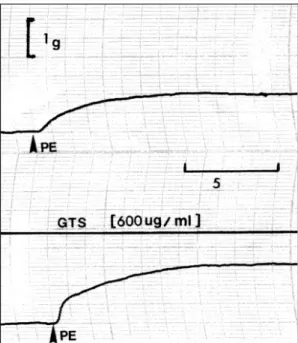
When 10
-6M and 10
-5M of phenylephrine were ad- ministered into the aortic bath, the active tensions of them were 0.75±0.05 g and 1.02±0.12 g from the resting tension level, respectively. However, under the preloading with total Ginseng saponin at a concentration of 600 μg/ml, phenylephrine-induced tensions were si- gnificantly potentiated to 1.14±0.11 g (p<0.01) and 1.
52±0.13 g (p<0.01) from resting level from 7 rat aortic strips, which were 152.0% and 149.1% of the control contractile responses, respectively, as shown in Figs. 1 and 2.
High K exerts two distinct effects on cells:(1) de- polarization of cell membrane, and (2) depolarization- induced influx of calcium via voltage-dependent calc- ium channels.
21)When added through the bath, high potassium at the concentration of 35 mM and 56 mM, which is mem-
Fig. 1. The typical tracing showing the effect of total
Ginseng saponin (GTS)on phenylephrine (PE)-inducedcontractile responses in the rat aortic strip. Upper:
PE-induced contractile response. Lower:PE-induced contractile response in the presence of total Ginseng saponin (600 μg/ml). At arrow mark, the indicated dose (10
-5M) of phenylephrine was added to the bath.
The chart speed was 5 mm/min.
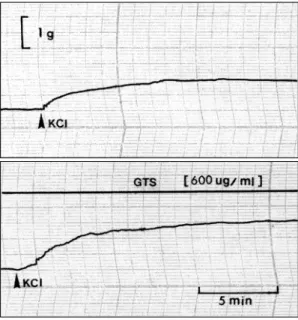
brane depolarizing agent, caused an increase in aortic contraction, respectively. As shown in Fig. 3 and 4, high potassium-induced contractile responses before preloading with total Ginseng saponin were 1.13±
0.19 g and 1.58±0.17 g, while after pretreatment with total Ginseng saponin at a concentration of 600 μg/
ml they were greatly enhanced to 1.56 ±0.18 g (p
<0.01) and 2.27±0.21 g (p<0.01), which were 138.1%
and 143.7% of the corresponding control from 8 rat aortic strips, respectively.
Since it has been found that prostaglandin F
2α(5×
10
-6M) is a vasoconstrictor in dog cerebral arteries
22), it is likely interesting to examine the effect of total
Ginseng saponin on prostaglandin F
2α -induced con-
traction in the rat aortic strips. Prostaglandin F
2α(5×
10
-6M) produced prominent and steady-state contra- ction in the rat aortic strips as shown in Fig. 5. In 6 rat aortic strips, prostaglandin F
2α(5×10
-6M) caused the contractile response of 1.32±0.18 g from the resting tension level but, even in the presence of total Ginseng saponin (600 μg/ml), it was not affected (98.5% of the control) as in Fig. 6.
The effect of nicardipine on total Ginseng sa- ponin-induced potentiation of the contractile response evoked by high K+ in the isolated rat aorta
In order to investigate the effect of nicardipine, a dihydropyridine derivative and L-type Ca
2+channel blocker
23)on total Ginseng saponin-induced potentia- tion of the contractile response evoked by high pota- ssium in the rat aortic strips, nicardipine (10
-6M) was preloaded into the bath. In the presence of nicardipine effect, total Ginseng saponin-induced potentiation of the contractile response evoked by high potassium (35
Fig. 2. Influence of total Ginseng saponin (GTS) on phenylephrine (PE)-induced contractile responses in the isolated rat aortic strips. The contractile response was induced by adding 1 uM and 10 uM of PE, respecti- vely after adaptation with normal Krebs solution for two hours prior to initiation of the experimental protocol.
“CONTROL”and“AFTER”denote active tension induc- ed evoked by PE before (CONTROL) and after adding total ginseng saponin (600 μg/ml), respectively. Num- ber in the parenthesis indicates number of experim- ental rat aortic strips. Vertical bars represent the standard error of the mean (S.E.M). Ordinate:the active tension (% of control). Abscissa:concentrati- ons of PE (M). Statistical difference was obtained by comparing the control with the GTS-pretreated group.
***:p<0.01
Fig. 3. The typical tracing showing the effect of total
Ginseng saponin (GTS)on high potassium(KCL)-ind-
uced contractile response in the rat aortic strip. Up-
per:KCI-induced contractile responses. Lower:KCL-
induced contractile response in the presence of total
Ginseng saponin (600 μg/ml). At dots, the indicated
does(35 mM) of KCL was added to the bath. The
chart speed was 5 mm/min.
mM) were greatly depressed to 0.31±0.02 g (19.4%
of the control, p<0.01) from the resting tension level from 6 adrenal glands in comparis-on with their corre- sponding control values of 1.60±0.15 g as depicted in Fig. 7 and 8.
Discussion
The present experimental results suggest that total Ginseng saponin potentiates the contractile responses induced by stimulation of adrenergic α
1-receptor and the membrane depolarization in the isolated rat aortic strips, which appears to be in relation to calcium influx.
Generally, extracellular Ca
2+has been unequivocal- ly shown to play a critical role in excitation-contrac- tion coupling in vascular smooth muscle. Most of cellular mechanisms accepted in accounting for the contraction of vascular smooth muscle by various agents are based on increased intracellular Ca
2+either through influx of extracellular Ca
2+or through release Fig. 4. Influence of total Ginseng saponin (GTS) on
high potassium-induced contractile responses in the isolated rat aortic strips. High potassium (35 and 56 mM, respectively) was added into the bath before and after pretreatment with GTS (600 μg/ml). Other lege- nds are the same as in Fig. 2. ***:p<0.01
Fig. 5. The typical tracing showing the effect of total
Ginseng saponin (GTS) on prostaglandine F2a (PGF
2a) -induced contractile responses in the rat aortic strip.
Upper:PGF
2a-inducd contractile response. Lower:
PGF
2a-induced contractile response in the presence of total Ginseng saponin (600 μg/ml). At dots, the in- dicated dose (5×10
-6M) of phenylephrine was add- ed to the bath. The chart speed was 5 mm/min.
Fig. 6. Influence of total Ginseng (GTS) saponin on pro-
staglandin F
2α -induced contractile response in the
isolated rat aortic strips. prostaglandin F
2α(5 M) was
added into the bath before and after pretreatment
with GTS (600 μg/ml). Other legends are the same as in
Fig. 2. ns:nonsignificance.
of intracellularly stored Ca
2+.
24-27)And it well known that potassium chloride (KCI) opens voltage-dependent calcium channels by depolarizing the cell membrane of vascular smooth muscle, resulting in increased influx of extracellualr Ca
2+.
26)28-30)Kim and his colleagues
31)have shown that the contractile responses of vascular smooth muscle induced by CaCl
2and KCI may result most likely from increased influx of extracellular Ca
2+through the voltage-dependent calcium channels. In terms of these results, the present findings that total Ginseng saponin enhances the contraction of rat aortic smooth muscle evoked by phenylephrine (α
1-adrene- rgic receptor agonist) and KCI (membrane depolarizer) suggest strongly that total Ginseng saponin can
facilitate influx of extracellular Ca
2+.
In previous studies, three cellular mechanisms have been proposed to explain relaxant response of vascular smooth muscle:(i) blockade of extracellular Ca
2+entry into cells,
32-33)(ii) increase in binding or seque- stration of intracellular Ca
2+,
34-35)and (iii) inhibiting the release of intracellular stored Ca 2+.
35-37)In the light of these findings, the present result suggests that total Ginseng saponin can enhance the contractile re- sponses of vascular smooth muscle evoked by phenyle- phrine and /or KCI through increased extracellular Ca
2+entry into the muscle cells. Because the pretreat- ment with 5 M nicardipine, an inhibitor of the dihydro- pyridine Ca
2+channel, abolished almost completely total Ginseng saponin-induced potentiation of contra- ction evoked by KCI in the present study.
Moreover, this effect of total Ginseng saponin seems Fig. 7. The typical tracing showing nicardipine effect on
potentiation of total Ginseng saponin (GTS) to high potas-sium (KCI)-induced contractile responses in the rat aortic strip. Upper:the potentiation of GTS (600 μ g/ml) to high potassium-induced contractile res-ponse.
Lower:nicardipine effect on the potentiation of GTS to high potassium-induced contractile response. At arrow mark, the indicated dose (35 mM) of KCL was added to the bath. The chart speed was 5 mm/min.
Fig. 8. Influence of nicardipine on total Ginseng saponin
(GTS)-induced potentiation of contractile response
by high potassium in the isolated rat aortic strips. High
potassium (35 mM) along with GTS (600 μg/ml) was
added into the bath before and after pretreatment with
nicardipine (1 M). GTST NI:GTSTN:cardipine. Other leg-
ends are the same as in Fig. 2. ***:p<0.01
to contribute at least partly to the facts that Ginseng extract causes the hypertensive action
9-10), but not to the facts that it rather produes the hypotensive action.
4-8)The contractions of vascular smooth muscles induced by neurohumoral agents have been composed of two components:Phasic contraction induced by the Ca
2+released from inside the cell and tonic tension related to the Ca
2+influx,
31)38)both leading to increased intra- cellular calcium.
In the present study, prostaglandin F
2α, which is known as a vasoconstrictor in cerebral arteries of the dog
22)and the pig
39), caused a contractile response in the isolated rat aortic smooth muscles. However, prostaglandin F
2α-induced contractile response was never influenced by the pretreatment with total Ginseng saponin. This finding indicates that total Ginseng sapo- nin does not affect prostaglandin receptors. Responses to prostaglandin F
2α vary with species and vascular bed. It is a potent constrictor of both pulmonary arteries and veins in human beings.
40-41)Thus, the most plausible explanation accounting for the facilitatory action of total Ginseng saponin on the vascular contractions induced by stimulation of adren- ergic α
1-receotors and the membrane depolarization in the isolated rat aortic strips is the increased extra- cellular calcium into muscle cells likewise in neuronal tissues.
Summary
Background::: :
It has been known that Ginseng extract causes the hypotensive action while it rather produces the hyperte- nsive action. Some studies have suggested that Ginseng extract causes a biphasic response on blood pressure, namely, transient fall followed by prolonged elevation.
It has been also shown that administra-tion of Korean Red Ginseng powder has no effect on blood pressure in normotensive and hypertensive rats. The present study was designed to examine the effect of total Ginseng saponin on contractile responses of vasoconstrictors in the rat aorta and to establish the mechanism of its action.
Methods::::
The ring segment of aorta was mounted in a muscle
bath filled with oxygenated Krebs solution for the measurement of isometric tension. After the equili- bration period, under the presence of total Ginseng sa- ponin, isometric tension induced by some vasoconstri- ctors were observed and compared to the control respo- nses. The data were expressed as % of the control tension.
Results::::
Phenylephrine (an adrenergic α
1-receptor agonist) and high potassium (a membrane depolarizing agent) caused greatly contractile responses in the rat aorta, respectively. However, in the presence of total ginseng saponin (600 g/ml), the contractile responses of phen- ylephrine (10
-6and 10
-5M) and high potassium (3.5×
10
-2and 5.6×10
-2M) were markedly potentiated whe- reas prostglandin F
2α(5×10
-6M) -induced contractile responses was not affected. The contractile responses induced by phenylephrine (10
-5M) and high potassium (3.5×10
-2M) even under the presence of total ginseng saponin (600 g/ml) were greatly inhibited by the pre- treatment of nicardipine (10
-6M), a calcium channel blocker.
Conclusion::: :
Taken together, these experimental results suggest that total ginseng saponin can enhance the contrac-tile responses evoked by stimulation of adrenergic α
1- receptor and the membrane depolarization in the isola- ted rat aortic strips, which seems to be associated to calcium influx.
KEY WORDS:Isolated rat aortic smooth muscle・
Total ginseng saponin・Vasoconstriction.
■ Acknowledgment
This study was supported partly by the fund from Chosun University (1997–1998).
REFERENCES