ABSTRACT
Background and Objectives: Impaired recovery from left ventricular (LV) dysfunction is a major prognostic factor after myocardial infarction (MI). Because P2Y
12receptor blockade inhibits myocardial injury, ticagrelor with off-target properties may have myocardial protection over clopidogrel. In animal models, ticagrelor vs. clopidogrel protects myocardium against reperfusion injury and improves remodeling after MI. We aimed to investigate the effect of ticagrelor on sequential myocardial remodeling process after MI.
Methods: High platelet inhibition with ticagrelor to improve LV remodeling in patients with ST-segment elevation MI (HEALING-AMI) is an investigator-initiated, randomized, open- label, assessor-blinded, multi-center trial done at 10 sites in Korea. Patients will be enrolled if they have ST-segment elevation MI (STEMI) treated with primary percutaneous coronary intervention and a planned duration of dual antiplatelet treatment of at least 6 months.
Screened patients will be randomly assigned (1:1) using an internet-based randomization with a computer-generated blocking with stratification across study sites to either ticagrelor or clopidogrel treatment. The co-primary primary endpoints are LV remodeling index with three-dimensional echocardiography and the level of N-terminal prohormone B-type
Original Article
Yongwhi Park , MD, PhD
1, Si Wan Choi, MD, PhD
2, Ju Hyeon Oh , MD, PhD
3, Eun-Seok Shin , MD, PhD
4, Sang Yeub Lee, MD, PhD
5, Jeongsu Kim , MD, PhD
6, Weon Kim , MD, PhD
7, Jeong-Won Suh, MD, PhD
8, Dong Heon Yang, MD, PhD
9, Young-Joon Hong, MD, PhD
10, Mark Y Chan, MD, PhD
11, Jin Sin Koh, MD, PhD
12, Jin-Yong Hwang, MD, PhD
12, Jae-Hyeong Park , MD, PhD
2,
Young-Hoon Jeong , MD, PhD
1, and HEALING-AMI Trial Investigators
1
Department of Internal Medicine, Gyeongsang National University Changwon Hospital, Changwon, Korea
2
Division of Cardiology, Department of Internal Medicine, Chungnam National University Hospital, Daejeon, Korea
3
Department of Internal Medicine, Changwon Samsung Medical Center, Changwon, Korea
4
Division of Cardiology, Department of Internal Medicine, Ulsan University Hospital, Ulsan, Korea
5
Division of Cardiology, Department of Internal Medicine, Chungbuk National University Hospital, Cheongju, Korea
6
Division of Cardiology, Department of Internal Medicine, Pusan National University Yangsan Hospital, Yangsan, Korea
7
Division of Cardiology, Department of Internal Medicine, Kyung Hee University Hospital, Seoul, Korea
8
Division of Cardiology, Department of Internal Medicine, Seoul National University Bundang Hospital, Seongnam, Korea
9
Division of Cardiology, Department of Internal Medicine, Kyungpook National University Hospital, Daegu, Korea
10
Division of Cardiology, Department of Internal Medicine, Chonnam National University Hospital, Gwangju, Korea
11
Department of Cardiology, Singapore National University Heart Centre, Singapore
12
Department of Internal Medicine, Gyeongsang National University Hospital, Jinju, Korea
Rationale and Design of the High Platelet Inhibition with Ticagrelor to Improve
Left Ventricular Remodeling in Patients with ST-Segment Elevation Myocardial Infarction (HEALING-AMI) Trial
Received: Nov 9, 2018 Revised: Feb 5, 2019 Accepted: Feb 20, 2019 Correspondence to
Young-Hoon Jeong
Department of Internal Medicine, Gyeongsang National University Changwon Hospital, 11 Samjeongja-ro, Seongsan-gu, Changwon 51472, Korea.
E-mail: [email protected] Copyright © 2019. The Korean Society of Cardiology
This is an Open Access article distributed under the terms of the Creative Commons Attribution Non-Commercial License (https://
creativecommons.org/licenses/by-nc/4.0) which permits unrestricted noncommercial use, distribution, and reproduction in any medium, provided the original work is properly cited.
ORCID iDs
Yongwhi Park
https://orcid.org/0000-0003-3626-9717 Ju Hyeon Oh
https://orcid.org/0000-0001-7007-9760 Eun-Seok Shin
https://orcid.org/0000-0002-9169-6968 Jeongsu Kim
https://orcid.org/0000-0001-6877-4289 Weon Kim
https://orcid.org/0000-0003-1264-9870 Jae-Hyeong Park
https://orcid.org/0000-0001-7035-286X Young-Hoon Jeong
https://orcid.org/0000-0003-0403-3726
Trial Registration
ClinicalTrials.gov Identifier: NCT02224534
FundingThis study is supported by research grants from AstraZeneca Korea and the Basic Science Research Program through the National Research Foundation (NRF) of Korea funded by the Ministry of Science, ICT and Future Planning (NRF-2015R1A5A2008833).
Conflict of Interest
The authors have no financial conflicts of interest.
Author Contributions
Conceptualization: Park Y, Jeong YH; Data curation: Park Y, Chan MY, Park JH; Formal analysis: Park Y; Funding acquisition: Jeong YH; Investigation: Park Y, Choi SW, Oh JH, Shin ES, Lee SY, Kim JS, Kim W, Suh JW, Yang DH, Hong YJ, Koh JS, Hwang JY, Jeong YH;
Methodology: Park Y, Chan MY, Park JH, Jeong YH; Resources: Chan MY; Software: Park JH;
Visualization: Chan MY; Writing - original draft:
Park Y, Park JH, Jeong YH; Writing - review &
editing: Park Y, Jeong YH.
natriuretic peptide (NT-proBNP) at 6 months representing post-MI remodeling processes.
Changes of LV end-systolic/diastolic volume indices and LV ejection fraction between baseline and 6-month follow-up will be also evaluated. Analysis is per protocol.
Conclusions: HEALING-AMI is testing the effect of ticagrelor in reducing adverse LV remodeling following STEMI. Our trial would show the benefit of ticagrelor vs. clopidogrel related to the recovery of post-MI LV dysfunction beyond potent platelet inhibition.
Trial Registration: ClinicalTrials.gov Identifier: NCT02224534
Keywords: Myocardial infarction; Ventricular Remodeling; Platelet; Ticagrelor; Clopidogrel
INTRODUCTION
The impaired left ventricular (LV) function after acute myocardial infarction (AMI) is the most important cause of heart failure (HF) and a major determinant of long-term prognosis.
1-3)Timely early reperfusion therapy, either with pharmacological or mechanical regimens, markedly has reduced short-term mortality and the loss of myocardium in AMI patients.
1)2)However, the morbidity and mortality of post-MI HF remain high despite the advanced interventional devices and techniques.
1)The reduction of short-term mortality with efficient acute care in company with insufficient long-term therapeutic options to treat MI survivors might contribute to persistently high prevalence of HF. The size of the infarct area, wound healing process, and chronic LV remodeling are the major determinants of HF after AMI, which are partly reduced by timely reperfusion therapy and conventional pharmacotherapy.
4)5)However, additional therapeutic strategies are still required to facilitate the wound healing and preclude the development of HF following large-sized MI.
Myocardial wound healing or repair following MI, a well-orchestrated complex process,
has been considered to begin with an inflammatory phase characterized by replacement of
the necrotic myocardium with granulated tissue, and is followed by a proliferative phase
with the inhibition of inflammation and mobilization of collagen-based matrix, and by the
final healing phase resulting in scar formation.
4)5)While on this process, adverse cardiac
remodeling may precipitate impaired LV function and HF.
4)5)Although the wounding
healing process after AMI is not fully elucidated, monocytes are key cell lines for myocardial
injury, repair and remodeling including the entire process of scar formation and healing
after the event.
4)6-8)In addition, it has been suggested that “platelets” play an important
role in inhibiting further bleeding at the site of injury and subsequently initiating wound
healing.
9)Furthermore, the crosstalk between platelets and inflammatory cells may
involve in the wound healing process after AMI.
10)Activated platelets directly interact with
monocytes and recruit macrophages,
10)11)which may suggest that uncontrolled activation of
platelets boosts the adverse cardiac remodeling. Although the inflammatory cells promote
cardiac repair by mobilizing the fibroblasts into the interstitial space and facilitating
angiogenesis, persistent increase in inflammatory process (indicated by C-reactive
protein [CRP]) is associated with ventricular aneurysm or adverse LV remodeling.
8)12-14)In
post-MI LV remodeling, activated platelets may be important triggers for the first wave
of inflammatory cells accumulating within the infarcted myocardium. Therefore, the
phenotype of high platelet reactivity (HPR) in the presence of unpredictable and suboptimal
antiplatelet agents might provoke excessive infiltration of inflammatory cells in the infarct
myocardium.
There has been paucity of study in terms of the role of activated platelets during the wound healing process after MI. In a rat MI model, Liu and his colleagues
15)showed that platelets accumulation promote inflammatory response, LV remodeling and rupture.
16)These studies demonstrated that clopidogrel reduced platelet-leukocyte aggregates and the risk of LV rupture in the infracted myocardium compared with no treatment or aspirin.
15)16)This suggested that antiplatelet agents might be a novel approach to improve cardiac remodeling in the early phase of cardiac healing. More interestingly, clopidogrel treatment did not reduce the extent of initial infarct size compared with untreated control despite the reduction of the risk of LV rupture during the acute phase and the risk of pathologic LV remodeling in the chronic phase of MI.
15)16)Another animal study utilizing a rat infarct model demonstrated that ticagrelor protected against reperfusion injury, and long-term (4-week) administration of ticagrelor improved heart function and attenuated the LV remodeling after myocardial injury.
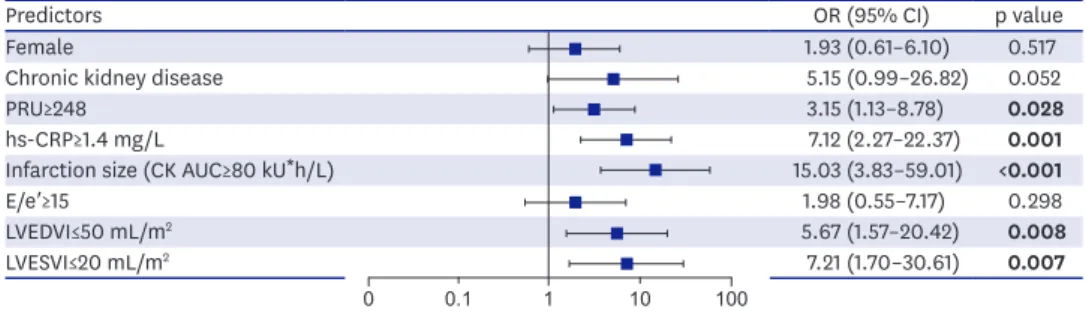
17)However, there are little data to support this influence of HPR on inflammation and LV remodeling in human myocardium. Whilst, in our observational REMODELING (Role of platelet reactivity in left ventricular remodeling after ST-segment elevation myocardial infarction) study, we demonstrated an association between platelet reactivity and LV remodeling in patients with ST-segment elevation MI (STEMI) patients undergoing primary percutaneous coronary intervention (PCI) (Figure 1).
18)Our study also supported the synergistic effect of platelet reactivity and inflammation (i.e., CRP) on LV remodeling in these patients. Indeed, ticagrelor was capable of reducing MI-induced myocardial damage (myocardial edema and infarct size) compared with clopidogrel in an animal study.
19)Moreover, another animal study showed that pre-treatment with ticagrelor reduced ischemia- reperfusion injury, which subsequently related to the improvement of heart function compared with clopidogrel.
20)The latter observation may support the idea of potential benefit of potent P2Y
12receptor inhibitor compared with clopidogrel in the prevention of LV remodeling after AMI. However, there has been no human study to prove this pleiotropic effect of ticagrelor.
Based on the results from animal and human experiments, we hypothesized that chronic treatment with ticagrelor vs. clopidogrel treatment might be associated with an improved LV remodeling process in large-sized MI patients. We describe herein the design of the high platelet inhibition with ticagrelor to improve left ventricular remodeling in patients with ST-segment elevation myocardial infarction (HEALING-AMI) study, an investigator- initiated, randomized, open-label, assessor-blinded, multi-center evaluation of ticagrelor vs.
clopidogrel in STEMI patients undergoing primary PCI.
Predictors OR (95% CI) p value
Female 1.93 (0.61–6.10) 0.517
Chronic kidney disease 5.15 (0.99–26.82) 0.052
PRU≥248 3.15 (1.13–8.78)
0.028hs-CRP≥1.4 mg/L 7.12 (2.27–22.37)
0.001Infarction size (CK AUC≥80 kU
*h/L) 15.03 (3.83–59.01)
<0.001E/e′≥15 1.98 (0.55–7.17) 0.298
LVEDVI≤50 mL/m
25.67 (1.57–20.42)
0.008LVESVI≤20 mL/m
27.21 (1.70–30.61)
0.0071 10 100
0 0.1
Figure 1. Predictors of adverse LV remodeling in the REMODELING trial.18)
AUC = area under the curve; CI = confidence interval; CK = creatine kinase; hs-CRP = high sensitivity C-reactive
protein; LV = left ventricular; LVEDVI = left ventricular end-diastolic volume index; LVESVI = left ventricular end-
systolic volume index; OR = odds ratio; PRU = P2Y
12reaction units; REMODELING = role of platelet reactivity in left
ventricular remodeling after ST-segment elevation myocardial infarction.
METHODS
Study hypotheses and objectives
Activated platelets have diverse impacts on the whole aspect of AMI.
9-11)During the plaque rupture, platelets are immediately activated and aggregated, and consequently initiate the thrombotic occlusion in coronary arteries. At the time of reperfusion, platelets expand the infarct size through formation of microemboli and release of vasoconstrictors.
After PCI, the phenotype of HPR is closely associated with the risk of ischemic event in MI survivors. In addition, our preliminary REMODELING study has suggested another potential role of activated platelets in post-MI LV healing process based on echocardiographic evaluation.
18)Another experimental analysis also supported the strong relationship between platelet reactivity and the level of N-terminal prohormone B-type natriuretic peptide (NT-proBNP) at one month among post-MI patients.
21)These findings may represent that activated platelets have the systemic effects in arterial vasculatures and the local effects within the infarcted myocardium among MI patients. Built on these data, we hypothesize that clinical benefit of ticagrelor may be related with its protective effects on thrombotic event occurrence and pathologic LV remodeling process in post-MI patients.
We designed the HEALING-AMI study to compare the influence of ticagrelor vs. clopidogrel on chronic LV remodeling process measured by three-dimensional (3D) echocardiography and NT-proBNP in STEMI patients undergoing primary PCI. The primary objective of the HEALING-AMI study is to demonstrate the adjunctive role of long-term ticagrelor therapy in enhancing the recovery of LV dysfunction. Moreover, this study will determine whether the high platelet inhibition by P2Y
12inhibitor culminate the protection of infarcted myocardium.
Study design
This is a prospective, randomized, open-labeled, blinded endpoint, multi-center trial.
The study population enrolled at 10 academic centers in Korea. The present study is an investigator-initiated study with a research grant from AstraZeneca Korea (Seoul, Korea).
Other than financial sponsorship, the company has no roles in protocol development, study management, data collection, and data analysis. The design and execution of the trial, statistical analyses, and manuscript preparation is exclusively and independently performed by the investigators. This study protocol has been approved by the Institutional Review Board of each center (GNUH 2014-05-023). The study protocol was registered at www.ClinicalTrials.
gov (NCT02224534).
Trial status
The HEALING-AMI began recruitment on October 20, 2014 and the recruitment has been completed on June 20, 2018. Considering the 6-month follow-up period, overall trial end date is scheduled on December 2018.
Study population and randomization
After arrival on emergency room, suspected STEMI patients planned to primary PCI are
eligible for the initial randomization if they are at least 18 years of age and have clinical
symptoms of AMI of >30 minutes and <12 hours.
2)Specific electrocardiographic (ECG)
criteria for STEMI is considered suggestive of ongoing acute coronary artery occlusion in
the following cases: at least two contiguous leads with ST-segment elevation ≥2 mm in men,
or ≥1.5 mm in women in leads V2–V3 and/or ≥1 mm in the other leads (in the absence of LV
hypertrophy or new left bundle branch block [LBBB]).
2)If patients showed cardiogenic shock, refractory ventricular arrhythmias or atrial fibrillation at the time of randomization, these patients were excluded from the randomization. The detailed inclusion and exclusion criteria are summarized in Table 1.
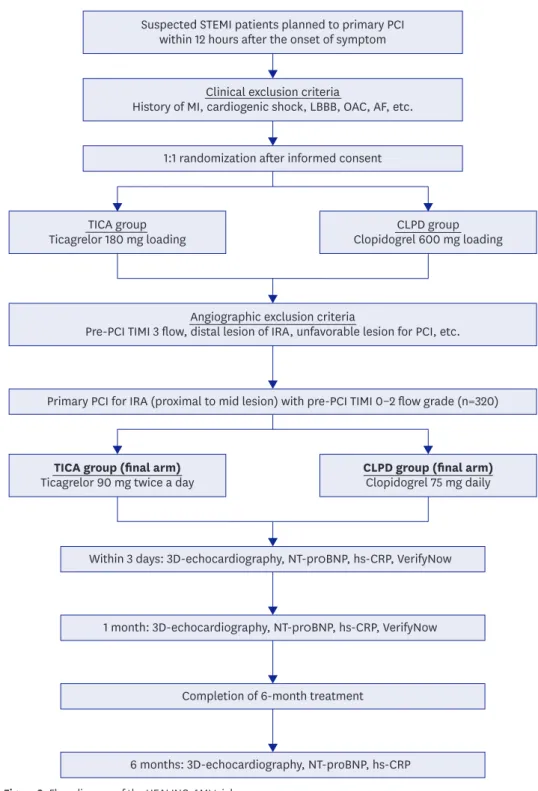
If all eligible clinical criteria are met and written informed consent is achieved, patients are randomly assigned and administered with 180-mg ticagrelor or 600-mg clopidogrel loading (1:1 fashion) in the emergency room based on computer-generated sequential block randomization (Figure 1). Because the large-sized infarcted myocardium may be important to evaluate the benefit of antiplatelet agent on post-MI LV remodeling, we enrolled STEMI patients with the infarct-related artery located in the proximal or mid portion of major epicardial coronary artery with thrombolysis in myocardial infarction (TIMI) 0, 1, or 2 grade flow at the time of initial diagnostic coronary angiography. If the infarct-related artery is not suitable for PCI, patients are excluded from the final study arm (Table 1).
The final treatment arms include only cases of STEMI patients treated with uneventful primary PCI for the aforementioned lesion (Figure 2). According to the consideration of calculated sample size, approximately 320 patients consist of the cohort. The patient assigned to the TICA group have ticagrelor 90 mg twice daily, whereas those assigned to the CLPD group have clopidogrel 75 mg daily during the entire study period. To evaluate post-MI
Table 1. Inclusion and exclusion criteriaInclusion criteria
1. Ages eligible for study: 18 years and older
2. The first-time onset STEMI patients uneventfully treated with primary PCI 3. Patients undergoing PCI within 12 hours after the onset of symptom
4. The infarct-related artery must have TIMI 0, 1, or 2 grade flow at the time of initial diagnostic angiography (before wire passage)
5. Primary PCI with plans to treat only 1 epicardial coronary artery (proximal or mid-portion) Clinical exclusion criteria
1. Previous history of myocardial infarction
2. Left bundle branch block on ECG at the time of screening 3. Cardiogenic shock at the time of randomization 4. Refractory ventricular arrhythmias or atrial fibrillation 5. New York Heart Association class IV congestive heart failure
6. Severe or malignant hypertension (systolic BP >180 mmHg and/or diastolic BP >120 mmHg) 7. Fibrinolytic therapy
8. History of hemorrhagic stroke
9. Intracranial neoplasm, arteriovenous malformation, or aneurysm 10. Ischemic stroke within 3 months prior to screening
11. Platelet count <100,000/mm
3or hemoglobin <10 g/dL
12. A need for oral anticoagulation therapy that cannot be safely discontinued for the duration of the study 13. Women who are known to be pregnant, have given birth within the past 90 days, or are breast-feeding 14. Unable to cooperate with protocol requirements and follow-up procedures
15. A history of P2Y
12receptor inhibitor pretreatment (at least prior 1 month) 16. An increased risk for bradycardia
17. Concomitant therapy with a strong cytochrome P-450 3A inhibitor or inducer Angiographic exclusion criteria
1. Distal territory lesion of infarct-related artery
2. Coronary anatomy that may require coronary artery bypass graft surgery within 6 months 3. Anticipated multi-vessel intervention during the index procedure (planned, staged procedures are
permitted within 6 months)
4. The presence of features that are highly unfavorable for PCI
5. Myocardial infarction caused by thrombosis within or adjacent to a previously implanted stent 6. An unprotected left main stenosis >50% or that will require intervention
BP = blood pressure, ECG = electrocardiograpic; PCI = percutaneous coronary intervention; STEMI = ST-segment
elevation myocardial infarction; TIMI = thrombolysis in myocardial infarction.
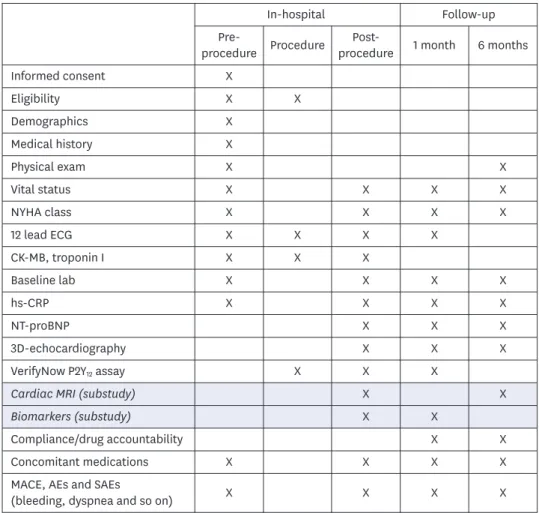
LV remodeling process, echocardiographic and NT-proBNP measurements will be scheduled during hospitalization, and 1 and 6 months after PCI.
22)Biochemical profiles including VerifyNow P2Y
12assay and high sensitivity C-reactive protein (hs-CRP) will be measured
Suspected STEMI patients planned to primary PCI within 12 hours after the onset of symptom
1:1 randomization after informed consent
CLPD group Clopidogrel 600 mg loading
Primary PCI for IRA (proximal to mid lesion) with pre-PCI TIMI 0–2 flow grade (n=320)
Within 3 days: 3D-echocardiography, NT-pr0BNP, hs-CRP, VerifyNow
1 month: 3D-echocardiography, NT-pr0BNP, hs-CRP, VerifyNow
Completion of 6-month treatment
6 months: 3D-echocardiography, NT-proBNP, hs-CRP Clinical exclusion criteria
History of MI, cardiogenic shock, LBBB, OAC, AF, etc.
TICA group Ticagrelor 180 mg loading
TICA group (final arm) Ticagrelor 90 mg twice a day
Angiographic exclusion criteria
Pre-PCI TIMI 3 flow, distal lesion of IRA, unfavorable lesion for PCI, etc.
CLPD group (final arm) Clopidogrel 75 mg daily
Figure 2. Flow diagram of the HEALING-AMI trial.
AF = atrial fibrillation; HEALING-AMI = high platelet inhibition with ticagrelor to improve left ventricular remodeling in patients with ST-segment elevation myocardial infarction; hs-CRP = high-sensitivity C-reactive protein; IRA = infarct related artery; LBBB = left bundle branch block; MI = myocardial infarction; NT-proBNP
= N-terminal prohormone B-type natriuretic peptide; OAC = oral anticoagulant; PCI = percutaneous coronary intervention; STEMI = ST-segment elevation myocardial infarction; TIMI = thrombolysis in myocardial infarction; 3D
= three-dimensional.
according to the protocol (Figure 3). Patients will be also questioned about the adherence of medication and the occurrence of side effects by well-trained research coordinators.
Adjunctive pharmacological therapy and PCI procedure
The 300-mg aspirin loading is administered before the index PCI, whether or not taking it previously, and aspirin is further continued at 100 mg daily indefinitely. The choice of intra-procedural anticoagulant is at the discretion of the operator; unfractionated heparin, enoxaparin, and bivalirudin are all permitted. The unfractionated heparin, dosage per label instructions and local standard of care will be administered. Glycoprotein IIb/IIIa inhibitor can be used by the discretion of attending interventionists. During the study period, all patients receive guideline-recommended optimal medical treatment including beta blocker, angiotensin blocker and statin. Diuretics such as loop diuretic and aldosterone antagonist can be used at the discretion of the attending physician.
The goals of the PCI procedure are to achieve optimal angiographic efficacy of PCI with any stent while minimizing the risk of procedure-related complications. All interventions are performed using the standard technique. Primary PCI targeting a single epicardial coronary
Informed consent Eligibility Demographics Medical history Physical exam Vital status NYHA class 12 lead ECG CK-MB, troponin I Baseline lab hs-CRP NT-proBNP
3D-echocardiography VerifyNow P2Y
12assay Cardiac MRI (substudy)
Concomitant medications MACE, AEs and SAEs
(bleeding, dyspnea and so on)
Pre- procedure
In-hospital Follow-up
Procedure Post- 1 month 6 months procedure
Biomarkers (substudy)
Compliance/drug accountability X
X X
X X X X X
X X
X
X
X
X X
X
X
X X
X X
X X X X X X X X X X X
X X X X X
X X X
X X X X
X X X X X
X
X X
X
Figure 3. Schedule of measurement.
AE = adverse event; CK-MB = creatine kinase-MB; CRP = high-sensitivity C-reactive protein; ECG =
electrocardiography; hs-CRP = high-sensitivity C-reactive protein; MACE = major adverse cardiovascular event;
MRI = magnetic resonance imaging; NT-proBNP = N-terminal prohormone B-type natriuretic peptide; NYHA =
New York Heart Association; SAE = serious adverse event; 3D = three-dimensional.
artery is allowed. If multi-vessel intervention is mandatory, planned and staged procedures are permitted within the study period. Radial access is allowed and encouraged, as is use of arterial closure devices after femoral access. Other approved PCI techniques including thrombus aspiration may be utilized prior to stent implantation at the operator's discretion.
Direct stenting and bifurcation stenting will be also allowed if needed. Intravascular
ultrasound or any other imaging devices are also used according to the physician's discretion.
At the end of procedure, TIMI frame count and myocardial blush grade are recommended to obtain (Supplementary Data 1).
Study endpoints
There are two primary endpoints in this study: 1) LV remodeling index measured by 3D-echocardiography (%) (a relative change in LV end-diastolic volume seen at 6-month follow-up compared with the baseline during admission); and 2) the level of NT-proBNP at 6-month follow-up. Co-primary endpoints are selected based on the previous reports.
18)21)Because LV function or volume is frequently preserved or slightly impaired following AMI, concomitant use of NT-proBNP may better predict the recovery of post-MI LV dysfunction and improve the risk stratification.
23)Secondary endpoints include the following data measured by 3D-echocardiography:
1. Prevalence of pathologic LV remodeling (a relative >20% increase in end-diastolic volume seen at 6-month follow-up compared with the baseline during admission);
2. The changes of LV end-systolic/end-diastolic volume indices (mL/m
2) and LV ejection fraction (%) between the baseline and 6-month follow-up.
Prespecified subgroup studies
Cardiac magnetic resonance imaging substudy
The primary endpoint of this substudy is the LV remodeling index between the acute phase and 6-month follow-up.
The secondary endpoints include the following:
1. LV ejection fraction (%), LV end-diastolic and end-systolic volume (mL) at 6 months, comparing acute phase magnetic resonance imaging (MRI);
2. Infarct size (grams and percentage of total LV mass) at 6 months and acute phase MRI;
3. Area-at-risk (AAR, grams and percentage of total LV mass) at 6 months and acute phase MRI.
Substudy of platelet-immune interaction
This substudy is designed to explore the basic mechanism how platelets do influence on the LV remodeling after AMI. The primary endpoint of this substudy is the count of monocyte- platelet aggregates. The secondary endpoints include the following:
1. The count of CD14
++CD16
+CCR2
+monocyte-platelet aggregates;
2. The count of CD14
++CD16
−CCR2
+monocyte-platelet aggregates;
3. The count of CD14
++CD16
+CCR2
+monocyte subset;
4. The count of CD14
++CD16
−CCR2
+monocyte subset;
5. The level of inflammatory biomarkers (nuclear factor κB, IL-1β, IL-6, IL-10, and monocyte chemoattractant protein-1).
Other prespecified studies
1. Inflammatory indicators: hs-CRP, neutrophil-lymphocyte ratio, platelet-lymphocyte
ratio, and fibrinogen;
2. Angiographic perfusion indicators: TIMI flow grades, myocardial blush grades and corrected TIMI frame count;
3. ECG indicators; degree of ST-segment resolution (%), prevalence of complete ST- segment resolution (>70%) (%);
4. Platelet function test: VerifyNow P2Y
12assay (PRU, BASE);
5. Vascular function test: pulse wave velocity, EndoPAT, IIEF-5 questionnaire;
6. Safety endpoint: Platelet Inhibition and Patient Outcomes (PLATO) or Bleeding Academic Research Consortium (BARC) bleeding criteria.
Data collection and statistical considerations Data collection and monitoring
The principal investigator, the study coordinator, and the Clinical Trials Center at
Gyeongsang National University Hospital (executive committee) are jointly responsible for all aspects of the study protocol and amendments. Site data collection will be performed by a dedicated affiliated research coordinator. Relevant data will be collected and entered into a computerized database by specialized personnel at the clinical data-management center.
Data coordination and site management services will be performed by outside contract research organization (C&R Research, Seoul, Korea). At appropriate intervals, designated trial monitors will review all investigational data for accuracy and completeness, ensuring protocol compliance. All data will be verified with the use of hospital records or telephone interviews, and all adverse clinical events will be adjudicated by an events committee whose members are unaware of patients' treatment assignments.
Sample size calculations
Based on echocardiographic data from the REMODELING trial,
18)the prevalence of LV remodeling at 1 month was 24.0% on clopidogrel and significantly associated with the level of platelet reactivity measured by VerifyNow P2Y
12assay (Figure 4). The prevalence of LV remodeling in the 1st quartile (cutoff of 177 PRU) was 10.7%, which might indicate the chance of LV remodeling occurrence during low platelet reactivity by ticagrelor.
24)The mean level of LV remodeling index was −5.2% in the total cohort, whereas this value was −9.9% in the patients with the 1st quartile. We assume the total data of REMODELING as the CLPD group, while the 1st quartile data as the TICA group. Exploratory data analysis showed that
0 10 40
30
20 50
LVR pr eval ence (%)
1st quartile
(29–177) 2nd quartile
(178–236) 3rd quartile
(237–293) 4th quartile (294–) 10.8
p for trend=0.015
23.1
27.0
35.1
Figure 4. Incidence of adverse LV remodeling according to distribution of platelet reactivity (PRU measured by
VerifyNow test).
18)LV = left ventricular; LVR = left ventricular remodeling; PRU = P2Y
12reaction units.
the standard deviations tend to be too large, which hinders us to get appropriate sample sizes as planned. Thus, we truncated the lower and upper 15% of the original data to adjust the means and the standard deviations hoping to get reasonable sample sizes (Tables 2 and 3).
In order to have 80% of statistical power at 5% of significance level, we need to recruit about 160 subjects for the CLPD and TICA groups, considering the 15% drop-outs. Therefore, the total number of patients is estimated at 320 STEMI patients (up to 160 in each group) to achieve 5% of 2-sided alpha error and 80% of study power in the superiority model considering 15% drop out rate. Sample size was calculated with the use of PASS software.
Based on NT-proBNP data from the RECOVERY trial,
21)NT-proBNP levels at 1 month were 680±1,102 and 1,852±5,114 pg/mL during ticagrelor and clopidogrel, respectively. Assuming the 6-month difference of NT-proBNP by 400 pg/mL between the treatment arms, at least 105 patients in each group were needed with a power of 95%, a two-sided 2-sided alpha error=0.05, and a standard deviation of 800 pg/mL. Considering a 15% drop-out rate, we will enroll at least 121 patients in each group.
Statistical analysis
Because the HEALING-AMI trial is focusing on the long-term process of post-MI LV remodeling (between the baseline and 6-month follow-up), the main analysis will be based on the per-protocol protocol. This per-protocol analysis will be performed only in patients completing the whole study protocols and measurements with no major violations. All enrolled subjects who have received same or more than 1 study drug and have provided safety information, are counted in the safety analysis.
The per-protocol analysis on the primary endpoint will be presented with the Student unpaired t-test. The results of secondary endpoints and subgroup studies will be compared based on the χ
2test (or Fisher's exact test) or Student unpaired t-test, as appropriate. The correlations between LV remodeling and laboratory parameters will be assessed based on Pearson or Spearman analysis.
Predefined major protocol violations/deviations are missing data for the primary endpoint, violation of inclusion criteria, and additional protocol violations that will be possibly defined during the blind data review. Missing patients will be censored at the last follow- up visit. Alive or dead status will be specifically searched for all missing patients. Baseline characteristics will be tabulated and comparability/differences between the treatment groups will be examined by means of descriptive statistics.
Table 3. Sample sizes calculated for several scenarios using the truncated data
Type I and II errors Number for each group Total number Adjusted number considering 15% drop-outs
α=0.05, 1−β=0.8
139 278 320α=0.05, 1−β=0.9 193 386 444
α=0.10, 1−β=0.8 102 204 235
α=0.10, 1−β=0.9 148 296 341
Table 2. Quartiles for each group from the original data
Group_1 p_0 p_5 p_10 p_15 p_20 p_80 p_85 p_90 p_95 p_100
1 −109.9 −50 −37.7 −30.5 −22.9 12.1 14.3 21.55 28.9 59.4
2 −109.9 −52.1 −40.8 −36.7 −26.9 10.8 12.4 20 29.9 33.6
DISCUSSION
For the measurements of LV volumes, remodeling and ejection fraction, cardiac MRI is acknowledged as the gold standard method.
25)However, cardiac MRI is just utilized as an alternative modality just in case of non-diagnostic echocardiographic measurement.
25)Indeed, cardiac MRI has limitations such as high cost, low availability, and less reliability in case of tachycardia frequently found in patients with STEMI. Given that the high agreement with cardiac MRI for the measurement of LV volume, 3D echocardiography may be a pragmatic method for the evaluation of LV remodeling.
26)In addition, the HEALING-AMI trial included the level of NT-proBNP at 6 months as a co-primary endpoint to evaluate the LV dysfunction in patients with normal LV systolic function even after STEMI. The level of NT-proBNP at long-term is a sensitive marker associated with LV dysfunction and prognosis after MI.
2)3)Neurohormonal activation is a key mechanism of the LV remodeling and the progression of HF after AMI.
4)In patients with HF after AMI, NT-proBNP reflecting the neurohormonal activation after myocardial injury has a strong prognostic value, which is well correlated with infarct size, LV dysfunction and adverse outcome in patients with AMI.
23)The measurement of NT-proBNP is useful for establishing a diagnosis, prognosis and disease severity in HF after AMI, irrespective of echocardiographic parameters.
3)Indeed, the majority of patients who survive a first-ever AMI have preserved or only slightly impaired LV systolic function.
1)27)28)However, patients with preserved ejection fraction after AMI are also at high risk of HF and cardiac death.
29)Importantly, the mortality rate related to HF with preserved ejection fraction (HFpEF) was not less than that caused by HF with reduced ejection fraction (HFrEF).
29)Moreover, the prevalence of HFpEF has been less reduced over time than that of HFrEF despite the improvement of MI care.
1)27)28)Our preliminary observation showed that HPR was associated with the high level of NT-proBNP.
21)Of importance, ticagrelor significantly reduced the risk of high 30-day NT-proBNP compared with clopidogrel (relative risk reduction=55%; 95% confidence interval=0.202–0.983; p=0.045).
This suggested that strong platelet inhibition with ticagrelor might preclude the development of HFpEF after AMI. In addition, the assessment of NT-proBNP together with echocardiographic assessment may better predict the LV remodeling after AMI.
LV remodeling is the most frequent sequelae after STEMI and is furthermore a powerful predictor of subsequent HF and mortality. This prompts the therapeutic modalities to prevent pathologic LV remodeling after MI. The HEALING-AMI will provide the effect of ticagrelor going beyond potent platelet inhibition and shed light on the new therapeutic approach on LV remodeling after MI. In addition, the extensive substudies including platelet- immune interaction, cardiac MRI, angiography and vascular function will also enhance our understanding of the pathophysiologic mechanism of LV remodeling.
Our study has several limitations. First, current STEMI guidelines
2)30)already recommend
a potent P2Y
12inhibitor (ticagrelor or prasugrel) in preference to clopidogrel in patients
with STEMI undergoing primary PCI. The main purpose of the HEALING-AMI trial was
to reveal the beneficial effect of ticagrelor on LV remodeling compared with traditional
antiplatelet regimen. The positive result from HEALING-AMI would add more evidences
regarding the favorable effect of ticagrelor on wound healing process, as well as its protective
effect on atherothrombotic events. There have been crucial concerns regarding clinical
benefit of standard-dose potent P2Y
12inhibitor in East Asian patients with acute coronary
syndrome.
31)32)HEALING-AMI may touch another issue regarding clinical benefit of ticagrelor
in East Asian patients with enhanced thrombogenic profile (e.g., STEMI patients treated with primary PCI). Second, considerable portion of the initial randomized cohort was dropped out following coronary angiography, which may be related with prolonged enrollment period and the heterogeneity of the final cohorts. Finally, the size of the infarct area was not evaluated using the reliable method from the total cohort. Because differences in the initial infarct size between the groups may not be adjusted, its wide variance may affect accurate comparison in LV remodeling process.
SUPPLEMENTARY MATERIAL
Supplementary Data 1 Methods of measurements Click here to view
REFERENCES
1. Benjamin EJ, Virani SS, Callaway CW, et al. Heart disease and stroke statistics-2018 update: a report from the American Heart Association. Circulation 2018;137:e67-492.
PUBMED | CROSSREF
2. Ibanez B, James S, Agewall S, et al. 2017 ESC guidelines for the management of acute myocardial infarction in patients presenting with ST-segment elevation: the Task Force for the management of acute myocardial infarction in patients presenting with ST-segment elevation of the European Society of Cardiology (ESC). Eur Heart J 2018;39:119-77.
PUBMED | CROSSREF
3. Yancy CW, Jessup M, Bozkurt B, et al. 2017 ACC/AHA/HFSA focused update of the 2013 ACCF/AHA guideline for the management of heart failure: a report of the American College of Cardiology/American Heart Association Task Force on clinical practice guidelines and the Heart Failure Society of America.
Circulation 2017;136:e137-61.
PUBMED | CROSSREF
4. Burchfield JS, Xie M, Hill JA. Pathological ventricular remodeling: mechanisms: part 1 of 2. Circulation 2013;128:388-400.
PUBMED | CROSSREF
5. Liehn EA, Postea O, Curaj A, Marx N. Repair after myocardial infarction, between fantasy and reality: the role of chemokines. J Am Coll Cardiol 2011;58:2357-62.
PUBMED | CROSSREF
6. Anzai T. Post-infarction inflammation and left ventricular remodeling: a double-edged sword. Circ J 2013;77:580-7.
PUBMED | CROSSREF
7. Ziegler-Heitbrock L. The CD14
+CD16
+blood monocytes: their role in infection and inflammation. J Leukoc Biol 2007;81:584-92.
PUBMED | CROSSREF
8. Tapp LD, Shantsila E, Wrigley BJ, Pamukcu B, Lip GY. The CD14
++CD16
+monocyte subset and monocyte-platelet interactions in patients with ST-elevation myocardial infarction. J Thromb Haemost 2012;10:1231-41.
PUBMED | CROSSREF
9. Nurden AT. Platelets, inflammation and tissue regeneration. Thromb Haemost 2011;105 Suppl 1:S13-33.
PUBMED | CROSSREF
10. Rondina MT, Weyrich AS, Zimmerman GA. Platelets as cellular effectors of inflammation in vascular diseases. Circ Res 2013;112:1506-19.
PUBMED | CROSSREF
11. Semple JW, Italiano JE Jr, Freedman J. Platelets and the immune continuum. Nat Rev Immunol 2011;11:264-74.
PUBMED | CROSSREF
12. Opie LH, Commerford PJ, Gersh BJ, Pfeffer MA. Controversies in ventricular remodelling. Lancet 2006;367:356-67.
PUBMED | CROSSREF
13. Italiano JE Jr, Richardson JL, Patel-Hett S, et al. Angiogenesis is regulated by a novel mechanism: pro- and antiangiogenic proteins are organized into separate platelet α granules and differentially released. Blood 2008;111:1227-33.
PUBMED | CROSSREF
14. Swiatkiewicz I, Kozinski M, Magielski P, et al. Value of C-reactive protein in predicting left ventricular remodelling in patients with a first ST-segment elevation myocardial infarction. Mediators Inflamm 2012;2012:250867.
PUBMED | CROSSREF
15. Liu Y, Gao XM, Fang L, et al. Novel role of platelets in mediating inflammatory responses and ventricular rupture or remodeling following myocardial infarction. Arterioscler Thromb Vasc Biol 2011;31:834-41.
PUBMED | CROSSREF
16. Du XJ, Shan L, Gao XM, et al. Role of intramural platelet thrombus in the pathogenesis of wall rupture and intra-ventricular thrombosis following acute myocardial infarction. Thromb Haemost 2011;105:356-64.
PUBMED | CROSSREF
17. Ye Y, Birnbaum GD, Perez-Polo JR, Nanhwan MK, Nylander S, Birnbaum Y. Ticagrelor protects the heart against reperfusion injury and improves remodeling after myocardial infarction. Arterioscler Thromb Vasc Biol 2015;35:1805-14.
PUBMED | CROSSREF
18. Park Y, Tantry US, Koh JS, et al. Novel role of platelet reactivity in adverse left ventricular remodelling after ST-segment elevation myocardial infarction: the REMODELING trial. Thromb Haemost 2017;117:911-22.
PUBMED | CROSSREF
19. Nanhwan MK, Ling S, Kodakandla M, Nylander S, Ye Y, Birnbaum Y. Chronic treatment with ticagrelor limits myocardial infarct size: an adenosine and cyclooxygenase-2-dependent effect. Arterioscler Thromb Vasc Biol 2014;34:2078-85.
PUBMED | CROSSREF
20. Vilahur G, Gutiérrez M, Casani L, et al. Protective effects of ticagrelor on myocardial injury after infarction. Circulation 2016;134:1708-19.
PUBMED | CROSSREF
21. Kang MG, Ahn JH, Jang JY, et al. Ticagrelor versus clopidogrel is associated with better recovery of LV function after AMI. J Am Coll Cardiol 2017;69:125.
CROSSREF
22. Sjöblom J, Muhrbeck J, Witt N, Alam M, Frykman-Kull V. Evolution of left ventricular ejection fraction after acute myocardial infarction: implications for implantable cardioverter-defibrillator eligibility.
Circulation 2014;130:743-8.
PUBMED | CROSSREF
23. Thygesen K, Mair J, Mueller C, et al. Recommendations for the use of natriuretic peptides in acute cardiac care: a position statement from the Study Group on Biomarkers in Cardiology of the ESC Working Group on Acute Cardiac Care. Eur Heart J 2012;33:2001-6.
PUBMED | CROSSREF
24. Storey RF, Angiolillo DJ, Patil SB, et al. Inhibitory effects of ticagrelor compared with clopidogrel on platelet function in patients with acute coronary syndromes: the PLATO (PLATelet inhibition and patient Outcomes) PLATELET substudy. J Am Coll Cardiol 2010;56:1456-62.
PUBMED | CROSSREF
25. Ponikowski P, Voors AA, Anker SD, et al. 2016 ESC guidelines for the diagnosis and treatment of acute and chronic heart failure: the Task Force for the diagnosis and treatment of acute and chronic heart failure of the European Society of Cardiology (ESC)Developed with the special contribution of the Heart Failure Association (HFA) of the ESC. Eur Heart J 2016;37:2129-200.
PUBMED | CROSSREF
26. Jenkins C, Moir S, Chan J, Rakhit D, Haluska B, Marwick TH. Left ventricular volume measurement with echocardiography: a comparison of left ventricular opacification, three-dimensional echocardiography, or both with magnetic resonance imaging. Eur Heart J 2009;30:98-106.
PUBMED | CROSSREF
27. Gerczuk PZ, Kloner RA. An update on cardioprotection: a review of the latest adjunctive therapies to limit myocardial infarction size in clinical trials. J Am Coll Cardiol 2012;59:969-78.
PUBMED | CROSSREF
28. Gerber Y, Weston SA, Redfield MM, et al. A contemporary appraisal of the heart failure epidemic in Olmsted County, Minnesota, 2000 to 2010. JAMA Intern Med 2015;175:996-1004.
PUBMED | CROSSREF
29. Gerber Y, Weston SA, Enriquez-Sarano M, et al. Mortality associated with heart failure after myocardial infarction: a contemporary community perspective. Circ Heart Fail 2016;9:e002460.
PUBMED | CROSSREF
30. Levine GN, Bates ER, Bittl JA, et al. 2016 ACC/AHA guideline focused update on duration of dual antiplatelet therapy in patients with coronary artery disease: a report of the American College of Cardiology/American Heart Association Task Force on clinical practice guidelines: an update of the 2011 ACCF/AHA/SCAI guideline for percutaneous coronary intervention, 2011 ACCF/AHA guideline for coronary artery bypass graft surgery, 2012 ACC/AHA/ACP/AATS/PCNA/SCAI/STS guideline for the diagnosis and management of patients with stable ischemic heart disease, 2013 ACCF/AHA guideline for the management of ST-elevation myocardial infarction, 2014 AHA/ACC guideline for the management of patients with non-ST-elevation acute coronary syndromes, and 2014 ACC/AHA guideline on perioperative cardiovascular evaluation and management of patients undergoing noncardiac surgery. Circulation 2016;134:e123-55.
PUBMED | CROSSREF
31. Bae JS, Ahn JH, Tantry US, Gurbel PA, Jeong YH. Should antithrombotic treatment strategies in East Asians differ from Caucasians? Curr Vasc Pharmacol 2018;16:459-76.
PUBMED | CROSSREF
32. Kang J, Kim HS. The evolving concept of dual antiplatelet therapy after percutaneous coronary intervention: focus on unique feature of East Asian and “Asian paradox”. Korean Circ J 2018;48:537-51.
PUBMED | CROSSREF