308 www.eymj.org
INTRODUCTION
Ketone bodies can be an alternative energy source if glucose supply is limited, such as during prolonged fasting, or when the body is in a catabolic state.1 In patients with defects in ke- tolysis, the accumulation of ketone bodies can cause fatal ke- toacidosis, which may lead to brain damage because of ener- gy depletion that could manifest as psychomotor retardation or even death.1-3
Succinyl-CoA:3-ketoacid CoA transferase (SCOT) deficien- cy (OMIM #245050) is a rare autosomal recessive inborn error
of ketone body utilization.1 SCOT, which catalyzes the conver- sion of acetoacetate to acetoacetyl-CoA, is encoded by the OXCT1 gene, mapped to 5p13 and consisting of 17 exons.1,4 Affected patients present with intermittent episodes of ketosis preceded by infection or fasting, and usually respond quickly to fluid therapy and bicarbonate infusion. Here, we report the first Korean infant with SCOT deficiency caused by novel compound heterozygous mutations in the OXCT1 gene, who showed life-threatening ketoacidosis requiring continuous renal replacement therapy (CRRT).
CASE REPORT
A 12-month-old girl presented with tachypnea and vomiting after a one-day fever. Her parents reported symptoms of de- creased activity over a period of two days. Born at 40 weeks gestation and weighing 3.18 kg, she was the first child of unre- lated healthy parents. The patient was unconscious and was respiring deeply, but otherwise non-specific on physical and neurological examinations. Laboratory results showed high
A Rare Cause of Life-Threatening Ketoacidosis: Novel Compound Heterozygous OXCT1 Mutations Causing Succinyl-CoA:3-Ketoacid CoA Transferase Deficiency
Young A Kim
1,2, Seong Heon Kim
1, Chong Kun Cheon
1, and Yoo-Mi Kim
31Department of Pediatrics, Pusan National University Children’s Hospital, Yangsan;
2Research Institute for Convergence of Biomedical Science and Technology, Pusan National University Yangsan Hospital, Yangsan;
3Department of Pediatrics, Chungnam National University Hospital, College of Medicine, Chungnam National University, Daejeon, Korea.
Succinyl-CoA:3-ketoacid CoA transferase (SCOT) deficiency is a rare inborn error of ketone body utilization, characterized by ep- isodic or permanent ketosis. SCOT deficiency is caused by mutations in the OXCT1 gene, which is mapped to 5p13 and consists of 17 exons. A 12-month-old girl presented with severe ketoacidosis and was treated with continuous renal replacement therapy.
She had two previously unrecognized mild-form episodes of ketoacidosis followed by febrile illness. While high levels of ketone bodies were found in her blood and urine, other laboratory investigations, including serum glucose, were unremarkable. We identified novel compound heterozygous mutations in OXCT1:c.1118T>G (p.Ile373Ser) and a large deletion ranging from exon 8 to 16 through targeted exome sequencing and microarray analysis. This is the first Korean case of SCOT deficiency caused by novel mutations in OXCT1, resulting in life-threatening ketoacidosis. In patients with unexplained episodic ketosis, or high anion gap metabolic acidosis in infancy, an inherited disorder in ketone body metabolism should be suspected.
Key Words: Ketoacidosis, ketone body metabolism, OXCT1
Case Report
pISSN: 0513-5796 · eISSN: 1976-2437
Received: October 4, 2018 Revised: January 2, 2019 Accepted: January 6, 2019
Corresponding author: Yoo-Mi Kim, MD, PhD, Department of Pediatrics, Chun- gnam National University Hospital, College of Medicine, Chungnam National Uni- versity, 282 Munwha-ro, Jung-gu, Daejeon 35015, Korea.
Tel: 82-42-280-7288, Fax: 82-42-255-3158, E-mail: [email protected]
•The authors have no potential conflicts of interest to disclose.
© Copyright: Yonsei University College of Medicine 2019
This is an Open Access article distributed under the terms of the Creative Com- mons Attribution Non-Commercial License (https://creativecommons.org/licenses/
by-nc/4.0) which permits unrestricted non-commercial use, distribution, and repro- duction in any medium, provided the original work is properly cited.
Yonsei Med J 2019 Mar;60(3):308-311 https://doi.org/10.3349/ymj.2019.60.3.308
309
Young A Kim, et al.
https://doi.org/10.3349/ymj.2019.60.3.308
anion gap metabolic acidosis and ketonuria (Table 1). Serum glucose (88 mg/dL), ammonia (50 μmol/L), and lactate (0.5 mmol/L) levels were normal, and other laboratory findings were also unremarkable. She was admitted to the pediatric in- tensive care unit for mechanical ventilation, and CRRT was performed because of refractory metabolic acidosis (pH of 6.94, HCO3- of 5.2 mmol/L) despite fluid therapy and sodium bicarbonate infusion for 6 hours. CRRT was discontinued af- ter 3 days as ketoacidosis improved, and she was weaned off mechanical ventilation 5 days later.
Her medical records revealed that she had previously been hospitalized twice due to febrile illnesses. Notably, she had metabolic acidosis with ketonuria (Table 1); however, these findings were neglected because her condition rapidly im- proved after fluid therapy. Given her repeated ketoacidosis episodes in infancy, an inborn error of metabolism was sus- pected. Although the results of tandem mass spectroscopy and plasma amino acid analysis showed no abnormalities, high levels of ketone bodies were detected in her blood and urine (Table 2). L-carnitine profile showed low levels of free
carnitine. These findings were suggestive of a defect in ketone body metabolism, specifically ketone body utilization.
For genetic confirmation, targeted exome sequencing was performed. Initially, the results were interpreted as a novel homozygous mutation: OXCT1:c.1118T>G (p.Ile373Ser). This variant has not been previously reported in SCOT deficiency patients and was not found in gnomAD (http://gnomad.
broadinstitute.org/) or the Korean Reference Genome Data- base (http://coda.nih.go.kr/coda/KRGDB/index.jsp). This novel variant was predicted to be deleterious by SIFT (https://
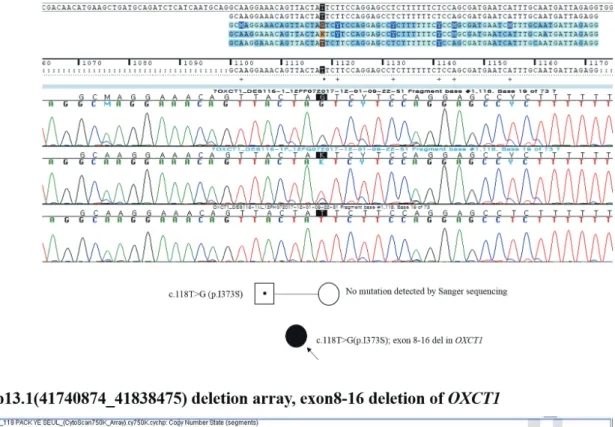
sift.bii.a-star.edu.sg/), PROVEAN (http://provean.jcvi.org/), and MutationTaster (http://www.mutationtaster.org/), with scores of 0.036, -4.25, and 0.953, respectively. However, since this mutation was inherited only from her father and since a loss of heterozygosity was not identified, a deletion in the ma- ternal allele was suspected. Through microarray analysis, a large deletion ranging from exon 8 to 16 in OXCT1 (Fig. 1) was revealed. This large deletion was thought to be inherited ma- ternally; however, microarray analysis was not performed on the patient’s mother because the parents wanted to delay the analysis until after they had their next child.
The patient was prescribed a mild protein restricted diet (2.0 g/kg/day), with supplements of L-carnitine (100 mg/kg/day), making sure to avoid excessive fat intake. A patient emergency card was given to the patient’s parents, and they were in- structed to monitor urine ketones using a dipstick test. Ke- tones were not detected when she was in a stable condition.
She experienced three more episodes of ketosis accompanied with febrile illnesses, and ketonuria was reversed quickly by fluid therapy. She has exhibited normal growth and develop- ment as of a follow-up at 25 months of age. This study was ap- proved by the Institutional Review Board of Pusan National University Yangsan Hospital (approved number: 05-2018- 116), and a written informed consent was obtained.
DISCUSSION
Since the first case of SCOT deficiency was described in 1972,2 Table 1. Laboratory Findings for the Patient during Episodes of Ketosis
Patient’s age (months) Reference
ranges
6 9 12 (present) 17 22 23
pH 7.31 7.33 6.98 7.37 7.38 7.16 7.35–7.45
pCO2 (mm Hg) 19.9 22.7 21.8 46 28.3 26 27–41
HCO3- (mmol/L) 10.2 12.3 5.2 26.6 17.1 9.3 20–28
Base deficit (mmol/L) 13.3 11 24.4 0.8 6.0 17.9 1–7
Anion gap (mEq/L) 22.2 17.7 19.8 5.4 5.0 20.1 7–16
Urine ketone 3+ 3+ 3+ 1+ 1+ 2+ -
Predisposing factor
Fever Urinary tract
infection
Fever No proven micro-organism
Fever No proven micro-organism
Fever Influenza B virus
Fever Bocavirus
Fever No proven micro-organism
Table 2. Abnormal Laboratory Findings in the Blood and Urine of the Patient
Value Reference range Blood ketone bodies
Acetoacetic acid (mmol/L) 2.495 0.050−0.150
3-hydroxybutyrate (mmol/L) 0.711 0.050−0.300 Urine organic acid analysis
Acetoacetic acid (mmol/mol Cr) 5978.1 <5 3-hydroxybutyrate (mmol/mol Cr) 7751.6 <11.4 2-hydroxybutyrate (mmol/mol Cr) 261.6 <5.1
Lactic acid (mmol/mol Cr) 570.1 <285
Adipic acid (mmol/mol Cr) 105.3 <34.3
4-hydroxyphenyllactic acid (mmol/mol Cr) 8.9 <3.1 4-hydroxyphenylpyruvic acid (mmol/mol Cr) 4.3 <0.4 Plasma carnitine
Free carnitine (μmol/L) 12.1 27−49
Acyl carnitine (μmol/L) 25.3 7−19
Total carnitine (μmol/L) 37.4 38−68
310
SCOT Deficiency with Novel OXCT1 Mutations
https://doi.org/10.3349/ymj.2019.60.3.308 and causative pathogenic mutations were found in OXCT1 in
1996,4 about 30 patients and 24 different OXCT1 mutations have been reported worldwide.2-13 This is the first case of SCOT deficiency in Korea, genetically confirmed with a novel
OXCT1 missense mutation in one allele and a large deletion in the other.
Ketone bodies in the form of acetoacetate and 3-hydroxy- butyrate are produced from free fatty acids in the liver. In the
A
B
Fig. 1. Partial Sanger sequencing of OXCT1 showing a c.1118T>G (p.Ile373Ser) mutation in the patient and her father (A), and microarray results for this patient presenting a partial deletion at 5p13.1(41740874_41838475) consistent with the region from exon 8 to 16 of the OXCT1 gene (B).
311
Young A Kim, et al.
https://doi.org/10.3349/ymj.2019.60.3.308
mitochondria of extrahepatic tissues, SCOT catalyzes the con- version of acetoacetate to acetoacetyl-CoA, and then, beta- ketothiolase catalyzes the cleavage of acetoacetyl-CoA into acetyl-CoA, which is an energy source for ATP generation. As SCOT acts in the rate-limiting step in ketolysis, processes downstream of this step do not occur in cases of complete SCOT deficiency, leading to permanent ketosis.1,12 Depending on the SCOT enzyme activity they have, patients demonstrate either episodic or permanent ketosis.3,4,8-12 In our patient, epi- sodic ketosis indicated that partial enzyme activity remained, although enzyme activity assays were not performed. Post mortem examination of the first reported SCOT-deficient pa- tient, who died at six months of age, revealed fatty infiltration of the liver and decreased brain size.2 However, owing to im- proved awareness of SCOT deficiency and more experience in the general management of metabolic crises, most patients have a good prognosis, at least those reported in the litera- ture,4-10 and cases of neurological impairment and mortality in relation to SCOT deficiency are rarely found.2,3
In patients with acute episodes, the recommendation is to treat the metabolic acidosis and infuse sufficient glucose to suppress ketogenesis. When patients are stable, it is recom- mended that they avoid prolonged fasting and excessive fat intake, mildly restrict protein intake to reduce ketogenesis, and take carnitine supplements as required.12 The urine ke- tone dipstick test, a very simple and inexpensive way to mea- sure ketonuria, is effective for the early detection of ketosis and could prevent a life-threatening crisis.
SCOT deficiency is not detected in newborn screening, and except for high levels of ketone bodies in the blood and urine, patients only have non-specific laboratory results.1 Therefore, suspecting a metabolic disorder relating to ketone bodies is the first step in diagnosing SCOT deficiency. Episodic ketosis, ketoacidosis, or high anion gap metabolic acidosis in infancy could be clues for the diagnosis of an inherited disorder of ke- tone body metabolism.
In summary, we report the first Korean patient with SCOT deficiency with novel compound heterozygous OCXT1 muta- tions, who showed life-threatening ketoacidosis that was re- stored by CRRT.
ACKNOWLEDGEMENTS
We thank the patient and her family for their participation in this study. We wish to thank Green Cross Genome for provid- ing the genetic results in this study.
AUTHOR CONTRIBUTIONS
Conceptualization: Yoo-Mi Kim. Data curation: Young A Kim. Formal analysis: Young A Kim. Funding acquisition: Young A Kim, Yoo-Mi Kim. Investigation: Yoo-Mi Kim. Methodology: Yoo-Mi Kim. Project administration: Yoo-Mi Kim. Resources: Seong Heon Kim, Chong Kun Cheon. Software: Young A Kim, Yoo-Mi Kim. Supervision: Chong
Kun Cheon, Seong Heon Kim. Validation: Young A Kim, Yoo-Mi Kim.
Visualization: Yoo-Mi Kim. Writing—original draft: Young A Kim, Yoo-Mi Kim. Writing—review & editing: Young A Kim, Seong Heon Kim, Chong Kun Cheon, Yoo-Mi Kim.
ORCID iDs
Young A Kim https://orcid.org/0000-0002-8332-5200 Seong Heon Kim https://orcid.org/0000-0001-8003-3010 Chong Kun Cheon https://orcid.org/0000-0002-8609-5826 Yoo-Mi Kim https://orcid.org/0000-0002-8440-5069
REFERENCES
1. Mitchell GA, Fukao T. Inborn errors of ketone body metabolism.
In: Scriver C, Beaudet A, Sly W, Valle D, Childs V, Kinzler K, et al., editors. The metabolic and molecular bases of inherited disease.
8th ed. New York (NY): McGraw-Hill, Inc; 2001. p.2327-56.
2. Tildon JT, Cornblath M. Succinyl-CoA:3-ketoacid CoA-transferase deficiency. A cause for ketoacidosis in infancy. J Clin Invest 1972;
51:493-8.
3. Berry GT, Fukao T, Mitchell GA, Mazur A, Ciafre M, Gibson J, et al.
Neonatal hypoglycaemia in severe succinyl-CoA:3-oxoacid CoA- transferase deficiency. J Inherit Metab Dis 2001;24:587-95.
4. Kassovska-Bratinova S, Fukao T, Song XQ, Duncan AM, Chen HS, Robert MF, et al. Succinyl CoA:3-oxoacid CoA transferase (SCOT):
human cDNA cloning, human chromosomal mapping to 5p13, and mutation detection in a SCOT-deficient patient. Am J Hum Genet 1996;59:519-28.
5. Shafqat N, Kavanagh KL, Sass JO, Christensen E, Fukao T, Lee WH, et al. A structural mapping of mutations causing succinyl- CoA:3-ketoacid CoA transferase (SCOT) deficiency. J Inherit Metab Dis 2013;36:983-7.
6. Pretorius CJ, Loy Son GG, Bonnici F, Harley EH. Two siblings with episodic ketoacidosis and decreased activity of succinyl-CoA:3- ketoacid CoA-transferase in cultured fibroblasts. J Inherit Metab Dis 1996;19:296-300.
7. Pérez-Cerdá C, Merinero B, Sanz P, Jiménez A, Hernéndez C, Garcáa MJ, et al. A new case of succinyl-CoA: acetoacetate trans- ferase deficiency. J Inherit Metab Dis 1992;15:371-3.
8. Hori T, Yamaguchi S, Shinkaku H, Horikawa R, Shigematsu Y, Takayanagi M, et al. Inborn errors of ketone body utilization. Pe- diatr Int 2015;57:41-8.
9. Fukao T, Sass JO, Kursula P, Thimm E, Wendel U, Ficicioglu C, et al. Clinical and molecular characterization of five patients with succinyl-CoA:3-ketoacid CoA transferase (SCOT) deficiency. Bio- chim Biophys Acta 2011;1812:619-24.
10. Longo N, Fukao T, Singh R, Pasquali M, Barrios RG, Kondo N, et al. Succinyl-CoA:3-ketoacid transferase (SCOT) deficiency in a new patient homozygous for an R217X mutation. J Inherit Metab Dis 2004;27:691-2.
11. Baric´ I, Sarnavka V, Fumic´ K, Maradin M, Begovic´ D, Ruiter JP, et al. A new case of succinyl-CoA:acetoacetate transferase deficiency:
favourable course despite very low residual activity. J Inherit Metab Dis 2001;24:81-2.
12. Fukao T, Mitchell G, Sass JO, Hori T, Orii K, Aoyama Y. Ketone body metabolism and its defects. J Inherit Metab Dis 2014;37:541-51.
13. Sasai H, Aoyama Y, Otsuka H, Abdelkreem E, Naiki Y, Kubota M, et al. Heterozygous carriers of succinyl-CoA:3-oxoacid CoA trans- ferase deficiency can develop severe ketoacidosis. J Inherit Metab Dis 2017;40:845-52.