• 검색 결과가 없습니다.

Quantitative Analysis and Validation of Hirsutenone and Muricarpone B from Fermented Alnus sibirica

N/A
N/A
Protected

Academic year: 2022

Share "Quantitative Analysis and Validation of Hirsutenone and Muricarpone B from Fermented Alnus sibirica"

Copied!
5
0
0

로드 중.... (전체 텍스트 보기)

전체 글

(1)

23(2) : 146-150 (2017)

https://doi.org/10.20307/nps.2017.23.2.146

146

Quantitative Analysis and Validation of Hirsutenone and Muricarpone B from Fermented Alnus sibirica

Jun YIN, Ki Hoon YOON, Seong Hye YOON, Hye Shin AHN, and Min Won LEE*

Laboratory of Pharmacognosy and Natural Product Derived Medicine, College of Pharmacy, Chung-Ang University, Seoul 156-756, South Korea

Abstract − Alnus sibirica (AS) geographically distributes in Korea, Japan, Northeast China and Russia. The bark of this plant had been used for antipyretic, expectorant, anti-phlogistic, antitussive, anti-asthmatic and as a health tea for alcoholism. Recently, we studied various biological activities of AS and the isolated diarylheptanoid. In present study, we conducted fermentation of AS (FAS) and isolated two diarylheptanoid (hirsutenone and muricarpone B). Moreover, we established the validation and contents determinations of the two compounds by HPLC on FAS.

Keywords − Alnus sibirica, Fermentation, HPLC, Validation, Content

Introduction

Alnus sibirica (AS), geographically distributes in Korea, Japan, Northeast China and Russia, and the bark part had been used as antipyretic, expectorant, antiphlogistic, antitussive, and as a health tea for alcoholism.

1

It was reported that Alnus species contain many phenolic constituents (concluding diarylheptanoids,

5

flavonoids,

6,7

and tannins

8-11

) and triterpenoids

12-13

and it exhibits a variety of bioactivities including anti-oxidant activity, anti- inflammation,

14

cytotoxicity,

15

and anti-adipogenic activity.

16

Fermentation process could make organic compound degrades to new product through oxidation-reduction producing ATP by glycolysis. And it attempted to ferment by herb medicine with various practical fermentation technology in order to obtain maximum therapeutic effect

17

or/and reduce the side effects.

18

Moreover, it is recently under attention as not only herb medicine

19

but also balancing the rumen microorganisms.

20

On this research, we fermented AS (FAS) with Lactobacillus plantarum and isolated two compounds, hirsutenone and muricarpone B. And hirsutenone which was changed to the major component in FAS, and muricarpone B, which was not be found in Alnus species plants, were conducted to evaluate the contents and validations as characteristic components of FAS.

Experimental

Plant material − The stems of AS were collected from

‘Kuksabong’, Seoul, Republic of Korea, on January of 2015, certificated by Prof. Lee Min Won (Pharmacognosy Lab, College of Pharmacy, Chung-Ang University). And a voucher specimen was deposited at the herbarium of the college of pharmacy, Chung-Ang University. The botanical specimen ID is 20150816AS.

Extraction and Fermentation – AS were extracted with 80% prethanol A at room temperature, and yielded AS extract. The AS extract was fermented (FAS) by using Lactobacillus plantarum with MRS broth (6.4% dextrose, 18.2% proteose peptone No.3, 18.2% beef extract, 9.1%

yeast extract, 9.1% sodium acetate, 1.8% polysorbate 80, 3.6% amonium citrate, 3.6% dipotassium phosphate, 0.9%

magnesium sulfate, and 0.5% manganese sulfate) in 7 days at room temperature.

Isolation – FAS was applied to Sephadex LH-20 with the water-methanol gradient (from 10:0 to 0:10) to yield 22 fractions. The fraction 15 was applied to MCI CHP20P column with the water-methanol gradient (from 2:8 to 0:10) to yield hirsutenone (750 mg) and muricar- pone B (230 mg).

Hirsutenone [1,7-bis-(3,4-Dihydroxyphenyl)-4-Heptene- 3-One] : amorphous brown oil; 1H NMR (300 MHz, Acetone-d6) δ 6.88 (dt, J = 16.0, 6.8 Hz, 1H, H-5), 6.74 – 6.67 (m, 4H, H-2’, 2’’, 5’, 5’’), 6.51 (m, 2H, 6’, 6’’), 6.08 (d, J = 16.0 Hz, 1H, H-4), 2.82 – 2.40 (m, 8H, H-1, 2, 6, 7).

*Author for correspondence

Prof. Dr. Min Won Lee, College of Pharmacy, Chung-Ang Univer- sity, Seoul 156-756, South Korea

Tel: +82-2-820-5602; E-mail: [email protected]

(2)

Muricarpone B [1,7-bis-(3,4-Dihydroxyphenyl)-4-Heptene] : amorphous brown oil; 1H NMR (600 MHz, Acetone-d6) δ 6.68 (d, J = 7.2, 1H, H-5’), 6.68 (d, J = 7.2, 1H, H-5’’), 6.66 (d, J = 2.1 Hz, 1H, H-2’), 6.64 (d, J = 2.1 Hz, 1H, H2’’), 6.46 (dd, J = 7.2, 2.1, 1H, H-6’’), 6.44 (dd, J = 7.2, 2.1, H-6’’), 2.7-2.58 (br, 4H, H-1, 2), 2.42 (d, J = 7.2 Hz, 2H, H-7), 2.39 (d, J = 7.2 Hz, 2H, H-4), 1.48 (m, 4H, H- 5, 6); 13C NMR (151 MHz, Acetone-d6) δ 210.27(C-3), 144.83 (C-3’’), 144.75 (C-3’), 143.09 (C-4’’), 142.87 (C- 4’), 133.78 (C-1’’), 132.81 (C-1’), 119.31 (C-6’’), 119.21 (C-6’), 115.30 (C-2’’), 115.27 (C-2’), 115.08 (C-5’’), 114.99 (C-5’), 44.05(C-2), 42.12(C-4), 34.70 (C-7), 31.03 (C-5), 28.97(C-1), 23.08 (C-6).

HPLC analysis − High-performance liquid chromato- graphy (HPLC) (Waters 600 system (USA)), Thermo

®

Syncronis C18 (5 μm, 4.6 * 250 mm) Column was used for quantitative surveys of the compounds content. The mobile phase consists of solvents A (H

2

O) and B (ACN) were described and filtered by Whatman

®

membrane filters (0.2 μm, diam. 47 mm) (Table 1).

Validation − For set up the HPLC analysis method of main compounds from FAS, we used validation guide line that was published by KFDA (Korea Food and Drug Administration), including specificity, linearity, limit of quantitation (LOQ), accuracy and precision. [Specificity:

to confirm if the compounds were separated well from other compounds. Linearity: to solute the main compounds (hirsutenone and muricarpone B) of FAS by MeOH and dilute to 4 concentrations (2000, 1000, 500, 250 μg/mL) and to calculate the linear regression equation (y = ax + b, y: area of peak on HPLC, x: concentration of compound) and the volume of R

2

(the linearity is valid when R

2

is greater than 0.99). The limit of Quantitation (LOQ): to calculate the LOQ by using the formula LOQ = 10 * σ/S ( σ: deviation of b, S: average of a) that is a calculation of LOQ published by KFAD. The accuracy and precision: in 4 concentrations (2000, 1000, 500, 250 μg/mL) of compounds should be tested by HPLC intraday and interday, 3 times respectively (accuracy: ± 10%, precision: < 2).

Content – We calculated the contents of hirsutenone and muricarpone B from FAS by using the linear regression equation.

Results and Discussion

We fermented AS with Lactobacullus plantarum yielded FAS and hirsutenone

21

and muricarpone B

22

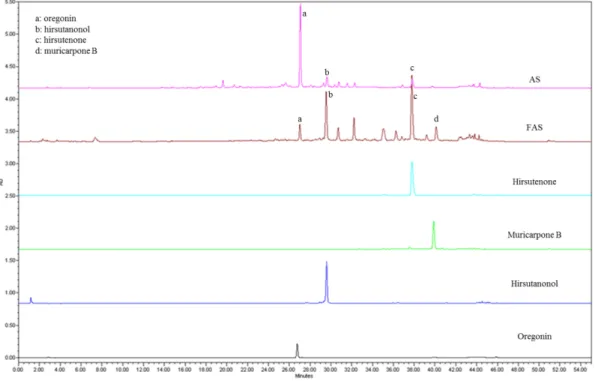
were isolated from FAS. (Fig. 1) The result of HPLC showed that oregonin (a), which is a major component present in AS, was decreased obviously. On the other hand, aglycone types of diarylheptanoid including hirsutenone (b), hirsutanonol (c) and muricarpone B (d) which are minor components in AS or not found from AS, were increased (Fig. 1, 2). It is probably due to the fermentation not only to cleave the aglycone and sugar, but also led to produce new material through some other oxidation or/and reduction.

In addition, aglycones like hirsutenone showed more potent biological activities than its glycoside, oregonin.

Thus, fermentation might be a way to develop the bioac- tivities of original plants.

The contents and the validations of hirsutenone (b) and muricarpone B (d) in FAS were evaluated. The content of hirsutenone which has various biological activities

23-26

was increased almost 15-fold compared with AS and muricarpone B, which not been isolated from AS, was Table 1. Analysis condition of HPLC

Column Thermo

®

Syncronis C

18

HPLC column (5 µm, 250 × 4.6 mm)

Detector Waters 112 UV/VIS (280 nm)

0 min 20 min 35 min 38 min 45 min 47 min 55 min

H

2

O 95 75 60 0 0 95 95

ACN 5 25 40 100 100 5 5

Fig. 1. The structures of main components of FAS, oregonin,

hirsutenone and muricarpone B.

(3)

detected by HPLC (Fig. 2).

Content − HPLC pattern of FAS and AS had been studied by HPLC analysis with a good separation (Fig. 2).

The content of hirsutenone and muricarpone B in FAS were 28.7% and 6.72%. (Table 2).

Validation

Specificity: Compare the HPLC chromatogram of FAS with the standard compounds (hirsutenone and muri- carpone B), the retention time of hirsutenone and muricarpone B were confirmed at 37.87 min and 40.40 min, respectively. From the FAS HPLC chromatography, hirsu- tenone and muricarpone B were separated well with other compounds (Fig. 2).

Linearity: In the linear regression equation of hirsutenone, y = 7587.2x − 860963 and R

2

was 0.9976.

And in the linear regression equation of muricarpone B, y = 3998.8x + 26209 and R

2

was 0.9999. Both the R

2

of hirsutenone and muricarpone B were greater than 0.99, thus the linearity of hirsutenone and muricarpone B were confirmed (Fig. 3, 4; Table 3).

Limit of Quantitation (LOQ): The LOQ of hirsutenone and muricarpone B were 76.12 μg/mL and 4.49 μg/mL, The standard oregonin (a) and hirsutanonol (c) were isolated from previous work.

15

Fig. 2. HPLC pattern of FAS, AS and the specificity of hirsutenone and muricarpone B.

Table 2. Content of hirsutenone and muricarpone B in extract of FAS and AS

Compound FAS (%) AS (%)

Hirsutenone 28.70 2.74

Muricarpone B 6.72 −

Fig. 3. Linearity of hirsutenone.

Fig. 4. Linearity of muricarpone B.

(4)

respectively, which is satisfying the KFAD validation guide line (Table 3).

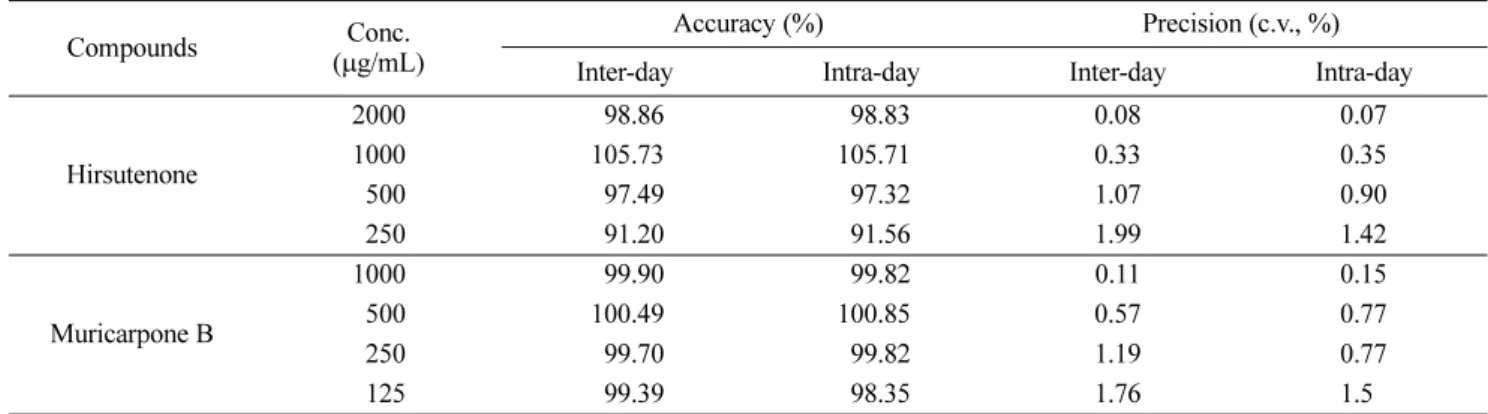
Accuracy and Precision: The precision of hirsutenone and muricarpone B were 0.07~1.99 and 0.11~1.76, respectively. Both the precision of two compounds were less than 2, thus the precision of hirsutenone and muricarpone B were confirmed. The accuracy of hirsu- tenone and muricarpone B were 91.20%~105.73% and 98.35%~100.85%, respectively. Both the accuracy of two compounds were within the range of 90%~110%, thus the accuracy of hirsutenone and muricarpone B were confirmed (Table 4).

Conclusion

We fermented AS and isolated hirsutenone and muricarpone B. Moreover, we established the HPLC validation of hirsutenone and muricarpone B, and calculated the content of two compounds as 28.7% and 6.72% respectively from FAS, and the accuracy and precision of the HPLC analysis was in the range of 80~

120% and less than 2%, respectively, showed the developed HPLC analysis method is an accurate and a good reproducibility. These results of HPLC analysis method of hirsutenone and muricarpone B might be a good database for further research.

Acknowledgments

This study was supported by the Basic Science Research

Program through the National Research Foundation of Korea (NRF-2014R1A1A2056899), which is funded by the Ministry of Education, Science, and Technology.

References

(1) Lee, S. J. Korea folk Medicine; Seoul National University Publishing Center: Korea, 1996, pp40.

(2) Asakawa, Y.; Genjida, F.; Hayashi, S.; Matsuura, T. Tetrahedron Lett. 1969, 10, 3235-3237.

(3) Terazawa, M.; Okuyama, H.; Miyake, M. Mokuzai gakkaish 1973, 19, 45-46.

(4) Karchesy, J. J.; Laver, M. L.; Barofsky, D. F.; Barofsky, E. J. Chem.

Soc. 1974, 16, 649-650.

(5) Nomura, M.; Tokoroyama, T.; Kubota, T. Phytochemistry 1981, 20, 1097-1104.

(6) Suga, T.; Iwata, N.; Asakawa, Y. Bull. Chem. Soc. Jpn. 1972, 45, 2058-2060.

(7) Asakawa, Y. Bull. Chem. Soc. Japan 1971, 44, 2761-2766.

(8) Yoshida, T.; Memon, M. U.; Okuda, T. Heterocycles 1981, 16, 1085- 1088.

(9) Ishimatsu, M.; Tanaka, T.; Nonaka, G.; Nishioka, I. Phytochemistry 1989, 28, 3179-3184.

(10) Khvorst, O. P.; Serbin, A. G.; Komissarenko, N. F.; Goldienko, V.

G. Khim. Farm. Zh. 1989, 23, 445-449.

(11) Lee, M. W.; Tanaka. T.; Nonaka, G.; Nishioka, I. Phytochemistry 1992, 31, 967-970.

(12) Aoki, T.; Ohta, S.; Aratani, S.; Hirata, T.; Suga, T. J. Chem. Soc.

Perkin Trans. 1. 1982, 2, 1399-1403.

(13) Sakamura, F.; Ohta, S.; Aoki, T.; Syga, T. Phytochemistry 1985, 24, 2744-2745.

(14) Suga, T.; Ohta, S.; Ohta, E.; Aoki, T. Phytochemistry 1986, 25, 1243-1244.

(15) Kim, M. H.; Park, K. H.; Kim, S. R.; Park, K. J.; Oh, M. H.; Heo, J. H.; Yoon, K. H.; Yin, J.; Yoon, K. H.; Lee, M. W. Nat. Prod. Res. 2016, 30, 206-213.

Table 3. Linear ranges and LOQ of hirsutenone and muricarpone B

Compound Linear range

( µg/mL) Response slope (a)

Response Factor (b)

Correlation Coefficient (R

2

)

LOQ ( µg/mL)

Hirsutenone 250~2000 7587.2 −860963 0.9976 76.12

Muricarpone B 125~1000 3998.8 26209 0.9999 4.49

Table 4. Precision and accuracy of hirsutenone and muricarpone B

Compounds Conc.

( µg/mL)

Accuracy (%) Precision (c.v., %)

Inter-day Intra-day Inter-day Intra-day

Hirsutenone

2000 98.86 98.83 0.08 0.07

1000 105.73 105.71 0.33 0.35

500 97.49 97.32 1.07 0.90

250 91.20 91.56 1.99 1.42

Muricarpone B

1000 99.90 99.82 0.11 0.15

500 100.49 100.85 0.57 0.77

250 99.70 99.82 1.19 0.77

125 99.39 98.35 1.76 1.5

(5)

(16) Bae, C. I.; Gong, J. M.; Oh, J. W.; Kim, H. J.; Oh, G. J.; Park, S.

K.; Chung, S. G.; Cho, E. H. Yakhak Hoeji 1997, 41, 559-564.

(17) Lee, M.; Song, J. Y.; Chin, Y. W.; Sung, S. H. Bioorg. Med. Chem.

Lett. 2013, 23, 2069-2073.

(18) Pahng, S. H. Korean J. Orient. Med. 2011, 17, 53-60.

(19) Kim, K. Y.; Song, H. J. Herbal processology; Shinil Press: Korea, 2002, p 547.

(20) Park, J. H.; Kim, H. J.; Lee, M. J. J. Soc. Korean Med. Obes. Res.

2009, 9, 1-14.

(21) Kim, H. J.; Kim, K. H.; Yeom, S. H.; Kim, M. K.; Shin, J. G.; Lim, H. W.; Lee, M. W. Chinese Chem Lett. 2005, 16, 1337-1340.

(22) Giang, P. M.; Son, P. T.; Matsunami, K.; Otsuka, H. Chem. Pharm.

Bull. 2006, 54, 139-140.

(23) Kuroyanagi, M.; Shimomae, M.; Nagashima, Y.; Muto, N.; Okuda.

T.; Kawahara, N.; Nakane, T.; Sano, T. Chem. Pharm. Bull. 2005, 53, 1519-1523.

(24) Jeong, M. S.; Choi, S. E.; Kim, J. Y.; Kim, J. S.; Kim, E. J.; Park, K. H.; Lee, D. I.; Joo, S. S.; Lee, C. S.; Bang, H.; Lee, M. K.; Choi, Y.

W.; Li, K. S.; Moon, N. J.; Lee, M. W.; Seo, S. J. Clin. Dev. Immunol.

2010, 2010, 618517.

(25) Kim, J. H.; Lee, K. W.; Lee, M. W.; Lee, H. J.; Kim, S. H.; Surh, Y.

J. FEBS Lett. 2006, 580, 385-392.

(26) Choi, J. G.; Lee, M. W.; Choi, S. E.; Kim, M. H.; Kang, O. H.; Lee, Y. S.; Chae, H. S.; Obiang-Obounou, B.; Oh, Y. C.; Kim, M. R.; Shin, D.

W.; Lee, J. H.; Kwon, D. Y. Eur. Rev. Med. Pharmacol. Sci. 2012, 16, 853-859.

(26) Choi, J. G.; Lee, M. W.; Choi, S. E.; Kim, M. H.; Kang, O. H.; Lee, Y. S.; Chae, H. S.; Obiang-Obounou, B.; Oh, Y. C.; Kim, M. R.; Shin, D.

W.; Lee, J. H.; Kwon, D. Y. Eur. Rev. Med. Pharmacol. Sci. 2012, 16, 853-859.

Received March 17, 2017

Revised May 8, 2017

Accepted May 9, 2017

수치

Fig. 1. The structures of main components of FAS, oregonin, hirsutenone and muricarpone B.
Fig. 2. HPLC pattern of FAS, AS and the specificity of hirsutenone and muricarpone B.
Table 4. Precision and accuracy of hirsutenone and muricarpone B

참조

관련 문서