Research Article
Effect of Enzyme Treatment on Silage Quality : Meta-analysis
Sangbuem Cho
1*, Sanghoon Yeom
1, Namhyung Kim
1, Dohyeong Li
2, Jaehoon Lee
3, Sang Moo Lee
3, Ji Hong Lee
4, Su-Jin Shin
5, Mi-So Kim
5and Nag-Jin Choi
51
Institute of CALSNBT, Seoul, 08506, Korea,
2DREAMFEED Co Ltd, Youngin, 16817, Korea,
3Department of Animal Science, Kyungpook National University, Sangju 37224, Korea,
4Department of Animal Science, Gyeongbuk Provincial
College, Yecheon 36830, Korea,
5Department of Animal Science, Chonbuk National University, Jeonju 54896, Korea
ABSTRACT
The present study investigated the effect of enzyme inclusion on silage quality using meta-analysis tool. A total of 16 research papers reporting the effect of enzyme application on silage quality were employed in the meta-analysis of this study. Mixed model for integrating quantitative results from multiple studies was used first to calculate the predicted error of each study.
Individual error from the estimated model was the applied into standard deviation of each study to calculate the mean difference.
Finally, summary effect was determined using standard mean difference (SMD) and inversed variance weighting. Mixed model analysis and SMD analysis showed the same effect patterns in all analysis items. Enzyme inclusion in silage significantly (p <
0.05) altered all silage quality characteristics investigated compared to control when enzyme was not included. Our results showed that enzyme treatment increased dry matter content, preserved crude protein effectively, and elevated water soluble carbohydrate content. However, the pH value, acetic acid, propionic acid, neutral detergent fiber, and acid detergent fiber contents in silage with enzyme inclusion were lower than those of the control.
(Key words : Enzyme, Silage characteristics, Meta-analysis)
. INTRODUCTION
Improvement of silage quality is an important in terms of providing the good forage to the ruminant animal, and it was highly related to performance and meat quality of beef cattle (Cho et al., 2012). Bacterial inoculant, organic acid and enzymes have been applied to improve silage quality (Nadeau et al., 2000). Even though all those additives have the different mode of action in silage quality alteration, it was reported that application of those additive could improve rapid acidification, decrease proteolysis and ensure safety during its usages after exposure to air (Lynch et al., 2014). Among those additives, bacterial inoculation has been mostly studied. The application of enzyme in silage was attempted to support the bacterial growth in the crop which contained a relatively low amount of soluble carbohydrate which is essential for rapid colonization (Meeske et al., 2002). Since water soluble carbohydrate (WSC) is known as a critical factor that determines silage quality via altering growth and colonization of epiphytic
bacteria on the crops (McDonald et al., 1991; Jone et al., 1998). However, there is few report represent the alteration of silage characteristics by enzyme treatments, particularly under the consideration of quantitative summarization. The present study conducted meta-analysis using multiple literatures reported the effect of enzyme treatment on silage characteristics.
. MATERIALS AND METHODS 1. Data set
Published research studies reported the effect of enzyme treatment on silage quality were identified by a computerized literature search. Research articles were selected based on the use of enzyme and presence of data set in number and then total 16 studies were used in this work (Chamberlain and Robertson, 1992; Stokes, 1992; Hristov, 1993; Fredeen and McQueen, 1993; Sheperd et al., 1995; Weinberg et al., 1995; Sheperd and Kung, 1996; Patterson et al., 1997;
* Corresponding author : Cho Sangbuem, Institute of CALSNBT, 503 BYC-HIGHCITY 131, Gasan digital 1-ro, Geumcheon-gu, Seoul, 08506, KOREA. Office: +82-70-8789-4600; Mobile: +82-10-3101-4795; E-mail: [email protected]
Ridla and Uchidaz, 1998; Meeske et al., 1999; Nadeau et al., 2000; Zhang and Kumai, 2000; Kung and Ranjit, 2001;
Dean et al., 2005; Peymanfar and Kermanshahi, 2012).
2. Data analysis
Two subsequent model analyses were performed. First, mixed model considering fixed, random effects and errors from publication was applied with data from selected 16 studies (St-Pierre, 2001). Variation of individual data was calculated based on predicted response from the mixed model using RMSPE (root mean square of predicted error).
Second, the mean difference between control (without enzyme) and treatment (with enzyme) group using Hedges’s adjusted g for pooling was used for calculation of a SMD.
Summary effect size across the studies was estimated using fixed and random effect models. Inversed weighing and the DerSimonian-Laird estimate for between studies were applied in random effect model consideration. Cochran’s Q
statistics and I
2statistics were employed in heterogeneity test. Publication bias was tested using funnel plot, and asymmetric was trimmed by ‘Trim-and-Filling’ method.
Mixed model analysis was performed using SPSS program (version 18, IBM, USA). Analysis of SMD, heterogeneity and publication bias test were performed using the package
‘meta’ in the R statistical program (version 3.2.3).
. RESULTS 1. Data set
Total 16 research papers were used in the analysis.
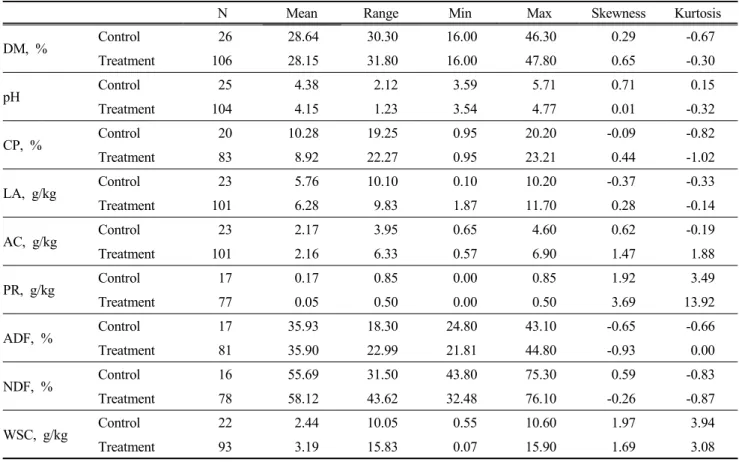
Descriptive statistics for used data involved in comparison items are summarized in Table 1. Numbers of used experiments in each study were ranged from 17 to 106.
Most of the data did not have normal distribution except pH (treatment) and CP (control). Propionate data resources showed a highly narrow range and great kurtosis (13.92).
Table 1. Descriptive statistics for employed data on meta-analysis
N Mean Range Min Max Skewness Kurtosis
DM, % Control 26 28.64 30.30 16.00 46.30 0.29 -0.67
Treatment 106 28.15 31.80 16.00 47.80 0.65 -0.30
pH Control 25 4.38 2.12 3.59 5.71 0.71 0.15
Treatment 104 4.15 1.23 3.54 4.77 0.01 -0.32
CP, % Control 20 10.28 19.25 0.95 20.20 -0.09 -0.82
Treatment 83 8.92 22.27 0.95 23.21 0.44 -1.02
LA, g/kg Control 23 5.76 10.10 0.10 10.20 -0.37 -0.33
Treatment 101 6.28 9.83 1.87 11.70 0.28 -0.14
AC, g/kg Control 23 2.17 3.95 0.65 4.60 0.62 -0.19
Treatment 101 2.16 6.33 0.57 6.90 1.47 1.88
PR, g/kg Control 17 0.17 0.85 0.00 0.85 1.92 3.49
Treatment 77 0.05 0.50 0.00 0.50 3.69 13.92
ADF, % Control 17 35.93 18.30 24.80 43.10 -0.65 -0.66
Treatment 81 35.90 22.99 21.81 44.80 -0.93 0.00
NDF, % Control 16 55.69 31.50 43.80 75.30 0.59 -0.83
Treatment 78 58.12 43.62 32.48 76.10 -0.26 -0.87
WSC, g/kg Control 22 2.44 10.05 0.55 10.60 1.97 3.94
Treatment 93 3.19 15.83 0.07 15.90 1.69 3.08
DM, dry matter; CP, crude protein; LA, lactic acid; AC, acetic acid; PR, propionic acid; NDF, neutral detergent fiber; ADF, acid detergent fiber; WSC, water soluble carbohydrate.
2. Mixed model evaluation
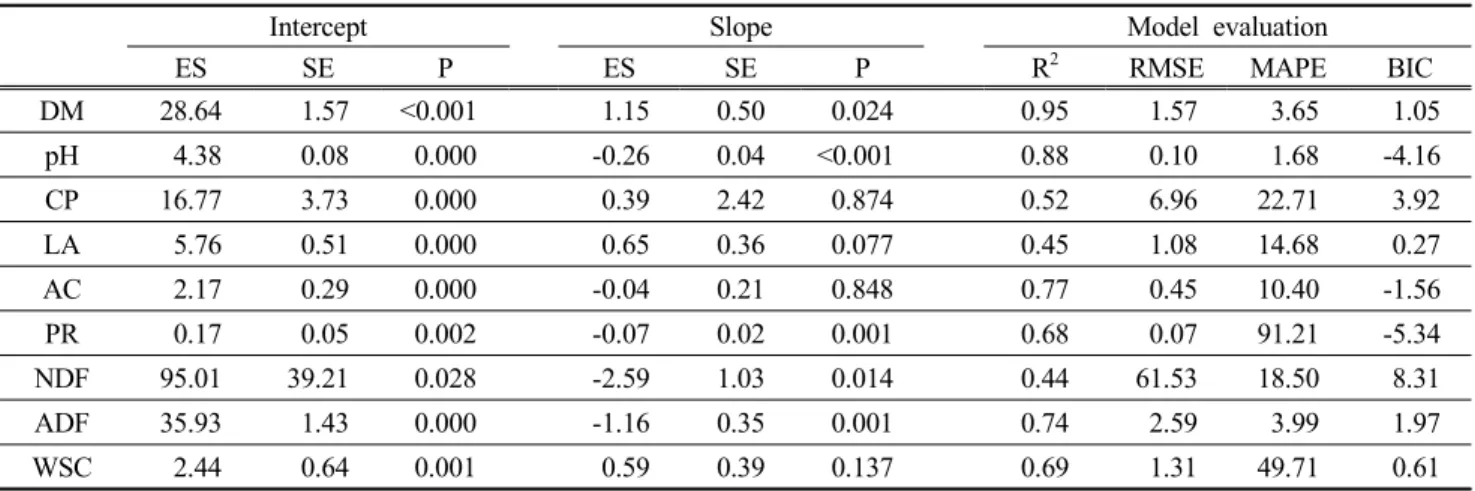
Prior to conduct SMD analysis, mixed model fitting was performed using achieved data from literature to draw trend line of enzyme inclusion effect on silage and to calculate RMSPE of individual data for the assumption of standard deviation. Results of mixed model parameters are summarized in Table 2. Significant effects of enzyme application on alteration of silage quality were found in dry matter, pH, propionate, neutral detergent fiber (NDF) and acid detergent fiber (ADF) (p<0.05). Effect of the enzyme on dry matter (DM) was showed positive effects. However, the effect of enzyme on pH, propionate, NDF and ADF were shown in negative effect. The greatest RMSE and MAPE were detected for NDF and propionate, respectively.
3. Summary effect
Summary effects of enzyme inclusion on silage quality are shown in Table 3. In SMD analysis, all effects on silage characteristic were significant (p<0.05). Summary effect on DM was positive on both fixed and random effect model. The random effect model showed greater effect size than the fixed. In heterogeneity, Q statistics was greater than the degree of freedom (df) (105) and not showed significant (p=0.082). I
2statistics was 16.5%. Effect on pH was negative at both of fixed and random model. Q
statistics (116.97) was greater than df (103) and not showed significant (p=0.162). In CP content, enzyme inclusion effect was found as positive at both fixed and random effect model. In heterogeneity, Q statistics was less than df (77) and not showed significant (p=0.896). I
2statistics was zero.
Effect of enzyme application on lactic acid (LA) production was positive at both fixed and random effect model. Q statistics in heterogeneity assessment was less than df (100) and not significant (p=0.746). I
2statistics was zero.
According to SMD analysis, acetic acid (AC) production was greater in control than the treatment at both fixed and random model. Q statistics of heterogeneity was greater than df (100), and it was significant (p=0.002). I
2statistics was 30.3%. Effect of enzyme inclusion on propionic acid (PR) content in silage was negative at both fixed and random effect model. Q statistics was greater than df (61), and it was significant (p=0.020). I
2statistics was 28.8%.
Effect of enzyme inclusion on NDF and ADF were negative at both of fixed and random effect model. Q statistics at both of NDF and ADF were greater than their df (77 and 80). In their probability, only NDF showed significant (p=0.011). I
2statistics for NDF and ADF were 28.7% and 19.1%, respectively. Effect of enzyme on WSC content in silage was positive at both fixed and random effect model. In heterogeneity test, Q statistics was greater than df (92) and not showed significant (p=0.445). I
2statistics was 1.3%.
Table 2. Regression statistics for calculation of root mean square of predicted error
Intercept Slope Model evaluation
ES SE P ES SE P R
2RMSE MAPE BIC
DM 28.64 1.57 <0.001 1.15 0.50 0.024 0.95 1.57 3.65 1.05
pH 4.38 0.08 0.000 -0.26 0.04 <0.001 0.88 0.10 1.68 -4.16
CP 16.77 3.73 0.000 0.39 2.42 0.874 0.52 6.96 22.71 3.92
LA 5.76 0.51 0.000 0.65 0.36 0.077 0.45 1.08 14.68 0.27
AC 2.17 0.29 0.000 -0.04 0.21 0.848 0.77 0.45 10.40 -1.56
PR 0.17 0.05 0.002 -0.07 0.02 0.001 0.68 0.07 91.21 -5.34
NDF 95.01 39.21 0.028 -2.59 1.03 0.014 0.44 61.53 18.50 8.31
ADF 35.93 1.43 0.000 -1.16 0.35 0.001 0.74 2.59 3.99 1.97
WSC 2.44 0.64 0.001 0.59 0.39 0.137 0.69 1.31 49.71 0.61
DM, dry matter; CP, crude protein; LA, lactic acid; AC, acetic acid; PR, propionic acid; NDF, neutral detergent fiber; ADF, acid detergent fiber; WSC, water soluble carbohydrate.
ES, estimates; SE, standard error; T, t-value; P, p-value; RMSE, root mean square error; MAPE, mean absolute percentage error; BIC, standardized Baysian information criterion.
4. Publication bias
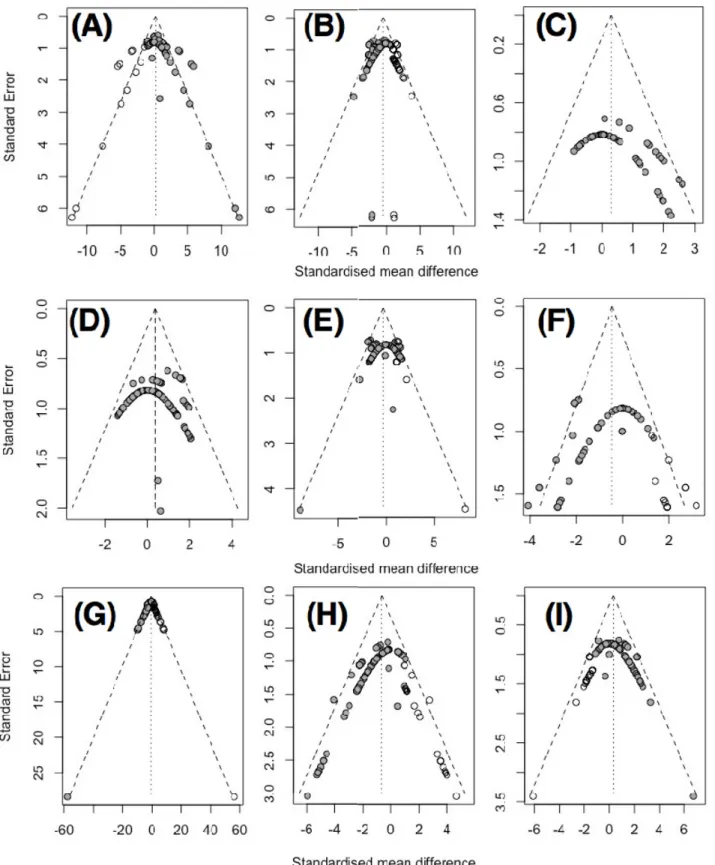
Distribution of standard error based on standardized mean differences for silage characteristics are visualized at Fig. 1.
Symmetrically arranged plots were accomplished by employing Trim-and-Fill procedure when considerable asymmetric was found. All characteristics were employed in Trim-and-Fill procedure except CP (Fig. 1C) and lactic acid (Fig. 1D).
Trimmed summary effects of enzyme inclusion on silage characteristics (except CP and lactate) are summarized in Table 4. All measured effects were significant (p<0.05).
Positive effects were detected in DM, CP, LA, and WSC contents. Negative effects were found in pH, AC, PR, NDF and ADF.
.
Ⅳ DISCUSSION
1. Model evaluation, heterogeneity and publication bias
Two model evaluations were subsequently employed in this work. Mixed model analysis was conducted in first to draw effect patterns of enzyme inclusion on silage characteristics. Then, RMSPE of individual data was calculated and those errors were assumed as the variance of individual studies. Calculation of summary effect using SMD is based on the variance of individual studies since the variance is used for estimation of inversed variance weight which can greatly influence the probability of summary effect (Cho et al., 2013). In model accuracy of Table 3. Summary effects and heterogeneity test results for application of enzyme on silage
Item k
1)Summary effect Heterogeneity
Fixed effect Random effect Q static I
2static
DM 106 0.33
2)(<0.001)
3)0.34 (<0.001)
125.71 (0.082) 16.5%
[0.15; 0.49]
4)[0.16; 0.53]
pH 104 -0.82 (<0.001) -0.85 (<0.001)
116.97 (0.163) 11.9%
[-1.01; -0.64] [-1.05; -0.65]
CP 78 0.31 (0.002) 0.31 (0.002)
61.83 (0.896) 0.0%
[0.11; 0.50] [0.11; 0.50]
LA 101 0.37 (<0.001) 0.37 (<0.001)
90.31 (0.746) 0.0%
[0.19; 0.54] [0.19; 0.53]
AC 101 -0.45 (<0.001) -0.46 (<0.001)
143.42 (0.002) 30.3%
[-0.64; -0.26] [-0.68; -0.23]
PR 62 -0.66 (<0.001) -0.72 (<0.001)
85.65 (0.020) 28.8%
[-0.89;-0.43] [-1.01; -0.43]
NDF 79 -1.00 (<0.001) -1.16 (<0.001)
109.34 (0.011) 28.7%
[-1.24; -0.76] [-1.46; -0.86]
ADF 81 -0.95 (<0.001) -1.02 (<0.001)
98.86 (0.075) 19.1%
[-1.18; -0.72] [-1.29; -0.80]
WSC 93 0.53 (<0.001) 0.53 (<0.001)
93.23 (0.445) 1.3%
[0.34; 0.73] [0.34; 0.72]
DM, dry matter; CP, crude protein; LA, lactic acid; AC, acetic acid; PR, propionic acid; NDF, neutral detergent fiber; ADF, acid detergent fiber; WSC, water soluble carbohydrate.
1) k, number of study.
2) Effect size.
3) P value.
4) 95% Critical interval.
Fig. 1. Trim and filled funnel plot for evaluation of publication bias. (A), dry matter; (B), pH; (C), crude protein
(not trimmed); (D), lactic acid (not trimmed); (E), acetic acid; (F), propionic acid; (G), neutral detergent
fiber; (H), acid detergent fiber; (I), water soluble carbohydrate.
mixed model, great RMSE and MAPE values were found in NDF and propionic acid, respectively (Table 2). In heterogeneity based on I
2statistics, propionic acid and NDF also showed great values (Table 3). Direction of slope in mixed model analysis (Table 2) showed same with effect size evaluation at both fixed and random model (Table 3).
Null hypothesis of Q statistics for heterogeneity is that all studies possess same effect size. In this work, pH, CP, lactic acid, ADF and WSC were detected as not significant in Q statistics. It could be assumed that effect of enzyme inclusion represented in all used studies possessed same effect each other. Contrarily, true effect sizes of enzyme treatment on DM, AC, PR and NDF were detected as variable among used studies. In I
2statistics in heterogeneity test, AC, PR and NDF showed relatively greater values than others. This large I
2statistics indicate that there can be a possible subgroup effects such as dose dependent effects. In publication bias test, only two characteristics, CP and lactic acid showed symmetric plot (Fig. 1) and it was found that Q statistics of those two characteristics were less
than degree of freedom (Table 2). So it can be assumed that effect of enzyme inclusion on CP and lactic acid content contained less within study errors.
2. Effect of enzyme inclusion on silage characteristics
Generally, target of silage processing techniques is known to preserve crop’s nature nutrients during storage via promoting rapid acidification and preventing unexpected bacterial contamination relevant to destroy of nutrients (Wilkins et al., 1971). Lactic acid bacteria, a starter culture strain, is regarded as an important factor that determine silage quality (Cho et al., 2014a). However, when a crop contains relatively low content of soluble carbohydrate, this low content of fermentable sugar can limit proper fermentation of lactic acid bacteria (Sheperd et al., 1995). Enzyme has been applied and studied to support bacterial growth when a crop containing low soluble carbohydrate by supplying sugar via destroying cell wall components of crop (Hristov, 1993). So, it can be hypothesized that application of Table 4. Trimmed effect size for application of enzyme on silage quality and comparison with effects of bacterial
inoculation and organic acid treatments
This work Cho et al. (2014)
2)k
1)Effect size 95% critical interval P value Bacterial inoculation
Organic acid treatment
DM 118 0.2252 0.0026; 0.4479 0.0474 ND
3)ND
pH 135 -0.5102 -0.7300; -0.2905 <0.0001 1.26 1.26
CP 78 0.3053 0.1115; 0.4990 0.0020 0.91 1.29
LA 101 0.3656 0.1940; 0.5372 <0.0001 1.22 1.13
AC 110 -0.3360 -0.5626; -0.1094 0.0037 1.28 1.12
PR 75 -0.4544 -0.7586; -0.1502 0.0034 1.50 1.47
NDF 105 -0.7852 -1.1202; -0.4502 <0.0001 0.62 1.25
ADF 93 -0.6981 -0.9802; -0.4160 <0.0001 1.26 0.99
WSC 113 0.3218 0.1101; 0.5334 0.0029 0.84 1.10
DM, dry matter; CP, crude protein; LA, lactic acid; AC, acetic acid; PR, propionic acid; NDF, neutral detergent fiber; ADF, acid detergent fiber; WSC, water soluble carbohydrate
1)k, number of study
2)Cho et al. (2014), they used risk ratio in calculation of effect size (Meantreatment/ Meancontrol). So, effect size greater than 1 means that mean of treatment was great than mean of control, vise versa.
3)ND, not determined.
enzyme results in loss of DM. However, there is a discrepancy for the effect of enzyme on DM loss (Fredeen and McQueen, 1993). The present study showed that there was no DM loss and indicated significant DM increment compared to the control (Table 4). However, effect of enzyme treatment on pH and lactic acid concentration in silage from this work was coincided with the hypothesis of enzyme action in supplying sugar to lactic acid bacterial growth. Theoretically, based on the hypothesis of enzyme action in silage fermentation and, proteolysis should be reduced, but protein preservation should be increased when bacterial inoculation was applied and enzyme treatment was included. However, the discrepancy on this effect was also found in many studies (Kung et al., 1990; Nadeau et al., 2000; Lynch et al., 2014). The present work also compared effect of bacterial inoculant and organic acid presented in previous work (Table 4) (Cho et al., 2014a). The result showed that enzyme and organic acid treatment could improve the CP content in silage whereas bacterial inoculation could decrease CP in silage (Table 4). NDF and ADF are cell wall components and application of enzyme hypothesized the breakdown of cell wall components which could support soluble carbohydrate supplement to lactic acid bacteria. The result of meta-analysis supported the hypothesis by showing significant negative effect size (p<0.05) on both of NDF and ADF (Table 4). A possible decrement of NDF can be explained by degradation of hemicellulose and cellulose.
Hemicellulose can be destroyed by acidic hydrolysis, however cellulose breakdown is not easily achieved by the action of organic acid produced by lactic acid bacteria.
There is certain variation based on crops and silage fermentation conditions, application of enzyme is suggested as a way to decrease cellulose in crop effectively (Nadeau et al., 2000). Bacterial inoculation decreased NDF and increased ADF compared to the control (Table 4). Organic acid treatment increased the NDF and decreased the ADF compared to the control (Table 4). These comparison results indicated that application of enzyme, bacterial inoculant and organic acids shared not common effect on NDF and ADF of silage. Protein preservation benefit could be more effectively achieved by treating silage with enzyme and organic acid than treatment with bacterial inoculation. More WSC content in silage could be expected by enzyme
treatment as described in earlier. Acetic acid is regarded as an important organic acid relevant to anti-microbial activity that is able to ensure suppression of unexpected spoilage during silage usage. It is also related to palatability (Cho et al. 2014b). Effect of additives on this acetic acid production is varied depend on type of additive. Bacterial inoculant and organic acid were reported to increase acetic acid production, particularly application of heterofermentative lactic acid bacteria (Cho et al., 2014a; Cho et al., 2014b).
The effect of enzyme inclusion, there were discrepancy in acetic acid concentration of silage (Jaakkola, 1990; Kung et al., 1991).
. CONCLUSION
The present work was conducted to show how silage characteristics could be altered by enzyme treatment via integrating multiple research results using meta-analysis.
Even though there was a possible heterogeneity and publication bias, a conclusive response of silage against to enzyme was found as followings: increment of DM, CP, LA and WSC, and decrement of pH, AC, PR, NDF and ADF. And those responses can be used for simulation of silage additive according to designed silage fermentation and characteristics.
. ACKNOWLEDGEMENTS
This work was carried out with the support of
“Cooperative Research Program for Agriculture Science &
Technology Development (PJ011978022016)” Rural Development Administration, Republic of Korea.
. REFERENCES
Chamberlain, D.G. and Robertson, S. 1992. The effects of the addition of various enzyme mixtures on the fermentation of perennial ryegrass silage and on its nutritional value for milk production in dairy cows. Animal Feed Science and Technology.
37:257-264.
Cho, S., Kwon, C.H. and Kim, E.J. 2014a. Effects of baterial inoculants and oragnic acids on silage quality: Meta-analysis.
Journal of The Korean Society of Grassland and Forage Science.
34:94-102.
Cho, S., Kang, J.S., Cho, K.J., Lee, K.H., Kwon, C.H., Song, J., Lee, K., Kim, S.Y. and Kim, E.J. 2014b. Effect of homofermentative and heterofermentative lactic acid bacteria on the quality and aerobic stability of silage: Meta-analysis. Journal of The Korean Society of Grassland and Forage Science.
34:247-253.
Cho, S., Ryu, C., Yang, J., Mbiriri, D.T. and Choi, N.J. 2013. Effect of conjugated linoleic acid feeding on the growth performance and meat fatty acid profiles in broiler : Meta-analysis.
Aisan-Australasian Journal of Animal Science. 26:995-1002.
Cho, S.B., Lee, S.M. and Kim, E.J. 2012. Effect of different forages on growth performance, meat production and meat quality of hanwoo steers : Meta-analysis. Journal of The Korean Society of Grassland and Forage Science. 32:175-184.
Dean, D.B., Adesogan, A.T., Krueger, N. and Littell, R.C. 2005.
Effect of fibrolytic enzymes on the fermentation characteristics, aerobic stability, and digestibility of bermudagrass silage. Journal of Dairy Science. 88:994-1003.
Fredeen, A.H. and McQueen, R.E. 1993. Effect of enzyme additives on quality of alfalfa/grass silage and dairy cow performance.
Canadian Journal of Animal Science. 73:581-591.
Hristov, A.N. 1993. Effect of a commercial enzyme preparation on alfalfa silage fermentation and protein degradability. Animal Feed Science and Technology. 42:273-282.
Jaakkola, S. 1990. The effect of cell wall degrading enzymes on the preservation of grass and on the silage intake and digestibility in sheep. Journal of Agricultural Science Finland. 62:51-62.
Jone, E.L., Jone, J.E., Fychan, R., Bowling, P. and Jones, R. 1998.
Whole crop barely and oats undersown with Italian ryegrass/red clover as big bale silage in an organic system. In Alternative Forages for Ruminants. Lane, G.P.E. and Wilkinson, J.M., editors. Chalcome Publications. 73-79.
Kung, L. and Ranjit, N.K. 2001. The effect of Lactobacillus buchneri and other additives on the fermentation and aerobic stability of barley silage. Journal of Dairy Science. 84:1149-1155.
Kung, L., Carmean, B.R. and Tung, R.S. 1990. Microbial inoculation or cellulase enzyme treatment of barley and vetch silage harvested at three maturities. Journal of Dairy Science. 73:1304- 1311.
Kung, L.J., Tung, S.R., Maciorowski, K.G., Buffum, K., Knutsen, K.
and Aimutis, W.R. 1991. Effects of plant cell-wall-degrading enzymes and lactic acid bacteria on silage fermentation and composition. Journal of Dairy Science. 74:4284-4296.
Lynch, J.P., Jin, L., Lara, E.C., Baah, J. and Beauchemin, K.A. 2014.
The effect of exogenous fibrolytic enzymes and a ferulic acid
esterase-producing inoculant on the fibre degradability, chemical composition and conservation characteristics of alfalfa silage.
Animal Feed Science and Technology. 193:21-31.
McDonald, P., Henderson, A.R. and Heron, S.J.E. 1991. The biochemistry of silage, 2nd Edition. Chalcome Publications, Marlow, Bucks, UK. 255-257 pp.
Meeske, R., Basson, H.M. and Cruywagen, C.W. 1999. The effect of a lactic acid bacterial inoculant with enzymes on the fermentation dynamics, intake and digestibility of Digitaria eriantha silage. Animal Feed Science and Technology. 81:237- 248.
Meeske, R., Van Der Merwe, G.D., Greyling, J.F. and Cruywagen, C.W. 2002. The effect of adding an enzyme containing lactic acid bacterial inoculant to big round bale oat silage on intake, milk production and milk composition of Jersey cows. Animal Feed Science and Technology. 97:159-167.
Nadeau, E.M., Buxton, D.R., Russell, J.R., Allison, M.J. and Young, J.W. 2000. Enzyme, bacterial inoculant, and formic acid effects on silage composition of orchardgrass and alfalfa. Journal of Dairy Science. 83:1487-1502.
Patterson, D.C., Mayne, C.S., Gordon, F.J. and Kilpatrick, D.J. 1997.
An evaluation of an inoculant/enzyme preparation as an additive for grass silage for dairy cattle. Grass Forage Science. 52:325- 335.
Peymanfar, S. and Kermanshahi, R.K. 2012. The effect of bacteria, enzymes and inulin on fermentation and aerobic stability of corn silage. Iranian Journal of Microbiol. 4:180-186.
Ridla, M. and Uchida, S. 1998. Effects of combined treatment of lactic acid bacteria and cell wall degrading enzymes on fermentation and composition of rhodesgrass (Chloris gayana Kumth.) silage. Aisan-Austalasian Journal of Animal Science.
11:522-529.
Sheperd, A.C. and Kung, L. 1996. An enzyme additive for corn silage: effects on silage composition and animal performance.
Journal of Dairy Science. 79:1760-1766.
Sheperd, A.C., Maslanka, M., Quinn, D. and Kung, L. 1995.
Additives containing bacteria and enzymes for alfalfa silage.
Journal of Dairy Science. 78:565-572.
St-Pierre, N.R. 2001. Invited review: Integrating quantitative findings from multiple studies using mixed models methodology. Journal of Dairy Science. 84:741-755.
Stokes, M.R. 1992. Effects of an enzyme mixture, an inoculant, and their interaction on silage fermentation and dairy production.
Journal of Dairy Science. 75:764-773.
Weinberg, Z.G., Ashbell, G., Hen, Y. and Azrieli, A. 1995. The effect of cellulase and hemicellulase plus pectinase on the
aerobic stability and fibre analysis of peas and wheat silages.
Animal Feed Science and Technolology. 55:287-293.
Wilkins, R.J., Hutchinson, K.J., Wilson, R.F. and Harris, C.E. 1971.
The voluntary intake of silage by sheep. I. Interrelationships between silage composition and intake. Journal of Agricultural Science. 77:531-537.
Zhang, J. and Kumai, S. 2000. Effluent and aerobic stability of cellulase and LAB-treated silage of napier grass (Pennisetum purpureum Schum). Asian-Australasian Journal of Animal Science. 13:1063-1067.
(Received August 20, 2016 / Revised September 7, 2016 / Accepted September 7, 2016)