393
Novel Coronary Stent Platforms
Bon-Kwon Koo, MD1,2 and Peter J. Fitzgerald, MD2
1Department of Internal Medicine, Seoul National University College of Medicine, Cardiovascular Center and
Cardiovascular Research Institute, Seoul National University Hospital, Seoul, Korea, 2Stanford University Medical Center, Stanford, California, USA
ABSTRACT
The stent has been a key part of percutaneous coronary intervention. The advent of drug-eluting stents has further expanded the indication for this technology with a lower overall rate of restenosis. However, the limitations of the current generation stent platforms have become more apparent as more complex are being treated with percutaneous coronary intervention. Coronary stenting sometimes results in a suboptimal outcome for challenging lesion subsets such as tortuous, calcified, bifurcating and multiple and long lesions. In this review, novel stent systems that have been developed to overcome the challenges surrounding current stent designs will be discussed. (Korean Circ J 2008;38:393-397)
KEY WORDS: Coronary artery stenosis; Angioplasty, transluminal, percutaneous, coronary; Stents; Drug- eluting stents.
Introduction
Through the marked reduction of in-stent restenosis, the use of drug-eluting stents has definitely expanded the field of percutaneous coronary intervention.1-4) How- ever, as more and more complex lesions are being treated with drug-eluting stents, the limitations of the current stent designs have become more apparent. Complex lesion characteristics challenges stent delivery and the designs of the current stents are not always suitable for the complex anatomy, such as bifurcation lesions. Fur- thermore, the use of multiple stenting results in incre- ased costs for both the patients and healthcare providers.
In this review, recently developed novel stent systems that have been designed to overcome these limitations will be described.
Improvement in Deliverability
Despite the recent progress in coronary stents and delivery system, a failure to cross the stent through calcified, tortuous or stented segments is still one of the main causes of procedural failure.5)6) A novel stent and
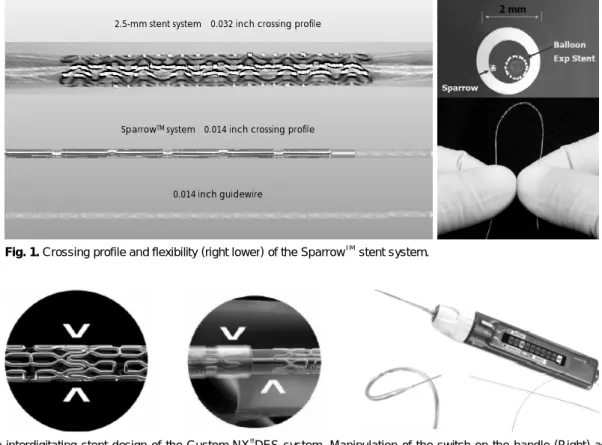
delivery system named SparrowTM (CardioMind, Sunny- vale, CA, USA) consists of a baremetal, self-expanding nitinol stent incorporated into an assembly minia- turized to a 0.014-inch diameter guidewire platform.7) As this system has a guidewire-level crossing profile and excellent flexibility (Fig. 1), it allows stenting for complex lesions that are inaccessible with current stent systems. A feasibility study (CARE 1 trial, n=22) in patients with small vessel disease showed no six-month major adverse cardiac events with an angiographic late loss of 0.73±0.57 mm. The drug-eluting version of this stent system has been also developed and is currently under clinical evaluation.
In Situ Stent Customization for Long/Multiple Lesions
Treatment of long or multiple lesions using currently available fixed-length stent systems requires several de- vices and a separate exchange for each stent. This pro- cedure increases the complexity, time and cost of stent usage. The Custom NX® DES system (XTENT®Inc., Menlo Park, CA, USA) is composed of multiple inter- digitated cobalt chromium stent modules up to 60 mm, each 6 mm in length (Fig. 2).8) This stent has a biode- gradable polymer that releases Biolimus A9, a sirolimus analog. An operator can select the appropriate stent length in situ and the deployment of multiple stents is allowed with a single delivery device. In addition, this
Correspondence: Bon-Kwon Koo, MD, Department of Internal Medicine, Seoul National University College of Medicine, Cardiovascular Center and Cardio- vascular Research Institute, Seoul National University Hospital, 28 Yeongeon- dong, Jongno-gu, Seoul 110-744, Korea
Tel: 82-2-2072-2062, Fax: 82-2-3676-4103 E-mail: [email protected]
system also allows the operator to shorten the balloon length to perform higher pressure post-dilatation within the stented segment. Therefore, long and multiple lesions of variable lengths and diameters, in one or more arteries, can be treated with a single device. The two- year follow-up results of a feasibility study (CUSTOM I trial, n=30) showed no major adverse cardiac event with an eight-month angiographic late loss of 0.26±
0.23 mm.9) With the favorable results of the CUSTOM I-III trials, the pivotal clinical trial for this stent will soon be started.
Dedicated Stents for Bifurcation Lesions
Percutaneous coronary intervention for bifurcation lesions is technically difficult due to the anatomical vari- ability and complexity of the lesions.10) Bifurcation in- tervention is associated with more procedural complexity, a lower procedural success rate and a higher clinical event rate.11-13)
As the overall design of stents has been optimized for straight, non-bifurcating coronary artery lesions, dedicated stents for bifurcation lesions have been de- veloped. In general, these stents can be divided into three categories: Y-type complete bifurcation stents, st- ents with side branch access and side branch stents. As there has been limited progress in the development of
Y-type stents, novel stents of the other categories will be described.
Stents With Side Branch Access
Side branch accessible main branch stents are de- signed to preserve access to a side branch during a pro- cedure and to provide adequate scaffolding of the side branch ostium. In most stents, the aperture is located at the center of a stent and the proximal part of side branch balloon is mounted within the main branch stent (Multilink FrontierTM, Abott Vascular, Santa Clara, CA, USA; Twin RailTM, Invatec, Roncadelle, Italy; Nile Croco, Minvasys, Genevilliers, France). In the FRON- TIER Stent Registry (n=105), the procedural success rate of the Multilink FrontierTM stent (Fig. 3) was 93%
and the six-month target lesion revascularization rate was 13.3%.14) A drug-eluting version of this stent will soon be available.
The TAXUS PetalTM bifurcation stent (Boston Sci- entific, Natick, MA, USA) has a unique petal structure in the middle of the stent to provide consistent me- chanical support to the side branch ostium (Fig. 3).
This stent system has the same anti-proliferative drug and polymer as the TAXUS stent. The TAXUS PETAL I First Human Use trial has recently begun.
The AntaresTM Sidebranch Adaptive System (Trireme Medical, Pleasanton, CA, USA) is also designed to faci-
Fig. 1. Crossing profile and flexibility (right lower) of the SparrowTMstent system.
2.5-mm stent system:0.032 inch crossing profile
SparrowTM system:0.014 inch crossing profile
0.014 inch guidewire
Fig. 2. The interdigitating stent design of the Custom NX®DES system. Manipulation of the switch on the handle (Right) activates the separation of the interdigitated segment at a desired location; therefore, the operator can customize the stent length.
litate side branch access and maximize side branch os- tial scaffolding. It is a balloon-expandable stainless steel stent with a unique side branch ostial preservation str- ucture in the center of the stent. This ostial preser- vation structure opens into the side branch ostium and adapts to the asymmetric anatomy of the side branch with variable angles (Fig. 4). A side branch stabilizing wire is encased in a wire management system and it allows direct side branch wiring and access after stent deployment into the parent vessel, and thus eliminates the need for stent strut re-crossing. The first human clinical trial of this stent is ongoing.
The StentysTM coronary bifurcation stent (Stentys, SAS, Paris, France) is a self-expanding, drug-eluting stent designed to treat Y-type bifurcation lesions with various calibrations.15) Unlike most other dedicated bifurcation stents, this stent does not require precise positioning of the side branch segment. As the Z-shaped mesh of the stent is linked by small inter-connections, the struts can be disconnected using an angioplasty balloon to create
side branch access and to achieve side branch ostial scaf- folding (Fig. 5). Therefore, any strut can be selected as a side branch opening after main branch stent implantation.
Side Branch Stents
The Tryton Side-Branch StentTM (Tryton Medical, Newton, MA, USA) has a unique design to cover the side branch completely in all bifurcation lesions with different angulations. This stent is a cobalt chromium stent composed of three different zones-a side branch region with a standard stent design, a transition zone and the main vessel region (Fig. 6). In the first human study (Tryton I, n=30), the six-month major adverse cardiac events rate was 9.9% with an angiographic late luminal loss of the side branch of 0.17±0.35 mm.16) The procedural success rate was 93.3%. In this trial, the side branch was treated first with the Tryton stent and then a standard drug-eluting stent was subsequently implanted in the main branch. The SideguardTM Ostium protection deviceTM (Cappella, Auburndale, FL, USA) is a self-expanding stent with a pre-formed, trumpet- shaped nitinol frame (Fig. 6). This is an anatomically- designed side branch stent for complete ostial coverage.
In the Sideguard I FIM study (n=15), the acute angio- graphic success rate of this device was 80%.17)
Stents to Cover the Proximal Part of a Bifurcation Lesion
The AxexssTM stent (Devax, Irvine, CA, USA) consists of a self-expanding nickel titanium platform with a bioabsorbable polymer that releases Biolimus A9. The stent is designed to be placed in the proximal part of the main vessel, at the level of the carina. It has a strai- ght and conical configuration to expand properly into the complex anatomy of a bifurcation lesion (Fig. 7).
Fig. 3. Designs of the Multilink FrontierTM (upper) and TAXUS PetalTM (lower) bifurcation stents.
Fig. 4. Angiographic and intravascular ultrasound results of a bifurcation lesion treated with an AntaresTM stent. The ostial preservation structure (arrow) covers the side branch ostium to provide scaffolding.
Before
After
Proximal Main Vessel Side Branch Ostium Distal Main Vessel
The unique design and expansion of this device enha- nces the interaction between the adequate mechanical scaffolding and accurate delivery of antirestenosis drugs.
After AxxessTM stent implantation, additional stents can be easily placed at the distal main or side branches.
In the AXXESS Plus trial (n=139), which was the first human trial of the Axxess stent for non-left main bi- furcation lesions, the six-month target lesion revas-
cularization rate was 7.5%, with an angiographic late luminal loss of Axxess stent of 0.09±0.56 mm.18) This stent system also showed favorable outcomes for left main bifurcation lesions (AXXENT trial).19)
Conclusion
Due to an increasing demand to treat more complex
Fig. 5. The StentysTM coronary bifurcation stent. The struts can be disconnected using an angioplasty balloon to create side branch ac- cess and to achieve side branch ostial scaffolding as the struts are linked by small interconnections.
Fig. 6. The design of the Tryton side branch stentTM(Left) and the SideguardTMOstium protection deviceTM (Right).
Fig. 7. The straight and conical configuration of the AxxessTM(left upper) and Axxess LMTM(for left main, left lower) stents and a long- itudinal intravascular ultrasound view of a bifurcation lesion treated with the AxxessTM stent and additional stents (Right).
Axxess stent Additional stent
lesions with percutaneous coronary intervention, a num- ber of novel stent designs has been developed. As op- posed to the one-design-fits-all concept, the current developments are directed toward the achievement of a lesion specific approach. Most of these novel devices have shown promising results from feasibility studies.
Larger randomized trials are being planned or are on- going to confirm the safety and efficacy of the deivces further. These next generation technologies will expand the filed of intracoronary stenting and improve clinical outcomes for patients with coronary artery disease.
Acknowledgments
The CardioVascular Research Foundation, Korea (CVRF), suppor- ted this work.
REFERENCES
1) Morice MC, Serruys PW, Sousa JE, et al. A randomized compa- rison of a sirolimus-eluting stent with a standard stent for coro- nary revascularization. N Engl J Med 2002;346:1773-80.
2) Stone GW, Ellis SG, Cox DA, et al. A polymer-based, paclitaxel- eluting stent in patients with coronary artery disease. N Engl J Med 2004;350:221-31.
3) Seung KB. Drug eluting stent and percutaneous coronary inter- vention. Korean Circ J 2003;33:857-60.
4) Park JS, Kim YJ, Shin DG, et al. Clinical and angiographic out- come of sirolimus-eluting stent for the treatment of very long lesions. Korean Circ J 2006;36:490-4.
5) Lohavanichbutr K, Webb JG, Carere RG, et al. Mechanisms, ma- nagement, and outcome of failure of delivery of coronary stents.
Am J Cardiol 1999;83:779-81.
6) Ferrer Gracia MC, Moreno R, Perez Vizcayno MJ, et al. Failure in the implantation of drug eluting stents: frequency and related factors. Med Intensiva 2007;31:423-7.
7) Yamasaki M, Ako J, Honda Y, et al. Novel guidewire-based stent delivery system: examination by intravascular ultrasound. Cath- eter Cardiovasc Interv 2008;72:47-51.
8) Evans LW, Doran P, Marco P. XTENT® Custom NXTM drug elut-
ing stent systems. EuroInterv 2007;3:158-61.
9) Grube E, Sievert H, Hauptmann KE, et al. Novel drug eluting stent system for customised treatment of coronary lesions: CUS- TOM I feasibility trial 24 months results. EuroInterv 2008;4:71-8.
10) Kim W, Kim YJ, Lee WJ, et al. Lesion location: its impacts on the procedural and postprocedural outcomes of unprotected left main coronary stenting. Korean Circ J 2007;37:419-24.
11) Tanabe K, Hoye A, Lemos PA, et al. Restenosis rates following bifurcation stenting with sirolimus-eluting stents for de novo na- rrowings. Am J Cardiol 2004;94:115-8.
12) Lemos PA, Hoye A, Goedhart D, et al. Clinical, angiographic, and procedural predictors of angiographic restenosis after sirolimus- eluting stent implantation in complex patients: an evaluation from the rapamycin-eluting stent evaluated at Rotterdam Cardiology Hospital (RESEARCH) study. Circulation 2004;109:1366-70.
13) Colombo A, Moses JW, Morice MC, et al. Randomized study to evaluate sirolimus-eluting stents implanted at coronary bifurca- tion lesions. Circulation 2004;109:1244-9.
14) Lefevre T, Ormiston J, Guagliumi G, et al. The FRONTIER Stent Registry: safety and feasibility of a novel dedicated stent for the treatment of a bifurcation coronary artery lesions. J Am Coll Car- diol 2005;46:592-8.
15) Laborde JC, Borenstein N, Behr L, Ramcharitar S. Stentys coro- nary bifurcation stent. EuroInterv 2007;3:162-5.
16) Onuma Y, Muller R, Ramcharitar S, et al. Tryton I, First-In-Man (FIM) study: six month clinical and angiographic outcomes, an- alysis with new quantitative coronary angiography dedicated for bifurcation lesions. EuroInterv 2008;3:546-52.
17) Grube E, Wijns W, Schofer J, Shmulewitz A, Steckel MG, Leon MB. FIM results of Cappella Sidegruard for treatment of coro- nary bifurcations. Am J Cardiol 2007;100:18L. Abstract 18) Grube E, Buellesfeld L, Neumann FJ, et al. Six-month clinical
and angiographic results of a dedicated drug-eluting stent for the treatment of coronary bifurcation narrowings. Am J Cardiol 2007;
99:1691-7.
19) Hasegawa T, Ako J, Miyazawa A, et al. Analysis of left main co- ronary bifurcation lesions treated with Biolimus-eluting Devax Axxess plus nitinal self-expanding stent: Intravascular ultrasound results of the AXXENT trial. Am J Cardiol 2007;100:18L. Abstract