Articles published in Obstet Gynecol Sci are open-access, distributed under the terms of the Creative Commons Attribution Non-Commercial License (http://creativecommons.
org/licenses/by-nc/3.0/) which permits unrestricted non-commercial use, distribution, and reproduction in any medium, provided the original work is properly cited.
Copyright © 2015 Korean Society of Obstetrics and Gynecology
Case Report
Obstet Gynecol Sci 2015;58(2):175-178 http://dx.doi.org/10.5468/ogs.2015.58.2.175 pISSN 2287-8572 · eISSN 2287-8580
www.ogscience.org 175
Introduction
Endometrial cancer is one of the most common and curable gynecologic cancers. It usually occurs in women over the age of 50 years. The risk factors for endometrial cancer are associ- ated with exposure to unopposed estrogen, obesity, diabetes mellitus, and hypertension [1].
Endometrial cancer has been divided into two subtypes. Type I (endometrioid histology) is estrogen-related and is low grade with estrogen receptor positivity; it typically arises from atypical complex hyperplasia. Type II (serous, clear cell carcinoma) is not estrogen-related and is known to be associated with its pre- cursor, endometrial intraepithelial carcinoma, adjacent to an atrophic endometrium. Genetic background research of these two subtypes revealed distinct molecular mechanisms. For examples, PTEN or β-catenin gene mutations are common in type I. However, mutations in HER2/neu, p53, p16, e-cadherin, and a loss of heterozygosity are found in type II [2].
Breast cancer genes 1 and 2 (BRCA1 and BRCA2) are the most well-known genes linked to an increased risk of breast and ovarian cancers, as well as several other types of cancer [3]. The prevalence of BRCA1/2 mutations among cancer pa- tients may differ according to region and ethnicity from 1.1%
to 39.7% [4]. Lim et al. [5] examined BRCA1 and BRCA2 germ line mutations in Korean ovarian cancer patients and reported that 13 deleterious mutations (11 in BRCA1 and 2 in BRCA2) were detected among 54 patients.
In breast cancer, the average lifetime risk is 65% and 45%
in women with BRCA1 and BRCA2 mutations, respectively. In ovarian cancer, the average lifetime risk is 39% and 11% in women with BRCA1 and BRCA2 mutations, respectively [6].
Recently, BRCA genes have been studied in association with endometrial cancer. There are only several case reports pub- lished in relation with endometrial cancer among BRCA gene carriers, and no genetic basis has been established. Levine et al. [3] studied the risk of endometrial carcinoma associated with BRCA mutations and concluded that the lifetime risk of endometrial carcinoma is not associated with BRCA mutation.
Our case is the first evidence of a possible genetic associa- tion between BRCA2 mutation and endometrial cancer in the Korean population. This finding can be helpful information for the diagnosis of genetic cancers by providing possible insight
Received: 2014.7.21. Revised: 2014.8.14. Accepted: 2014.8.27.
Corresponding author: Min Kyu Kim
Department of Obstetrics and Gynecology, Samsung Changwon Hospital, Sungkyunkwan University School of Medicine, 158 Paryong-ro, Masanhoewon-gu, Changwon 630-723, Korea
Tel: +82-55-290-6040 Fax: +82-2-6442-9285 E-mail: [email protected]
Endometrial cancer occurence five years after breast cancer in BRCA2 mutation patient
Sang Eun Oh
1, Soo Hyun Kim
1, Mee Seon Kim
2, Min Kyu Kim
31Department of Obstetrics and Gynecology, Samsung Medical Center, Sungkyunkwan University School of Medicine, Seoul; Departments of 2Pathology and 3Obstetrics and Gynecology, Samsung Changwon Hospital, Sungkyunkwan University School of Medicine, Changwon, Korea
We recently experienced a case of endometrial cancer 5 years after the diagnosis of breast cancer in a patient with a mutation in the BRCA2 gene. A 55-year-old Korean woman who had a past history of breast cancer in her 50s underwent an operation for endometrial cancer. Final pathology confirmed stage Ia, and no adjuvant treatment was performed. After surgery, considering her history of sequential cancer occurrence, genetic counseling was offered.
The result showed the BRCA2 variation of unknown significance mutation. This is the first case report of sequential cancers (endometrial and breast) in a patient with a BRCA2 mutation among a Korean population.
Keywords: BRCA; Breast neoplasms; Endometrial neoplasms
www.ogscience.org 176
Vol. 58, No. 2, 2015
to patients regarding the association of endometrial cancer with the BRCA2 mutation.
Case report
A 55-year-old woman was referred to the Samsung Changwon Hospital for further treatment of biopsy proven endometrial can- cer. The patient then underwent abdominal-pelvic computed to- mography and magnetic resonance imaging that demonstrated an approximately 15-mm round mass in the ventral wall of the uterus without any evidence of distant or lymph node metastasis.
She underwent surgical staging, including laparoscopic as- sisted vaginal hysterectomy, bilateral salpingo-oophorectomy, laparoscopic pelvic lymph node dissection, and washings.
The final pathology confirmed stage I endometrioid adeno- carcinoma with squamous differentiation, grade 1/III, with endometrial stromal invasion but no myometrial invasion. And there was no pelvic lymph-node metastasis (0/5).
Her medical history revealed that she had been diagnosed with left breast invasive ductal carcinoma in her 50s for which she underwent a modified radical mastectomy. After that, she was treated with letrozole from December 2009 to February 2014.
Her father died of stomach cancer in his 60s. Considering her past history of breast cancer, she received genetic counseling with informed consent for testing for BRCA1 and BRCA2 germ- line mutations. Then, the genetic tests were performed.
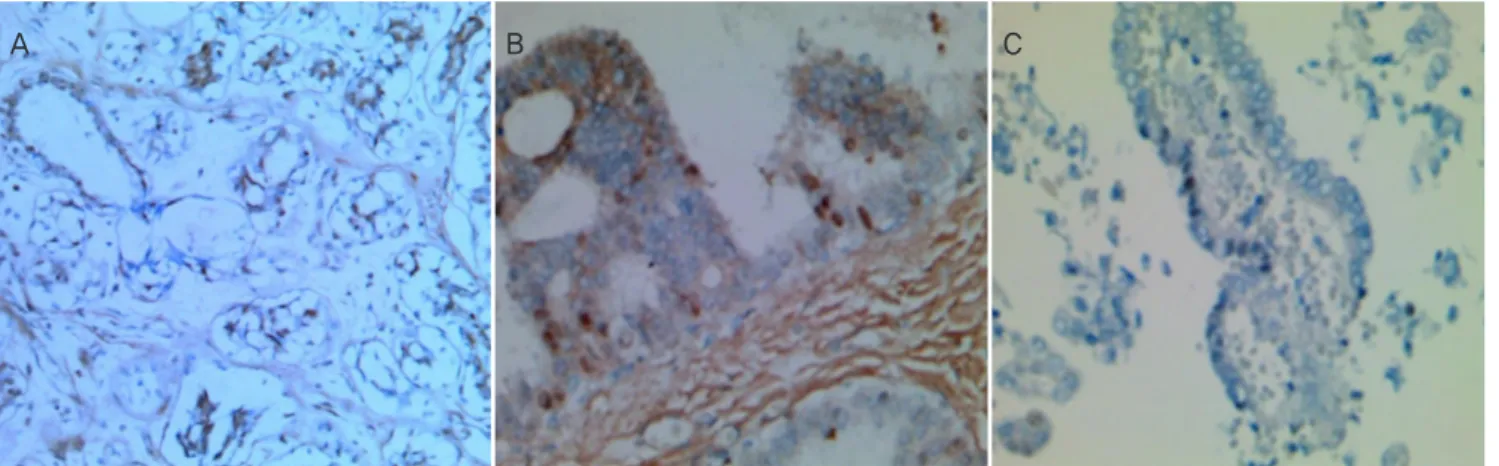
Immunohistochemistry (IHC) analysis showed that the endo- metrial/breast tissue stained positive for BRCA2 (10%/30%) by proportion (Fig. 1). A previous study did not prove the availability of IHC detecting BRCA mutation, but genetic risk assessment, including family history and IHC, needs additional
investigation. She was offered cancer risk assessment based on cancer type, family and personal cancer history, and IHC results.
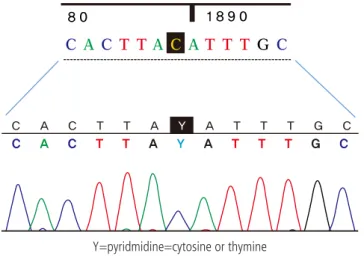
On her blood sample for genetic testing, a BRCA2 muta- tion was detected. A missense mutation from threonine to isoleucine due to a 1889 site nucleotide substitution from cy- tosine to thymine of BRCA2 gene was identified (c.1889C>T [p.Thr630Ile]) (Fig. 2).
Discussion
Among the Korean population, this is the first case that dem- onstrates endometrial cancer after breast cancer in a patient with a BRCA2 mutation. In addition, this case shows possible genetic relationships between breast cancer and endometrial cancer.
Germ line mutations in BRCA1 or BRCA2 increase the risk of breast cancer by 40% to 80% and ovarian cancer by up to 11% to 40% [7]. Other cancers such as pancreatic, gall- bladder, gastric, malignant melanoma, and prostate have been reported to be related to BRCA1 and 2 mutation [8-10].
Approximately 5% of endometrial cancer cases are caused by germline mutations [11]. A recent study showed that the BRCA mutation is related to an increased endometrial cancer risk in addition to ovarian carcinoma among gynecologic ma- lignancies [1,3].
This is first case of a patient with a BRCA2 variation of un- known significance mutation who developed endometrial cancer after breast cancer diagnosis. It is hard and expensive to offer genetic testing for all cancer patients. Considering her early breast cancer diagnosis in her 50s and her family history of cancer (father with stomach cancer), genetic counseling and
Fig. 1. Immunohistochemistry of BRCA2 (×200). BRCA2 reagent (Abcam, ab27976). (A) Control (breast), (B) breast, and (C) endometrium.
A B C
www.ogscience.org 177 Sang Eun Oh, et al. Endometrial cancer in BRCA mutation cancer
testing should have been offered to her.
There are three options for BRCA mutation carriers: risk-re- ducing salpingo-oophorectomy (RRSO), screening for sequen- tial cancer, and chemoprevention. Early detection through CA- 125 and transvaginal ultrasound are not effective prevention strategies for ovarian cancer. Chemoprevention with low dose oral contraceptives decrease ovarian cancer risk by as much as 44% to 60% [12].
Bilateral risk reducing mastectomy is known to decrease breast cancer risk by 90% in BRCA mutation carriers. RRSO in BRCA mutation carriers decreases ovarian cancer risk as well as improving overall mortality [13].
Prophylactic hysterectomy may be offered at the time of RRSO to reduce endometrial cancer risk in patients with BRCA mutations with the additional risk factor of tamoxifen use [14].
Risk-reducing surgery can be an emotional and economical chal- lenge to patients, but careful and exact genetic risk assessment and counseling should be offered to appropriate patients with cooperation with breast surgeons and gynecologic oncologists.
Conflict of interest
No potential conflict of interest relevant to this article was reported.
References
1. Hornreich G, Beller U, Lavie O, Renbaum P, Cohen Y, Levy-
Lahad E. Is uterine serous papillary carcinoma a BRCA1- related disease? Case report and review of the literature.
Gynecol Oncol 1999;75:300-4.
2. Lax SF. Molecular genetic pathways in various types of en- dometrial carcinoma: from a phenotypical to a molecular- based classification. Virchows Arch 2004;444:213-23.
3. Levine DA, Lin O, Barakat RR, Robson ME, McDermott D, Cohen L, et al. Risk of endometrial carcinoma associated with BRCA mutation. Gynecol Oncol 2001;80:395-8.
4. Shanmughapriya S, Nachiappan V, Natarajaseenivasan K.
BRCA1 and BRCA2 mutations in the ovarian cancer popu- lation across race and ethnicity: special reference to Asia.
Oncology 2013;84:226-32.
5. Lim MC, Kang S, Seo SS, Kong SY, Lee BY, Lee SK, et al.
BRCA1 and BRCA2 germline mutations in Korean ovarian cancer patients. J Cancer Res Clin Oncol 2009;135:1593-9.
6. Antoniou A, Pharoah PD, Narod S, Risch HA, Eyfjord JE, Hopper JL, et al. Average risks of breast and ovarian cancer associated with BRCA1 or BRCA2 mutations detected in case Series unselected for family history: a combined analy- sis of 22 studies. Am J Hum Genet 2003;72:1117-30.
7. Petrucelli N, Daly MB, Feldman GL. BRCA1 and BRCA2 hereditary breast and ovarian cancer [Internet]. Seattle (WA): University of Washington; c2013 [cited 2015 Jan 20]. Available from: http://www.ncbi.nlm.nih.gov/books/
NBK1247/.
8. Struewing JP, Hartge P, Wacholder S, Baker SM, Berlin M, McAdams M, et al. The risk of cancer associated with spe- cific mutations of BRCA1 and BRCA2 among Ashkenazi Jews. N Engl J Med 1997;336:1401-8.
9. Easton DF, Steele L, Fields P, Ormiston W, Averill D, Daly PA, et al. Cancer risks in two large breast cancer families linked to BRCA2 on chromosome 13q12-13. Am J Hum Genet 1997;61:120-8.
10. Goggins M, Schutte M, Lu J, Moskaluk CA, Weinstein CL, Petersen GM, et al. Germline BRCA2 gene mutations in patients with apparently sporadic pancreatic carcinomas.
Cancer Res 1996;56:5360-4.
11. Meyer LA, Broaddus RR, Lu KH. Endometrial cancer and Lynch syndrome: clinical and pathologic considerations.
Cancer Control 2009;16:14-22.
12. Vessey M, Painter R. Oral contraceptive use and cancer.
Findings in a large cohort study, 1968-2004. Br J Cancer 2006;95:385-9.
13. Tone AA, Salvador S, Finlayson SJ, Tinker AV, Kwon JS, Lee
C A C T T A Y A T T T G C C A C T T A Y A T T T G C
C A C T T A C A T T T G C
8 0 1 8 9 0
Fig. 2. Gene sequencing results.