• 검색 결과가 없습니다.

Veterinary Science

N/A
N/A
Protected

Academic year: 2022

Share "Veterinary Science"

Copied!
5
0
0

로드 중.... (전체 텍스트 보기)

전체 글

(1)

Veterinary Science

Expression of placenta growth factor mRNA in the rat placenta during mid-late pregnancy

Wan-Sung Choi

1

, Gyeong-Jae Cho

1

, Chung-Kil Won

2

, Phil-Ok Koh

2,

*

1

Department of Anatomy and Neurobiology, College of Medicine and Institute of Health Sciences, Gyeongsang National University, Jinju 660-751, Korea

2

Department of Anatomy, College of Veterinary Medicine and Institute of Animal Medicine, Gyeongsang National University, Jinju 660-701, Korea

The placenta is an essential organ that synthesizes several growth and angiogenic factors for its own growth as well as fetal development. It is known that the placenta growth factor (PlGF) is a member of the vascular endothelial growth factor family and is critical for placental growth and fetal development. However, there is little information regarding the expression pattern and cellular localization of PlGF mRNA in rat placenta during pregnancy. The aim of this study was to define the distribution of PlGF mRNA in rat placenta at various gestations. RT-PCR analysis showed that the expression level of PlGF mRNA increased as gestation advanced.

Using in situ hybridization histochemistry, positive cells of PlGF mRNA were detected in chorionic villi. PlGF mRNA was expressed in the trophoblast cells and stroma cells surrounding the blood vessels within chorionic villi on day 13 and 15. Also, positive signals of PlGF mRNA were strongly detected in stroma cells of chorionic villi on day 17, 19, and 21. In particular, the density and number of positive signals of PlGF mRNA was significantly increased as gestation advanced. The expression pattern of PlGF mRNA in rat placenta during pregnancy demonstrates that PlGF plays a functional role for placental growth and fetal development during mid-late pregnancy.

Key words: placenta, placenta growth factor, rat

Introduction

The placenta is a vital organ for both fetal development and the maintenance of pregnancy. It is the biosynthetic site

of growth hormones and several growth factors, basic fibroblast growth factor and insulin like growth factor, which are responsible for placental growth as well as fetal development [4,7,20,22]. The placenta requires neo- vascularization for successful placentation. It is known that angiogenesis and vascular transformation are important processes for the normal development of placenta [8]. It has also been shown that the placenta produces vascular endothelial growth factor (VEGF) and placenta growth factor (PlGF), which are essential for placental growth and fetal development [6,23].

It is well accepted that VEGF is a major regulator of blood vessel growth and induces vascular permeability [13].

VEGF contributes to the development and growth of the endothelium and is potentially an important regulator of angiogenesis, particularly during extensive tissue growth [9, 11]. Another member of the VEGF family, PlGF, promotes in vitro proliferation of endothelial cells [17]. PlGF is a polypeptide growth factor that shares a 53% amino acid sequence homology with the platelet derived growth factor domain of VEGF. PlGF produces at least three isoforms:

PlGF-1, PlGF-2, and PlGF-3, which are derived from the same gene via alternate splicing [3,18]. PlGF was formerly known as a potent angiogenic growth factor capable of inducing the proliferation, migration, and activation of endothelial cells [17]. Unlike VEGF, it was reported that abundant expression of PlGF is restricted to the placenta [18]. It is now known to distribute in many nonplacental cells, including cells of the microvasculature during pathological angiogenesis such as tumors and wound healing cells [10,16].

In a human term placenta, PlGF is expressed in villous trophoblasts and vascular endothelium [23]. The distribution of PlGF in these cells demonstrates that PlGF plays an important endocrinological and nutritional role, and contributes to the regulation of placental function. However, the expression pattern and cellular localization of PlGF mRNA in rat placenta during pregnancy is still unknown.

*Corresponding author

Tel: +82-55-751-5809; Fax: +82-55-751-5803

E-mail: [email protected]

(2)

in liquid nitrogen for RNA extration. For in situ hybridization studies, animals (3 rats per group) were perfused with 4% paraformaldehyde in 0.1 M phosphate buffered saline (PBS) through the left cardiac ventricle.

Placentas were fixed and cryoprotected with 20% sucrose phosphate buffer for 24 hr. Sections of 15 µ m thickness were prepared on the probe-on plus-charged slides (Fisher Scientific, USA), and stored at 70

o

C until use.

Total RNA extration and Reverse transcription PCR analysis

Total RNA from tissues was extracted by the acid guanidium thiocyanate phenol choroform method [5].

Complemantary DNAs were prepared from 500 ng of total RNA using oligo (dT) primers and Moloney murine leukemia virus reverse transcriptase (Promega, Madison, USA). The reaction components were incubated at 22

o

C for 10min and at 37

o

C for 70 min, heated to 95

o

C for 5 min, and flash cooled to 4

o

C. The oligonucleotide primers used for the amplification of PlGF cDNA were 5'-ATGCCGCTCATGA GGGCTG-3' and 5'-CTTCATCTTCTCCCACAGAG-3'. The RT product samples were subjected to 30 cycles of amplification in a Perkin-Elmer PCR Thermal Cycler (Perkin Elmer, USA) with denaturation at 94

o

C for 30 sec, primer annealy at 63

o

C for 30 sec, and primer extension at 72

o

C for 15 min. PCR products were electrophoresed in a 1.2% agarose gel and were stained with ethidium bromide and photographed with Polaroid Type 667 instant film (Hertfordshire, UK). Beta-actin was used as an internal control for procedual variation. For quantification, the intensity of PCR bands was measured densitometrically and analyzed using SigmaGel (version 1.0; Jandel Scientic Software, USA) software. Our results are the mean of five independent experiments and expressed as mean ± S.E.M.

In situ Hybridization Histochemistry

All solutions were made with sterile water, and glassware was autoclaved to prevent contamination by RNase. In situ

Tissue slides were posthybridized in a posthybridization buffer. Following a wash in 4 × SSC for 30 min, the sections were then treated with ribonuclease A (50 µ g/ml) at 37

o

C for 10 min, washed twice in 2 × SSC and 1 × SSC, transferred to a washing buffer containing 1 × SSC at 65

o

C for 30 mins, and dehydrated in alcohol solutions with ascending concentrations. The slides were exposed to β -max autoradiography X-ray film (Amersham, Sweden) for 4 days in light-tight cassettes at 70

o

C. They were dipped into NTB2 emulsion (1 : 1 dilution; Eastman Kodak, USA), exposed at 4

o

C for 2 weeks, developed in Kodak D19 developer (1 : 1 dilution; Eastman Kodak, USA) at 15

o

C, and counterstained with hematoxylin. The slides were observed under a dark and a bright field microscope, and then photographed.

Data analysis

RT-PCR signals were normalized to their β -actin signals.

One-way analysis of variance was determined using Graph- pad Instat Software (Version 1.15; Instat, USA). A p - value ( p < 0.05) was deemed statistically significant; data are expressed as mean ± SE.

Results

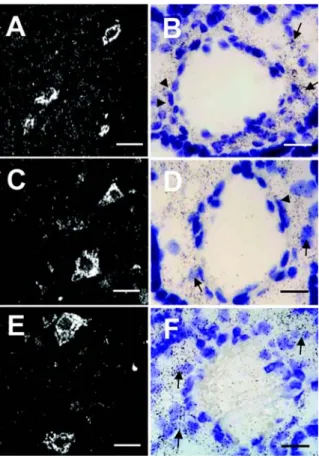
We evaluated the expression and distribution of PlGF mRNA in rat placenta at various gestations. RT-PCR analysis revealed the up-regulation of PlGF mRNA in rat placenta during mid-late pregnancy. The expression level of PlGF mRNA increased as gestation advanced (Figs. 1A and 1B). In particular, the expression of PlGF was markedly increased on day 19 and 21 during late pregnancy.

In situ hybridization histochemistry indicated that the expression of PlGF mRNA was detected in trophoblast cells and stroma cells of chorionic villi within the labyrinth zone.

Positive signals of PlGF mRNA were specifically observed

in trophoblast cells and stroma cells of the surrounding

blood vessels within the chorionic villi on day 13 (Figs. 2A

(3)

and 2B). Also, positive cells of PlGF mRNA appeared in trophoblast cells and stroma cells within chorionic villi on day 15 (Figs. 2C and 2D). On day 17, the expression of PlGF mRNA was significant in stroma cells within chorionic villi (Figs. 2E and 2F). Positive signals of PlGF mRNA were strongly expressed in stroma cells within the chorionc villi on day 19 and 21 (Figs. 3A, 3B, 3C, and 3D).

In particular, the density and number of positive signals of PlGF mRNA were significantly increased as gestation advanced.

Discussion

We showed the expression and distribution of PlGF mRNA in rat placenta at various gestations. Vuorela et al.

[23] demonstrated that PlGF was expressed in villous trophoblast and vascular endothelium in human placenta at term. However, there is little information regarding the expression pattern and distribution of PlGF mRNA in rat placenta during pregnancy. We confirmed the existence of PlGF in rat placenta at various gestations. RT-PCR analysis and in situ hybridization histochemistry showed that the expression of PlGF mRNA was increased as gestation progressed, and it was strongly detected in trophoblast cells and stroma cells within chrionic villi.

Angiogenesis and vascular transformation are important processes for the normal development of the placenta and fetus [8]. The previous studies reported that the angiogenic growth factors VEGF and PlGF exist in placenta and act as important factors for placental development and fetal

Fig. 1. RT-PCR analysis of PlGF from rat placental extracts during mid-late pregnancy. (A) The expression of PlGF was increased at the late stage of pregnancy. (B) Densitometric analysis of PlGF mRNA levels are represented as an arbitrary unit (A.U.) that is normalized to β -actin. * p < 0.05 (vs. control).

Fig. 2. Localization of PlGF mRNA in rat placenta on day 13 (A and B), 15 (C and D), and 17 (E and F). Dark-field (A, C, and E) and bright-field (B, D, and F) microphotographs of PlGF mRNA.

Positive signals of PlGF mRNA were detected in trophoblast cells (arrowheads) and stroma cells (arrows) of chorionic villi within the labyrinth zone. Scale bar: A, C, and E, 200 µ m; B, D, and F, 25 µ m.

Fig. 3. Expression of PlGF mRNA in rat placenta on day 19 (A and B) and 21 (C and D) by in situ hybridization histochemistry.

Positive cells of PlGF mRNA were detected in stroma cells within the chorionic villi. Arrows indicate the positive signals.

Scale bar: A and C, 200 µ m; B and D, 25 µ m.

(4)

Athanassiades et al. [2] showed that exogenous PlGF stimulates the proliferation of first trimester extravillous trophoblasts. Thus, PlGF may contribute to successful placentation by regulating trophoblast apoptosis and function during gestation [2]. In this study, data showed that PlGF was strongly expressed in trophoblast cells and stroma cells of chorionic villi during the mid gestation period.

However, the expression of PlGF mRNA was significantly increased in whole stroma cells during the late gestation period. VEGF was expressed in stroma cells within villi in human placenta [21]. Localization of VEGF in stroma cells demonstrates that VEGF plays an important role in the physiological growth and function of the vascular system in the villous stroma. Also, VEGF has been known to act directly on vascular endothelial cells by promoting cell proliferation and permeability [13]. Our data on the localization of PlGF in stroma cells of chorionic villi coincides with the expression of VEGF in these cells.

We reported the cellular distribution of pituitary adenylate cyclase activating polypeptide (PACAP) and its receptor in human and rat placenta [14,15]. It is well accepted that PACAP acts as a growth factor in various cells, and stimulates VEGF release [12]. Our previous studies showed that PACAP and its receptor mRNAs were expressed in stroma cells of stem villi and terminal villi [14,15]. Also, the expression of these genes was significantly increased during late pregnancy. Our data demonstrated that PACAP plays an important role for placental growth and fetal development.

In this study, PlGF was strongly expressed in stroma cells of chorionic villi within a labyrinth zone during mid-late pregnancy. The expression level of these genes increased as gestation advanced. Vascular growth in the placenta and fetus required tissue growth during the mid-late pregnancy.

Generally, the labyrinth zone carries out the exchanges of substances between maternal and fetal body through both maternal and fetal circulation. The expression of PlGF in chorionic villi can demonstrate that PlGF contributes to the development and growth of the fetus. Thus, we demonstrated

2. Athanassiades A, Lala PK. Role of placenta growth factor (PIGF) in human extravillous trophoblast proliferation, migration and invasiveness. Placenta 1998, 19 , 465-473.

3. Cao Y, Ji WR, Qi P, Rosin A, Cao Y. Placenta growth factor: identification and characterization of a novel isoform generated by RNA alternative splicing. Biochem Biophys Res Commun 1997, 235 , 493-498.

4. Cerro JA, Pintar JE. Insulin-like growth factor binding protein gene expression in the pregnant rat uterus and placenta. Dev Biol 1997, 15 , 278-295.

5. Chomczynski P, Sacchi N. Single-step method of RNA isolation by acid guanidinium thiocyanate-phenol-chloroform extraction. Anal Biochem 1987, 162 , 156-159.

6. Clark DE, Smith SK, He Y, Day KA, Licence DR, Corps AN, Lammoglia R, Charnock-Jones DS. A vascular endothelial growth factor antagonist is produced by the human placenta and released into the maternal circulation.

Biol Reprod 1998, 59 , 1540-1548.

7. Correia-da-Silva G, Bell SC, Pringle JH, Teixeira N.

Expression of mRNA encoding insulin-like growth factors I and II by uterine tissues and placenta during pregnancy in the rat. Mol Reprod Dev 1999, 53 , 294-305.

8. Demir R, Kaufmann P, Castellucci M, Erbengi T, Kotowski A. Fetal vasculogenesis and angiogenesis in human placental villi. Acta Anat (Basel) 1989, 136 , 190-203.

9. Dvorak HF, Brown LF, Detmar M, Dvorak AM. Vascular permeability factor/vascular endothelial growth factor, microvascular hyperpermeability, and angiogenesis. Am J Pathol 1995, 146 , 1029-1039.

10. Failla CM, Odorisio T, Cianfarani F, Schietroma C, Puddu P, Zambruno G. Placenta growth factor is induced in human keratinocytes during wound healing. J Invest Dermatol 2000, 115 , 388-395.

11. Ferrara N, Davis-Smyth T. The biology of vascular endothelial growth factor. Endocr Rev 1997, 18 , 4-25.

12. Gloddek J, Pagotto U, Paez Pereda M, Arzt E, Stalla GK, Renner U. Pituitary adenylate cyclase-activating polypeptide, interleukin-6 and glucocorticoids regulate the release of vascular endothelial growth factor in pituitary folliculostellate cells. J Endocrinol 1999, 160 , 483-490.

13. Keck PJ, Hauser SD, Krivi G, Sanzo K, Warren T, Feder

(5)

J, Connolly DT. Vascular permeability factor, an endothelial cell mitogen related to PDGF. Science 1989, 246 , 1309- 13012.

14. Koh PO, Kwak SD, Kim HJ, Roh G, Kim JH, Kang SS, Choi WS, Cho GJ. Expression patterns of pituitary adenylate cyclase activating polypeptide and its type I receptor mRNAs in the rat placenta. Mol Reprod Dev 2003, 64 , 27-31.

15. Koh PO, Won CK, Noh HS, Cho GJ, Choi WS. Expression of pituitary adenylate Cyclase activating polypeptide and its type I receptor mRNAs in human placenta. J Vet Sci 2005, 6 , 16. 1-5. Luttun A, Brusselmans K, Fukao H, Tjwa M, Ueshima S, Herbert JM, Matsuo O, Collen D, Carmeliet P, Moons L.

Loss of placental growth factor protects mice against vascular permeability in pathological conditions. Biochem Biophys Res Commun 2002, 295 , 428-434.

17. Maglione D, Guerriero V, Viglietto G, Delli-Bovi P, Persico MG. Isolation of a human placenta cDNA coding for a protein related to the vascular permeability factor. Proc Natl Acad Sci 1991, 15 , 9267-9271.

18. Maglione D, Guerriero V, Viglietto G, Ferraro MG, Aprelikova O, Alitalo K, Del Vecchio S, Lei KJ, Chou JY, Persico MG. Two alternative mRNAs coding for the angiogenic factor, placenta growth factor (PlGF), are

transcribed from a single gene of chromosome 14. Oncogene 1993, 8 , 925-931.

19. Ni Y, May V, Braas K, Osol G. Pregnancy augments uteroplacental vascular endothelial growth factor gene expression and vasodilator effects. Am J Physiol 1997, 273 , 938-944.

20. Ogilvie S, Buhi WC, Olson JA, Shiverick KT.

Identification of a novel family of growth hormone-related proteins secreted by rat placenta. Endocrinology 1990, 126 , 3271-3273.

21. Shiraishi S, Nakagawa K, Kinukawa N, Nakano H, Sueishi K. Immunohistochemical localization of vascular endothelial growth factor in the human placenta. Placenta 1996, 17 , 111-121.

22. Srivastava RK, Gu Y, Ayloo S, Zilberstein M, Gibori G.

Developmental expression and regulation of basic fibroblast growth factor and vascular endothelial growth factor in rat decidua and in a decidual cell line. J Mol Endocrinol 1998, 21 , 355-362

23. Vuorela P, Hatva E, Lymboussaki A, Kaipainen A, Joukov V, Persico MG, Alitalo K, Halmesmaki E.

Expression of vascular endothelial growth factor and

placenta growth factor in human placenta. Biol Reprod 1997,

56 , 489-494.

수치

Fig. 3.  Expression of PlGF mRNA in rat placenta on day 19 (A and B) and 21 (C and D) by  in situ  hybridization histochemistry.

참조

관련 문서

miR-302c was markedly downregulated during HSC activation and TGF-b treatment in HSCs, and that miR-302c suppressed E6AP expression via binding to 3’- UTR of E6AP mRNA,

mRNA expression of osteonectin, Runx2 and BSP(bone sialoprotein) in MC3T3-E1 cells cultured for 24 hours on 4 different titanium surfaces.. The mRNA were analyzed

Although Korea has been playing a leading role in the development of fusion power generation and Korea is playing a leading role in the world stage,

In this study, we found that Pin1 plays a pivotal role in insulin- induced AP-1 activation through its interaction with p70S6K and prolongs activity of

These results demonstrated that a positive role of Slug and Twist in tumor invasion in CRA, and inverse correlation between Twist and Slug expression

In conclusion, ellipsis plays an important role in English discourse as a grammatical device for drawing the listener's attention to the focal information

Effect of caloric restriction on the expression of PGC-1 and PPARs mRNA in liver of Otsuka Long-Evans Tokushima Fatty Rats.. Long-lived growth hormone

Urban freeway plays a key role in the urban transportation system and also takes a lot of share in the urban traffic generated in the big city. However,