Introduction
Schizophrenia is often characterized by an alternation of deterioration and remission, adversely affecting the patients’
daily life, including their occupational and educational ac- tivities.
1)In the past, the treatment of schizophrenia was fo- cused on the reduction of positive symptoms. These days, due to the wide use of atypical antipsychotics, enhancement of the
quality of life of patients has become more important, for in- stance, minimization of the side effects of the antipsychotics, alleviation of negative symptoms, depressive symptoms, and cognitive dysfunction.
2-4)Although it is not easy to define the concept of quality of life in patients with schizophrenia, the re- cent studies have suggested that the multi-dimensional con- cept of subjective well-being is associated with the activities of daily life, including self-management and social roles, so- cial support, treatments, and side effects of the antipsychot- ics.
5)Subjective well-being in patients with schizophrenia is important because it is recognized as an important shift in the evaluation of treatment goals.
2,6)Schizophrenia patients’ sub- jective well-being is an important index in evaluating the treat- ment course, and is being widely used in clinical settings. Sub- jective well-being is closely associated with the patients’ quality of life
7-9)and is a predictive factor of complying with antipsy- chotics as well as of remission and recovery from symptoms.
10-12)Various sociodemographic and clinical variables can affect
Received: September 15, 2014 / Revised: September 25, 2014 Accepted: September 30, 2014
Address for correspondence: Seung-Hyun Kim, Department of Psychia- try, Korea University Guro Hospital, Korea University College of Medicine, 80 Guro-dong, Guro-gu, Seoul 152-703, Korea
Tel: 02-2626-3162, Fax: 852-1937 E-mail: [email protected]
Funding for this study was provided by CJ HealthCare. CJ HealthCare had no further role in the study design; in the collection, analysis or interpre - tation of data; in the writing of the manuscript; or in the decision to submit the paper for publication. Its contents are solely the responsibility of the au - thors.
Variables Influencing Subjective Well-Being in Patients with Schizophrenia
Jinseung Oh, MD
1, Young-Hoon Ko, MD, PhD
2, Jong-Woo Paik, MD, PhD
3,
Moon-Soo Lee, MD, PhD
1, Changsu Han, MD, PhD
2, Hyun-Ghang Jeong, MD, PhD
1, Byung-Joo Ham, MD, PhD
3, Yong-Ku Kim, MD, PhD
2and Seung-Hyun Kim, MD, PhD
11
Department of Psychiatry, Korea University Guro Hospital, Korea University College of Medicine, Seoul,
2
Department of Psychiatry, Korea University Ansan Hospital, Korea University College of Medicine, Seoul,
3
Department of Psychiatry, Korea University Anam Hospital, Korea University College of Medicine, Seoul,
4
Department of Psychiatry, School of Medicine, Kyung Hee University, Seoul, Korea
Objectives : The purpose of this study was to analyze the relationship between subjective well-being and other clinical parameters such as sociodemographic and clinical variables, which include positive and negative symptoms, depressive symptoms, insight, and side effects.
Methods : Fifty-one outpatients diagnosed with schizophrenia were recruited in this study. Subjective well-being was assessed using a self-rating scale, the Subjective Well-being under Neuroleptics-Short form (SWN-K). Sociodemographic variables were also evaluated and other evaluations were conducted using the Positive and Negative Syndrome Scale (PANSS), Calgary Depres- sion Scale for Schizophrenia (CDSS), Liverpool University Neuroleptic Side Effect Rating Scale (LUNSERS), Korean Version of the Revised Insight Scale for Psychosis (KISP), and Multidimensional Scale of Perceived Social Support (MSPSS). The relation- ship between subjective well-being and these clinical variables was assessed.
Results : Education years and social support scores were positively correlated with the total SWN-K scores, but severity of illness, severity of depression, severity of side effect, and the scores on insight were negatively correlated. The stepwise multiple regression analyses indicated that the total SWN-K score of the patients with schizophrenia was associated with negative symptoms and in- sight.
Conclusion : Better insight and more severe negative symptoms in patients with schizophrenia may be associated with worse subjective well-being. Results indicate that careful evaluation of subjective well-being is essential for proper management of pa- tients with schizophrenia. (Korean J Schizophr Res 2014;17:93-99)
Key Words : Schizophrenia · Subjective well-being · SWN-K · Insight · Negative symptom.
Korean J Schizophr Res Vol. 17. 2, 2014
the subjective well-being of the patients with schizophrenia.
The severity of the positive and negative symptoms has been known to adversely affect the quality of life in patients with schizophrenia.
13-16)In addition, the severity of anxiety and de- pressive symptoms was reported to have been associated with the subjective quality of life.
4,17-21)Side effects of antipsychot- ics are associated with low subjective life satisfaction and quality of life in schizophrenia patients,
11,22)and social sup- port has also been found to affect the same.
23-25)The deterio- ration in cognitive functions, such as executive function and working memory, negatively affects the quality of life of the patients.
26,27)However, several studies about the effect of schizophrenia patients’ insight on their quality of life have shown inconsistent and debatable findings.
3,28-30)Therefore, it is important to measure and analyze the level of subjective well-being of the patients and the clinical variables influenc- ing it with the objective methods.
This study evaluated the subjective well-being of 51 outpa- tients with schizophrenia under antipsychotics using the Sub- jective Well-being under Neuroleptics-Short form (SWN-K).
31)In addition, this study assessed social sociodemographic fac- tors, support level, and clinical variables including positive and negative symptoms, depressive symptoms, cognitive func- tion, insight, and side effects. Then it examined which variables among them could be significantly associated with subjective well-being.
Materials and Methods
Study sample and procedure
Subjects were recruited consecutively from outpatient clin- ics at three university hospitals in Seoul and Gyeonggi Prov- ince, Korea (Korea University Guro Hospital, Korea Universi- ty Ansan Hospital, Kyunghee University Hospital). Inclusion criteria were age between 20 and 65 years, diagnosis of schizo- phrenia by the psychiatrists according to the Diagnostic and Statistical Manual of Mental Disorders 4th ed. (DSM-IV) cri- teria, admission to the hospital or emergency room at least once in the past two years, and taking oral antipsychotics. Ex- clusion criteria were comorbid diagnoses that might influence outcome measures (e.g., mental retardation), alcohol or sub- stance dependence, risk of suicide, pregnancy or lactation, administration of depot antipsychotic injection, administra- tion of electroconvulsive therapy within previous six months, unstable or inadequately treated medical conditions or seizure disorder, and hospitalization within previous three months.
The SWN-K, for measuring the subjective well-being of the
patients with schizophrenia who were taking antipsychotic drugs, and the evaluation of their clinical symptoms and cog- nitive functions were conducted at the start of the study. Formal training for all clinical rating scales was provided at an inves- tigator meeting and supplemented by written training mate- rials. Each assessment was completed by trained inter-rater- reliable clinicians at each hospital site. The Research Ethics Committee of the Medical Faculty of Korea University, ap- proved the study and the patient made an informed consent to participate in the study.
Sociodemographic factors
Through medical-record reviews and interviews with the subjects and their families, the demographic factors of subjects, such as age, gender, marital status, education years, housing status, and occupation, and the clinical factors such as disease duration, onset age, family history, and frequency of hospital- ization were investigated.
The Korean-version of the Subjective Well-being under Neuroleptics-Short form (SWN-K)
The SWN is a 38-item self-report scale developed in 1995, and a 20-item contracted version was developed in 2001. The short version has been widely used and was translated into Korean. The reliability and validity of the Korean version in evaluating the schizophrenia patients’ quality of life have been demonstrated.
3,4,31-33)The SWN-K consists of 20-item with a 6-point Likert scale. Higher scores on the SWN-K indicate high- er subjective well-being of the patient. This study used the SWN- K to evaluate the subjective well-being of patients with schizo- phrenia.
Evaluation of the clinical symptoms
The Positive and Negative Syndrome Scale (PANSS) was
used to evaluate the severity of current psychopathology of the
subjects in the present study.
34-36)The Calgary Depression
Scale for Schizophrenia (CDSS) was used to evaluate the de-
pression.
37,38)The Korean Version of the Revised Insight Scale
for Psychosis (KISP),
39)10-item, self-report Drug Attitude In-
ventory (DAI-10),
40,41)Multidimensional Scale of Perceived So-
cial Support (MSPSS),
42)Liverpool University Neuroleptic Side
Effect Rating Scale (LUNSERS)
21)were assessed in the patients
with schizophrenia. To evaluate the cognitive function of the
patients, the digit symbol substitution test, semantic verbal flu-
ency test, and trail-making test were conducted using the Ko-
rean Wechsler Intelligence Scale (KWIS).
Statistical analysis
For the analysis of the sociodemographic factors, mean and SD were included as continuous variables, and frequency and percentage as categorical variables. Variables correlated with subjective well-being were identified by using the Pearson’s correlation analysis. The stepwise multiple regression analysis was conducted to identify a factor having a significant effect on the subjective well. SPSS version 18.0 was used for the sta- tistical analyses. The statistical significance was set at a two- tailed threshold of p<0.05.
Results
Sociodemographic and clinical characteristics
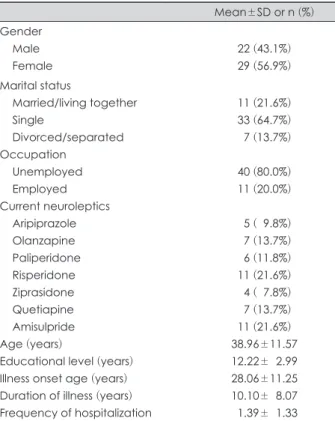
This study enrolled 51 subjects (22 males and 29 females).
The mean age of patients was 38.96±11.57 years. The mean for education years was 12.22±2.99 years. In terms of marital sta- tus, majority of the participants were single (n=33, 64.7%), followed by married/couple (n=11, 21.6%), and separated/di- vorced (n=7, 13.7%). The disease duration of schizophrenia was 10.10±8.07 years. All patients were taking only one anti- psychotic such as risperidone (n=11, 21.6%), amisulpride (n=11, 21.6%), olanzapine (n=7, 13.7%) quetiapine (n=7, 13.7%), pali- peridone (n=6, 11.8%), aripiprazole (n=5, 9.8%), and ziprasi- done (n=4, 7.8%)(Table 1, 2).
Comparison between the SWN-K scores and sociodemograph- ic variables
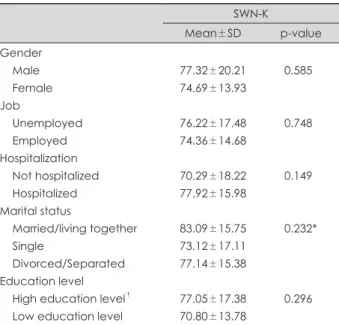
There was no significant difference of the SWN-K score ac- cording to the gender and educational level. Also, the SWN-K score did not significantly differ between the groups accord- ing to the job status or marital status (Table 3).
Correlation between the SWN-K score and sociodemographic, and clinical variables in patients with schizophrenia
The SWN-K score did not significantly correlate with age, onset age and disease duration of schizophrenia. No signifi- cant correlation was observed between subjective well-being
Table 1. Sociodemographic characteristics of the subjects (n=51) Mean±SD or n (%) Gender
Male Female
22 (43.1%) 29 (56.9%) Marital status
Married/living together Single
Divorced/separated Occupation
Unemployed Employed Current neuroleptics
Aripiprazole Olanzapine Paliperidone Risperidone Ziprasidone Quetiapine Amisulpride Age (years)
Educational level (years) Illness onset age (years) Duration of illness (years) Frequency of hospitalization
11 (21.6%) 33 (64.7%) 07 (13.7%)
40 (80.0%) 11 (20.0%)
05 (09.8%) 07 (13.7%) 06 (11.8%) 11 (21.6%) 04 (07.8%) 07 (13.7%) 11 (21.6%) 38.96±11.57 12.22±02.99 28.06±11.25 10.10±08.07 01.39±01.33
Table 2. Clinical characteristics of the subjects (n=51) Mean±SD SWN-K
Mental functioning Self-control
Emotional regulation Physical functioning Social integration Total
PANSS score Positive score Negative score General score Total score CDSS score LUNSERS
Extrapyramidal Psychic Anticholinergic Other autonomic Allergic reaction Hormonal Miscellaneous Red herrings Total score DAI-10
Subjective positive score Subjective negative score Total score
KISP MSPSS
Family score Friends score Significant other score Total score
14.55±04.09 15.20±04.18 15.90±04.06 15.43±04.21 14.75±03.83 75.82±16.80
10.67±03.94 14.71±06.72 26.73±08.38 52.10±17.32 02.56±02.73
05.29±04.59 12.43±07.77 03.53±03.38 03.45±03.38 01.86±02.41 02.57±02.77 03.14±02.31 05.94±04.79 32.27±22.10
01.73±30.25 01.78±02.07 03.51±04.19 13.02±05.92
05.06±01.55 03.56±01.74 03.95±01.65 04.19±01.20 SWN-K : Subjective Wellbeing on Neuroleptics-Short form, PANSS : Positive and Negative Syndrome Scale, CDSS : Cal- gary Depression Scale for Schizophrenia, LUNSERS : Liverpool University Neuroleptic Side Effect Rating Scale, DAI-10 : Drug Attitude Inventory-10, KISP : Korean Version of the Revised In- sight Scale for Psychosis, MSPSS : Multidimensional Scale of Perceived Social Support
and the cognitive function tests such as the Digit Symbol Sub- stitution Test, Semantic Verbal Fluency Test, and Trail Mak- ing Test A and B, as well as the subjective responses to drugs as measured by the DAI-10. However, there was a significant positive correlation between the SWN-K score and education- al year (r=0.286, p=0.042). Significant negative correlations were found between the SWN-K scores and all the total scores and subscores of the PANSS and CDSS. Intermediate or high- er-level significant negative correlations were observed be- tween the SWN-K score and the total scores of the LUNSERS, as well as the scores on all its subscales, except for the hormonal items. The KISP, which evaluated the patients’ insight, showed a significant negative correlation with the SWN-K score(r=
-0.701, p=0.001)/ The KISP score had a significant positive correlation with the CDSS score (r=0.469, p=0.001). In addi- tion, the SWN-K score showed significant positive correlations with the total scores and subscores on the MSPSS. The fam- ily score of the MSPSS had a significant correlation with the SWN-K score with a high correlation coefficient (r=0.543, p=
0.001) (Table 4).
Multiple regression analysis showed that the scores of the negative symptoms in the PANSS and the KISP had significant negative correlations with the SWN-K score. The regression equation, SWN-K=112.114-1.921*KISP-0.746*PANSS negative score, was significant and explained 57% of the variance in the SWN-K scores (Table 5).
Discussion
The impact of sociodemographic and clinical factors on the subjective well-being of patients with schizophrenia were in-
Table 3. Comparison of the SWN-K scores with demographic data
SWN-K
Mean±SD p-value Gender
Male Female Job
Unemployed Employed Hospitalization
Not hospitalized Hospitalized Marital status
Married/living together Single
Divorced/Separated Education level
High education level† Low education level
77.32±20.21 74.69±13.93
76.22±17.48 74.36±14.68
70.29±18.22 77.92±15.98
83.09±15.75 73.12±17.11 77.14±15.38
77.05±17.38 70.80±13.78
0.585
0.748
0.149
0.232*
0.296
p-values were calculated using the Independent samples t-test.
* : The one-way ANOVA, Tukey’s post-hoc analysis, † : High edu- cation level indicates high school graduation or over. SWN-K : Subjective Wellbeing on Neuroleptics-Short form
Table 4. Bivariate correlations between the SWN-K scores and clinical measures of the subjects (n=51)
SWN-K
r p-value
Age (years) Education (years) Illness onset age (years) Duration of illness (years) PANSS score
Positive score Negative score General score Total score CDSS LUNSERS
Extrapyramidal Psychic Anticholinergic Other autonomic Allergic reaction Hormonal Miscellaneous Red herrings Total score DAI-10 KISP MSPSS
Family score Friends score Significant other score Total score
Digit symbol substitution test Verbal fluency test Trail making test A Trail making test B
-0.142 0.321 -0.286 0.042*
-0.142 0.322 -0.021 0.885
-0.407 0.003† -0.362 0.009† -0.327 0.019*
-0.391 0.005† -0.457 0.001†
-0.583 0.001† -0.524 0.001† -0.461 0.001† -0.509 0.001† -0.324 0.020*
-0.158 0.267 -0.532 0.001† -0.549 0.001† -0.564 0.001† -0.202 0.155 -0.701 0.001†
-0.543 0.001† -0.323 0.021*
-0.286 0.042*
-0.520 0.001† -0.068 0.640 -0.150 0.293 -0.126 0.382 -0.124 0.390 p-values were calculated using the Pearson’s correlation anal- ysis. * : Significant at the 0.05 level (two-tailed), † : Significant at the 0.01 level (two-tailed). SWN-K : Subjective Wellbeing on Neuroleptics-Short form, PANSS : Positive and Negative Syn- drome Scale, CDSS : Calgary Depression Scale for Schizophrenia, LUNSERS : Liverpool University Neuroleptic Side Effect Rating Scale, DAI-10 : Drug Attitude Inventory-10, KISP : Korean Version of the Revised Insight Scale for Psychosis, MSPSS : Multidimension- al Scale of Perceived Social Support
Table 5. The multiple regression analyses for clinical variables re- lated with subjective wellbeing in the subjects (n=51)
β 95% C.I. p-value
KISP -1.921 -2.477, -1.365 0.001
PANSS negative score -0.746 -1.255, -0.238 0.005 KISP : Korean Version of the Revised Insight Scale of Psychosis, PANSS : Positive and Negative Syndrome Scale